The Smog of War: The Battle for Britain’s Clean Air
The wartime government’s programme of deliberate smoke production was an attempt to protect Britain from the Luftwaffe; for the National Smoke Abatement Society, the decision was a disaster.
On 20 June 1940, with the threat of large-scale enemy bombing looming ever closer and the Battle of Britain imminent, a letter from the Ministry of Home Security was sent to selected town clerks across Britain. The missive would signal the beginning of one of the wartime coalition government’s more curious initiatives: a controversial programme of deliberate smoke production intended to obscure Britain’s key military-industrial sites from the aerial threat posed by the Luftwaffe.
Register to read more articles for free.
When you register, you will receive the History Today newsletter. Click here to read our Terms of Use.
The Smog of War: The Battle for Britain’s Clean Air
The wartime government’s programme of deliberate smoke production was an attempt to protect Britain from the Luftwaffe; for the National Smoke Abatement Society, the decision was a disaster.
On 20 June 1940, with the threat of large-scale enemy bombing looming ever closer and the Battle of Britain imminent, a letter from the Ministry of Home Security was sent to selected town clerks across Britain. The missive would signal the beginning of one of the wartime coalition government’s more curious initiatives: a controversial programme of deliberate smoke production intended to obscure Britain’s key military-industrial sites from the aerial threat posed by the Luftwaffe.
The decision made in wartime London was a world away from the sedate Derbyshire spa town of Buxton, where, in 1929, a merger of the London-based Coal Smoke Abatement Society (founded 1899) and the Manchester-based Smoke Abatement League of Great Britain (founded 1842) had taken place (Buxton being chosen as a neutral territory for the negotiations). The motivation for the amalgamation was partly due to the latter having accrued what was referred to by the resulting organisation – the National Smoke Abatement Society (NSAS) – as ‘an unpleasant bank overdraft’. The NSAS, subsequently to be based in London, would seek to campaign against what it described in its first annual report in 1930 as ‘the evils of air pollution’ by working towards the abolition of both industrial and domestic smoke, popularising smokeless methods of heat and power production, and promoting and supporting legislation that prevented the pollution of the atmosphere.
This was no small task. A 1921 Ministry of Health Departmental Committee on Smoke and Noxious Vapours Abatement report estimated that Britain discharged three million tons of soot – consisting of fuel waste particles, noxious fumes, grit, and dust – into the atmosphere every year. In 1926 the Royal Commission on the Coal Industry, appointed on 5 September 1925 ‘to inquire into and report upon the economic position of the Coal Industry, and the conditions affecting it, and to make any recommendations for the improvement thereof’, published a report estimating that this tonnage was equal to nearly three days’ output of all the collieries in Britain, so that, as the report succinctly put it: ‘The work of over a million men for three days every year is devoted to providing the soot which pollutes our atmosphere.’
There was considerable public interest in the commission’s report, and in response the government took the unusual step of reducing its cover price to such an extent that it was sold at a loss. In its recommendations the commission rejected a proposal made by the Miners’ Federation for nationalisation of the coal industry, and instead recommended that the industry continue under private enterprise, with a number of proposals for its reorganisation, but no recommendations for how to clean it up.
The Journal of the National Smoke Abatement Society, November 1938. Wellcome Collection. Public Domain.
Nevertheless, the report drew mass attention to the issue of smoke pollution, and later in 1926 a Public Health (Smoke Abatement) Act was passed. The act included provisions for the definition of ‘the expression “smoke”’ (to ‘include soot, ash, grit, and gritty particles’) and the imposition of penalties for ‘smoke nuisances’. Air pollution measurement devices, which gauged levels of sulphur dioxide and lead peroxide, were installed across Britain by the Department of Scientific and Industrial Research. The Investigation of Atmospheric Pollution for the year ending 31 March 1940, published by the department, demonstrated that a marked improvement in the condition of the atmosphere had been achieved by the outbreak of the Second World War.
Smoke abatement in wartime
In the autumn 1939 edition of its journal, Smokeless Air, the NSAS expressed concern that while some ‘progressive’ organisations would find their work vastly increased by the war, others – such as itself – would have to ‘mark time until peace returns’. However, comparatively normal conditions during the first few months of the war (the so-called ‘Phoney War’) made it possible for the organisation to carry out a modest level of activity; nearly 50 of its members agreed to act as lecturers on smoke abatement at nationwide meetings arranged through the Ministry of Information.
The society had initially been hopeful that it could convince the government that it was in the interests of the war effort to use coal-burning boilers and furnaces efficiently, thereby saving fuel and reducing smoke emissions. Its Smoke Abatement in Wartime pamphlet, published in January 1940, positioned smoke emissions as a clear and present danger to the security of Britain’s industry, stating that ‘from time immemorial smoke has been used as a guide, or on the other hand, has betrayed the position of those who wished to be concealed’. It followed, therefore, that ‘measures for the prevention of any smoke that could possibly assist aerial attack should be effectively undertaken’. Furthermore, the NSAS argued that:
Since smoke is an indication of the partial, and therefore wasteful, combustion of bituminous coal, the encouragement of smoke abatement is of direct assistance to measures for coal conservation and fuel economy that are today more essential than ever.
Poster for the ‘Smoke Abatement’ exhibition at the Science Museum, London, 1936. Edward Roth/Alamy Stock Photo.
However, the inevitable consequences of wartime industrial production meant heavy coal use and the maximising of industrial output. Staff shortages in local authorities made it impossible to enforce existing smoke abatement legislation, which would in any case be suspended in 1943 due to the exigencies of war.
A meeting of the NSAS’ governing council was called for early April 1940 in Manchester, with an invitation extended to the wider membership in order to canvass a broad range of opinions regarding what the society’s ongoing activities should be during wartime. Some 60 people attended, more than anticipated, considering the wartime conditions. Strong anecdotal evidence was provided from local authority representatives that, since the start of the war, smoke pollution had increased in Halifax, Leeds, Manchester, and Sheffield. The meeting resolved that industrial smoke emissions should be kept to a minimum for economic, as well as atmospheric reasons. The society’s argument – that the war was ‘developing into a struggle in which economic factors were likely to be of decisive importance’ – was intended to appeal to the government, couching its objectives in terms that clearly related to the war effort.
Let there be smoke
As with other organisations broadly concerned with the environment, such as the Council for the Preservation of Rural England and the National Trust, the war meant that usual ways of operating and campaigning had to be rethought. Out went public petitions, press coverage was subject to censorship, and questions in Parliament could only be asked in a circumspect manner to avoid the impression of undue dissent or criticism, or inadvertently giving away information which could be useful to the enemy. In, therefore, came less transparent private lobbying by letter, phone, or in-person meetings in offices or gentlemen’s clubs. The society recognised as much, stating in the winter 1939-40 issue of Smokeless Air that ‘the war in many ways limits our progress as a propaganda organisation’, and in its 1941 annual report reflected that ‘the work to be done during the war is almost entirely carried out by post and through publications and other writing’.
NSAS activities were further hampered by its staff and members being lost to national service. The production of information for members and supporters was also, from 4 September 1942, curtailed due to paper rationing. The society’s London-based headquarters at Chandos House in Westminster was abandoned due to the threat from bombing and was, for a time, moved to Epsom in Surrey, and Woodborough, a village just outside Nottingham. Regular committee meetings were made impossible due to transport difficulties; the NSAS’ executive committee did not meet between May 1940 and April 1943.
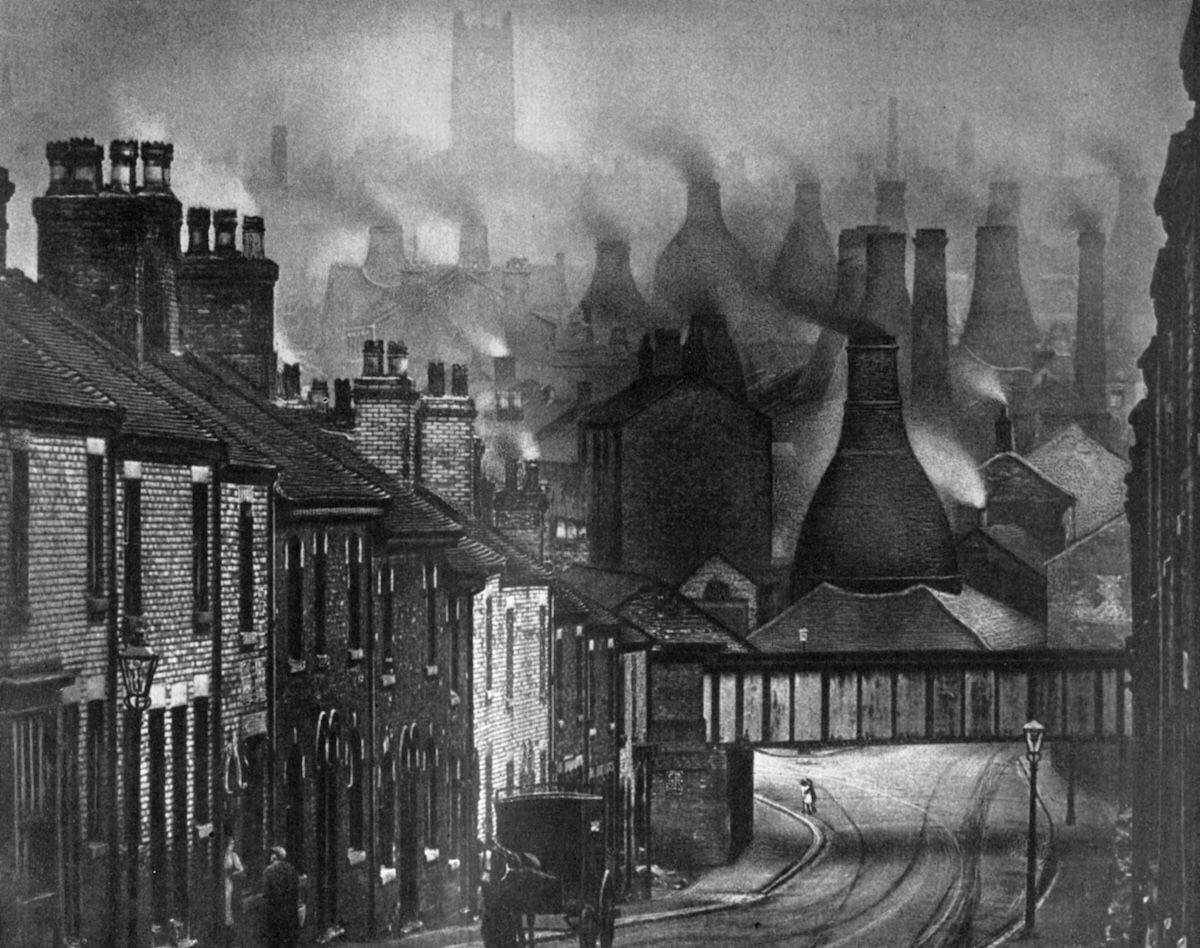
The NSAS was therefore not in the best operational shape to contest the Ministry of Home Security’s announcement on 20 June. Based at Horseferry House, an art deco building in Pimlico, the ministry’s Smoke Production Division, created in 1939, was one of the government’s lesser known wartime departments. The ‘confidential’ home security circular was titled ‘Production of Extra Smoke from Industrial Works’, and was sent to selected local authorities containing the greatest concentrations of heavy industry in England and Wales, such as the Black Country in the Midlands, the Potteries in Staffordshire, Lancashire, and South Wales. The following day another circular was sent to the authorities of industrial areas in Scotland.
Illustration of industrial pollution in Sheffield, c.1925. Heritage Images/TopFoto.
On the authority of the Minister of Home Security, Sir John Anderson, the circular required that, ‘as a matter of urgency’, arrangements be made for all industrial works in those areas to produce as much extra smoke as was feasible ‘without incurring too much waste’. This was, the circular continued, regarded as ‘imperative in the national interests’ in order to make industrial targets ‘less readily definable’ to enemy aircraft. Local authorities were required to task their sanitary inspectors or smoke abatement officers to visit as soon as possible all firms ‘both large and small’ which had the capacity to emit smoke from their coal-consuming furnaces and to ensure they would emit as much dark smoke as was feasible without, as far as was possible, emitting noxious gases. Experts would be on hand to advise on how to generate maximum smoke emissions: ‘Arrangements are being made to supply you at an early date with the names of Combustion Engineers who will be prepared to give technical advice to your officers or to any firm desiring it.’ Further, the Ministry advised that it was taking the ‘necessary appropriate steps’ to protect complying factories from legal proceedings which might be taken against them by anyone objecting to the extra emissions.
Then, on 2 July, a further ‘SECRET’ circular was sent out, advising that:
It has been decided to provide, as a matter of extreme urgency, special smoke protection during periods of moonlight for a number of industrial undertakings in different parts of the country. Smoke protection schemes, which will involve the emission of smoke from a large number of smoke-producing units, will be devised and put into operation for a large number of areas as quickly as possible … during the next period of moonlight, commencing on July 14.
A list of areas in which smoke protection schemes were to be operated would be sent in due course, with the first large-scale scheme to be implemented just two days later; local authorities would be individually informed of schemes proposed for their areas.
The Ministry was not finished. After the ‘Battle of Britain’ began on 10 July, and with the nation experiencing intense bombing, a further circular was issued on 13 August requiring that additional urgent steps be taken to increase the amount of dark smoke being emitted from coal and oil-consuming furnaces and should include, for the first time, non-industrial premises – although not domestic homes. This was to be confined to a list of areas that included Bristol, South Wales, London, the Black Country, the Potteries, Lancashire and the Merseyside area, Yorkshire, Teesside, Tyneside, and the entirety of Scotland. The circular even required that local authorities compile a list of premises that were deemed not to have made much of an effort to produce excess smoke, as the minister ‘is not entirely satisfied that the maximum effort has been made by all undertakings already approached’, so that ‘it may be considered what further steps need to be taken’.
Smoke in the skies
The NSAS learned about these circulars from its contacts in local authorities, and its reaction was as expected. Not only did the society consider the government’s decision a backward step in terms of both fuel efficiency and increased atmospheric pollution, it was also wrong-headed. Palls of smoke could make it easier for the Luftwaffe to detect the presence of industrial sites, and long plumes of smoke frequently seen, even in rural areas, could indicate the presence of isolated factories and works that might otherwise have remained unnoticed. Furthermore, in the society’s view, while under certain atmospheric conditions the palls of smoke that formed over towns and drifted across the countryside would make it more difficult for enemy aircraft to recognise specific objectives, the advantage gained in loss of visibility for the Luftwaffe would to an equal extent be a hindrance and source of danger to the RAF and could create difficulties for the ground defence. At the end of the war the NSAS would receive endorsement for this view from a flying officer, Arnold Chadwick, attached to the Meteorological Office, who cited the problem of visibility in the air and attributed one of the ‘greatest handicaps’ of flying during the war years as being ‘smoke haze’, which also made taking off and landing at airports a sometimes perilous activity.
Although the actual correspondence has not survived, the NSAS subsequently reported to its members that it had made representations to the Ministry of Home Security and to other ministries in 1940 when the smoke production scheme was first introduced, and again in 1942 when the urgent need for fuel economy, coupled with a perceived change in defence needs, strengthened the case for the withdrawal of the instructions. However, this was all done behind the scenes, as the society acknowledged in the summer of 1943, when its annual report stated that:
We have been very reticent, as we were asked to be, in discussing this peculiar and difficult problem, and no report has been made of the Society’s representations to the Government in 1940 and again this year.
Home secretary Herbert Morrison with a public warning poster about the danger of firebombs, 1941. Pastpix/TopFoto.
We do know that the NSAS made its presence felt within the corridors of power, however, as an internal Ministry of Town and Country Planning memo of July 1943 states that ‘the National Smoke Abatement Society is again on the war path’. The society also pursued a modest commercial route to counter the state’s smoke production policy, running adverts for Coalite, ‘the world-famous smokeless fuel’ invented in 1904, in Smokeless Air. Under the headline ‘Clean the Skies for the RAF’, the advertisement informed its readers about the benefits of Coalite:
‘Dirt’ has been described as ‘matter in the wrong place.’ How true that is with smoke from fires. The ‘Coalite’ process extracts the ‘matter’ and keeps it from the skies, and what would be ‘dirt’ is resolved into Petrol, Diesel Oil, Fuel Oil, Tar Acids, Chemicals, and many other valuable materials.
Imploring the reader to therefore use Coalite, the advertisement continued: ‘To burn these essential war requirements and pollute the air with the poisonous products of their combustion is a double crime.’ In January 1936 the NSAS awarded a posthumous gold medal to Thomas Parker, Coalite’s inventor, for his creation.
The Ministry of Home Security stuck to its guns however, and it was not until February 1943 that the smoke production policy was discontinued, largely because fuel efficiency in the industrial sector had become a greater imperative, but also because the bombing threat from the Luftwaffe had waned. Government being government, the Ministry could not bear the thought that it might be seen in some quarters that the opponents to smoke production had been successful, so it felt it necessary to assert in a February circular that ‘importance is still attached to the view that smoke from factories increases industrial haze and contributes materially to the air defence of vital points in industrial areas’.
‘Barbarous age’
Although swathes of potentially pollution-generating peacetime industry were closed for the duration of the war, Britain’s military-industrial capacity increased dramatically: from just three Royal Ordnance Factories during peacetime to 57 by 1942, mass-producing munitions, weapons, and other military hardware, sometimes on a 24 hour, seven days a week shift system. There was also the issue of coal shortages: very frequently a manufacturer would have to accept the type of coal that was available, which was not always of the best quality. All of this served to ensure that wartime smoke emissions increased, despite rationing decreasing domestic coal consumption.
This was borne out by results from the admittedly limited pollution monitoring devices still being maintained throughout the war. Although the number of atmospheric pollution measurements fell as the war progressed, there was still sufficient equipment (99 devices as of 31 March 1943) to measure air pollution across Britain. Comparing 1942-43 pollution figures with earlier years in the war, the NSAS was able to determine that war had brought an increase in atmospheric pollution, with a peak in 1941-42, corresponding with the drive to deliberately increase smoke production. While the merit of the programme of deliberate smoke emissions was debatable as a defence tactic, it had undeniably contributed to an increase in air pollution.
‘A vision of the future!’ Cartoon published in Smokeless Air, 1945. Wellcome Collection. Public Domain.
The NSAS was keen to move beyond what it described in its 1942 annual report as a ‘barbarous age’ of ‘reckless squandering of limited natural resources’, in which inefficient appliances wasted an inordinately high proportion of the fuel burned in them, and simultaneously discharged into the air vast quantities of fuel products ‘which properly used might have furthered the war effort in a score of different ways’. But the society was also quick to see the role it could play in the ‘winning of the peace’. As early as 1940 the organisation recognised that it should be preparing its own plans for the postwar era, as ‘the period of reconstruction that will follow the war should give many opportunities for ensuring more progressive steps for Smoke Abatement and the efficient utilisation of fuel’. The NSAS was buoyed by the fact that many local authorities were becoming institutional members, attracted by its proposals for measures to prevent the creation of further smoke pollution from buildings and houses to be built after the war. By the spring of 1943 the NSAS’ funds were higher than at any point in the organisation’s existence. It was reported to the society’s April 1943 executive committee meeting that cash and investments were up from £1,156 in July 1939 to £2,060 in April 1943 – in today’s money an increase from £45,800 to £81,700, an impressive achievement given the wartime context. In its 1946 annual report the NSAS was able to state that the organisation – and the cause for smoke abatement in general – was in a far stronger position than it ever had been previously, ‘with possibilities of success substantially more promising than could have been conceived before the war’.
Despite the rise in smoke pollution across the war, most obviously due to the work of the Ministry of Home Security, the NSAS could be said to have had ‘a good war’. But its optimism about the influence it might be able to exert on postwar reconstruction was largely misplaced – it found itself overwhelmed by competing voices demanding the postwar government’s ear, and, too, by the limited treasury coffers for investing in the latest fuel-efficient machinery. It would take the calamitous Great London Smog of 1952, in which up to 12,000 people died, to make an irresistible case for far-reaching smoke abatement legislation, which began with the Clean Air Act of 1956.
Reflecting the legislation it had been instrumental in creating, the NSAS became the National Society for Clean Air in 1958; this became Environmental Protection UK in 2007, which in turn merged into the Institution of Environmental Sciences, facilitating the creation of the Environmental Policy Implementation Community in 2024. As for Horseferry House, wartime home of the Smoke Production Division, it later appears to have become, for a while, the headquarters of the Environment Agency.
Gary Willis is an environmental historian researching the impact of the Second World War on the British countryside.