In the early 1800s harsh desert landscapes in North America’s West, including the Sonoran, Mojave, Chihuahuan, and Great Basin deserts, were considered a major obstacle by early advocates of US westward expansion. But when the Mexican-American War ended in 1848 the US acquired vast expanses of desert lands, including the territories now defined as Arizona, California, Nevada, Utah, and parts of neighbouring states. The 1853 Gadsden Purchase added a final sliver of desert territory to southern Arizona and New Mexico. America’s westward expansion was now a story of desert expansion.
In the mid-1800s Indigenous communities such as the Apache and Yavapai were still resisting the settler project of, first, the Spanish/Mexican colonisers, and, then, the European/American colonisers. In a few short years, a once abstract question of how the US government could take control of desert lands shifted to an immediate logistical issue. Establishing new US military outposts in this context was a daunting task due to limited food and water supplies in the region, combined with sparse or non-existent road networks.
Register to read more articles for free.
When you register, you will receive the History Today newsletter. Click here to read our Terms of Use.
In the early 1800s harsh desert landscapes in North America’s West, including the Sonoran, Mojave, Chihuahuan, and Great Basin deserts, were considered a major obstacle by early advocates of US westward expansion. But when the Mexican-American War ended in 1848 the US acquired vast expanses of desert lands, including the territories now defined as Arizona, California, Nevada, Utah, and parts of neighbouring states. The 1853 Gadsden Purchase added a final sliver of desert territory to southern Arizona and New Mexico. America’s westward expansion was now a story of desert expansion.
In the mid-1800s Indigenous communities such as the Apache and Yavapai were still resisting the settler project of, first, the Spanish/Mexican colonisers, and, then, the European/American colonisers. In a few short years, a once abstract question of how the US government could take control of desert lands shifted to an immediate logistical issue. Establishing new US military outposts in this context was a daunting task due to limited food and water supplies in the region, combined with sparse or non-existent road networks.
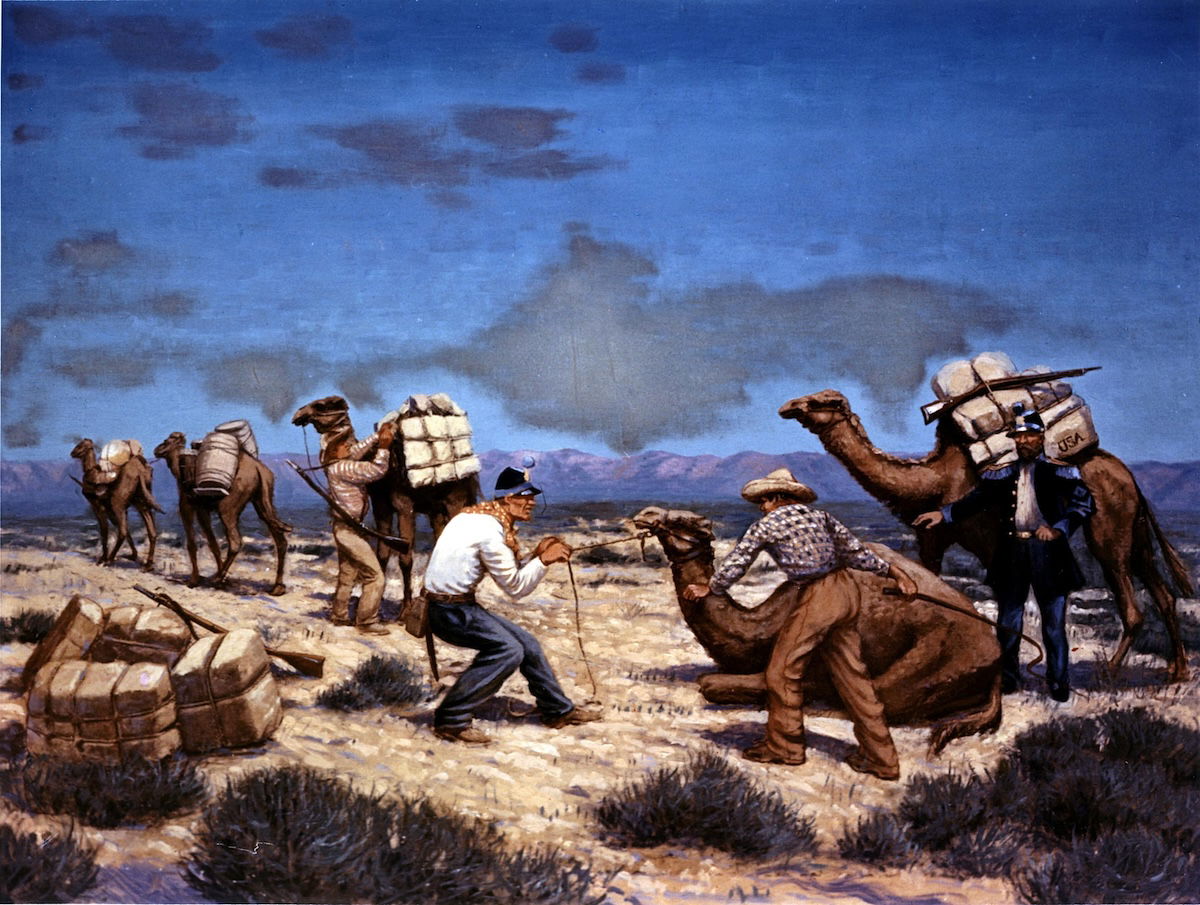
But some Americans thought they had an answer to the US Army’s desert challenges: camels. The idea was first suggested in an 1836 report to the War Department, written by Major George H. Crosman of the Quartermaster Corps, responsible for coordinating military logistics. Later gaining desert experience during the Mexican-American War, Crosman believed camels could help the army move people, equipment, and resources through the difficult desert terrain: ‘For strength in carrying burdens, for patient endurance of labor, and privation of food, water & rest, and in some respects speed also, the camel and dromedary (as the Arabian camel is called) are unrivaled among animals.’
The camel idea slowly spread among military leaders and advocates of US expansion in the 1840s, including the environmentalist George Perkins Marsh. In the early 1850s Marsh encountered the camel as a US envoy in the Ottoman Empire, and saw them used for both transport and in battle by local Arabs, Bedouins, and the French and British agents in the region. In 1854, having returned to the US, Marsh delivered a speech at the Smithsonian Institute in which he extolled the camel’s dual virtues as a ‘beast of burden’ and an ‘animal of war’. The US Army, he argued, should take advantage of the camel’s combined strengths to bear heavy loads across long distances, and to ‘strike terror’ among the settlers’ Native American opponents.
The most impactful advocate of camels was Jefferson Davis, who would later become the president of the Confederacy. Like Crosman, he had served in the Mexican-American War, where he gained firsthand experience of military operations in the desert west. Davis was not interested in Marsh’s vision of troops riding camels in battle, instead seeing them as an ideal solution to the supply chain challenges of establishing military control of the newly acquired western territories.
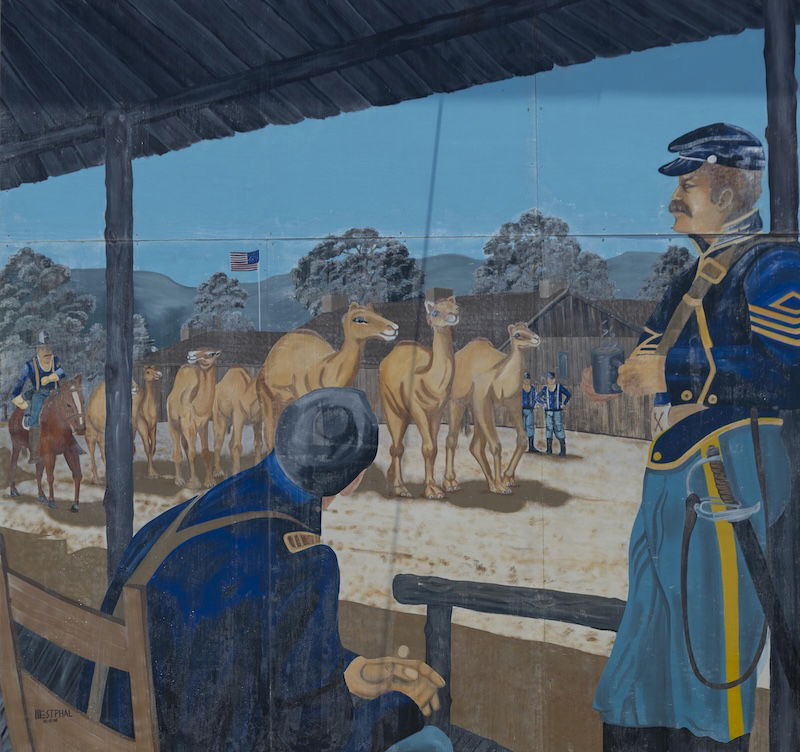
A mural depicting the arrival of camels at the U.S. Army’s Camp Verde in Texas, Carol M. Highsmith, 2014. Library of Congress. Public Domain.
As soon as Davis became secretary of war in 1853 he called on Congress to appropriate funding for an experiment to confirm his belief in the ‘advantages to be anticipated from the use of camels and dromedaries for military and other purposes’. He secured this appropriation in 1855; Congress approved $30,000 to build a ‘Camel Corps’ by sending the USS Supply to the Middle East and northern Africa to collect up to 50 camels. The mission was led by Major Henry C. Wayne, an evangelist of the camel scheme since the 1840s, and the person responsible for first introducing the idea to Davis.
Yet Wayne had no understanding of camels, let alone how to judge which breeds would be most suited to North America’s desert west. He therefore tried to get a diverse sample, which were divided in the ship’s register as ‘Arabian camels of burden’ or dromedaries with specific origins (including Tunis, Muscat, Mt Sinai, among others), as well as a handful of Bactrian camels. After several weeks, the USS Supply had 33 camels ready to cross the Atlantic. In the end, 34 arrived in Indianola, Texas in May 1856: one died en route, but two calves were born and survived the passage. After unloading, the USS Supply was ordered to repeat the mission, returning with another 41 camels in February 1857.
For all the urgency applied to secure funding for the Camel Corps, the army did not immediately use the animals in military service. Rather, they were tested with a few short treks in Texas and, in 1857, some were assigned to an expedition to California. Led by the former naval officer and frontiersman Edward Fitzgerald Beale, this was a test of the animals’ suitability for long-distance journeys. In Beale’s Congressional reports on the journey, he was effusive about the camels’ strength and endurance, elaborating: ‘At times I have thought it impossible they could stand the test to which they have been put, but they seem to have risen equal to every trial, and to have come off of every exploration with as much strength as before starting.’ His reports called for their wider adoption in military operations, but this enthusiasm was lost on government officials on the eve of the Civil War. Shortly after the war began, the Camel Corps was dismantled due to a lack of interest within the military ranks– though a few were commandeered by Confederate troops when they took Camp Verde, Texas, the project’s headquarters.
Beale’s pre-Civil War excursion to California had a more lasting impact, however, in that the Camel Corps became a popular culture sensation. Hundreds of people turned out along the way to greet the camel caravan, and revelled in the exotic spectacle. The San Francisco Evening Bulletin wrote that the camel caravan’s arrival in 1858 gave the streets ‘quite an Oriental aspect’, ‘bringing up weird and far-off associations to the Eastern traveler, whether by book or otherwise of the land of the mosque, crescent or turban, of the pilgrim mufti and dervish with visions of the great shrines of the world, Mecca and Jerusalem’.
The media helped to paint a new picture of the desert west. Rather than being a terrifying terrain filled with antagonistic Indigenous groups, the camel story cast the region as a local version of the Biblical ‘Old World’ deserts that were intimately familiar to the Christian American settlers. As the US strengthened its hold on these new desert lands, this Middle Eastern fantasy was likewise strengthened; American settlers consistently turned to it for lessons in how to build their new arid empire – ranging from the use of plants and animals to technologies for water use and agriculture to master the desert. The American experiment with camel colonialism was short-lived, but it illustrates a longstanding pattern of drawing inspiration from overseas empires, as well as romanticising the military foundations of the settler state.
Natalie Koch is Professor of Geography and the Environment at Syracuse University and author of Arid Empire: The Entangled Fates of Arizona and Arabia (Verso, 2022).