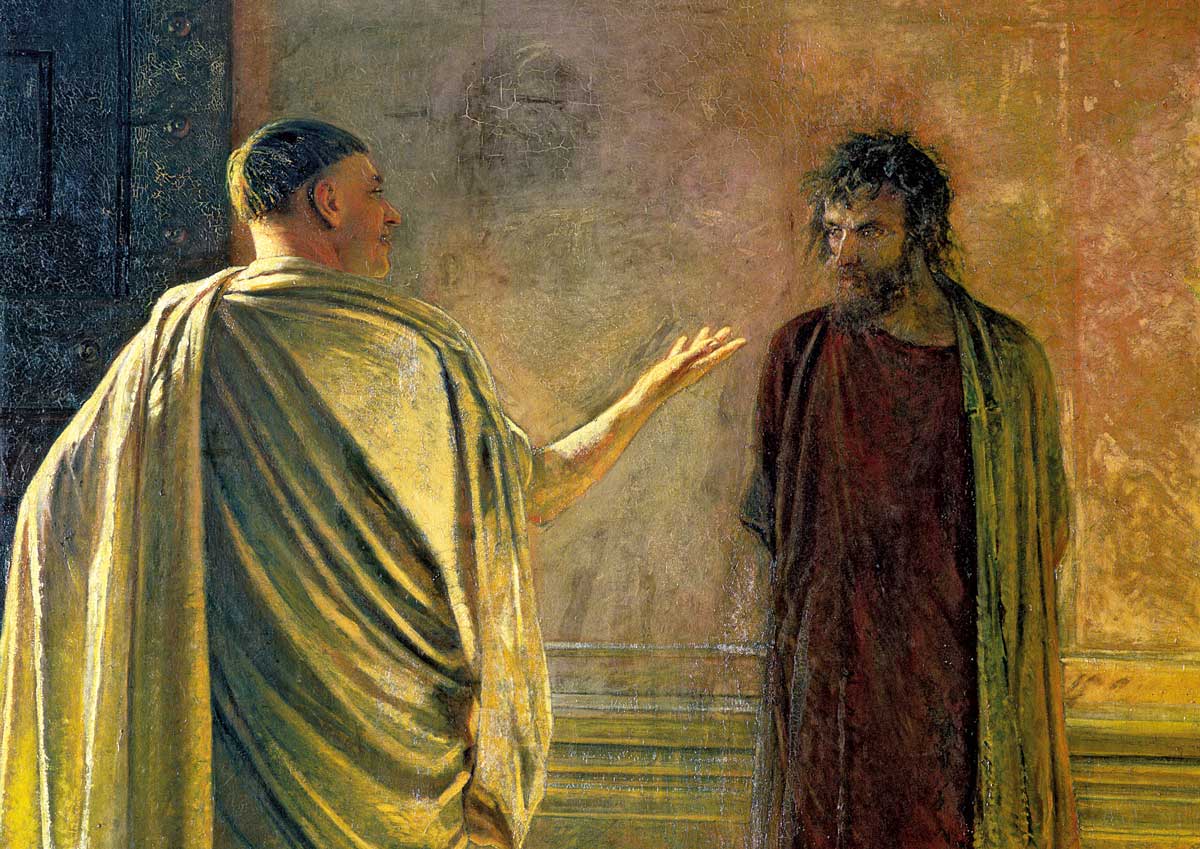
How did the idea of a European secular society come about? In this startlingly original book, David Lloyd Dusenbury argues that the separation of politics and religion, of ‘church and state’, can be attributed to a thread of Christian thought rooted in the Gospel accounts of the trial of Jesus before Pontius Pilate and in subsequent discourses over whether or not Pilate could be held guilty of having ordered ‘the death of God’.
This is not a book about Pontius Pilate, nor is it a book about what actually happened in the trial of Jesus. Both topics were of great interest to early Christian apologists, their pagan critics and a parade of later thinkers; and it is these rich intellectual traditions that the book exploits to make its case. Who condemned Jesus, and why, and did they have the right to do so? We encounter a patchwork of competing claims: for example, that Pilate refused to condemn Jesus; or that he condemned him, but believed him innocent; or that he condemned him as a criminal.
The Christian accommodation of the tradition that Pilate was guilty in one sense, but innocent in another, is the one that informs the main thrust of the book’s argument. Pilate was doing his duty as the representative of a secular power, but did not understand that Jesus was Christ: he was thus, through ignorance, innocent of the charge of deicide, but he nonetheless ordered Jesus’ execution.
Central to the thesis is the statement Jesus makes before Pilate in the Gospel of John (18:36): ‘My kingdom is not of this world.’ References to Jesus’ renunciation of worldly kingdoms can also be found in other parts of the New Testament. The book argues that his refusal to claim this dominion, or to save himself from crucifixion (even though his divine power could have enabled it) had important political consequences in the late antique Mediterranean and medieval Europe. St Augustine’s reading of the trial in John emerges as a kind of early manifesto for the division of the sacred realm from what we would call the ‘secular’. For Augustine, Jesus’ accusers and Pilate are innocent because they act in ignorance (‘they know not what they do’, Luke 23:34), but when Pilate sentences Jesus, he does so according to the justice of the saeculum (i.e. the temporal realm, as opposed to the eternal).
As the representative of temporal power, Pilate fulfilled his legal responsibility: this is his ‘innocence’. The justice of the saeculum is a form of justice, but imperfect compared to the justice of an all-knowing God. ‘Truth is not subject to human empire’, as the 17th-century legal theorist Samuel Pufendorf has it. From this partition of power and justice, between an imperfect worldly realm based on coercion and an eternal one based on the persuasive power of Christian religious truth, arises the idea of the secular.
This twofold partition of prerogatives had a practical aim: it helped the church to maintain its authority while avoiding conflict with political leaders who had military (coercive) power. After the conversion of Constantine to Christianity, church leaders strove to find a way to accommodate Roman imperial power without surrendering to it. Pope Gelasius I (492-96), who, like Augustine, hailed from north Africa, distinguished sacred from secular rule, reassuring the emperor Anastasius that the papacy had no interest in controlling the temporal realm. Yet six centuries later the papacy seemed to renege on this separation and persisted in its claim to worldly authority through medieval times. For critics like the scholar and priest Lorenzo Valla, who exposed as a forgery the Donation of Constantine, a central ‘ancient’ document used to support papal claims to earthly dominion, Jesus’ claim in John 18:36 was crucial counter-evidence. So too was it for Dante and Marsilius of Padua, who used Jesus’ renunciation to critique the papacy’s ‘perverse desire for government’. Rather than arguing for theocracy, these Christian intellectuals used the trial of Jesus to advance the cause of secular authority.
By tracing these lines of thought, the book argues that the New Testament contains statements that seem to define a sphere of authority that we would recognise as ‘secular’. Secular rule was certainly not a common feature of ancient states, where politics and religion – what Dusenbury calls a ‘temple-state’ – were normally indivisible, and while the word ‘secular’ would not gain its modern sense for more than 1,000 years, the use by early Christians of the concept of the ‘saeculum’ as a legitimate temporal realm separate from the eternal kingdom of God would seem to mark something revolutionary. The powerful image of Jesus renouncing any claim to rule in ‘this world’ helps to explain why some writers that we would normally associate with the secular, such as Thomas Hobbes and Jean-Jacques Rousseau, emerge as inordinately interested in the Pilate trial.
These deliberations might seem very far from our own experiences of secularity. Like democracy, we tend to take it for granted as a natural state of affairs. The paradox, according to this book, is that the secular is in large part the offspring of theological argument and, without Jesus’ confession before Pontius Pilate, we cannot know how our notions of secularity and tolerance might have developed.
The Innocence of Pontius Pilate: How the Roman Trial of Jesus Shaped History
David Lloyd Dusenbury
Hurst 411pp £25
Kevin Butcher is Professor in the Department of Classics and Ancient History at the University of Warwick.