
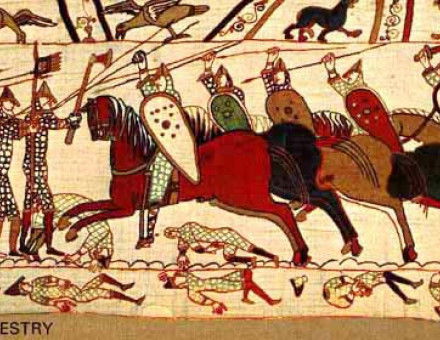
The Lance in Battle
T.H. McGuffe describes how the mounted lancer and the pike-bearing infantryman have appeared on European battlefields from classical times until within living memory.
T.H. McGuffe describes how the mounted lancer and the pike-bearing infantryman have appeared on European battlefields from classical times until within living memory.

J.H. Burns writes that few men have had a more decisive influence on the history of Scotland than John Knox. At what point in his career did he make up his mind to use his religious authority for political purposes, in order to bring down the “idolatrous sovereignties” that he saw around him? And why did he thus, almost unwittingly, become a revolutionary?
Edmund Baker describes how Cromwell's principal assistant in foreign affairs and his most devoted friend, Thurloe, saw in the Protectoral system “a mean between two intolerable extremes of unrestrained anarchy and reaction.”
From 1565 until the year of Waterloo, great Spanish galleons continued to cross the Pacific, bearing cargoes of American silver. ‘This prodigious voyage’ took a heavy toll of life. Yet still (wrote a Chronicler) ‘the desire of gain prevails...’
J.R. Pole describes how the idea of equality, when applied to the new multi-racial, multi-lingual, multireligious America of vast industry and teeming cities, was destined to conflict with some of the deepest existing preconceptions about the fundamental character of American society.
R.J. Adam presents a new study of the Jacobite rising, and of the complex pattern of local interests that helped to determine the conduct of the Scottish clan-leaders.
J.W. Blake describes how, during the colonial period, just over half a million emigrants—English, Scottish, Irish, French, German, Dutch, Swedish and Finnish—are calculated to have left Europe for a new home in America. Often they reached their goal only at the cost of hideous suffering.
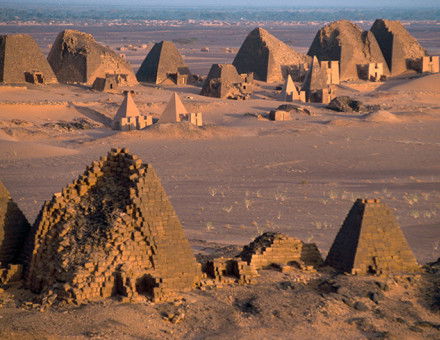
In the still largely unexplored Sudan lie the remains of one of the richest and least known of ancient African civilizations.
E. Badian studies the political background of Alexander’s plans for world conquest.
J. Leslie Nightingale describes how, during the 17th century, Puritanism spread into English villages, with the twelve sons of Jacob and all the major and minor prophets to be found on the village greens. Names after the Christian graces and virtues—Patience, Honour, Faith, Hope, Charity—were also widely bestowed at Puritan baptisms.