The Mighty MacCailean Mór
No Scottish clan is as controversial as the Campbells. Yet, says Ian Bradley, the opening of its Argyll Mausoleum offers a chance to re-assess a contentious past.
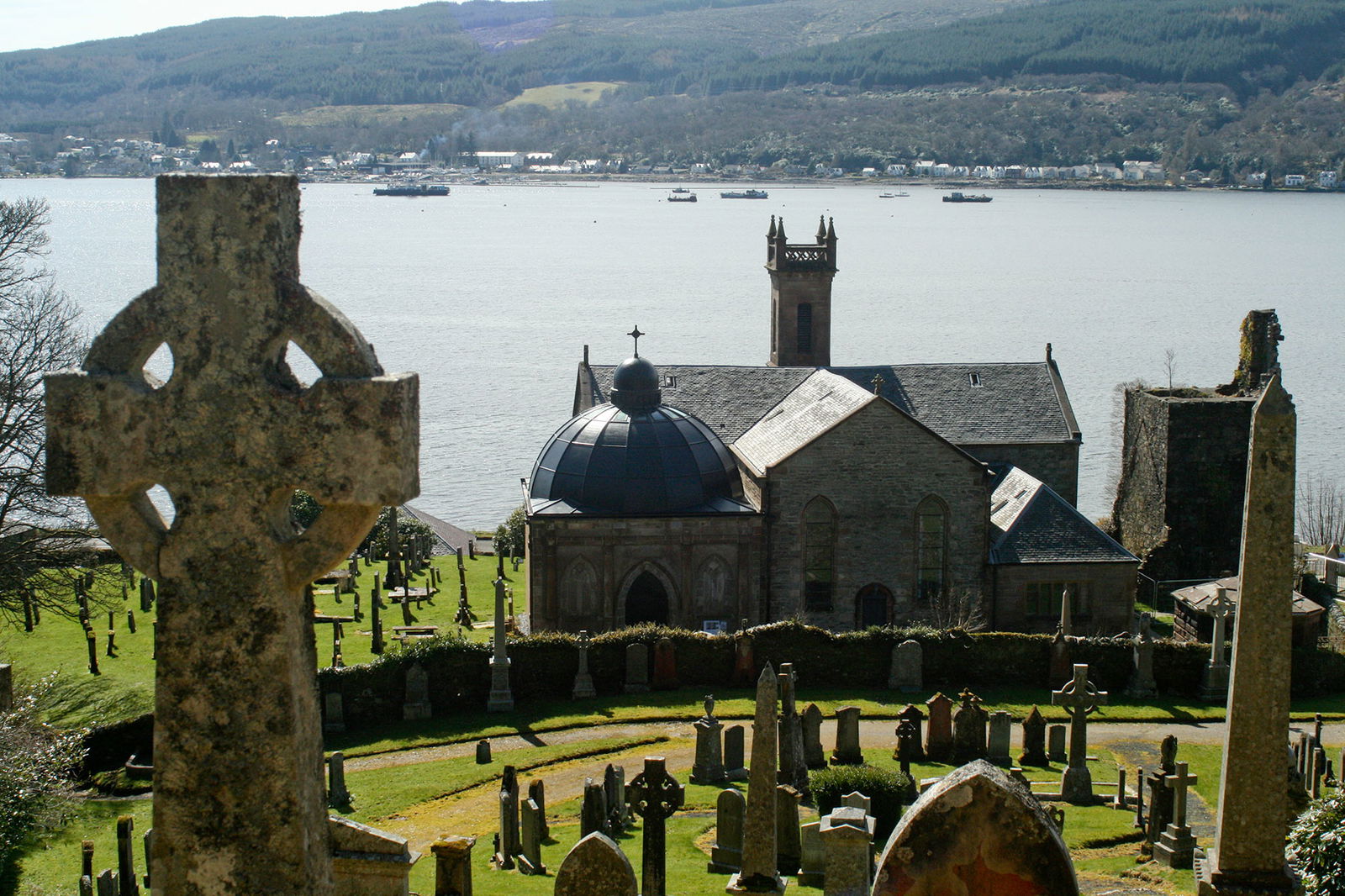 The recent restoration and opening to the public of one of Scotland's most intriguing and long-hidden buildings provides an opportunity to re-assess the achievements of a clan that has provoked more controversy and animosity than any other.
The Argyll Mausoleum, a strange circular structure that stands behind the parish church at Kilmun on the Holy Loch in the Cowal peninsula north of Dunoon, houses the bodies of virtually all the chiefs of the Clan Campbell who died between 1453 and 1949. It is difficult to think of any other building which encapsulates the history of a leading family over five centuries so powerfully and evocatively. The inscriptions on its tombs, which have hitherto been sealed up and hidden from public view, and the stories told of successive earls and dukes of Argyll in the excellent museum, which has been established in the entrance area of the adjacent church, bring to life the exploits and ethos of the clan that long dominated the religious, political and cultural life of the West Highlands and Islands of Scotland and had an influence far beyond that region.
The Campbells could certainly do with some good publicity. They have not had a good press, perhaps inevitably considering their power and also because they have had their share of black sheep and have sometimes shown arrogance and insensitivity. The unpopularity of the Campbell lairds of Jura, whose hold over the island lasted from 1666 to 1938, is perpetuated in the name of the most expensive and long matured Jura single malt whisky. It is called Prophecy, after the prediction of an elderly woman that the line would eventually come to an end with a one-eyed man leaving the island on a white horse. In the event, the personal possessions of the last laird, Charles Campbell, who had a glass eye, were carried to the pier at Craighouse in a cart drawn by a white horse.
If anti-Campbell sentiment is now used to sell whisky, it has a long pedigree. Historians have sniped at the clan and its leaders for their slippery duplicity, helped by the fact that the Gaelic word Cambeul means a wry or twisted mouth. In his monumental 1837 study of the Highlanders of Scotland, W.F. Skene wrote that the Clan Campbell was built on 'a policy characterised by cunning and perfidy'. In 1938 Hector MacKechnie castigated 'the sleekit Campbells, who combined claymore and parchment as never Celts before and encroached on all their neighbours'. Dislike of the Campbells has, of course, been especially prevalent among the MacDonalds, whose long animosity against the clan that ousted them from their dominant position in the West Highlands and Islands reached its height in the aftermath of the infamous and shameful massacre of Glencoe in 1692. A recent booklet on Iona Abbey, written by an Australian-based member of the Clan Donald, accuses the Campbells of seeking to play down and indeed obliterate the MacDonalds' contribution to the religious life of Argyll in the later Middle Ages. The cover of another book about the struggle between the two clans in the mid-17th century, Ronald Williams' The Heather and the Gale (1997), blames the Campbells for 'that fatal confrontation wherein Gaeldom, Catholicism and the king were eventually overwhelmed by Calvinism and bloody revolution'. These are just two examples among many in which the Campbells are portrayed as un-Scottish, inimical to and destructive of the culture and religion of the Gaels and altogether too attached to the court and to Lowland ways.
Campbells were undoubtedly involved in atrocities, although no more than several other clans. They were undoubtedly ambitious, but they also made a hugely positive contribution to the spiritual, political and cultural life of Argyll, not least in its Gaelic aspects. This contribution has recently been recognised by several scholars who have defended the Campbells against their many critics. Stephen Boardman has questioned the validity of some of the MacDonalds' allegations in an important revisionist study of the clan in the Middle Ages, The Campbells 1250-1513 (2006). Jane Dawson has argued that the clan played a notably positive role in the Scottish Reformation and Martin MacGregor has demonstrated how the Campbells were imbued with both principle and a deeply felt Scottish patriotism in their project to fuse Gaelic and British identity.
Like so much in Highland history, the origins of the Campbells are shrouded in misty legend and romance. Genealogies produced in the 17th century, by which time the clan was firmly ensconced in its ascendancy over Argyll, trace its origins to Diarmaid O'Duibne, a companion of Finn MacCoull, giving it Irish Gaelic ancestry. In Fingalian legend, Diarmaid eloped with Finn's wife, Gráinne. He died after slaying a wild boar and standing barefoot on its bristles, which had been poisoned by Finn. This may explain why a boar's head features prominently on the Campbell coat of arms. There is a fine example of this symbol among the funeral accoutrements that languished in the Argyll Mausoleum and are now displayed in the new museum in Kilmun Church. As the Campbells developed their hold on Argyll, the ancient Gaelic heartland of Dál Riata, and sought to establish their claim to headship of the Gaels in succession to the MacDonald Lords of the Isles, they further emphasised their Irish/Gaelic roots. The 8th Duke of Argyll confidently wrote in 1887 of 'the purely Celtic family from which I descended – a family of Scoto-Irish origin – Stephen Boardman that is to say, belonging to that Celtic colony from Ireland which founded the Dalriadic kingdom, and to whom the name of Scots originally belonged'.
In fact, the Campbells were probably British in origin, with their roots in the old kingdom of Strathclyde. The first of the family who can definitely be associated with Argyll was Colin, known as Cailean Mór, who appears to have been granted the title of Bailie of Loch Awe and Ardscotnish by Edward I in the mid-1290s. He was killed around 1296 in an ambush by the MacDougalls, who were strong opponents of the English crown. Subsequent Campbell clan chiefs have styled themselves MacCailean Mór to signify their descent from him.
The Campbells built up their land and power in Argyll in the early 1300s, thanks largely to their association with Robert Bruce. They continued to grow in power and prestige through the 14th and 15th centuries as a result of their support for Bruce's successors. Appointed hereditary royal lieutenants with vice-regal powers, they became the principal agents of royal authority in the Western Highlands and Islands and, to an extent unequalled by any other clan, managed to combine the roles of Gaelic potentates and major figures at the Lowland Scottish Court.
In pride of place in the Argyll Mausoleum is the newly restored effigy of Duncan Campbell, who around 1440 was either granted or simply adopted the title of Lord Campbell of Lochawe, and his wife Marjory. The collegiate church which he founded at Kilmun in 1441 became the clan's ecclesiastical centre and the burial place of its chiefs for the next 500 years. It is not entirely clear why he chose to extend the existing small church on the north shore of the Holy Loch for this purpose. It may have been that it was already a holy place to which pilgrims were coming because of its association with St Munn, an Irish missionary monk contemporary with Columba. This choice of location almost certainly also reflected the southward shift in the Campbells' sphere of power and influence from the Loch Awe area to mid-Argyll and Cowal, which led around the same time to the use of Dunoon Castle as a stronghold and the establishment of Inveraray as the main clan base.

All that now remains of the mid-15th century Collegiate Church is its tower, which is thought to have been where the provost and chaplains lived. The building was badly damaged in 1646 during the Covenanting Wars by the pro-royalist Lamonts, traditional enemies of the Campbells, who laid siege to the tower in which around a hundred local inhabitants had taken refuge. After enticing out those huddled inside with a promise that they would be allowed to leave in safety, the Lamonts slaughtered over 35 men, women and children on the loch shore and set light to the building. The scorch marks and cracked stones resulting from this action can still be seen on the inside of the tower, now standing in a semi-ruined state adjacent to Kilmun Church, which was rebuilt in 1688 and then again in 1841.
For 200 years or so Campbell chiefs were buried under the floor of the church that Duncan Campbell had built and endowed. By the early 17th century, however, there were reports of an unpleasant stench from their decomposing bodies and in 1669 the 9th Earl of Argyll built a private burial chapel adjoining the north wall of the church. In 1795 it was rebuilt and extended as a mausoleum, being further refurbished in 1892 by John, Marquess of Lorne and later 9th Duke of Argyll. He replaced the slated roof with a cast-iron dome with 12 skylights, making the interior surprisingly light and airy and banishing the gloomy and dejected atmosphere that had troubled him when he first visited it. Small vaults were built to contain the coffins of the Dukes of Argyll, each with a marble tablet set in front, with substantial platforms above them providing plenty of room for future burials. High on the walls above these platforms are fine carvings of the Galley Of Lorne, the symbol of the ancient Norse kingdom of the Isles, which is a prominent device in the Campbell coat of arms. An inscription on one side reads: 'Their sail is furled, their voyage o'er/Their souls have reached Christ's holy shore' and on the other: 'Our race forget not those of yore/God takes the load of life they bore.'

Beneath the mausoleum's stone floor are thought to lie the remains of the earls of Argyll which were originally buried under the church floor. The earliest, Duncan's grandson and successor, Colin, chief from 1453 to 1493, was created Earl of Argyll by James II of Scotland in 1457 and in 1469 he acquired through marriage the Lordship of Lorne, a title which brought the Galley of Lorne into the Campbell coat of arms. Like his predecessors, he was appointed royal lieutenant with vice-regal authority over much of mainland Argyll and its adjacent islands. The appointment of his son, Archibald, the 2nd Earl, as Lieutenant of the Isles gave official sanction to the Campbells' triumph over the MacDonalds, who had forfeited their title and power as Lords of the Isles in 1493. Thereafter the Campbells effectively assumed the headship of the Gaels throughout the West Highlands and Islands. Colin, the 3rd Earl of Argyll and clan chief from 1513 to 1529, was a notable patron of humanist scholars and did much to preserve Gaelic literature and culture, notably through supporting the compilation of the Book of the Dean of Lismore, the most important manuscript in the history of Gaelic verse in Scotland.
The Campbells enthusiastically embraced the doctrines of the Protestant Reformers, which swept across Scotland in the mid-16th century. Archibald, 4th Earl of Argyll, was the first of the Scottish nobility to embrace the Reformation. Prominent among the lords of the congregation who signed the first open declaration in support of the Protestant cause in 1557, the following year, on his deathbed, he solemnly charged his son and heir, another Archibald, to forward the cause of reformed religion. The 5th Earl, who was a close friend and supporter of John Knox, duly put himself at the head of the Protestant movement in Scotland and was in no small measure responsible for its triumph in 1560. Jane Dawson has shown how the Campbells as a whole played a crucial role in establishing the Protestant Kirk throughout and beyond Argyll on the basis of a formidable patronage network and ties of kinship and family allegiance.

A simple brass cross on the floor of the mausoleum marks the presumed place of burial of the skeleton and severed head of Archibald, 8th Earl and first and only Marquess of Argyll, who was a leading figure in the ultra-Presbyterian Covenanting movement, which fiercely opposed Charles I's efforts to impose bishops and Anglican liturgy on the Scottish Kirk. He also led the Covenanting forces into battle in the so-called Bishops' Wars (1639-40) and subsequently in the early stages of the British Civil Wars. Following the restoration of Charles II, he was beheaded in 1661 and hailed as a Presbyterian martyr. A somewhat macabre exhibit in the new museum invites visitors to put a coin in the slot and watch an eerie apparition of his grisly remains. Beside it is this poetic epitaph:
Unfortunate Archibald, Earl number eight,
Lost his head in a gruesome fate.
His body was buried – but his head followed later,
Displayed on a spike for three years as a traitor.
The 9th Earl, also called Archibald, was equally committed to the defence of Protestantism against absolutist monarchy. Exiled to Holland in 1681, he set sail from there in 1685 with three heavily armed ships to raise a rebellion in Scotland against the staunchly Catholic James VII and II. Timed to coincide with the Duke of Monmouth's rising in the south-west of England, it led to skirmishes across Argyll before petering out. Forced to retreat, he gave himself up following a battle on the south bank of the Clyde and was subsequently beheaded, like his father, in Edinburgh.
Fortunes improved for the Campbells with the deposition of James VII and II in the Glorious Revolution of 1689. Archibald, the 10th Earl of Argyll, was among those nobles who went to Holland to offer the Scottish crown to William and Mary. He was rewarded for his support by being created the first Duke of Argyll in 1701. Throughout the 18th century the Campbells remained staunchly loyal to the Hanoverians and opposed to the Jacobite Pretenders to the throne. They were also firm enthusiasts for the union of the parliaments of England and Scotland. Archibald's son, John, the 2nd Duke of Argyll, was instrumental in persuading the Scottish parliament to open negotiations on the Treaty of Union with England and he was one of the chief protagonists on the Scottish side in the negotiations which led to the 1707 Act of Union. The only one of the 18th- and 19th-century Dukes of Argyll not to be laid to rest in the mausoleum at Kilmun, he was buried in Westminster Abbey.
A recent biography by Roger Emerson, An Enlightened Duke (2013), has raised the profile and reputation of Archibald, the 3rd Duke of Argyll, who has been described by Alexander Murdoch in his Oxford Dictionary of National Biography entry as 'the personification of Unionist Scotland in the first half century after the Union' and 'the father of the Scottish Enlightenment'. An assiduous and generous patron of leading philosophers and liberal theologians, he was particularly supportive of the Moderate movement in the mid-18th century Church of Scotland, which sought to embrace Enlightenment ideas and challenge conservative evangelicals in the Kirk. Patrick Cuming, a leading Moderate who was three times Moderator of the Church's General Assembly, was almost wholly dependent for his influence on the duke's patronage.
Undoubtedly the most significant figure to be buried in the Kilmun Mausoleum in terms of British public life is George Douglas Campbell, who was 8th Duke of Argyll for the whole of the second half of the 19th century. A remarkable polymath, who served as a cabinet minister in every Whig and Liberal Government between 1852 and 1881, he was a distinguished amateur philosopher, theologian, naturalist and geologist, as well as a talented poet and painter, and exemplified the intellectual, liberal and mystical Presbyterian faith that characterised many Campbells in the 18th and 19th centuries. He staunchly defended the Presbyterian Church of Scotland against the Episcopalian preferences of Gladstone, with whom he fell out over Home Rule, joining the Liberal Unionists in 1881. He was devoted to the history and religious heritage of Argyll and was responsible for preserving the fabric of Iona Abbey, which had been in a ruined and derelict state since soon after the Reformation. Shortly before his death in 1900 he relinquished ownership of all the ecclesiastical buildings on Iona and handed them over to a trust linked to the Church of Scotland. It was charged with re-roofing and restoring the abbey church so that it could be used for public worship and with preserving and, where appropriate, restoring the other buildings. The trustees were also enjoined to allow all branches of the Christian church to hold services within the restored sanctuary.
The 8th Duke's third wife, Ina, wanted her husband to be buried on Iona but his will specified that he was to be laid to rest with his ancestors at Kilmun. After his death in Inveraray in 1900, she removed his heart and preserved it in a pickling jar. It is said to have been taken to Iona and placed under his effigy in the abbey when it was constructed in 1912. An adjoining effigy was placed over her tomb after her death in 1925. Among the objects removed from the Argyll Mausoleum and now on display in the adjacent museum is a fine sculpture of an angel lifting Christ from the cross, which was made, possibly as a tribute to her father-in-law, by Princess Louise, daughter of Queen Victoria, wife of the 8th Duke's son, John, Marquess of Lorne, who succeeded his father, becoming 9th Duke in 1900 and dying in 1914.
The last Duke of Argyll to be buried at Kilmun was the bachelor 10th Duke, Niall, who died in 1949. He was steeped in the legends and folklore of Argyll and unusually open to supernatural experience. He claimed to see the Galley of Lorne, crewed by the spirits of his ancestors, passing above Loch Fyne on its aerial journey to the original Campbell heartland of Loch Awe. On summer evenings he would often go down to the River Aray and blow a horn to summon 'the wee people'. He firmly believed in fairies, believing them to be 'the spirits of a race of men who ages ago lived in earth mounds, which are what they frequent' and describing them as 'little green things which peer at you from behind trees, as squirrels do, and disappear into the earth'.

The two most recent dukes of Argyll have been buried on the island of Inishail in Loch Awe, the ancient Campbell heartland. In the case of the 11th Duke, who died in 1973, this is said to be because he did not want to lie close to the US Polaris submarines which were then stationed in the Holy Loch just a few hundred yards away from Kilmun Church. He is commemorated by a high-standing Celtic cross on the edge of the ancient graveyard. The 12th Duke, who died in 2001, is buried in a railed enclosure in long grass beyond the graveyard. His massive tombstone, with his name 'Ian' engraved in large letters below a boar's head, is already overgrown and looks somewhat forlorn, a reminder that even the mighty MacCailean Mór is mortal.
The legacy of the Campbells will always be controversial. Formidably clever and passionately Presbyterian, they were firmly committed to forwarding the cause of enlightened Protestantism in Scotland as a whole and the West Highlands in particular. They have left their footprint across Argyll in the neat, ordered, planned towns which they created, notably Campbeltown, Inveraray and the smaller townships of Bowmore and Port Ellen on Islay. Their symmetrical grid structure, white-painted buildings and prominent kirks breathe the atmosphere of clean, ordered Presbyterian decorum. The loyalty of the earls and dukes of Argyll to the Kirk, their support for scholarly, moderate, open-minded ministers, their patronage of Gaelic learning, their interest in folklore and their strongly mystical bent have played a major role in making Argyll presbyterianism very different from the hard-edged and rigidly Calvinist faith to the north and west and the drier more rational religion to the east and south.
At a time when nationalist sentiments are in the ascendant, the Campbells' strong support for the Union and the Crown, their Anglicising tendencies and endeavours to bring Lowland influences into the Highlands are unlikely to win them much favour. Yet the work of recent historians has demonstrated that they were thoroughly committed to the Gaelic language and culture of the West Highlands and were far from being the alien, unpatriotic lairds that they have so often been portrayed as by their enemies. They will always be controversial but the opening up of the Argyll Mausoleum will allow many to discover more and make their own minds up about this most remarkable family.
Ian Bradley is Principal of St Mary's College, University of St Andrews and author of Argyll: The Making of a Spiritual Landscape to be published in 2016.