

The Trial Of Jesus: the Enigma of the First Good Friday
S.G.F. Brandon asserts that Pontius Pilate regarded Jesus as guilty of sedition. Whether he was right is another matter.
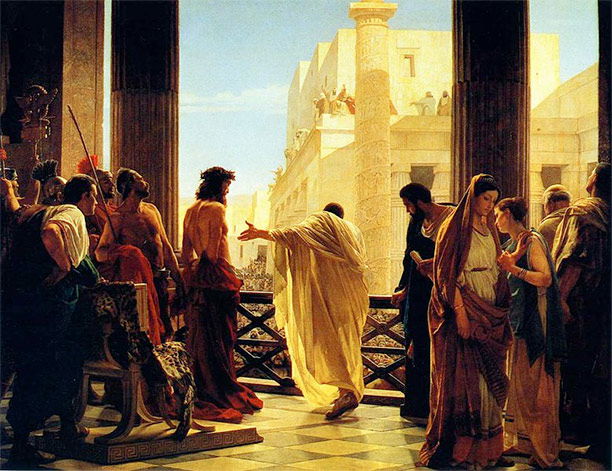 By a strange irony of history, the surest thing known about Jesus of Nazareth is that he was executed by the Romans for sedition against their government in Judaea. The circumstances of Jesus’ birth, the length of his public ministry, and the exact content of his teaching are all matters of uncertainty, but the cause of his death is beyond doubt.
For the fact that Jesus was crucified as a rebel on the orders of Pontius Pilate, the Roman procurator of Judaea is attested by all four Gospels, and it is briefly mentioned by the Roman historian Tacitus, writing early in the second century.
The witness of the Gospels is especially significant, because the fact of the Roman execution of Jesus on such a charge was very embarrassing for the early Christians. They would obviously have never invented it; indeed, they would probably have not recorded it, if the fact had not been so well known.
That the Gospel writers do describe the crucifixion of Jesus, and the events that led up to it, at considerable length, is, in fact, the real cause of the mystery that invests the tragic event. For their accounts are found, on analysis, to be inspired by a strong apologetical motive— indeed, they are attempts to explain the embarrassing fact that Jesus was actually executed as a political offender. Because of this apologetical intent, any attempt to elucidate the problem of the Roman condemnation of Jesus must begin with an evaluation of the Gospel evidence.
The pivotal document is the Gospel of Mark; for it is the earliest of the Gospels, and its narrative framework was closely followed by the authors of the Gospels of Matthew and Luke. The Gospel of John, which is later in date, generally reproduces the Markan presentation of the Trial and Crucifixion of Jesus, though evidently being more concerned with the theological significance of these events.
The Gospel of Mark represents an innovation in Christian thought and practice. No one had hitherto thought of writing a narrative account of the career of Jesus. The reason for this was undoubtedly the fact that the first Christians believed so strongly that Jesus would shortly return from heaven, with supernatural power, to bring the existing world-order to an end. In other words, in the three or four decades since the Crucifixion no need had been felt to record the earthly life of Jesus for posterity—because there would be no posterity!
What, then, caused the change that produced the Gospel of Mark? Clearly we must look for some adequate cause; the change implies a truly profound alteration in the primitive Christian outlook. To answer the question means knowing the date of the Gospel. Scholars have been accustomed to date it for the period A.D. 65-75.
Now, during this decade occurred the Jewish revolt against Rome. It had been coming for some time, owing to Roman maladministration and the Jewish conviction, so fervently held, that the Elect People of Israel could pay allegiance to no other lord than Yahweh, the god of Israel. The revolt broke out in the year 66, and for the next four years the life of the Jewish nation was convulsed in war, until final catastrophe overwhelmed it in 70, when Jerusalem was captured and razed, and its famous Temple destroyed by fire.
The effect of this Jewish War upon the infant Christian Church was profound. Hitherto the Christian movement had been directed and controlled from Jerusalem, where the original community of apostles and disciples had been established. This community., the Mother Church of Christianity, disappeared in the catastrophe of A.D. 70. The consequent situation was fraught with peril and perplexity for Christians elsewhere.
Not only had they lost the original source of the authority and tradition of their faith, but they faced the very real danger of being regarded by the Roman government as ‘fellow-travellers’ with Jewish nationalism. At no place was this danger greater than in Rome itself, the capital of the Empire that had been so sorely tried by the Jewish revolt. It was for the Christian community in Rome that the Gospel of Mark was originally written.
This fact of the Roman origin of the Markan Gospel is of supreme significance for determining the date of its composition. The question that now faces us, in the light of the preceding considerations, is: when, during the period A.D. 65-75, would the need have arisen among the Christians of Rome for a written record of the career of Jesus, seeing that this need had never been felt before? The evidence points irresistibly to one answer only: the need arose out of the situation caused by the Jewish War against Rome.
The a priori probability that this was so finds remarkable confirmation when we examine the Gospel itself. But first we must notice another fact of great importance in this connection. In the year 71, the Emperor Vespasian, together with his sons Titus and Domitian, celebrated a splendid triumph in Rome to commemorate their victory over rebel Judaea. The occasion was one of great significance for both the Roman people and the new imperial dynasty of the Flavii.
Since the death of Nero in 68, the Roman state had suffered a series of grave disasters. It had been plunged in civil war shortly after the Jews had revolted. The Jewish War itself had begun with the crushing defeat of a Roman army by the rebels. The consequences were likely to have been felt afar; for Judaea occupied an important place in the Roman strategical position in the Near East.
The country lay athwart the main routes connecting Egypt with Syria; there was also a large Jewish population in Mesopotamia, likely to make common cause with their Judaean brethren against Rome, a situation that the Parthians in turn could have exploited for invading the Roman provinces. The Romans had, accordingly, been badly frightened by the Jewish War, and they were profoundly grateful to Vespasian, who had both put an end to the civil war and crushed the Jewish rebels.
The occasion was important to Vespasian and his sons, for they were founding a new imperial dynasty. It would obviously be to their advantage to make the most of their victory by impressing the people of Rome with their achievements. Coins were issued commemorating the conquest of Judaea; but it was the triumph that provided the best opportunity for bringing home to the Roman people the magnitude of their victory. We are fortunate in having a detailed account of it from Josephus, the Jewish historian, who had actually served as a general on the Jewish side.
Through the streets of Rome, on the day concerned, the victorious legionaries paraded, with the trophies of their victory and multitudes of Jewish captives. The treasures of the Temple were borne in the triumphal procession, the great Menorah or seven-branched candelabra, the altar of shew-bread, the silver trumpets, and the purple curtains that had veiled the Holy of Holies—a sculptured representation of the scene still adorns the Arch of Titus in the Forum.
The procession also included tableaux depicting scenes from the War which, Josephus tells us, impressed the people by their realistic presentation. The triumph culminated with the execution of Simon ben Gioras, one of the chief Jewish leaders, as Vespasian offered a sacrifice of thanksgiving to Jupiter in the great temple on the Capitol.
This triumph must have made the Jewish revolt very real to the people of Rome; for it was designed to render them vividly aware of the gravity of the danger from which the new Emperor and his son had delivered them. Among the spectators that day were doubtless many Christians, who thus beheld the spectacle of Israel’s ruin. But the sight would have given them other thoughts than those that moved their pagan neighbours. This evidence of Jewish sedition must have been a disturbing reminder of the fact that Jesus, the founder of their faith, had also been executed for sedition against Rome.
They would have been made embarrassingly aware that many of their fellow citizens were likely to view Christianity as Tacitus did when he wrote: “Christus, the founder of the name, had undergone the death penalty in the reign of Tiberius, by sentence of the procurator Pontius Pilate, and the pernicious superstition (exitiabilis superstitio) was checked for a moment, only to break out once more, not merely in Judaea, the home of the disease (originem eius mali), but in the capital itself, (i.e. Rome), where all things horrible or shameful in the world collect and find a vogue”.
The Gospel of Mark reflects the situation of the Roman Christians at this time with an amazing fidelity. Space allows us to select one passage only that, on analysis, unmistakably indicates the time and purpose of the Gospel’s composition. In chapter xii. 13-17, Jesus is represented as being questioned about the duty of the Jews to pay tribute to Rome. Since this issue could have had no spiritual significance for the Christians of Rome, we may reasonably ask why the author of the Gospel devoted space to it?
The answer can only be that the subject was politically important to the Roman Christians. The conclusion in turn raises the obvious question: when could the Christians in Rome have thus been interested in the attitude of Jesus to the Jewish obligation to pay tribute? The answer is equally obvious; when the issue had been so disturbingly intruded upon the attention of the Roman Christians by the Flavian triumph in A.D. 71, as we have seen.
In this passage about the Tribute Money, the Jewish leaders are depicted as trying to make Jesus compromise himself on a matter that was a burning issue for the Jewish nationalists—the non-payment of tribute was one of the causes of the revolt in 66. The author of the Markan Gospel represents Jesus as endorsing the Jewish obligation to pay tribute to Caesar; but there are grounds for grave doubt that this was really the view of Jesus. The Markan presentation, however, was needed in Rome at this time; for it assured the Christians there, and any others who might read the Gospel, that Jesus was loyal to Rome and opposed to Jewish nationalism.
II
This involved discussion concerning the origins of the Gospel of Mark has been necessary, in order to evaluate its account of the Trial of Jesus. On investigation, this Gospel is found to be an account of Jesus, composed by a member of the Christian community in Rome to meet the needs of his fellow Christians., in danger and perplexity owing to the Jewish War and the publicity given to it by the Flavian triumph in Rome.
This apologetical purpose is evident in many ways other than that we have just noted. But the essential point of concern for the author was the Roman execution of Jesus. Even though he represented Jesus as loyal to Rome over the tribute question, there remained the undeniable fact that Pontius Pilate had crucified Jesus as a rebel. How was this awkward and disturbing fact to be explained?
The author of Mark endeavours to meet the difficulty by transferring the responsibility for the Crucifixion from the Roman governor to the Jewish leaders. He prepares for this by showing the Jewish leaders, variously described as ‘the scribes and Pharisees’ and the ‘high priests’, as planning to destroy Jesus from the very start of his ministry. Thus we are told that, after Jesus had healed a man with a withered hand on the sabbath, “The Pharisees went out, and immediately held counsel with the Herodians against him, how to destroy him.” (iii.6.)
This theme of the malicious intent of the Jewish authorities is gradually developed, as the narrative proceeds. How their intent would be implemented is foretold in detail in a prophecy assigned to Jesus himself: “Behold, we are going up to Jerusalem; and the Son of man will be delivered to the chief priests and the scribes, and they will condemn him to death, and deliver him to the Gentiles; and they will mock him, and spit upon him, and scourge him, and kill him; and after three days he will rise.” (x.33-34.)
After describing further encounters with Jesus during the last days in Jerusalem, Mark relates how the Jewish leaders finally succeeded in arresting him, owing to the defection of one of his disciples. The fact is significant; for it indicates that Jesus was too strongly supported by the crowd for the Jewish authorities to arrest him publicly. Mark does not tell for what specific reason they then seized Jesus; we have only his earlier, general assertions that they had determined to destroy him from the beginning of his ministry.
Mark admits that the Jewish authorities sent a heavily armed band to arrest Jesus, and that there was some armed resistance to his arrest in Gethsemane. He minimises this resistance as “one of those who stood by drew his sword, and struck the slave of the high priest and cut off his ear.” (xiv.47.) He does not disclose, as the later Evangelists do, that the disciples were armed and that it was one of them who struck the blow.
After his arrest, according to Mark, Jesus was taken, it still apparently being night, before the Sanhedrin, the highest Jewish tribunal. The trial that follows is described in a way that raises a whole host of problems, both with regard to procedure and to what really happened. Mark's opening statement reiterates his theme of the evil intent of the Jewish leaders: “Now the chief priests and the whole council sought testimony against Jesus to put him to death; but they found none. For many bore false witness against him, and their witness did not agree.” (xiv.55-6.)
The impression that Mark's statements are evidently meant to convey is that the Jewish authorities, determined on destroying Jesus, used the trial as a legal pretext for accomplishing their aim. What is said about the ‘false witnesses’, however indicates a rather different situation. For, if they had suborned persons to give false evidence about Jesus, the Jewish leaders were strangely punctilious in rejecting that evidence when it was not mutually corroborated—surely they would have arranged things better, or have been less scrupulous about the rules of evidence, if they had ‘rigged’ the trial.
But Mark was obviously more concerned to establish the responsibility of the Jewish leaders for the Crucifixion than to present a logically coherent narrative. This also seems to be the explanation of his next statement. According to him, the only specific charge made against Jesus was when “some stood up and bore false witness against him, saying, ‘We heard him say, I will destroy this temple that is made with hands, and in three days I will build another, not made with hands’. Yet not even so did their testimony agree.” (xiv.57-9.)
Mark describes this charge as “false witness”, thereby suggesting that it was not true; and this suggestion is confirmed by the statement that the evidence of these witnesses did not agree. However, as John ii. 19 and the Acts of the Apostles vi.14 indicate, there seems to have been a tradition in the primitive Christian community in Judaea that Jesus had made some utterance against the Temple; and Mark himself seems to imply this in xiii.1-2.
Certain suggestions can be offered to elucidate the problem here. In the first place, it is unlikely that Jesus had actually threatened that he would destroy the Temple, for we know that his disciples continued to worship there and regarded it as the dwelling-place of God—this devotion would be hard to explain, if Jesus had so spoken against the Temple. Further, the accusation is rejected by Mark as false testimony. What seems the most probable solution is that the charge at the Sanhedrin trial arose out of the attack that Jesus had made a few days before on the Temple trading-system. (xi.15-18.)
This system was necessary for the efficient running of the Temple cultus. Jews making the prescribed money offerings to the Temple had to change the Roman currency, which was offensive to the sacred Law, into a suitable Temple currency. Those who came to offer sacrifices needed to buy the sacrificial animals there. These facilities were licensed by the high priest. Such transactions, as well as the banking facilities offered by the Temple, provided a lucrative income to the sacerdotal aristocracy who managed the Temple.
This sacerdotal aristocracy, moreover, controlled “native affairs”, under the Romans: the high priest was appointed by the procurator. This pro-Roman aristocracy was naturally hated by patriotic Jews; and, in attacking their trading organisation in the Temple, Jesus was in effect attacking their control over the people and religion of Israel. There can be little doubt that Jesus’ action in the Temple was a much more serious affair than it is represented to have been by Mark and the other Evangelists. And there is every reason to believe that it would have constituted one of the chief charges preferred against him.
The Jewish authorities undoubtedly were concerned to discover what exactly was Jesus’ intention in making this attack. Mark’s curious reporting of the charge and of the conflict of evidence suggests that the Jewish authorities were unable to get a clear statement of what Jesus had said about his aims during his action in the Temple.
According to the Markan account of the Sanhedrin trial, after failing to get sufficient evidence about the Temple affair, the high priest then asked Jesus directly whether he claimed to be the Messiah of Israel: “Are you the Christ, (i.e. Messiah), the Son of the Blessed?” That he should have asked such a question, following on the Temple charge, clearly shows that the high priest connected revolutionary action with one who might claim to be the Messiah. In contemporary Jewish belief, the Messiah would bring the existing world-order to an end.
Mark reports Jesus as affirming that he was the Messiah in terms of current apocalyptic expectation: “I am; and you will see the Son of man sitting on the right hand of Power, and coming with the clouds of heaven.” (xiv.62). The high priest takes this answer as blasphemy, and, with the concurrence of the Sanhedrin, condemns Jesus to death.
Now we encounter one of the greatest problems of the Markan account. In the first place, although Josephus tells of many Messianic pretenders during the period A.D. 6-70, there is no record of any being condemned to death by the Sanhedrin for making such a claim. Secondly, according to Jewish Law, the penalty for blasphemy was death by stoning—the death of Stephen provides a contemporary instance of this (Acts vi.l2ff.)
But the Sanhedrin does not proceed to arrange for the execution of this sentence in the case of Jesus. Instead, Mark goes on to relate, without a word of explanation, that, in the morning, the Jewish authorities handed Jesus over to Pontius Pilate. The charge preferred by them is not mentioned, but it was obviously a political one; for Pilate immediately asks Jesus, “Are you the King of the Jews?” (xv.1-2.)
This action of the Jewish leaders, and the alteration of the charge, have caused much debate among scholars. There seems to be evidence that at this time the Sanhedrin could condemn on a capital charge; but the sentence had to be confirmed by the Roman governor. Presumably, if the Sanhedrin had condemned Jesus to death for blasphemy, they would have applied to Pilate for confirmation. If this had been given, Jesus would have been executed by stoning.
That this was not so, and that Jesus was delivered to Pilate charged with sedition, indicates that the Jewish authorities were concerned with the political, not the religious, significance of Jesus. This concern is intelligible. The high priest and the Sanhedrin were responsible to the Roman governor for Jewish affairs. Jesus’ triumphal entry into Jerusalem and his action in the Temple had clearly disturbed the peace and good order of the Jewish state, besides challenging their own position.
That the Romans would hold them responsible for the continuance of the menace that Jesus constituted is attested by John xi. 48, where Caiaphas, the high priest is reported as saying to the Sanhedrin: “What arc we to do? For this man performs many signs. If we let him go on thus, every one will believe in him, and the Romans will come and destroy both our holy place and our nation”.
Consequently, the action taken by the Jewish leaders was in accordance with their responsibilities, and it anticipated Roman action. Having arrested Jesus, they examined him about his aims and supporters, preparatory to handing him over to Pilate. The charge was essentially a political one, although it must be remembered that politics and religion were inextricably bound up in Judaea at this time. Luke gives the most explicit account of the charges preferred against Jesus by the Jewish leaders: “We found this man perverting our nation and forbidding us to give tribute to Caesar, and saying that he himself is Christ a king, (xxiii.2.)
We must return to the Markan account, remembering that it is the earliest version. Mark represents Pilate as convinced of Jesus’ innocence; “for he perceived that it was out of envy that the chief priests had delivered him up.” (xv. 10.) Now, if this was indeed the opinion of Pilate, the course open to him was obvious. He had the authority and power to dismiss the case. We know a great deal about the character of Pilate from Philo of Alexandria and Josephus.
These Jewish writers agree in showing Pilate to have been a tough-minded man, ready to use force, and not one to be intimidated by the Jewish leaders and people. Consequently, if he had been convinced that Jesus was innocent, he was unlikely to have hesitated about thwarting the intention of the Jewish leaders. What Mark tells of his subsequent conduct at the Trial, is, therefore, difficult to reconcile with his character, as well as with logic, as we shall see.
Instead of dismissing the case, Pilate is depicted as trying to save Jesus by availing himself of an otherwise unknown custom. According to Mark, it was the custom at the Passover for the Roman governor to release a prisoner chosen by the crowd. There is no other evidence for such a custom. This negative witness is important, because Josephus is careful to record all the privileges granted to the Jews by the Romans.
But that is not all. Such a custom is inherently impossible. Judaea was seething with revolt; its government would have been annually frustrated by having to release a notable prisoner—according to Mark, on this occasion a dangerous rebel, probably a Zealot, was freed.
But, even if we pass over the improbability that such a custom existed, what Mark tells of Pilate’s use of it passes beyond belief. He depicts this tough Roman procurator, who was backed by a strong military force, as resorting to this custom to save a man he adjudged innocent. In so doing, he invites the Jerusalem mob to choose between Jesus and a rebel leader, Barabbas, who had killed Romans in a recent insurrection.
To have given the crowd such a choice would have been the height of folly, if Pilate h~d sought thus to save Jesus. The mob’s decision was a foregone conclusion. Led by the chief priests, they naturally chose Barabbas, to them a patriotic hero. Frustrated, Pilate is represented as weakly asking the mob: “what shall I do with the man whom you call the King of the Jews?” (xv.12.)
The picture of a Roman governor consulting a Jewish mob about what he should do with an innocent man is ludicrous to the extreme. But to this extreme the author of the Markan Gospel was evidently prepared to go, to explain away the problem of the Roman execution of Jesus. Thus he completes his picture of Jewish responsibility for the Crucifixion. The Jewish leaders, who were determined on destroying Jesus from the very beginning of his ministry, finally succeed in their fell design by forcing the reluctant Pilate to do their will.
To round off this presentation of Jewish guilt, Mark describes the Jewish leaders, on Golgotha, as mocking the dying Jesus, while the Roman centurion recognises his divinity as he dies: “Truly this man was the Son of God!” The death of Jesus is marked by the rending of the Temple Veil, thus symbolising the obsolescence of Jewish religion, (xv.37-9.)
Mark's account of the career of Jesus and the circumstances of his Crucifixion would have been welcomed by the Christians of Rome. The embarrassment of Jesus’ execution for sedition against Rome was alleviated by the explanation of Jewish responsibility. Far from condemning Jesus to death, the Roman Christians now knew that Pilate actually recognised his innocence and tried to save him.
Jesus had, moreover, given proof of his loyalty to Rome in the matter of the tribute, and the Roman centurion had been the first to perceive his divinity. The Jewish leaders who had plotted his death, and the Jewish people that had demanded it, had brought upon their nation the terrible catastrophe of A.D. 70, which had been so graphically commemorated in the streets of Rome in A.D. 71.
III
Mark’s explanation of the Roman execution of Jesus, motivated as it had been by the needs of the Christian community in Rome in A.D. 71, exercised a formative influence on subsequent Christian tradition. The writers of the Matthewean and Lukan Gospels accepted it, elaborating upon it according to the particular requirements of the communities for which they wrote. Their additions were inspired by the need to allay a widespread belief in the Roman Empire that Christianity was in origin and nature a revolutionary movement.
Thus the Gospel of Matthew expands Mark’s brief and reticent mention of the armed resistance in Gethsemane by representing Jesus as rebuking the disciple who drew the sword: “Put your sword back into its place; for all who take the sword will perish by the sword.” (xxvi.52.)
The author of this Gospel was writing for a Jewish Christian community, probably in Alexandria, where there was a great need to damp down revolutionary feeling after the fall of Jerusalem in A.D. 70. The words, attributed to Jesus here, had a poignant significance in the light of the disaster that had befallen the Judaean Jews in consequence of their resort to war.
An addition that Matthew also makes to the Markan account of the trial of Jesus was destined to have tragic consequences for the Jewish people. To emphasise the innocence of Jesus, Pilate is represented as publicly repudiating responsibility for the condemnation of Jesus. He washes his hands symbolically before the people, declaring, “I am innocent of this man’s blood”.
The Jewish people are made to answer: “His blood be on us and on our children!” (xxvii.24-6.) The legacy of these words has been terrible; they have been cited to justify centuries of Christian persecution of the Jews. It is significant that only at the recent Vatican Council has a formal declaration been made, exonerating subsequent generations of Jews from responsibility for the murder of Christ.
IV
The historian, who seeks to understand why the Romans executed Jesus for sedition, has first to investigate the Gospel of Mark, as we have endeavoured to do here. He has to penetrate behind Mark's apologetical presentation, to discern what really happened on that first Good Friday. So far as a reasonable assessment can be made, it would seem that the Jewish authorities arrested Jesus because they regarded him as a menace to the peace and well-being of the Jewish state, for which they were responsible to the Romans.
After interrogating Jesus, they handed him over to Pontius Pilate, accusing him of seditious teaching and action. Pilate, who probably knew something of Jesus’ activities, accepted the charge and ordered his crucifixion. He gave orders that the titulus, stating the cause of his condemnation, should be placed at the head of the cross: it read: “This is Jesus, the King of the Jews”.
Pilate also ordered that two lestai should be crucified with Jesus. The fact is significant; for we know that the Romans called the Zealots, the Jewish resistance-fighters, lestai, i.e. brigands. These men had doubtless taken part in the recent insurrection in Jerusalem. (Mk. xv.7.) That Jesus was crucified between two rebels surely indicates that Pilate regarded him as such.
Thus, so far as the historian can today evaluate the evidence concerning the Roman execution of Jesus, it would seem that Pontius Pilate regarded Jesus as guilty of sedition. Whether he was right in his assessment is another matter.

