Time and Tides
In a world of rapid growth in maritime trade, understanding the tides was vital. Yet it was a complex process, dependent on science, geography, mathematics, religion and ego, writes Hugh Aldersey-Williams.
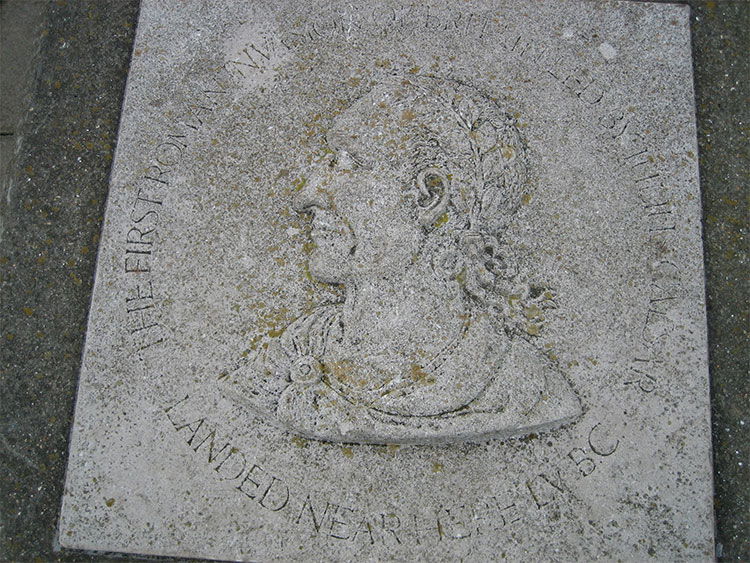 When Julius Caesar’s invasion of Britain was under way in September 54 BC, Marcus Tullius Cicero wrote from Rome in reply to a letter from his brother Quintus, who was accompanying Caesar. The letter had spoken of the apprehension the Romans felt about tidal shores: ‘How glad I was to get your letter from Britain! I was afraid of the ocean, afraid of the coast of the island. The other parts of the enterprise I do not underrate; but yet they inspire more hope than fear.’
Accustomed to the small tides of the Mediterranean, the Romans had reason to be fearful. Both of Caesar’s landings, in 55 and then 54 BC, were hampered by the strong, unfamiliar tides of the English Channel. ‘The Deified Caesar crossed over to the island twice’, the geographer Strabo relates, ‘although he came back in haste, without accomplishing anything great or proceeding far into the island, not only on account of the quarrels that took place in the land of the Celti, among the barbarians and his own soldiers as well, but also on account of the fact that many of his ships had been lost at the time of the full moon, since the ebb-tides and the flood-tides got their increase at that time.’
The exact point where Caesar set foot on British soil for the first time is not recorded. Unsurprisingly, though, it has become a discussion point for generations of historians. The answer depends on an understanding of the tide as much as on the analysis of military intentions. In one instance, in 1862, Thomas Lewin argued that the Roman fleet would have been swept westward to Hythe, while Edward Cardwell argued the opposite, saying that it would have been carried east around South Foreland towards Deal, both places more than ten miles in opposite directions along the coast from the Channel’s narrowest point at Dover.
Sir George Biddell Airy, the Astronomer Royal, ruled on the matter. He refuted Cardwell’s suggestion of a beach-head at Deal or Walmer (where there is an optimistically placed memorial) as ‘absolutely impossible’ – although, wisely no doubt, he refused to nominate an alternative landing point. Cardwell had gone astray misreading the scientific literature, mistaking a time of day (3.10pm) for a duration of tidal flow (3 hours, 10 minutes). He had also fallen victim to a landlubber’s misconception that if the tide is flowing away from a place then the sea level there must be going down, which is often not the case.
What is not in doubt is that the Romans were wrestling with tides of far greater magnitude than those to which they were accustomed. The Mediterranean is what marine biologists term a ‘micromareal’ region. Its tidal range is seldom more than a metre and its strong currents are generally confined to a few quirky spots, such as at Chalcis in Greece, where Aristotle is reputed to have drowned himself in the sea when he could not figure out its tidal logic, and the famed whirlpool of Charybdis in the Messina Strait.
It is perhaps no surprise that some of the earliest discoveries about the tides come not from the cradle of western civilisation on the shores of the Mediterranean, but from the wilder fringes.
The Northumbrian monk and historian Bede discussed the tides in his treatise of 725, The Reckoning of Time. (This work’s promotion of the idea of calculating the year based on the date of Christ’s birth, instead of the regnal year of the local monarch, gives us the Anno Domini system we use today.) Bede clearly noted the coincidence of the highest tides with the new moon and full moon, although with no understanding of any mechanism linking the two. This helped to dismiss earlier ideas that the tides arose by the action of unseen geysers.
Bede’s observations about the tide arose from the need to agree the date of Easter, which is calculated based on religious calendars and the phase of the moon. The Reckoning of Time bedded this traditional computus in a clearer understanding of the astronomical and cosmological context on which it was dependent. Bede demonstrated, for example, how the Jewish and Roman calendars converge every 19 years, coincident with the slowest rhythm observable in the tides. He also included his findings concerning the moon and its effects made by various direct and indirect methods, noting ‘this union of the ocean with the orbit of the moon’. He even provided a metaphorical glimpse of the attractive force of gravity: it is as if the sea is ‘unwittingly drawn up by some breathings of the moon’, he wrote. More significantly, he noted that the time of high tide advances a little each day in time with the hour at which the moon rises. He measured this difference to be 47 and a half minutes.
Bede must have measured the tides himself on the Northumbrian coast, where his monastery was situated. But his real breakthrough was to solicit similar data from other locations, which showed how the high tide moved like a slow wave clockwise around the west and east coasts of Britain. He was perhaps inspired to do this by comparing anecdotes with visiting monks from other seaside monasteries, such as that on the remote island of Iona on the west coast of Scotland. He used this monastic network to make what might fairly be called a scientific survey.
Later monastic scholars continued this work in a sporadic fashion. In the 13th century, Thomas Aquinas in Italy and Robert Grosseteste in England wrote commentaries on Aristotle, seeking to bring his science into line with Christian theology. Aquinas used the movement of the tides as evidence to sceptics of a ‘prime mover’ – God – in his Summa Theologica. Preoccupied above all with light, Grosseteste expanded on the accepted scientific view that the cause of the tides was related to the brightness of the moon, developing an ingenious (though erroneous) optical explanation for why the tides are high not only when the moon is full but also when it is new and not bright in the sky. The credit for his thinking was swiftly taken by a better-known friar, Roger Bacon, who in 1265 boasted to Pope Clement IV: ‘I have explained one of the most famous, greatest and most difficult effects which are met with in reality, I mean to say the flux and reflux of the sea.’
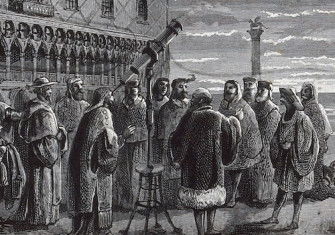
It was not until the scientific revolution of the 16th century, however, that proper progress began to be made. Two contrasting new perspectives on the tides were opened up, first by Galileo, then by Newton. In 1592 Galileo Galilei spent the summer in Venice conducting experiments on the motion of projectiles. What he saw there converted him to Copernicansim, the understanding that objects orbit around the sun at the centre of the Solar System. His experiments indicated to him that bodies could move under the influence of more than one force at a time: the propulsive force of the detonation and the still unrecognised force of gravity in the case of a projectile.
He also travelled on barges transporting fresh water to the island of Venice and noticed that their load slopped back and forth when the vessels stopped. He made a brilliant leap to compare this with the tides of the Adriatic Sea, a long, almost enclosed body of water, whose tides are greater at the ends than in the middle. For the tides to be similarly explained by the action of external forces, the Earth would have to move. Galileo reasoned that the tides, not only of the Adriatic, but of the world’s oceans, were similar oscillations induced by the Earth’s motion round the sun.

In the absence of direct astronomical evidence, the tides became the crux of Galileo’s argument in favour of the heliocentric Solar System. His Dialogue Concerning the Two Chief World Systems, the work which brought him into conflict with the Church, he had planned to call ‘Dialogue on the Tides’. But it was a leap too far. According to his biographer, David Wootton, ‘Galileo’s theory of the tides was disastrous, both for him and for Catholic Europe, because, armed with it, he saw no need to respect the limits on debate imposed by the Church.’ Galileo was wrong in important scientific respects, too, not least the fact that the moon played no part in his tidal theory, but he was correct in realising that all seas are subject to pendulum-like oscillations, which account to some extent for local tidal variations.
While studying at Cambridge in 1664, Isaac Newton began to list the scientific ‘quaestiones’ that would dominate his life. One of them was to explain the tides. Aside from Galileo’s oddly moonless theory, the most influential thinking about the cause of the tides at this time came from René Descartes, who sought to explain them as an effect of pressure exerted on the oceans by the moon. Newton hoped to ‘Observe if ye sea water rise not in days & fall at nights by reason of ye earth pressing from [the moon] uppon ye night water &c’. It did not, of course, and these and other enquiries led ultimately to Newton’s theory of gravitation. Published from 1687 onwards in the three volumes of the Principia, Newton’s theory explained the observed motions of celestial bodies far more satisfactorily than ever before and, on Earth, provided mathematical proof for there being two tides a day, rather than the one we might expect when the moon is in the sky. It showed that the sun is also an important factor, explaining the difference between neap and spring tides, those tides with the least and greatest difference in height between high and low tide, respectively.
Like Galileo, Newton also experienced problems in obtaining evidence to support his theory, although his difficulties were personal rather than ecclesiastical. Newton used tidal data gathered from various English ports, a project of the newly founded Royal Society. But the best and most recent data was in the possession of the Astronomer Royal, John Flamsteed. Before and long after the Principia was published, Newton badgered Flamsteed to see his data, railed at him when he found errors in it and used his position as president of the Royal Society to force Flamsteed to publish his work before he considered it ready. Newton ultimately showed his gratitude by expunging references to Flamsteed wherever he could from the second edition (1713) of his Principia.
The next major step forward was to think about real oceans. Newton’s mathematical theory was correct in principle, but could not be used to predict real tides. Galileo’s ideas were helpful, but not fundamentally correct or complete. Meanwhile, a world increasingly dependent on maritime trade could only rely on empirical data gathered at each port.
In 1738 the French Royal Academy of Sciences announced that the subject for its prestigious annual essay was to be ‘Sur le flux et reflux de la mer’ (On the flux and reflux of the sea). The competition attracted major European talent and produced some developments from the Newtonian position. In particular, the Swiss physicist Daniel Bernoulli showed that Newton’s mathematics could be employed with empirical port data to yield more reliable tidal predictions for real places.
A generation later, Pierre-Simon Laplace brought Newton’s and Galileo’s models of the tide together in a new ‘dynamic’ theory that, for the first time, made allowance for conditions imposed on tidal movement by the oceans as they actually exist. Newton had thought of the oceans in an equilibrium which is disturbed by the gravitational pull of the moon and sun. Laplace followed Galileo in thinking of them as already in motion, like oscillating basins whose contents are slopped about by the motion of the Earth and damped by friction between the water and the seabed and shore. Unlike Galileo, however, Laplace had the mathematical knowledge to show how the forces of gravity, friction and retardation owing to inertia acted on each slopping parcel of water in the ocean.
These new ideas were outlined in a pair of papers published by the French Royal Academy of Sciences in 1775 and 1776. Yet for all the mathematical virtuosity he was able to deploy, Laplace was still forced to make simplifications, such as that the oceans were uniformly 12 miles deep. Like Newton and Galileo, Laplace was to return again and again to the topic of the tide throughout his career, characterising it as the ‘thorniest problem in physical astronomy’.
Laplace’s equations were too cumbersome for practical use in predicting the tides until the invention by William Thomson, later Lord Kelvin, of an ingenious tide prediction machine in 1872. Astonishingly, one of these machines was still being used to calculate the tides for the Normandy beaches during the planning of the D-Day landings in 1944.
Today, tidal predictions are made digitally using up to 100 different astronomical factors. They are highly accurate – far greater, in fact, than is needed for navigational purposes. However, the data has become essential for scientists studying the likely effects of climate change, who, in order to predict the extent of rising sea levels, must first know where the mean sea level lies.
Hugh Aldersey-Williams is the author of Tide: The Science and Love of the Greatest Force on Earth (Viking, 2016).