

St. Wenceslas of Bohemia
Cecil Parrott describes how the elderly monarch from a Christmas carol was based on the character of a young and vigorous sovereign, assassinated on his birthday by his own brother.
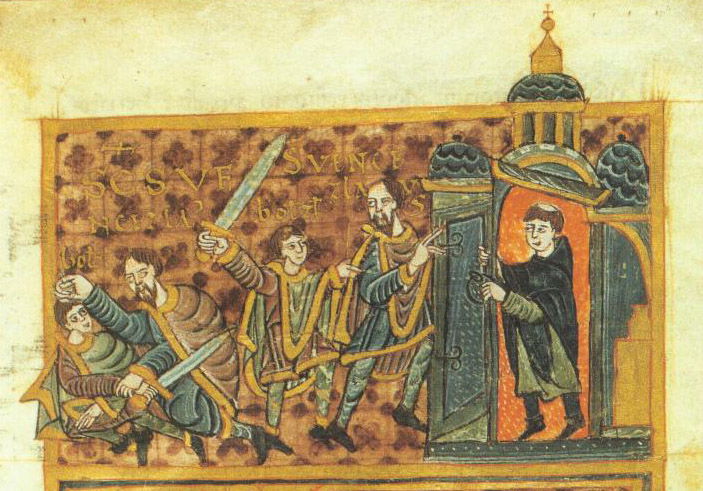
The Wenceslas of history was very different from the picture we have of him in the familiar carol. He was a young and vigorous man, who was still in his twenties when he met his death. Although a reigning prince, he never had the title of King, and his existence was by no means peaceful. On the contrary, it rivalled Renaissance drama in its cruelty and bloodshed.
When Wenceslas was a boy, his grandmother, who looked after him and to whom he was deeply attached, was driven out and strangled by his mother; and he, in his turn, was treacherously murdered on his birthday by his own brother, just as he was about to go into church to attend morning mass.
Wenceslas was born in 907 or 908, the grandson of Borivoj, one of the Premysl line and the first Bohemian ruler for whose existence there is historical and archeological evidence. Borivoj lived from 855 to 891, and, during part of this period, Bohemia was under the suzerainty of Svatopluk, ruler of Great Moravia. Borivoj must have had particularly good relations with the Moravian court; he made two visits to Svatopluk. He was not yet a Christian and, on his first visit in 874, he was not allowed to sit at the Moravian ruler’s table.
One of the legends relates that Methodius was so overcome by Borivoj’s humiliation, when he found him sitting on the floor like a serf or a dog, that he baptised him together with thirty men of his bodyguard and sent him back to Bohemia with a priest to instruct him. No doubt the same priest baptised Ludmila, his wife.
Ludmila’s conversion was even more important to Bohemia than that of Borivoj, since she survived the deaths of her husband and her two sons. She was a devout Christian and, during her twenty years of widowhood, she was not only an outstanding example to Wenceslas himself, but also a strong influence for good at the Bohemian court.
On his return, Borivoj built the first church in Bohemia—St. Clement at Levy Hradec near Prague. Excavations made on the site during the Second World War revealed the foundations of a small stone round church. Although the find caused some controversy, many Czech archaeologists believe that this is the church founded by Borivoj, and that, to construct it, he brought masons with him from Moravia.
In the middle of the ninth century Moravia was far more advanced than Bohemia, as is shown by the recent discoveries in Southern Moravia of the remains of sixteen stone churches, some of them round, and many of which date from as early as the first half of the ninth century.
But Borivoj’s attempts to introduce Christianity into Bohemia met with stubborn resistance from his countrymen, and he was forced to take refuge in Moravia once again. A second counter-coup, however, soon brought him back to Bohemia for good, and he celebrated his return by founding a second church, this time on the Hradcany in Prague, and dedicating it to the Virgin Mary.
Its foundations were discovered in 1950 and are now to be seen in a hall adjoining the Picture Gallery of the Hradcany. The skeletons in the grave may well be those of Borivoj’s elder son and successor, Spytihnev and his wife.
On Borivoj’s death in 891, Spytihnev ascended the throne. The foreign political situation had now changed. Svatopluk was dead and his sons, who were weak and divided, were powerless before the invading Magyar horde, whom the East Frankish King, Louis the German, had called in to help him against the Slavs.
Great Moravia thereupon began to disintegrate and its ties with Bohemia to loosen. In 895 Spytihnev finally broke with Moravia, and went to Regensburg with other Czech princes to swear allegiance to King Arnulf of Bavaria.
Following the Christian example of his father, Spytihnev founded a church in honour of St. Peter the Apostle at the castle of Budec near Prague, not far from Levy Hradec. This church later had a Latin school and may well have been under Bavarian influence. Once he had accepted Bavarian suzerainty, Spytihnev had to admit Bavarian missionaries who favoured the use of Latin rather than Slavonic in the liturgy.
In 905 Spytihnev was succeeded by Vratislav, Borivoj’s second son, and Wenceslas’s father. Little is known of him except that he had a wife named Drahomira, and that he built a basilica on the Hradcany, dedicated to St. George, the oldest surviving church on the Hradcany, which became not only the shrine of St. Ludmila but the first women’s convent in Bohemia.
Vratislav and his mother, Ludmila, seem to have distrusted Drahomira and to have made their own dispositions for the education of the young prince, who, naturally, was to be brought up as a Christian and taught to read both Slavonic and Latin. His grandmother, Ludmila, taught him Slavonic, and later he was sent to Budec to learn Latin. The legendists speak highly of his ability to read in those languages; and, according to one source, he had even studied Greek.
The decisions taken about Wenceslas’s education, which almost certainly were Ludmila’s, were most important. Thanks to this inspiration from both Rome and Byzantium, Wenceslas was much better educated than other reigning princes of his time—except Alfred the Great—or indeed than any other Bohemian prince up to the thirteenth century. His younger contemporary, the Emperor Otto I, only learnt to read and write towards the end of his life. Wenceslas, indeed, may be regarded as a forerunner of the “Ottoman Renaissance”.
But Wenceslas was also well equipped diplomatically for the struggle that still continued within the church between the supporters of Methodius and those of the Bishop of Regensburg. From the difficulties experienced by Methodius in Moravia, we know that there had been great rivalry between the Bavarian-trained and the Byzantine-trained missionaries, and that one of the main subjects of dispute was whether the Slavonic language should be used in the liturgy. The Bavarian-trained missionaries, supported in the end by the Pope and Svatopluk, succeeded in establishing Latin as the sole permitted language, and the followers of Methodius were eventually driven out of Moravia into Bulgaria.
This struggle must have spread to Bohemia, with Borivoj and Ludmila no doubt supporting Methodius’s teaching, and other groups at the court identifying themselves with the Bavarian view. It was not merely a question of disagreement on liturgical practices. The use of Slavonic in church ritual and religious writings was extremely important for the development of the native literature in Bohemia and Moravia. The final adoption of Latin as a result of Bohemia’s close connexions with Bavaria, whatever other advantages it may have brought, slowed down the development of literature in the vernacular.
After the death of Vratislav, Bohemia had two surviving royal widows, Ludmila and Drahomira, and two child princes, Wenceslas and Boleslav. When Wenceslas was brought back to the Hradcany from Budec, and once more put in his grandmother’s charge, Drahomira not unnaturally objected. She began to agitate against Ludmila, and the latter, explaining that she had no wish to stand in Drahomira’s way, left the Hradcany and moved to her own castle at Tetin.
But Drahomira was determined not only to rid herself of a rival but also to appropriate her property; and in the year 920 or 921 she sent two of her nobles, Tunna and Gomon, with a powerful force to Ludmila’s castle. They forced their way into the old lady’s bedroom and, despite her remonstrances, pulled her out of bed and threw her on the floor.
After begging to be permitted to pray a little—which her murderers allowed— she asked to be beheaded with the sword, because, as the legendist puts it, “she ardently desired a martyr’s crown, to which death by bloodshed would entitle her.” But Drahomira, it seems, was determined to deny her even this, and had instructed her men otherwise. They strangled her with a cord. Ludmila’s prayers were granted none the less: she became the first Bohemian saint and martyr.
Was there a political motive behind this murder? Later legendists have attributed it to the heathen prejudices of Drahomira and her followers. But Drahomira was a Christian herself, though she sprang from a people who had resisted attempts to convert them with exceptional stubbornness. The fact that she subsequently built a basilica over Ludmila’s grave confirms that she was nominally a Christian, even if her motive in doing so was far from pious: she dedicated the shrine to the Archangel Michael, apparently hoping that any miracles that might manifest themselves around Ludmila’s tomb would be attributed to the Archangel rather than to the dead lady.
Draho-mira’s injured pride, her jealousy, covetousness and ambition, seem to have been her principal motives. But, as later legends speak of the disbanding of Ludmila’s priests and their banishment, it is possible that anti-Christian prejudices, together with a dislike of the religious practices of the priests at the court, may have helped to influence her conduct.
Drahomira now seized all her mother-in-law’s property and began to rule the state, assisted by her faction, whom she had rewarded with gold, silver and precious clothing. Later, the murderers fell out among themselves; and Drahomira eliminated Tunna and Gomon—according to a modern theory, they were Germans—and vented her animosity on her own son, Prince Wenceslas, whom she and her faction accused of being corrupted by the priests with whom his grandmother had surrounded him and who, she claimed, were trying with his encouragement to turn him into a monk.
She did her best to kill or intimidate his priestly tutors and forbade them to have any contact with him; whereupon Wenceslas arranged to admit by night those who were closest to him through a private door he had made, hid his prayer book, breviary and psalter under his clothes, and read them covertly whenever he could be at peace. Finally, unable to bear it longer, he summoned his mother and her nobles and told them that henceforward he refused to submit himself to their control and would serve God with a sincere heart.
So the legendist informs us; but there is no doubt that a coup d’etat took place, the kind of palace revolution that often occurs during the minority of boy-rulers. There seems to have been a confrontation between “the party of the just”, who supported the young prince, and “the party of the unjust”, who supported Drahomira. Although “the just” were less numerous, they were more united than the rival party. They at length prevailed, and Wenceslas banished his mother.
It seems probable that Wenceslas’s faction received some help from outside. We know from the Bavarian annals that King Arnulf penetrated to Prague in 922, though this is not mentioned in either the Slav or the Latin legends. Since Wenceslas’s uncle had submitted to Bavarian suzerainty, it is conceivable that Arnulf came to the aid of the threatened dynasty and the legendists in question may have not mentioned the fact because they wrote at a time when power in the Empire had already passed out of the hands of the Bavarians into those of the Saxons.
Once internal order had been restored, Wenceslas determined to transfer his grandmother’s remains from Tetin to Prague, and on October 21st, 925, she was duly re-interred in the church of St. George on the Hradcany, which, at Wenceslas’s request, had recently been consecrated by the Assistant Bishop of Regensburg. Wenceslas now wished to follow the examples of his grandfather, uncle and father and found a church. He accordingly built a round church on the Hradcany, which he dedicated to St. Vitus, the patron saint of the Saxons.
The choice of this particular patron seems doubly odd; first, he was a German saint; secondly, Bohemia had belonged from 895 onwards to the diocese of Regensburg, and a Bavarian would have appeared more appropriate than a Saxon. One of the Slavonic legends, in fact, records that he dedicated the church to St. Emmeramus, the Bavarian patron, and there are some grounds for believing that this had been his original intention, but that the growing power of Saxony made it more politic to change to another saint. Both the Saxon chronicler Widukind and the Czech legendist Kristián speak of Wenceslas’s ties with Saxony.
The latter says that Wenceslas was linked in lasting friendship with King Henry, and the former, that, as long as he lived, he always remained his faithful adherent. It is recorded that Wenceslas secured from Henry some of the relics of St. Vitus, and this in itself shows with what esteem he was regarded by the Saxon King. The relics of St. Vitus had originally been held by the Franks when they were at the height of their power, but they were transferred to Saxony when power passed into Saxon hands. Wenceslas did well to secure some of the relics that had brought King Henry such success.
One of the more attractive miracles attributed to Wenceslas by the later legendists throws light on his relationship to the King. At a meeting of princes convened by the Emperor —presumably the King of Saxony, since there was no Emperor in Wenceslas’s time —Wenceslas is reported to have annoyed him so much by his unpunctuality that he gave the order that none of the princes should rise and offer their seat to him when he at length presented himself.
On Wenceslas’s tardy arrival, however, all the princes were surprised to see Henry himself rise and offer him the place of honour. When questioned afterwards, Henry explained that, as Wenceslas entered the room, he had seen angels beside him and a blazing cross on his forehead. This legend later attached itself to the so-called “helmet of St. Wenceslas”, preserved in the Cathedral of St. Vitus to this day, which has a crucifix on the protective piece covering the forehead.
Wenceslas had by now pardoned his mother and allowed her to return, although she was not permitted to resume her princely functions. But his brother Boleslav, with whom there had been no reconciliation, was already plotting to remove him. Wenceslas was to be invited to visit Stara Boleslav, the seat of Boleslav, to celebrate the feast of St. Cosmas and St. Damian, which preceded by two days the feast of the Archangel Michael. Wenceslas accepted the invitation despite the warnings of his entourage.
When he arrived, his brother and the other conspirators found it difficult to hide their murderous intentions. At the evening banquet held in Wenceslas’s honour, they rose and could hardly conceal the weapons they wore under their cloaks. One of Wenceslas’s bodyguard tried to persuade him to escape on a horse that he had kept ready; but the prince refused and returned to the hall to drink a pledge to St. Michael.
The next day, which was to be the fatal one, Wenceslas rose early to attend mass in the church of St. Cosmas and St. Damian. The conspirators had counted on this, and had persuaded the priest to lock the church door. When Wenceslas approached, Boleslav accosted him and struck him on the head with his sword. Wenceslas, who seems to have been strongly built, returned the blow and brought his brother to his knees.
With a typically quixotic gesture, he then handed back the sword and, wounded though he was, made his way towards the door. Boleslav thereupon summoned his bodyguard, who stabbed Wenceslas to death just as he had grasped the door handle—a handle shown in many old paintings of St. Wenceslas’s life, a copy of which is attached to the door of his chapel in the present cathedral. The murder was long thought to have taken place in 929, but recent researches suggest that it must have happened some six years later.
Having arranged for his brother to be quickly buried, Boleslav then rode to Prague with his supporters to take over the government. Later Wenceslas’s body was solemnly transferred to the Hradcany, and the saint was buried in the round church he had himself built, which became known as the Cathedral of St. Vitus and St. Wenceslas.
All Wenceslas’s supporters were persecuted. Some succeeded in escaping, including his faithful “page” and friend Podiven, who subsequently returned to avenge his master, killing one of the conspirators before he was himself slain. Among those who were forced to flee were all the foreign priests to whom Wenceslas had shown such favour. This had a result that the murderers had not reckoned with. The evicted clergy returned to their countries to tell an anguished tale of the saintliness of Wenceslas and the brutality of the usurper.
From that moment Wenceslas was canonised, if not in deed, at least by general acclaim, and for more than a thousand years Boleslav was depicted as a heathen and a Judas who brought Bohemia nothing but harm. More recently he has been rehabilitated by some Czech historians. Boleslav, they assure us, was not a heathen; under his rule the boundaries of Bohemia spread far beyond the Czech lands; and thanks to his family connections, Poland was won over to Christianity.
But, above all, Wenceslas came under a shadow as an alleged ally of the Germans. We know that, in 895, Spytihnev, with other Czech princes, had renewed his allegiance to the Empire, after a short interval during which he had become dependent on Svatopluk of Moravia. According to Widukind, King Henry of Saxony advanced with his forces on Prague and “received in subjection the prince, known for his Christian life, the brother of Boleslav.” Both Widukind and Kristián agree that relations between Henry and Wenceslas were excellent.
It is not explained why Henry found it necessary to advance on Prague: the only possible reasons could be the rivalry between Bavaria and Saxony, and Henry’s desire to establish that it was to Saxony that Bohemia owed allegiance. But Wenceslas’s close and friendly ties with the Empire have been widely misconstrued. Albert Hauck, the German ecclesiastical historian, describes Wenceslas as having died “almost more of a martyr to his devotion to Germany than to his Christian faith”; and there were Czech historians who said that Wenceslas’s acceptance of the suzerainty of the Empire was the happiest settlement of the Bohemian question, since it secured the basic conditions for the existence of the Czech people. Sentiments of this kind did Wenceslas’s reputation much harm during the German Protectorate and afterwards.
But there is no evidence that Wenceslas was “pro-German” at the expense of Bohemia’s national interests. It is none the less possible that his murder had a political background, and that Boleslav and his faction were in revolt against the conditions of the agreement with Saxony that Wenceslas had accepted.
Soon after Wenceslas’s death—thanks partly to the tales told by foreign priests—the legend of St. Wenceslas began to grow. Here we must distinguish between two interpretations of the word legend—the popular one, that is stories, having no historical basis, and the technical one, “legenda”, or what is to be read in churches about a saint’s life on the anniversary of his birth or death. Such legends are biographies of the saints, built on historical facts, but not free from fanciful additions.
Not many years after Wenceslas’s death a life of him appeared written in Old Slavonic, a later version of which exists today. Entitled “The First Old Slavonic Legend of St. Wenceslas”, it was followed, towards the end of the tenth century, by “The Life and Martyrdom of St. Wenceslas and His Grandmother St. Ludmila”, written in Latin by Kristián, a monk of the first monastery in Bohemia at Brevnov on the outskirts of Prague. The number of legends increased with the cult of the saint, and, in turn, they nourished the cult itself.
As it grew, more and more miracles and conventional hagiographical commonplaces found their way into Wenceslas’s biographies, with the result that, by the fourteenth century when it reached its highest point, the life of the saint was almost unrecognisable, so much had the record been deformed by legendists eager to ensure his fame. Hence the story of one Christmas carol, “Good King Wenceslas”.
The tale first reached us in John Capgrave’s The Chronicle of England, which appeared before 1460 and told “how Wenceslas used to rise secretly at night and with only one slave attending him, go to his forest; and, bearing wood thence on his shoulders, used to lay it secretly at the doors of widows and poor people. He used to collect corn in his field, and secretly tearing off the stalks and making wafers from them with his own hands, he distributed them among the churches”.
Our own carol was written by the Rev. John Mason Neale of East Grinstead (1818-1866) and was published in 1853. The only element this carol has in common with the story of St. Wenceslas, as told by the Czech legends, is the episode of the page, warming himself in the footprints of his master; but even this is a late addition, and first appears in a version of the life of Wenceslas published by the Emperor Charles IV in the fourteenth century.
References to Wenceslas helping the poor and going about barefoot on rough ways in search of churches, so that blood ran from his feet, are to be found in the earlier legends; but that is all. The page in the carol must be Podiven, his cup-bearer and friend. Kalousek, the Czech historian, believed that Neale got his material from a popular book, published in German in Prague during the early nineteenth century, entitled St. Wenceslas and Podiven.
Because of the fabulous elements which accumulated in the later legends of St. Wenceslas, we must look for the truth to the legends published soon after his death, or at least within some fifty years of it. According to the earliest source, the first Old Slavonic legend, Wenceslas clothed the naked, fed the hungry, was hospitable to travellers, protected widows, loved all people, rich and poor, ransomed those unfortunates who had been sold into slavery, adorned the churches with gold and assigned to them priests from many nations.
Kristián relates that he was so merciful that he cut down the gallows, destroyed the prisons and left the judges’ council-chambers if anyone were to be condemned to death. He also stresses his ascetic qualities: Wenceslas, we learn, tried to avoid drinking bouts, but, if he had to take part in them, he went to mass next day, tore off his most costly garment, gave it to the first priest he could find and begged him to pray for him, that he might be cleansed of his sins. “He was truthful in speech, just in judgment, faithful in everything that was entrusted to him and immeasurable in human kindness... He never took anything from anyone by force or guile”.
That these legends continue to grow, and that new versions of them may still come to light, is shown by a recent experience of the author who, not long ago, came across a report that there is a tunnel connecting the building of the present British Embassy in Prague with the Hradcany, and that it was in this passage that Wenceslas held his secret meetings with the priests whom his mother had forbidden him to meet!
Wenceslas was canonised soon after his death, possibly by St. Adalbert. His day is celebrated on September 28th. A considerable number of Bohemian churches have been built in his honour. Prague alone once contained seventy-nine; and there are, or were, hundreds of others in Czechoslovakia, not to speak of neighbouring countries in Central Europe. Even in the United States there are over sixty.
The sum total of what we know about Wenceslas’ life is meagre; and it has been said that his brief life-span was far less important than his thousand years of glory. St. Wenceslas was more than a saint: he was the protector of the Czech people. Whenever they fought, his name was on their lips, and his portrait on their banners. It was perhaps under the Emperor Charles IV that his cult reached its apogee. Charles, who had been at the French court, under the influence of the cult of St. Louis, rebuilt Prague’s Cathedral of St. Vitus in the Gothic style as a national shrine for St. Wenceslas, with a special chapel for the saint, built over the round church which he had himself founded and where his body lay buried.
Charles also made the royal crown of Bohemia, which was to rest on the head of the St. Wenceslas except during coronations, and was to be called the St. Wenceslas crown. At his direction, too, a beautiful polychrome statue of King Wenceslas was made for the chapel by sculptors belonging to the school of the architect who restored the cathedral, Peter Parler.
Recently, the chapel was again exhibited to the public, after an interval of many years during which its frescoes were being cleaned. Today it is one of the most popular monuments of the city. In their hearts, the Czechs have always been faithful to the memory of their national saint, and in moments of adversity they must often have quoted to themselves the words of the old Wenceslas chorale:
“Saint Wenceslas, ruler of Bohemia, our prince, pray for us ... Thou art the inheritor of the Czech lands, remember thy people and suffer not that we perish”.

