

Sing Choirs of Angels
Ian Bradley reflects on the origins and development of Christmas carols.
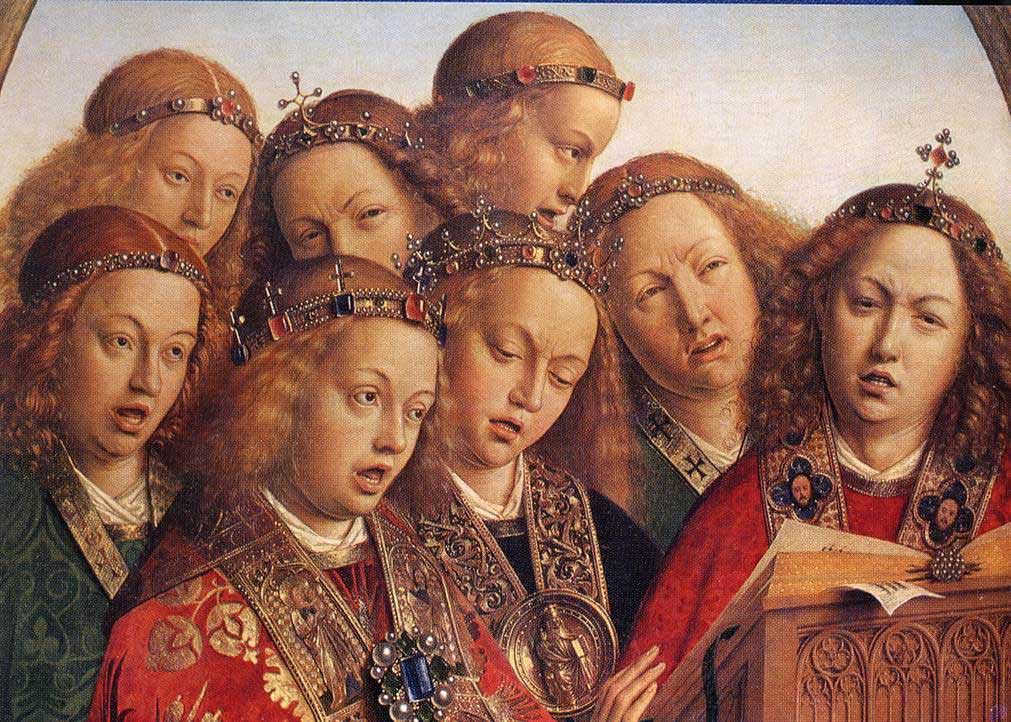
The sound of carols, whether emanating from a supermarket sound system or from the lips of youthful wassailers going from house to house, is one of the surest signals that Christmas is coming. Yet although it now seems almost unthinkable to celebrate (or survive) the festive season without them, carols originally had nothing to do with Christmas, nor even with Christianity. They were among the many pagan customs taken over by the medieval church which used them initially as much in the celebration of Easter as of Christmas. The subsequent development of the carol as a distinctive genre standing somewhere between the hymn, the folksong and the sacred ballad and having as its subject matter the story and significance of Jesus’s birth serves as an interesting pointer to several major currents in British religious, social and cultural history over the last five hundred years.
Born out of late medieval humanism, carols were suppressed by Puritan zealots after the Reformation, partially reinstated at the Restoration, sung by Dissenters and radicals to the distaste of the Established Church in the eighteenth century, rediscovered and reinvented by Victorian antiquarians and romantics, and re-written in the late twentieth century to fit the demand for social realism and political correctness. As well as reflecting the mood of their times, some of our best loved carols also contain coded comments on contemporary events, including, perhaps, the 1745 Jacobite rebellion and the revolutions across Europe in 1848.
The derivation of the word ‘carol’ has been the subject of much speculation. It probably goes back through the old French ‘caroler’ and the Latin ‘choraula’ to the Greek ‘choros’, a circling dance often accompanied by singing and associated with dramatic performances, religious festivities and fertility rites. The carol of classical times was a major element in popular celebrations to mark the passing of the winter solstice and the promise of spring. The coming of Christianity may well have increased the carol’s pagan connotations with its lively dance rhythms providing a marked contrast to the restrained and measured chants of the new religion. The Church was for long uneasy about the performance of such popular singing-dances and the ‘caraula’ was explicitly proscribed in a decree of the mid-seventh-century Council of Chalon-sur-Saône. The singing of carols was further condemned by the Council of Avignon in 1209 and as late as 1435 by the Council of Basle. The earliest known reference to the carol in English literature, which dates from around 1300 and uses the word in its modern spelling, has no religious connotations and seems to denote simply a round dance.
Although the Church came relatively early to see the advantages of incorporating elements of pagan customs such as the Roman Saturnalia and the Germano-Celtic Yule in its celebration of Christ’s nativity, it took much longer to be persuaded of the merits of carols. It was not until the austerity of early medieval Christianity had been tempered by the new spirit of imagination and romance associated with the twelfth-century renaissance that they were taken up as Christian folksongs. The new humanism also brought a change of emphasis away from death and judgement towards a more incarnational focus on the humanity and personality of Jesus, in which the cradle became almost as important an object of devotion as the Cross.
Francis of Assisi is often credited with being instrumental in bringing about this new interest in the feast of the Nativity and devotion to Christ as the Babe of Bethlehem. He was for long regarded as the instigator of the cult of the Christmas crib, but recent scholarship has shown that there was singing and dancing around cribs at Christmas time in several Italian churches more than a century before he set one up at Grecchio in 1223. There is no doubt, however, that Francis and his followers promoted the image of the baby lying in a manger surrounded by animals that was to feature prominently in so many carols. Franciscans were also more directly involved in Christianising the carol. Members of the Order of Friars Minor established by Francis in 1209 were at the forefront of developing the ‘lauda’, a vernacular Italian religious folk song with a dance rhythm which is often regarded as the prototype of the Christmas carol. From Italy this new style of popular sacred song spread to France and Germany where numerous carols were written during the fourteenth century, the best known being ‘In dulci jubilo’, an intermingling of Latin and German phrases traditionally attributed to the Dominican mystic, Heinrich Suso.
It was almost certainly through Franciscans that Christmas carols came to the British Isles. The earliest extant English Christmas carol, ‘A child is boren amonges man’ is found in a set of sermon notes written by a Franciscan friar before 1350. Collections of poems produced by friars in Kildare around the same time and in Scotland in 1372 contain lullabies to the infant Jesus.
The period from around 1400 to 1550 was the heyday of the English carol, by now established as a popular religious song generally on the theme of Christ’s nativity. Among those still sung which date from this time are ‘Adam lay ybounden’, ‘A child this day is born’, ‘A virgin most pure’ and ‘On Christmas night all Christians sing’. The development of open-air religious drama inspired the writing of carols to be sung during performances of the mystery plays, like the well-known Coventry carol, ‘Lullay, lulla, my little tiny child’, from the Pageant of the Shearmen and the Tailors performed in that city between 1400 and 1450. More worldly aspects of Christmas were also celebrated in song. The Boar’s Head carol, first found in a fifteenth-century manuscript, is one of several from this period which dwell on the pleasures of festive eating and drinking.
The distinguishing feature of the traditional (by which is generally meant late medieval and Tudor) English carol has often been taken to be its burden, or refrain, usually a couplet, repeated after every stanza. It is an indication both of the carol’s origins in folk song and dance and its greater suitability for exuberant performance in the home or street than lugubrious chanting in church. In content, as well as in verse structure and musical style, the carol is distinct from the hymn, generally eschewing theology in favour of narrative and focusing on the drama of the Nativity with its cast of innkeepers, shepherds, wise men, stars and beasts in the manger rather than on the direct praise of God.
Carol-singing in the later Middle Ages was not just a popular extra-ecclesiastical activity, however. The Church saw its appeal and potential and acknowledged that it provided more appetising fare for most worshippers than the monotonous tones of Gregorian chant or the severity of ancient Latin office hymns. Carols were brought into the Church’s liturgy. The Christmas Day offices had, in fact, long included the angels’ hymn to the shepherds beginning ‘Glory to God in the highest’ recorded in St Luke’s account of the Nativity. This was taken as a scripturally authorised precedent for including other carols in Christmas services.
The Reformation curbed carol singing in British churches. In Germany its effects were very different. Martin Luther's enthusiasm for congregational singing led him to write several Christmas hymns in the style of folk songs with strong popular tunes. The established churches of England and Scotland chose rather to follow Calvin's aversion to all but metrical psalms being sung in the sanctuary. As a result carols were no longer heard in church although they continued to be sung elsewhere. Indeed, their popularity was such in the early seventeenth century that one late Victorian antiquarian speculated that the word 'carol' was derived from the Latin name (Carolus) of Charles I. In 1619 Launcelot Andrewes used his first Christmas sermon as Bishop of Winchester to extol the glories of a day celebrated `as well as at home with Carolls, as in the Church with Anthemes'. An account of domestic Christmas festivities in 1631 describes `the evergreen ivie trimming and adorning the portals ... and the usual carols, to observe antiquitie, cheerefully sounding'.
Most Puritans shared the early Church's view that carol-singing was essentially a pagan activity. In Scotland it was regarded with particular suspicion and was often among the activities confessed by those accused in the witchcraft trials in the sixteenth and seventeenth centuries. Oliver Cromwell was determined to outlaw the practice despite the eloquent tribute paid to the original angels' carol by his friend and supporter, John Milton, in Paradise Lost:
His place of birth a solemn Angel tells
To simple shepherds, keeping watch by night;
They gladly thither haste, and by a quire
Of squadron'd Angels hear his carol sung.
Another defender of carol-singing was the Anglican divine, Thomas Warmstry, whose 1648 tract, The Vindication of the Solemnity of the Nativity of Christ, argued that 'Christmasse Kariles, if they be such as are fit for the time, and of holy and sober composures, and used with Christian sobriety and purity, are not unlawfull, and may be profitable, if they be sung with grace in the heart'. However, his arguments failed to sway members of the Long Parliament who included carols in the various measures prohibiting Christmas festivities which were passed during the period of the Commonwealth and Protectorate.
The Restoration of 1660 ended the official prohibition on the singing of carols and was greeted by the publication of a volume of New Carolls for this Merry Time of Christmas. However, the established churches remained in thrall to Calvinistic principles with regard to what could appropriately be sung in church. Throughout most of the eighteenth century the only Christmas hymn officially permitted in Church of England services was the paraphrase of St Luke's account of the Nativity, `While shepherds watched', written by Nahum Tate around 1698. Towards the end of the century it was joined on the `approved list' by `Hark the herald angels sing', the heavily altered version of Charles Wesley's `Hark, how all the welkin rings'.
Carols do seem to have survived in some of the more remote country churches where they were sung in the florid fuguing style favoured by west gallery bands and choirs. Oliver Goldsmith noted that churchgoers in the north of England parish where he set The Vicar of Wakefield (1766) `kept Up the Christmas carol'. In general, however, carol-singing reverted to being an extra-ecclesiastical activity, focused on the home, the streets and Dissenting chapels. New carols continued to be written - that rich blend of Christian and pagan imagery, `The holly and the ivy', made its first appearance in a broadside in 1710 - but they tended to be the work of those distanced from both the political and religious Establishment. In the early 1740s the plainchant scribe at the English Catholic college at Douai in France, John Wade, a fervent Jacobite, wrote 'Adeste Fidelis', later translated as 'O come, all ye faithful'. The dedication 'Regem nostrum Jacobum' and Stuart cyphers on the manuscript have led some historians to speculate that the carol may have been intended to rally Jacobites in Britain on the eve of Bonnie Prince Charlie's rising.
Although carols were out of official ecclesiastical favour, they were still regularly heard in the streets of towns and villages at Christmas time. The tradition of wassailers going from door to door singing and drinking the health of those whom they visited went back to medieval times. Indeed, it probably had pre-Christian origins in the fertility rites with which the first carols had been associated. In the English west country wassailers went through the orchards around Twelfth Night singing and shouting loudly to drive out evil spirits and pouring cider over the roots of trees to encourage fertility. Wassailing later became associated with `luck visits' made around the neighbourhood and general merrymaking, fortified by copious quantities of alcohol. It also merged with the tradition of 'waits' or watchmen who went through the streets of urban areas sounding a horn or crying out to mark the passing hours of the night. Increasingly the term 'waits' became applied to parties of singers and musicians who went from house to house at Christmastide in both towns and country areas. A book on Popular Antiquities, published in 1795, noted that in Newcastle upon Tyne and other places in the North of England boys and girls went round on the nights leading up to Christmas, including Christmas Eve, `knocking at the doors and singing their Christmas Carols'. A correspondent to the Gentleman's Magazine in 1811 wrote that while staying in the North Riding of Yorkshire he had been awoken at about six o'clock on Christmas morning `by a sweet singing under my window'. An American visitor to Yorkshire in 1820 reported a similar experience on Christmas Eve:
I had scarcely got into bed when a strain of music seemed to break forth in the air just below the window. I listened, and found it proceeded from a band, which I concluded to be the waits from some neighbouring village. They went round the house playing under the windows.
Despite this evidence suggesting that carol-singing was still flourishing, at least in the north of England, there was considerable concern in other parts of the country in the early 1800s that the tradition was dying out. The repertoire seems to have shrunk with many of the pre-Reformation carols dropping out of use. They were preserved thanks to the labours of a small group of antiquarians and folk song collectors. In 1822 Davies Gilbert, MP for Bodmin, published the first modern collection of traditional carols. He clearly saw them as belonging to a past world that had all but disappeared, noting that they had been sung `in Churches on Christmas Day, and in private houses on Christmas Eve, throughout the West of England up to the latter part of the late century' and giving a lyrical description of what had happened on Christmas Eve in the `Protestant West of England' until the late eighteenth century:
At seven or eight o'clock in the evening cakes were drawn hot from the oven; cyder or beer exhilarated the spirits in every house; and the singing of Carols was continued late into the night. On Christmas Day these Carols took the place of Psalms in all the churches, especially at afternoon service, the whole congregation joining; and at the end it was usual for the Parish Clerk to declare, in a loud voice, his wishes for a merry Christmas and a happy new year to all the parishioners.
A similar sense of the need to preserve a tradition on the verge of extinction inspired William Sandys, a London solicitor and antiquarian with strong Cornish connections, to publish a collection of Christmas Carols Ancient and Modern in 1833. While acknowledging that carols were still being sung `in the Northern counties and some of the Midland', he noted that `the practice appears to get more neglected every year'. Among the carols preserved by Sandys and Gilbert which might otherwise have fallen into oblivion were `God rest you merry, gentlemen', `The first Nowell' and 'I saw three ships come sailing in'. Other important collections included the wassail songs transcribed in 1843 bv John Broadwood from his Sussex parishioners, the Little Book of Carols (1846) and Old Christmas Carols (1863) published by Edward Rimbault, an organist who founded the Musical Antiquarian Society, and the Songs of the Nativity assembled in 1868 bv William Henry Husk.
Carols played an important role in the Victorian reinvention of Christmas as a largely domestic festival full of sentimentality and good cheer. A huge number of new carols were written in the mid-nineteenth century, many in a pseudo-traditional style. Even the pioneer socialist William Morris provided a pastiche medieval carol with the refrain `The snow in the street and the wind at the door'. It was the Victorians, rather than Bing Crosby, who invented the concept of the White Christmas, bringing snow into the Nativity story with Christina Rossetti's `In the bleak mid-winter' and Edward Caswall's `See amid the winter snow'. Moralising was also a feature of the Victorian carol, most famously exemplified in Cecil Frances Alexander's injunction in `Once in Royal David's City' that 'Christian children all must be mild, obedient, good as He'. American writers were equally infused with the sentimental spirit of the Victorian Christmas, producing `Away in a manger', 'O little town of Bethlehem', `We three kings of Orient Are' and `It came upon the midnight clear'. This last carol was written by Edmund Sears, a Unitarian minister in Massachussets, in 1849 and it was almost certainly the disruptions in Europe and the United States over the previous twelve months that he had in mind when he penned the lines 'O hush the noise, ye men of strife, and hear the angels sing'.
Thomas Hardy's novel Under the Greenwood Tree, published in 1872, contributed to the aura of romantic nostalgia with which the practice of carol-singing became invested in the later nineteenth century. It lamented the passing of the old Mellstock gallery band who had gone out at Christmas time enjoining the Wessex villagers to `remember Adam's fall' and `Arise and hail the sacred day'. In fact, the very forces which Hardy blamed for killing off the traditional waits and wassailers, Tractarian clergy with their robed choirs and organs, literally brought carols in from the cold and into church. The Oxford Movement finally ended the reign of metrical psalmody in the Church of England and introduced hymns and carols into the liturgy. Among those who led the way in this innovation was J.M. Neale whose 1853 Carols for Christmas-tide included translations of medieval Continental carols as well as his own `Good King Wenceslas', a highly fanciful account of the philanthropic activities of the tenth-century Bohemian prince. Another important collection, Christmas Carols Old and New, produced in 1871 by H.R. Bramley, fellow of Magdalen College, Oxford, and John Stainer, the college organist, did for carols what Hymns Ancient and Modern had done for hymns, making them easily accessible to clergy and organists and bringing them into the mainstream of Anglican worship.
In 1878 the cathedral choir in the newly created diocese of Truro switched from its usual practice of singing around the city on Christmas Eve to holding a service in church at l Opm. It included two lessons, prayers and a sermon interspersed with carols. Two years later the service was expanded to a festival of nine lessons and carols, providing a model that was taken up in 1918 at King's College, Cambridge and subsequently by many parish churches and cathedrals.
The early decades of the twentieth century saw renewed efforts to collect long-lost carols by those involved in the folklore revival. Cecil Sharp's English Folk Carols appeared in 1911 and Ralph Vaughan Williams' arrangements of traditional west country carol tunes in 1919 and 1920. Percy Dearmer's Oxford Book of Carols (1928) brought together numerous pre-Reformation texts and tunes, including carols for Lent, Passiontide, Easter and summer, with more recent items often culled from literary sources, while omitting anything that smacked of Victorian sentimentality. Its successor, The New Oxford Book of Carols (1992) is a more scholarly volume reflecting the considerable contemporary interest in recovering and researching old tunes and texts.
Carols are not just for antiquarians and scholars, however. They belong to a living tradition which is constantly being added to with new material. The last three decades have seen modern expressions of the Christmas story in Michael Perry's `Calypso Carol', Sydney Carter's `Every Star Shall Sing a Carol' with its references to space travel and John Bell's `Funny kind of night' which speaks of `Tax collectors, child inspectors, all in disarray'. A carol written in 1992 by Michael Forster, a Baptist minister, portrays Mary as a `blessed teenage mother'. Whatever feelings these and other modern lyrics stir up among traditionalists, there is no doubt that they conform to Percy Dearmer's oftquoted definition of carols as
...songs with a religious impulse that are simple, hilarious, popular and modern... set in such language as shall express the manner in which the ordinary man at his best understands the ideas of his age.
Hilarious for rather different reasons, and perhaps less happy, are some of the recent attempts to rewrite classic carols to eliminate gender-exclusive or overtly Christian language. With the arrival of the politically correct, multi-faith carol, purged of any reference to men, Christ, cribs or angels, we have come back where we started - with carols disconnected from Christmas or Christianity.
Further reading
- Erik Routley, The English Carol (OUP, 1958)
- Percy Dearmer (ed) The Oxford Book of Carols (OUP, 1928)
- Hugh Keyte & Andrew Parrott, The New Oxford Book of Carols (OUP, 1992)
- Douglas Brice, The Folk-Carol of England (Herbert Jenkins, 1967).

