

Picton at Waterloo
Of the British officers who fell at Waterloo, writes Antony Brett-James, none was more distinguished than General Sir Thomas Picton.
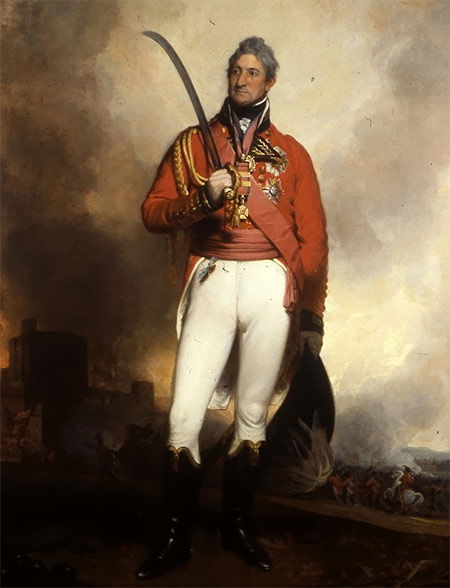
When, after the victory at Toulouse and the abdication of Napoleon, Sir Thomas Picton came home from south-western France, he decided to give up active service. For several years his health had been poor and he had been telling friends that he was getting too old for a vagrant, campaigning life; already in the previous year he had been obliged to leave the Peninsula to recuperate at Cheltenham.
Now, in the summer of 1814, he went there again, and then made his home at Ischoed in Carmarthenshire. Resolved to spend as much time as possible in his native Wales, he bought two adjacent farms and began to look around for an experienced bailiff to manage them.
The General also stood for Parliament, and enjoyed neither civic hospitality nor the conduct of an election campaign.
“I have been going through a good deal of Mummery and making puppet show triumphal Entries into Haverfordwest, Carmarthen, &c. I have pitied others in similar situations, and I am ashamed of myself: but those who become candidates for Popularity don’t know how far the torrent may carry them, or they would never undertake the voyage.”
He was duly elected, and, pledged to no one party, attended the House with some regularity.
All seemed peaceful, and then, early in March 1815, came the astounding news that Napoleon had escaped from Elba and arrived in France. The Powers conferring in Vienna declared him an outlaw. Armies were mobilized. Wellington went off to Brussels and took command of what was to be the Allied right wing.
Soon he was complaining of the troops and staff placed at his disposal: most of his Peninsular veterans were in America or on their way back; the foreign regiments were not of the first quality; more than ever he required a good staff and experienced generals. Of these one was Sir Thomas Picton, a man of whom Wellington later said: “he always behaved extremely well. No man could do better in the different services I assigned to him.” So it came about that Picton received a summons to join the Duke’s army in Flanders.
The General had a premonition that this campaign would be his last. At dinner one night in Grafton Street he raised a glass of red wine to his lips, but his hand trembled and the wine was spilled like blood on his clothes. Those present at table viewed the accident as a bad omen. If this were not enough for the superstitious, Picton was strolling one day with friends through a London churchyard when he came to an open grave, walked up the pile of newly thrown earth, and looked down.
“Why!” he exclaimed. “I think this would do for me.” He jumped into the grave and lay full length: the space fitted him exactly. No reassurances on his part could persuade his alarmed friends that this strange occurrence did not bode ill for the future. Indeed, Picton himself was impressed by the event, and said to one close friend: “When you hear of my death, you will hear of a bloody day.” And to another: “If we never meet again, you will at all events hear of me.”
By June nth his preparations had been made, his portrait painted by Beechey, ten horses purchased, his equipment assembled—it had cost him £1,200, but this sum he shrugged off as “a moderate Tax upon Ambition.” Now, with Captain Tyler, his senior aide-de-camp, who had been with him since Walcheren, he was on his way to Ramsgate.
Several of those who accompanied Picton to Belgium have left impressions of the General: they recall the fervent manner in which he drank a toast to Lord Wellington; his unusual silence and melancholy expression aboard the transport while he stood watching the white cliffs of Kent as though he would not see them again; his vigorous recollections of Peninsular campaigning.
Above all they remembered his dogmatic and astonishing claim that French officers, thanks to their military schools and academies, were superior to British officers. These, though as brave as lions, were ignorant of their profession, said Picton. “We are saved by our non-commissioned officers, who are the best in the world... If I had fifty thousand such men as I commanded in Spain [the 3rd “Fighting” Division], with French officers at their head, I’m damned if I wouldn’t march from one end of Europe to the other.”
We next see Picton flirting in excellent French with a pretty waiting-maid in the Ostend hotel where they stopped a night. In Brussels, early on June 15th, Picton was breakfasting at the Hotel d’Angleterre when a staff officer announced that Wellington wished to see him immediately. Picton, who was not wearing uniform but dark trousers and a blue frock-coat buttoned up to the throat, left the table, put on his round hat, and went off to the Park.
Here, in the centre of Brussels, he found the Duke walking between shrubberies and statues with Lord Fitzroy Somerset and the Duke of Richmond. Gronow, a young Guards officer on Picton’s staff, describes the encounter.
“The general’s manner was always more familiar than the Duke liked in his lieutenants, and on this occasion he approached him in a careless sort of way, just as he might have greeted an equal. The Duke bowed coldly to him and said, ‘I am glad you are come, Sir Thomas. The sooner you get on horseback the better. No time to be lost. You will take command of the troops in advance.’ That was all. Picton appeared not to like the Duke’s manner, and when he had bowed and left, he muttered words which convinced those who were with him that he was not much pleased with his interview.”
Picton had been given command of the 5th Division, quartered in the city. He had one Hanoverian brigade, but all his British battalions had fought in the Peninsula. So, too, had the respective brigade commanders: Sir James Kempt had been severely wounded in the assault on Badajoz; Sir Denis Pack had led a Portuguese brigade with distinction.
Their battalions had not served under his direct command before, but Picton knew their record and no man who had campaigned in Spain and Portugal could fail to know of Sir Thomas Picton. They knew him as a man of stern expression and abrupt manner, of irritable moods, strong oaths and often caustic tone of voice, jealous of interference, and on occasion impetuous.
They knew him as a general who, relentlessly though he punished plundering and any other excess, kept his promises and did all he could to help deserving officers and men to receive promotion, praise, or pension. Above all they knew Picton as one who, however hot-tempered he might be out of battle, was cool and determined and of bulldog courage once the fight had started.
That first day in Brussels he spent in meeting the regiments and in studying maps and the latest reports. Wellington’s army of 93,000, more than half of them foreigners of little experience, guarded two possible lines of approach from the south-west through Mons and Tournai, and watched the frontier running towards the coast; whereas Blücher’s 117,000 Prussians were extended between Liege in the east and Charleroi south of Brussels.
The Allies had decided not to march on Paris until the Austrian and Russian armies drew near to France’s eastern frontier, when a simultaneous offensive would be launched—on about June 20th. For his part, the Emperor Napoleon, guessing correctly that Paris was bound to be the Allies’ principal objective, and being too impatient to wage a defensive campaign, had resolved to forestall his opponents and carry the war into Belgium.
He knew that between Mons and the sea the frontier fortresses had been refortified, while farther east the Ardennes formed a natural barrier; but in the centre, where Charleroi fortress was still dismantled, lay a gap. He would strike through this gap and head for Brussels. With masterly skill, speed and secrecy 125,000 devoted troops had been concentrated near the frontier. Napoleon joined them on the 14th.
Wellington and his staff did not know all this. Nor, when Picton left the Park, were they yet aware that the French had crossed the frontier earlier in the day, driven the Prussians from the Sambre, and broken their defence line by Charleroi. Indeed, Picton found a strange lack of information all day at Headquarters. Late that afternoon news did arrive of Napoleon’s attack, but Wellington, whose constant fear was a turning movement to the west, could not yet judge for certain whether this was the enemy’s main thrust.
While awaiting more detailed reports from forward observers, he instructed his scattered divisions to be in readiness to move. He waited in vain; the vital message was detained by a Hanoverian officer who should have known better. At about seven o’clock, however, a muddy Prussian officer rode in to report that Blücher’s army was falhng back towards the north-east after sharp fighting.
Accordingly, the Duke despatched orders for his divisions to concentrate in an arc between Grammont and Nivelles. Later news caused him to have the troops in Brussels got under arms, ready to move out when and whither the events of the next few hours should dictate.
The assembly sounded. Drum and bugle calls rang out across the great square. Highland pipes squealed in the dark streets where soldiers went hurrying by. Gun-carriage and baggage-waggon rumbled over the cobblestones. Servants knocked at house doors and woke their officers, if these had settled down to sleep. But some had gone to the theatre, while others had received invitations to attend the Duchess of Richmond’s ball.
The members of the 5th Division, with blankets and four days’ provisions, formed up along the Rue Royale and the Park. The 95th were in position soon after eleven, but several regiments came from scattered billets and it was two o’clock before they reached the Park. At a few minutes to four a staff officer came riding across the Place Royale and into the Park.
Here, within the iron railings, every lawn and walk was hidden by waiting soldiers. “Yet not a sound was audible save a slight clatter of horses’ shoes upon the pavement. Seeing a long line of kilted men, I recognized Picton’s division standing at attention while its redoubtable Commander, attended by his Staff, was riding along the line, making his inspection—his were the only sounds.”
Like most of the senior officers and many an aide-de-camp, Picton had attended the ball given by the Duchess of Richmond. This would in any case have been a “take-leave” occasion, for the Allied troops had been expected to leave Brussels on the 20th. But the day’s crop of rumours, uncertainty, unexpected news and hurried parting had induced both excitement and melancholy among the assembled guests.
Wellington came in about midnight, in good time to lead in Lady Georgiana Lennox to the supper table in her mother’s house. When she asked him about the rumours, he replied gravely: “Yes, they are true. We are off tomorrow.”
The arrival of further military reports caused a more acute stir, and Wellington declared privately to the Duke of Richmond: “Napoleon has humbugged me, by God! He has gained twenty-four hours’ march on me.” Then he slipped away to bed. Officers took their leave of apprehensive tearful ladies. A few had no time to don uniform and went off to the war in evening clothes. Highland dancers who had come to entertain the guests hurried away to join their regiments—all under Picton’s command.
No sooner had Sir Thomas finished his inspection than the division was on the move, many women running along the ranks to bid a last weeping farewell. First marched the 95th Rifles in their sombre green uniform and black accoutrements. The redcoats of the 28th and 32nd followed, and the Royals and 44th. Then the Royal Highlanders (the 42nd) marching so steadily that even the sable plumes scarcely quivered over their bonnets; and the Cameron and Gordon Highlanders (the 79th and 92nd), also in kilt and plaid, swinging along to the tune of “Hielan’ Laddie.”
Watching it all from her bedroom window was Charlotte Eaton, who had just arrived in the city and, in the general excitement, had given up all idea of going to sleep. She caught a glimpse of Sir Thomas Picton himself, riding down the street “in true soldier-like style, with his reconnoitring glass slung across his shoulders, reining in his charger as he passed, to exchange salutations with his friends.”
Out through the Porte de Namur and into the countryside swung the long columns, their polished muskets gleaming in the early sunshine. Just beyond the beech woods of Soignes and the hamlet of Waterloo, which many an officer had been unable to find on his map, they halted for a meal.
Few of the men expected to be in action that day, and were in no hurry as they fetched water, or took a swig of spirits, or lay in the shade. Up the dusty road from Brussels rode the Duke of Brunswick and his black-uniformed Hussars. Then came Wellington and his staff, heading south for Quatre Bras. This village and the vital cross-roads to which it owes its name were held by 7,000 Dutch and Belgian troops.
The 5th Division resumed its march. The heat was now extreme, but in Genappe street friendly villagers put out tubs of drinking water and even proffered milk to the thirsty men. It was now two o’clock. Ahead came the sudden sound of musketry and cannon fire. The regiments pressed forward. Soon they met cartloads of wounded Belgian troops, and disabled soldiers hobbling along the road.
Picton learned that the situation at Quatre Bras was critical. His division further quickened its pace. Just before three o’clock the leading green-jackets sighted the farm buildings and, beyond, a plain flanked to left and right by woods. Having marched over twenty miles since daybreak, they had come in the nick of time.
Two other divisions were on their way, but Picton’s men would have to bear the brunt of the battle and hold the road running eastwards to Namur as a fine of communication with the Prussians. Quatre Bras itself was still defended by the Dutch and Belgian troops, but the farm of Gemioncourt three-quarters of a mile further forward had been lost to the French, whose columns were now moving to the main attack.
Their commander was Marshal Ney, to whom Napoleon had entrusted the left wing of his army, with orders to brush aside Wellington’s force at Quatre Bras and then attack Blücher in the flank, while the Emperor himself conducted the assault on the Prussian front at Ligny. Ney had acted with extreme caution throughout the morning. But at two o’clock, by which hour one of his two corps had arrived, he felt strong enough to attack. He had more guns than his opponents, a far stronger cavalry force, and ten thousand more foot soldiers.
Sir Thomas led forward two brigades—the only British troops on the scene. As Belgian skirmishers retired, the fine of infantry pushed and stamped their way through the tall corn crop, rye stalks reaching up to the Highlanders’ bonnets. The veterans fired a withering volley, gave a shout, and then charged. The French broke and retired in confusion, but in following up their advantage with unguarded zeal, Picton’s men were caught by a fierce cavalry charge. Ney had sent up his lancers to allow the infantry time to rally.
Wellington at once launched the Brunswick Hussars in counter-attack. The Duke of Brunswick was killed and the Hussars were routed. French lancers came in pursuit, rode past Pack’s brigade, and then wheeled to charge from the rear. The 32nd, confused by the corn and smoke, thought these horsemen were Allied cavalry until a German dragoon galloped up shouting “Franchee! Franchee!”
As a result, they had barely time to form square, and one side was driven in. Their colonel was killed and command of the battalion changed hands four times in ten minutes. Many a Scot fell beneath the formidable lances, but they managed to reform the square and beat off the French. The 44th did not attempt to form square—it was too late when the lancers swept out of the corn. Instead, the rear rank faced about and fired a most telling volley.
Ney now ordered his cuirassiers to crush the English and trample them underfoot. His bid nearly succeeded. Wellington got caught in the rush and escaped only by riding his horse at a ditch held by the 92nd (Gordon Highlanders) and leaping right over them.
Then he personally controlled their fire until the cuirassiers charged to within thirty yards. For this new onslaught Pack got the 42nd into square and stood at one corner. His cocked hat gave the signal to open fire. Horses reared and plunged and fell on dismounted riders. There sounded a neighing of horses, a clash of sabre on helmet and gleaming breastplate, and dreadful groans in the trampled rye.
Meanwhile Picton, who had no cavalry, took the 28th and Royals in column against the French horsemen. When they had advanced close enough to support the hard-pressed 42nd and 44th, he suddenly ordered them to form square. This they did, the redcoats standing shoulder high in the crops. As the French cavalry approached, they seemed to be wading through a sea of waving corn.
When the 28th were attacked on three sides at once, Picton’s deep voice steadied the regiment by recalling past glories: “Twenty-eighth, remember Egypt!” Later, when the men had with great coolness received and repulsed three charges and fought desperately with bayonet against sabre, Sir Thomas stood in the centre of their square and proudly addressed the troops: “Twenty-eighth, if I live to see the Prince Regent, I shall lay before him your bravery this day.”
The charge of the cuirassiers failed, and the remnants fled from the field of battle, sweeping many lancers with them in the tumult. All this time could be heard, though hidden by rolling hills, the boom of artillery in the battle between Napoleon and Blücher, which caused much anxious speculation, until, about four o’clock, some Prussian dragoons rode over to say that their positions were so far being maintained.
As the afternoon wore on, Ney persisted in sporadic attacks. His cannon fired again and again, causing numerous casualties. But all the while Wellington’s reinforcements were hastening to the sound of the guns. Count Alten’s 3rd division arrived soon after five from Mons, and at sunset the Guards division hurried up the Nivelles road. Now Wellington’s force, far from being outnumbered, had swollen to more than thirty thousand, and he took the offensive.
By nine o’clock the French had been evicted from Gemioncourt and the woods, and at dusk they withdrew. If Ney had failed to help the Emperor by attacking Blücher’s right flank, he had none the less prevented Wellington from marching to the support of his Prussian ally; and Quatre Bras had cost the Duke over 4,500 men.
That evening Picton’s men lay on the ground they had defended all afternoon. No fires were lit when the weary soldiers fell asleep among the dying and the dead. In the bloodstained farmyard of Quatre Bras the General, who had had a horse shot beneath him, observed to Tyler that he had never experienced such a hard day’s fighting. “I shall begin to think,” he added, “that I cannot be killed after this.” Perhaps his premonitions would prove false after all. But meantime he observed the severe casualties.
The 42nd alone had lost over fifty killed and 240 wounded. Already his regiments were seriously depleted, and a second and sterner battle lay in store. After nightfall two aides-de-camp groped their way into Picton’s quarters in search of wine and cold meat, and as they passed the room in which the General was lying they were surprised to hear him groan. Not for two days did they know the reason.
Next morning companies equalized their numbers and took up new positions. The dead were buried, the wounded received attention in nearby houses, and those with whole skins prepared breakfast—in some cases yesterday’s dinner—or procured vegetables and poultry from the hamlet.
At an early hour Wellington was up in Picton’s area. Wearing a low cocked hat, a blue frock-coat and cloak, white pantaloons and Hessian half-boots, he paced restively to and fro, waiting for news. Having had no report of the Prussians since the previous afternoon, he had sent off his aide-de-camp, Colonel Gordon, with a cavalry patrol in search of his allies. It was half past seven when Gordon returned to say that the French were in Ligny, the Prussians had been defeated and were marching north towards Wavre, eighteen miles to the rear.
These facts were confirmed an hour later, when an agitated Prussian messenger galloped up. Wellington expressed no surprise, for on seeing their exposed position the previous day he had forecast that the Prussians would be “damnably mauled.” Now he had little option but to withdraw likewise.
He sent word to Blücher that he would do battle with Napoleon so long as he had the support of at least one Prussian corps. Then, calmly and without hurry, he gave orders for the troops in Quatre Bras to retire upon Waterloo and the ridge of St. Jean, a dozen miles nearer to Brussels. This was “the spot where we must lick those fellows,” he had told the Duke of Richmond at the ball. Covered by the horse artillery and Lord Uxbridge’s cavalry, the troops withdrew. The French were still unaccountably silent on Ney’s front, and the Emperor, convinced that the Prussians were in retreat eastwards to Namur and Liege, was talking politics and dawdling.
Picton, who was not in a good humour, gave a most sulky acknowledgment to the order for retreat. He was already irritated enough at being compelled to ride a trooper’s horse, just because his servants had gone off in fright to the rear, taking his own horses with them; and he derived scant consolation from seeing the portly Tyler mounted on a pony with halter.
Ney, still unaware that his opponents were slipping away, had by one o’clock ordered no advance. But about an hour later a furious Napoleon arrived on horseback. He had loitered all the morning, and then, some fifteen hours after Ligny, had despatched Marshal Grouchy with 40,000 troops to follow up the vanished Prussians, but in the wrong direction. Now the Emperor thundered at Ney, and flung his cavalry against the British rearguard.
His tardy effort to prevent Wellington from eluding his clutches came near to success, but was thwarted by a thunderstorm of rare violence. Over forest and fields the rain slashed down as though a waterspout had burst. Tracks were soon churned up, cornfields became a morass, and horses, especially those of the heavy cuirassiers, floundered sometimes girth-deep in the mud. Indeed, the pursuing cavalry, half blinded by rain, could scarcely raise a canter, but even so the British rearguard was nearly overtaken.
Through the storm they rode—hussars and horse-gunners, limbers and waggons mingled in a pele-mele, mud-splashing retreat. The cavalry had a dangerous encounter by Genappe, and Napoleon, riding a white mare, his grey coat drenched, his hat in sodden disarray, urged his gunners to fire at the English. But he was too late. Already Wellington’s army was astride the road on his chosen ridge.
The 5th Division held a line immediately to the east of the Brussels-Quatre Bras road: first Pack, then Kempt, then the Hanoverian brigade. Across Picton’s front ran the narrow Wavre road, in parts between thick hedges, elsewhere in a cutting. On his left were two cavalry brigades, behind him waited two more, while forward of the position stood a brigade of Dutch and Belgian troops.
Towards evening we catch sight of Picton through the eyes of Cavalie Mercer, an officer of horse artillery whose six guns had been withdrawn helter-skelter from Quatre Bras and were now firing at Napoleon and his suite near La Belle Alliance. “While we were thus engaged, a man of no very prepossessing appearance came rambling amongst our guns, and entered into conversation with me on the occurrences of the day.
He was dressed in a shabby old drab greatcoat and a rusty round hat. I took him at the time for some amateur from Brussels (of whom we had heard there were several hovering about), and thinking many of his questions rather impertinent, was somewhat short in answering him, and he soon left us. How great was my astonishment on learning soon after that this was Sir Thomas Picton!”
That night of June 17th rain poured down on the regiments waiting along the slopes of St. Jean. Was this a prelude to victory? asked the Peninsular veterans, who recalled storms on the eve of Vittoria, Salamanca, and Fuentes de Onoro. Surely this thunderstorm must be a favourable omen. But meantime it was confoundedly unpleasant. They were dirty, unshaven, drenched to the skin.
Water was streaming off their collars and cuffs, they stood ankle-deep in mud, and raindrops kept hissing in the watch-fires round which they were trying to get dry. A few of the old campaigners smeared their blankets with clay and kept off some of the wet; several made themselves tents with blankets, halberds and muskets; others stretched out on scattered branches brought for fuel; but for most of the soldiers the dark hours dragged miserably.
Picton also spent a restless night in St. Jean: his name, scrawled in chalk, could still be seen on the cottage door several days later. In the morning he was about early. The rain had stopped, but drops glistened on the ears of com, and pools stood out in every hollow. Across the undulating plain dark patches of woodland showed among the ripening crops, and Sir Thomas watched the movement of the French, whose divisions were still coming up to the opposite ridge. He called on the officers of the 95th, on the right of his line, just behind La Haye Sainte, and took a cup of tea from their huge camp-kettle.
Then he stopped for a word with some gunners, only to dash off abruptly in the middle of a conversation to rectify an error he had spotted among the halfhearted Belgian troops on his front. Later he had a narrow escape when shots killed Tyler’s horse. Picton’s aides-de-camp always lived dangerously: he had already lost one in Spain and another in the south of France.
In the uneasy lull before the fighting began that day, the battlefield appeared, so one soldier tells us, “altogether in motion—a moving mass of human beings.” Officers stood about in groups, speculating as to whether Napoleon would attack after all the rain. Soldiers were carrying water and straw from the village, or rubbing dry their firelocks and inserting new flints. Highlanders were solemnly chanting “Scots wha hae” as they made breakfast of oatmeal and water—“stirabout,” they called it.
Some men sat round fires, drying their clothes, smoking, and roasting little pieces of meat on the embers. Picton went among them, talking with bluff geniality and confidence, despite his very unfavourable opinion of the position in which Wellington had chosen to fight.
At about ten o’clock the Duke and his staff rode along the line “as gay and unconcerned as if they were riding to meet the hounds in some quiet English county” (Gronow) and were greeted by loud huzzahs. During the night Blücher had sent a message that two Prussian corps would march to his aid at daybreak. Half an hour later the drums beat to arms, the troops fell in, and the muster-rolls were called.
Towards noon the battle opened, not on Picton’s front, but away to the right against the forward bastion of Hougoumont. Here the French columns won the copse but not their most obstinate attacks could gain the house. So, after an hour of costly fighting, the Emperor ordered a great attack against Wellington’s centre and left.
Soon after one o’clock, when Napoleon first sighted Prussian troops approaching from the east, musket balls began to whistle over Picton’s position. Skirmishers exchanged a brisk fire. Soon eighty French guns joined in, and a furious cannonade pounded the division.
Thanks to the shelter afforded by the hollow road and prickly hedge, and still more to the skilful disposition of troops on the reverse slope, most of the shells did little harm. Only the Dutch-Belgian brigade on the forward slope suffered severely from the half-hour bombardment. Noting this, Tyler said: “I am sure, General, the Belgians will run.” “Never mind,” replied Picton. “They shall have a taste of it, at all events.”
Down from the opposite ridge moved four imposing columns—some 13,000 men in all. Because of a fringe of trees on the skyline behind them, they seemed to be coming from a wood. This was d’Erlon’s corps, which on the 16th had shuttled ineffectually between Quatre Bras and Ligny without turning the scales in either battle. Now, confident of victory, they tramped through the smoke, their officers waving tiny swords in front.
Picton was about to withstand what turned out to be one of the most powerful attacks of the day, and he had a depleted division with which to do so. Pack, for instance, had only 1,400 men left. Furthermore, his regiments would obviously be outnumbered to great disadvantage. He had cavalry but no infantry on his left, and behind him only Lambert’s brigade—it had reached the field that very morning from America. But this was not a situation to daunt Sir Thomas, of whom a subaltern wrote warmly: “wherever danger assumed its most terrific form, there he was to confront it.”
Suddenly, away ahead in the smoke, the Belgians appeared scampering back over the brow. Tyler had been right. He himself had doubted their endurance. Their officers could not stop them, and they disappeared into the Foret de Soignes. Close behind strode d’Erlon’s troops, now more confident than ever thanks to the easy rout of the first defence line. Picton ordered Kempt’s brigade to stand up and advance to the brow. This they did under galling grapeshot and shellfire. A sharp volley, and then in with the bayonet.
The enemy columns, seeking to deploy, were too late and wavered. But already the thin British line had serious gaps. They had done splendidly but were too weak to hold off the French for long. So Sir Thomas brought forward Pack’s Highlanders. He put himself at their head and shouted “Charge! Hurra! Hurra!” Above the noise of battle his powerful voice was heard. Had it not been likened to twenty trumpets at Ciudad Rodrigo? The men cheered in response and followed. Then they saw the General on horseback, sword in hand. He looked along the line, and when the approaching French were but thirty yards away, bellowed “A volley and then charge!”
The volley was fired at such close range that the wads stuck smoking to the cloth of the French uniforms. Napoleon’s cavalry were coming up the slope. As Picton waved his sword, a ball struck him on the right temple. He fell back on his horse, dead. Tyler, close at hand, heard Picton’s dying shout: “Rally the Highlanders!”
He dismounted and ran to the General. With the aid of a soldier he lifted Sir Thomas to the ground and placed the body under a nearby tree. This, he thought, would be a sure landmark once the fighting was at an end. Then he hurried across to Sir James Kempt, who assumed command of the division.
By now two of d’Erlon’s columns had gained a hold on the ridge. Fortunately, powerful aid was at hand. As the 42nd were about to scramble through the prickly roadside hedge, they were ordered to open ranks, whereupon Sir William Ponsonby’s Union Brigade, heralded by the sound of galloping hooves, came out of the smoke and cleared the hedge. Through the 42nd swept the Scots Greys, to the war-cry of “Scotland for ever!” Together with the Royal Dragoons and Inni-skillings they took the enemy columns in the flank, set them in disorder, broke up their attack, and captured hundreds.
But the gallant cavalry regiments did not stop after their timely success. Instead, with far more dash than discipline, they galloped right up to the enemy’s guns, only to be charged in turn by cuirassiers and lancers, who inflicted terrible losses. Nevertheless, without their intervention, Picton’s men might well have been obliged to give ground against heavy odds; at least they could have achieved no decisive result. Now the line was safe, Lambert’s brigade came up to reinforce it, and the main tide of Napoleon’s attack crashed elsewhere.
All afternoon the fight went on about La Haye Sainte, until the farm was lost. All afternoon the Guards hung on valiantly to Hougou-mont. The French cavalry charged and charged in vain, and were badly mauled. Even the Imperial Guard could not wrest victory for the Emperor they revered. Blücher kept his promise and the Prussian corps pressed in from the east. By nightfall the battle was over, its course summed up by Wellington in the words: “They pommelled us and we pommelled them. We pommelled the hardest, and so we won.”
Tyler walked back to the tree he had marked, and examined Picton’s body. Already it had been robbed of a watch and spectacles. On one side the General’s coat was tom and the flesh there severely bruised and swollen. Now it was clear why Sir Thomas had been heard to groan on the evening of Quatre Bras.
During that earlier fight he had been struck by a musket ball and had two ribs broken. Resolved not to miss the greater battle that he knew must follow, he had asked his old servant to bind up the wound, and had kept the matter secret from everyone else, doing his best to conceal the pain.
At nine o’clock on the 19th a vehicle was seen moving out of Waterloo village: Picton’s body on its last journey. At Deal on June 25th minute guns fired from every ship in the Downs while the coffin was being carried to the beach. That night, in the Fountain Inn at Canterbury, the body lay in the very same room in which Picton had been entertained to dinner but two weeks before. In the morning his coffin, on the last stage of its journey to London, was escorted to the outskirts of the city by a battalion of the 52nd Foot, who marched with reversed arms to the tune of the Dead March from Saul.
At 21, Edwards Street, Portman Square, he lay in his coffin in the front parlour. Friends noted that his sword scabbard was dented by shot, his boots were still coated with the yellow mud of Waterloo, and his accoutrements lay about in some confusion.
On July 3rd eight mourning coaches waited outside the Bayswater Road burial ground of St. George’s, Hanover Square, while Sir Thomas Picton, G.C.B., was laid to rest in the family vault. Captain Tyler was there, and Picton’s clergyman brother, Edward, and General Sir Ewen Cameron, an old Army friend, who laid his hand on the coffin and, tears coursing down his cheeks, said: “God bless thee, Tom Picton! Fare thee well.”

