

Madame de Pompadour: The Other Cheek
Colin Jones and Emily Richardson reveal a little-known collection of obscene and irreverent 18th-century drawings targetting Madame de Pompadour, the favourite mistress of Louis XV of France.
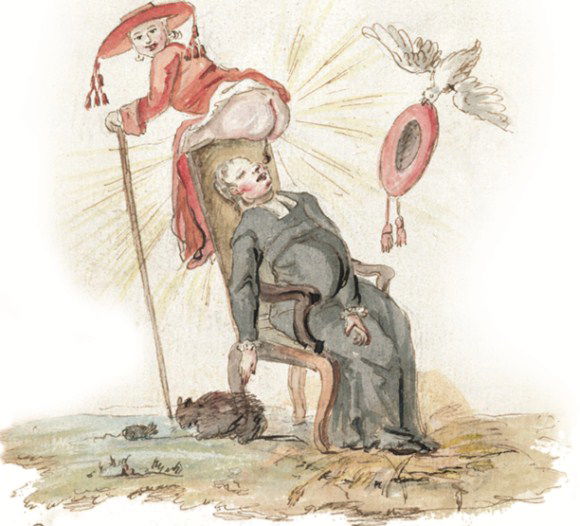 A woman dressed in a cardinal’s robes is squatting on the back of a chair, positioning her exposed behind so that she can defecate into the gaping mouth of a sleeping cleric. A dove hovers close by, bearing a winged cardinal’s hat. This obscene 18th-century image (shown above) displays a kind of French humour – crude, anti-clerical – that forms part of a long, Rabelaisian tradition. Yet what makes it both astonishingly bold and also highly unusual in its substance and context is that it represents Jeanne-Antoinette Poisson, Marquise de Pompadour (1721-64), Louis XV’s mistress, and her political client, the Abbé (soon to be Cardinal) Bernis. The caption reads ‘les biens viennent tous ensemble’ – ‘all good things come along together’. Text and image evoke the moment in December 1758 when Bernis received his promotion to the rank of cardinal, which was intended to give him eminent authority within the royal council. Yet at the same moment that the good news came through from Rome, the king dismissed Bernis and sent him into exile – allegedly under Machiavellian instruction from Bernis’ hitherto patron, Pompadour herself. There is no disputing where power lies in this picture: the arse of Madame de Pompadour.
This remarkable image, and others satirising Pompadour in a similar vein, comes from a manuscript book of drawings entitled the Livre de caricatures tant Bonnes que mauvaises (‘Book of Caricatures both Good and Bad’), composed from the 1740s through to the 1770s. The man responsible for them (even though he never owned up to the fact) was Charles-Germain de Saint-Aubin (1721-86), who was, from the 1740s, embroidery designer to the royal court.
Within the Saint-Aubin family the Livre de Caricatures was known as the livre de culs – ‘book of arses’. The book merits the name in that the 400-odd drawings consistently cock a snook at authority by turning a (usually) bared bottom towards it. There is a highly scatological body politics at play. Where fame, celebrity, power and pretension are on display a resounding fart is never far away. Choosing to focus on Madame de Pompadour’s rear was no incidental decision. For she was, for two decades, the cynosure of power, authority and celebrity in Louis XV’s France.
For over a century the Book of Caricatures has lain neglected in the library at Waddesdon Manor in Buckinghamshire, following its purchase in 1893 by Ferdinand de Rothschild, Waddesdon’s creator, an ardent Francophile and lover of the arts of 18th-century France. This is the first time that most of these images have been published.
The Pompadour drawings surprise on several levels. Such fierce visual political satire was, first of all, extremely unusual in France before 1789, when the Revolution opened the floodgates. The Ancien Régime lacked the vibrant, rumbustious tradition of political satire that England – with its Hogarth, Gillray, Rowlandson and the rest – enjoyed at much the same time. It is true that many writings sought to ‘desacralize’ the monarchy by highlighting the sexual high jinks and failings of the royal body. During the final years of the Ancien Régime a pornographic visual and textual genre would develop that mocked Louis XVI for his alleged impotence and Marie-Antoinette for her supposed sexual voraciousness. But this was exceptional and much less widely diffused before 1789 than historians sometimes maintain.
The drawings are surprising on a second count in that Madame de Pompadour took great pains to cultivate and protect her image. Even before the beauty that had first attracted Louis XV to her had begun to fade she developed an intimate knowledge of his character, which allowed her to present herself to him as someone who could indulge his every whim. She was zealous in displaying the outward trappings of respect for Louis’ Polish queen, Marie Leszczynska (1703-68), for the aristocratic elite and for court etiquette and ceremonial. The marquise presented to the world a kaleidoscopic whirl of images through all the media she could muster – painting, drawing, sculpture, engraving and print. In this way she projected a series of ideas of herself: her seriousness, respectability and virtue, her radiant beauty, enlightened patronage of the arts and letters, her Catholic devotion, faithful service to the crown and so on.
Pompadour’s attention to her image was motivated by the extreme vulnerability of her position. Had she lost the king’s favour, she would have plunged into the abyss. She had none of the family support networks that Louis’ earlier mistresses had enjoyed. The three Mailly sisters, with whom the king had serial liaisons from the late 1730s, were daughters of the Marquis de Nesle, whose noble ancestry dated back to the 11th century. Pompadour, by contrast, was the offspring of a broken home and her parents had been precariously situated on the edge of the high financial milieu, closer to the disdained world of trade than to a traceable aristocratic lineage. It is easy to understand why she became the target of countless petty jealousies across the political spectrum, both as the king’s favourite and a socially questionable parvenu.
Yet the marquise proved astonishingly successful in her task of image management. She kept her place in the king’s affections for nearly two decades, from 1745 to her death in 1764. Even though their sexual relationship ended in the mid-1750s, she retained the status of maîtresse en titre (official royal mistress) and the king was moved to tears at the news of her death in 1764.

The affection Louis lavished on Pompadour was expressed through powerful royal protection. From the very start of their relationship he placed the full panoply of royal power at her disposal. The tittle-tattle at court after he had picked out the ingénue in 1745 led to the appearance of a wave of ditties and satires that targeted her sexual identity as much as her social persona. These were the so-called ‘Poissonnades’, which conjoined the name of the satirical Mazarinades of the Fronde, aimed at Louis XIV’s Cardinal-Minister Mazarin (1602-61), with a pun on the marquise’s family name of poisson – fish. The Poissonnades were protected (and some possibly even instigated) by Louis XV’s minister, the Comte de Maurepas (1701-81). But when a poem appeared in Paris claiming that Madame de Pompadour had a venereal infection (fleures blanches or leucorrhoea) the king acted decisively by exiling Maurepas. The gesture silenced the printing presses and courtly gossip. Thereafter any individual who criticised or poked fun at Madame de Pompadour might find himself the victim of a lettre de cachet and risked imprisonment in the Bastille. (Nearly half a century after her death one of the prisoners released from the gloomy state prison on July 14th, 1789 was alleged to have been put there by Pompadour.)
In this context these satirical images were potential political dynamite. The third surprising aspect to the Livre de culs, therefore, is the authorship of Charles-Germain de Saint-Aubin, not least because he was very much of the world he satirised. As an elite embroiderer producing lush, rococo-style textiles for dresses and decorative and ceremonial hangings he was a regular habitué of the royal court, where his best clients were to be found. These included Louis XV and his queen, Louis XVI’s Marie-Antoinette, le gratin of the court aristocracy and Madame du Barry, Louis XV’s final mistress, as well as Pompadour.
Charles-Germain’s family would remember him as ‘likeable, witty, clever, very caustic, very satirical, very gallant with the ladies, and never out of place wherever he went’. Yet though such a description fits the sensibility in evidence in the Livre, absolutely everything else we know about him suggests the most conventional and orthodox of bourgeois existences. Charles-Germain’s originally peasant family had pulled itself up to a position of some eminence within Paris’s thriving luxury trades by hard work, tight family relationships with similarly aspirant bourgeois families and unconditional social conformism. It seems astonishing that such a figure would risk imprisonment, financial ruin and the end of his career by authoring such dangerous material.
Slideshow: See more of the obscene drawings
This is all the more strikingly the case in that the victim of Charles-Germain’s humour, Madame de Pompadour, was a generous patron to him. She not only commissioned his embroidery, she also presented him with small gifts, including a box of Chinese watercolours, vases and small items of furniture. These may have been by way of thanks for his tutoring her in the art of botanical drawing at which he was highly skilled, flowers being a mainstay of the embroiderer’s art.
That Charles-Germain actively sought Pompadour’s esteem is further suggested by his publication of a series of 12 coloured engravings, the bouquets champêtres, that he dedicated to her. His expertise in flower drawing is also evident in another surviving manuscript, the Recueil de plantes, a beautifully executed set of botanic drawings of flowers that he maintained from 1736, when he was a teenager, until the eve of his death in 1786. Within the collection is a drawing of a ‘belle du jour’ (convolvulus), accompanied by an inscription stating that the marquise herself had worked on it.
The suggestion that Charles-Germain’s attitude towards his patron was a little more complex, however, is hinted at in an anecdote also recounted in the Recueil de Plantes and written in a code derived from musical notation. Asked by Madame de Pompadour to come to her Parisian residence, the Hôtel d’Evreux on the Champs-Élysées, while she was away, to draw some flowers then in bloom, he ended up ‘picking’ a quite different ‘flower’: one of the marquise’s serving women. Beneath the polite conformism of Charles-Germain in his dealings with Madame de Pompadour lurked a much more sceptical, amused and even cynical sensibility.
The fact that Charles-Germain went to considerable lengths to put this little conquest into code highlights his awareness of the dangers of being explicit about the content and the meanings of his pictures. In the Livre de Caricatures he deliberately built a certain amount of deniability into his drawings. For example, one caption purports to misrepresent the notorious state prison: ‘One can see that I do not know how the Bastille is constructed.’ The latter was a huge rectangular, eight-towered building but the drawing shows only three towers. Yet, by more than chance, three towers were the main components of the coat of arms of the marquisate of Pompadour. The drawing thus makes a subversive connection between the prison and the marquise. The joke must have seemed all the more hilarious in that Charles-Germain’s paternal grandfather lived in the rue de Cerisaie, a stone’s throw from the Bastille, and from boyhood our artist would have known its external appearance rather well.
Who was in on the joke? There are over a dozen different handwritings in the Livre de Caricatures and a number of different artistic styles, all of which suggest a collective endeavour. It seems plausible that the volume was handed around and chortled over by one of the laughing groups (‘sociétés de rieurs’) that the historian Antoine de Baecque has identified in post-Louis XIV France – informal groupings that met to socialise, eat and drink together and focus their humour around jokes and riddles. Despite the volume’s title, the images are more correctly viewed as comic drawings than as caricatures – the latter form was making its way more slowly in France than in England or Italy. They display a form of humour that can be subversive but is often merely light, whimsical or fantastical. There are drawings evoking the worlds of theatre, music and dance; literary and scientific personalities; artists and connoisseurs; ecclesiastics from the pope down to mendicant friars; military men and popular celebrities. These co-exist alongside portraits, trophies, chinoiseries and many plain silly jokes. Several of the pictures and captions have a deliberately riddling quality about them – a phenomenon that links into a culture of puzzles and quizzes that we are beginning to learn was widespread in Enlightenment France, but which is also partly explicable in terms of the exigencies of self-preservation on the part of the group.
In terms of career and reputation the stakes were so high that only a relatively small and trustworthy set of individuals are likely to have been involved in the Livre. We may be pretty sure that the chosen few included family members, notably Charles-Germain’s brothers, the eccentric artist Gabriel, whose sense of humour and taste for Parisian flânerie find an echo in the volume, and Augustin, the successful engraver. Both men contributed drawings to the Livre. Other family members may well have been involved too – probably they were mostly male, for the schoolboyish, scatological and mildly misogynistic character of many of the drawings in the Livre de Caricatures makes female input questionable. Otherwise, it was likely that friends from the overlapping worlds of the luxury trades, painting, sculpture, theatre and petty administration composed the laughter group around Charles-Germain.
There is every reason to believe that members of the group were linked together not only by social rank, but also by a sense of humour that gloried in taking the high and mighty down a peg or two. Pompadour was far from alone in being the target of Saint-Aubin’s humour – but she was certainly a favoured target, not least because, though she played the grande dame, in terms of social origins she was anything but. A number of drawings play on the ‘poisson’ pun. What looks like a fishwife from one of the popular cris de Paris pictorial series cries out ‘poisson, poisson’, as two ankle-height demons pull her hell-wards. In another picture a tiny cleric bears on his back a huge fish. The caption (probably added later) reads: ‘For a number of years, despite the pride of Roman purple, fish was what we had in France that was greatest’. This Pompadour and Bernis reference is given an additional twist by the fact that the depiction of the marquise as a pale-green carp is an ironic echo of Pompadour’s taste in Chinese porcelain. Her enormous and precious collection included several light green Chinese celadon vases in the shape of carp. The artist might well have seen them in her private apartments.As this poke at Pompadour’s pretensions to be a connoisseur and a collector suggests, the marquise’s ceaseless polishing of her image was itself a source of humour for Charles-Germain and his circle. For example, in 1757 the François Boucher portrait painted the year before of Madame de Pompadour at the height of her success was displayed on an easel, on a raised dais – a privilege formerly only observed, in the case of royalty, at the Salon in the Louvre. Charles-Germain’s brother Gabriel even made an engraving of the scene, with an admiring crowd looking on. Charles-Germain’s take on it in the Livre was altogether less flattering. A satyr stands like a painter at his easel, on which the Boucher portrait is visible. The easel is not on a dais but the satyr-painter (and art critic, to judge by his magnifying glass and livret) is elevated on a book entitled ‘morals’ (‘Les Moeurs’). The image and its caption (‘truth overrides authority’) seem to be as much about Boucher the image-maker as about the Pompadour image itself.
Another drawing that combines an attack on Pompadour with criticism of her image-makers is an extraordinarily crude picture of her crouching over a bidet. The marquise was known to use a bidet, having purchased a fancy example from the art dealer Lazare Devaux in 1751. But there is probably a daringly offensive reference here to her alleged affliction of fleurs blanches – plus a ribald evocation of the much more polite ceremonial of her toilette, at which the marquise applied the last elements in her facial make-up, an occasion at which she developed the custom of receiving suitors, clients, ambassadors and dignitaries. This became a notorious association, in fact, and Boucher was responsible for another famous painting of her in this situation. Fawning priests shown kissing her feet are probably Jesuits (against whom Charles-Germain launched some of his choicest barbs in the Livre) and the reference is most likely to the occasion in 1755 when the marquise decided to take up a more orthodox religious position, appointing the Jesuit Père de Sacy as her spiritual director. She appears to have hoped that this would ingratiate her with the dévot faction at court, surrounding the queen and the Dauphin.

The toilette ceremony so closely linked to Pompadour’s image is also crudely satirised in a drawing showing a comically dressed-up female monkey. The caption reads ‘Lipstick, invention of the marquise de Cr...’. So renowned was the association between Pompadour and her toilette that, given the Livre’s interest in Pompadour’s cul, it is tempting to conclude that the ‘Cr’ may be a red herring, a strategem for deniability. It is also conceivable, however, that Charles-Germain was here targeting the Marquise de Créquy, who at one stage had thrown her hat into the ring to become Louis XV’s lover – and who consequently might be thought to be harbouring the ambition to replace Pompadour at her toilette. Even if this were the case, the drawing smears Pompadour as much as her sexual rival.
Pompadour had turned her toilette ritual into a mechanism of power and Charles-Germain displayed in a number of other drawings his deep disapproval of her claims to play a political role. In one, the marquise is shown precariously propping up Christophe de Beaumont, the archbishop of Paris, on the wheel of fortune. Beaumont had been so frequently under the cosh in the struggles involving the crown, the Parlement of Paris and the clergy over the Jansenist issue that it must have seemed a fortuitous moment in 1756 when the king rudely disciplined the Parlement, causing the archbishop to be hailed as triumphant. Charles-Germain’s drawing depicts the magistracy of the Parlement being crushed under the wheel of fortune – which would however soon revolve to the Parlement’s advantage. Unwanted interference in political process is evoked in a further drawing where the marquise hovers behind a jug-like royal official meting out punishment on a Parlement also represented as so many jugs (or rather mugs, as the word ‘cruche’ in French also means fool or idiot).
A particular object of criticism of Pompadour in the late 1750s – more broadly within the public sphere as well as at court and within the Saint-Aubin circle – was her role in secret diplomatic negotations with the Austrian envoy, Count von Starhemberg, which led to the Franco-Austrian alliance of 1756 and the start of the ‘Diplomatic Revolution’ within Europe. This was widely viewed as unwarranted interference in political and diplomatic process on the part of the marquise. A drawing in the Livre depicted Pompadour achieving a sterling piece of social and diplomatic climbing to embrace the long-haired Starhemberg. The same two individuals seem to be depicted in another drawing which also highlights an issue of balance: only the hands of friendship seems to prevent the centrifugally-challenged couple from collapsing backwards into the water. The caption, ‘whosoever lets go, perishes’, could have been a motto for the Seven Years War (1756-63), where France and Austria seemed strapped together in an unholy alliance that proved a dismal military failure. Pompadour was widely held to have been responsible for the appointment of generals who led French armies to inglorious defeats in the early years of the war. The Prince de Soubise, defeated commander at the battle of Rossbach in 1758, was a notorious Pompadour client and is represented as the donkey of Rossbach. Another Pompadour favourite, the Comte de Clermont, is depicted on his way to the front, loaded down with victuals and with Pompadour, in the green dress of her Salon portrait, seeing him off. The comte also held the honorific post of abbot of Saint-Germain-des-Prés, and the crozier on Pompadour’s head suggests that she was his ecclesiastical superior as well as his patron. A further drawing shows the famously lubricious Duc de Richelieu as a monkey wearing a Pompadour-pink rosette. He is depicted filling his boots, a gesture evoking his ignoble and well-publicised passion for plunder. Charles-Germain also makes a monkey of Richelieu in another drawing, where the king is shown in jockey’s cap rather than commander’s hat (or crown). Soubise turns his back as if in disgrace: this leaves him facing his patron, Madame de Pompadour.
The military disasters of the Seven Years War led to acute state financial crisis and the decision, in 1759, to melt down the court silver for purposes of coinage – an act which is comically depicted in a further drawing. While courtiers and clergy patriotically clamour to place their silver plate in the furnace of the royal mint Madame de Pompadour is shown tunnelling in from below, no doubt so as to sequester the silver. Her head is in the furnace, so she presents to the reader, appositely enough in the volume’s logic, her backside.
Like many of his contemporaries, Charles-Germain seems to have ascribed military failures to a feminisation of the king and his courtiers. In a rather subtle drawing, the god of love (in fact an adaptation of Falconet’s famous Amour menaçant statue that was located in Pompadour’s Hôtel d’Evreux) is seen handing a tapestry frame, or tambour, to what we may take to be the king. There was a fad at the royal court for male courtiers to engage in tapestry. Normally this was seen as women’s work and, moreover, was specifically associated with Madame de Pompadour. (In her later years, the marquise renounced the use of her toilette as the moment for reception of visitors and replaced it with audiences during which she sat working at tapestry.) The king thus receives a tambour, while on the other side of the statue Madame de Pompadour is shown working on one. However, the word tambour means ‘drum’ in French and it is precisely the military drum that is being denoted here, as is shown also by the military paraphernalia (sword, standard, cartographical instruments) cast carelessly aside on the ground. Madame de Pompadour was turning the king away from properly masculine royal duties.
How typical were the attitudes towards Madame de Pompadour and, through her, towards royal authority that emerge from this extrordinary visual commentary? Some historians have highlighted the Seven Years War as a particularly fragile moment in the monarchy’s hold over public opinion and Charles-Germain’s images endorse such a view. But the drawings also highlight how difficult it is to read social and political attitudes from outward appearances. On all available evidence – save for the chance survival of the Livre de Caricatures – Charles-Germain emerges as respectable, deferential and conformist, as befitted an individual who made his fortune by supplying luxury embroidery to the royal court. In his drawings, then, was he mildly letting off steam – or nurturing proto-revolutionary designs? And did his cruel drawings really represent his true feelings? A final, ambiguously-worded image composed on her death in 1764 strikes a plangent as well as a critical note:
Here lies d’Etiolle Pompadour
The flower and ornament of the Court,
Unfaithful wife and accomplished mistress
Whom both Marriage and Love mourn.
Whatever Envy may say
Marriage and Love are not wrong
The first to mourn her life
The second to mourn her death.
In giving the last word on Pompadour to Love was Charles-Germain expressing just a scintilla of belated regret for his treatment of his one-time patron in the pages of his Livre de Caricatures?


