

The Jacobite Rebellion
Few events have been as romanticised and misunderstood as the Jacobite Rebellion. And, as Jacqueline Riding explains, politics has brought its myths to the fore once again.
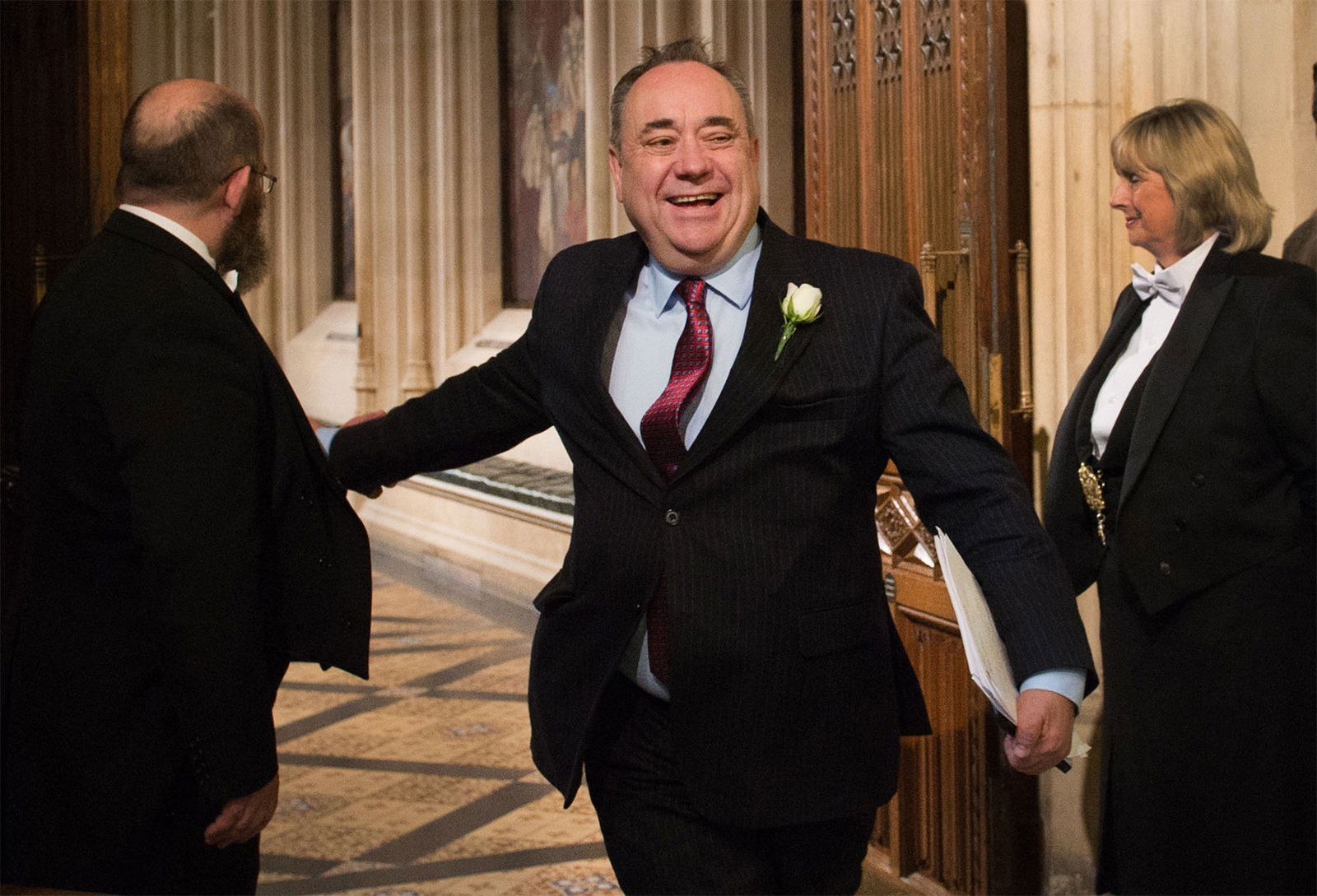
It was one of the images of the 2015 General Election. Not a beaming David Cameron on the steps of 10 Downing St after securing, against all the odds and the now discredited opinion polls, a Conservative majority (albeit a slim one). No, it was a photograph of Alex Salmond, former leader of the Scottish National Party (SNP) and ex-First Minister of Scotland. The new honourable member for Gordon is seen breezing past the doorkeepers at Members’ Lobby, en route to the Commons Chamber during the State Opening of Parliament, face flushed, arms swinging with abandon.
While this image, with the accompanying caption ‘When yer absolutely hammered but the bouncer still lets you in anyway’ went viral on Twitter, other, more observant, folk were noting a particular feature of Mr Salmond’s attire: a white rose button hole. This detail stimulated lively discussions, theories and clarifications. The thistle is understood to be the national flower of Scotland, so what was the significance of a white rose?
Some south of the border, particularly those from Yorkshire, expressed surprise and even delight, that Alex Salmond was signalling his camaraderie with God’s Own County, while others pondered whether the flower alluded to a little-known and unexpected affinity with the 15th-century Plantagenet kings of England. It emerged that, for several decades now, the Scottish Nationalists have worn a white rose at ceremonials such as the State Opening at Westminster and Holyrood, as recounted by a party source, to ‘symbolise the white rose in the poem’. That poem is ‘The Little White Rose’ by Hugh MacDiarmid:
The rose of all the world is not for me.
I want for my part
Only the little rose of Scotland
That smells sharp and sweet – and breaks the heart.
These lines are also carved into the Canongate Wall, part of the Scottish Parliament buildings in Edinburgh. The button hole that Mr Salmond and his fellows were sporting, however, turned out to be a cultivated African-grown florist rose rather than the beautiful, hardy and native little Scots Rose or rosa spinosissima, a common, five-petal summer flower, but the spirit of the symbol was there.
The unprecedented sight of 56 SNP MPs at Westminster all wearing white roses certainly drew attention to it. The ‘Little White Rose’ of Scotland may be a modern nationalist symbol, but from the late 17th century the white rose has been an emblem of the Jacobites, the supporters of the exiled Stuart king, James VII of Scotland and II of England and Ireland and his male heirs. Other symbols include the sunflower (loyalty), moths and butterflies (transformation/hope) and the oak leaf and acorns, the latter a dynastic symbol associated with the Boscobel Oak Charles II hid in after his defeat at the Battle of Worcester in 1651 (see History Matters, page 4). In exile for a second time, from 1690, the oak also came to signify the hope of a similar reversal in Stuart fortune. In some interpretations, the White Rose specifically signifies James Frances Edward Stuart (b.1688), James VII and II’s son, whose birthday, June 10th, is celebrated as ‘White Rose Day’. As seen on a fan at the Victoria and Albert Museum, a white rose and two buds represents James Francis Edward and his offspring, Charles Edward and Henry Benedict.

The white rose is thought to have become particularly visible, as a specifically Jacobite symbol, during Charles’ attempt to restore the dynasty in 1745-6. One legend has the Bonnie Prince (not unlike, according to Shakespeare, his distant Plantagenet forefathers) plucking a white rose to adorn his hat during the march through the Western Highlands towards Edinburgh. Even if this is true, for practical reasons it is unlikely that Charles or members of the Jacobite army wore roses throughout the campaign (July 1745 to April 1746). It is therefore a possibility, as suggested by the National Records of Scotland, that the white rose was represented, in turn, by the ‘white cockade’, which Jacobite troops and supporters certainly did wear. Cockades, textile rosettes, were already an established visual signal of political allegiance in Europe. But during the Jacobite Rebellion of 1745 the symbol had become so well known that the use of the white cockade, indeed ‘white’ in general, was the coded means by which adherents to the Stuart cause made themselves known wherever Charles and his army marched.
It was widely reported, prior to the prince’s arrival at Edinburgh on September 17th, 1745, that Charles habitually wore highland garb and a blue bonnet with a white cockade. Richard Cooper’s ‘Wanted poster’, produced after the British government announced a £30,000 bounty for the prince’s capture, was probably created before the Edinburgh-based artist had actually seen his subject, as the image is more caricature than portrait and the garb bears little relation to the red tartan short coat, red velvet breeches and boots Charles wore at this time. After his father was declared James VIII and III at Edinburgh’s Mercat Cross, the historian John Home, who was present, observed that ‘a number of ladies in the windows strained their voices with acclamation, and their arms with waving white hankerchiefs in honour of the day’. During the Jacobite army’s occupation of Manchester in late November, the teenager Elizabeth ‘Beppy’ Byrom, daughter of the poet and Jacobite sympathiser John, noted in her journal on November 29th the making of ‘St. Andrew’s crosses’, as she calls them, and the following day, St Andrew’s Day itself, ‘more crosses making till twelve o’clock’.
***
She is almost certainly referring to cockades of white cotton fabric or ribbon. In anticipation of Charles’ imminent arrival, Beppy had also purchased a white dress with a blue sash, which she wore to greet the occupying army and again the following evening, when she finally met the man of the hour himself. James Maxwell of Kirkconnell, an officer in the Jacobite army, recalled that from ‘Manchester to Derby the country seemed pretty well affected. As the army marched along, the roads, in many places, were lined with numbers of country people, who showed their loyalty by bonefires, acclamations, white cockades, and the like’. Another officer, Captain John Maclean, also noted ‘at severall houses we saw White flags hanging out Such as Napkins and white Aprons, and in the Gavels of Some houses white Cockades fixed’.
Whatever its origins, in the mid-18th century the white rose/cockade was an international symbol of political and dynastic affiliation, not specifically a Scottish nationalist one. This continued into the late 19th and early 20th centuries, with the formation of the Order of the White Rose, a society to which a medley of people were drawn, from Scottish nationalists to adherents of the ‘true’ British royal line, to sympathetic antiquarians. The latter were keen to rid the Jacobite cause and the Stuart dynasty in general of the thick, sticky layer of romantic doom that had enveloped it. At the same time, the legitimist Jacobite League of Great Britain even considered putting members forward as candidates in parliamentary elections. It is unlikely that many now, including the SNP, would advocate (through the wearing of a white rose) the removal of The Queen in favour of a German duke, Franz von Bayern (b.1933), who is identified by the Royal Stuart Society as the current heir of the Stuart dynasty and therefore, as Franz or Francis II, de jure British monarch. He is also, as it happens, the great-grandson of the last ruling King of Bavaria, Ludwig III. As Oscar Wilde might have said, to lose one crown … Alex Salmond denied any whiff of Jacobitism in his wearing of a white rose and, in any case, the Stuart heir has, we are told, no interest in pressing his claim. This seems, however, a good moment to explore other myths and realities around the Jacobites, Jacobitism and the event that generated and continues to perpetuate more myths than the entire subject combined: the 1745 Jacobite Rebellion.
Perhaps the most important myth to bust is nationality. All Jacobites were Scottish, right? The only thing that united all Jacobites was not their nationality, but their desire to see the return of the Stuarts to the British and Irish thrones. Jacobites came from all parts of the British Isles and Ireland and, in exile, formed an international network, living as far afield as Italy, America, Russia and beyond. Neither were all Jacobites Catholic. The ‘senior’ Stuart branch, the male heirs of James VII and II, were indeed Catholic, but many Jacobites were protestant: whether ‘High Church’ Anglican and Episcopalian, or dissenting. Lord George Murray, lieutenant-general of the Jacobite army during the ’45, was protestant, as was the Life Guards commander David Wemyss, Lord Elcho. It is true that some minorities, such as British Catholics, could expect greater tolerance under a Catholic monarch, although, aside from the prominent Catholic clans, few Catholics within Britain displayed any interest in joining Charles’ campaign. The most eminent English Catholics, the Duke and Duchess of Norfolk, attended court at St James’s at the height of the threatened advance to London. As Henry Fielding observed in his journal, The True Patriot:
The Season which they have chosen to express their Attachment to his present Majesty, should silence the Clamours of hot-headed Men, who cannot separate the Ideas of a Roman Catholic and a Rebel, tho’ it be a notorious Truth, that not one single Man of Consequence, who is a Professor of that Religion, hath taken the Opportunity, of these Times of Danger and Confusion, to express Marks of Disaffection to the Government, or to endeavour molesting it.
The prince’s Catholicism and that of his close associates, Sir Thomas Sheridan (Charles’ former tutor in Rome) and Colonel John William O’Sullivan, who were also Irish, created tensions within the Jacobite command from the onset. Some believed that James Francis Edward and his heirs should convert, as France’s Henry IV had done, while some wanted them back regardless, as their right to rule was divine and incontrovertible and was certainly not dictated by the desires (or, as they would see it, self-interest) of ministers and parliaments. Although James VII and II and his son sacrificed everything for their Catholicism, it is not so certain whether the Jacobite heir-apparent in 1745, Charles, would have done the same. While he needed the support, both financial and military, of his powerful Catholic cousin, Louis XV of France, he was unlikely to convert. But might he have done so to strengthen his position, in a predominantly Protestant Britain, once his father was in possession of the throne? We will never know, but there are some hints.
After the Battle of Culloden in April 1746, Hugh MacDonald of Baleshare recalled a conversation he had with Charles while the prince was a fugitive in the Western Highlands and Islands:
‘Do you ’no, Mr. M‘Donald,’ he says, ‘what religion are all the princes in Europe of?’ I told him I imagin’d they were of the same establish’d religion of the nation they liv’d in. He told me they had litle or no religion at all.
Such comments make clear that Charles was less wedded to Catholicism than either his father or his brother. Within a year of Charles’ reported comments, Henry had returned to Rome, taken holy orders and entered the College of Cardinals; a disastrous own goal for the Stuart cause and an act his brother never forgave. It is also rumoured that Charles converted to the Church of England on his secret visit to London in 1750. Yet, ultimately, it is the prince’s tragedy that the major bar to what he most desired was a thing he seemed to care so little about.
***
The Jacobites were Scottish Nationalists? Well, it is true that some supporters did want to see the dismantling of the Union between Scotland and England and, indeed, encouraging and capitalising on disaffection towards the Union was a key tool in the exiled Stuarts’ public relations and recruitment arsenal, at least within Scotland in the decades immediately following the Union of 1707. In October 1745 Charles issued a proclamation from Holyrood Palace reiterating the declared Stuart position that the Union was null and void, partly, he stated, because of the bitter complaints he had received from all corners of his father’s domains concerning it, but mainly, and crucially, because the Acts of Succession and Union barred the Catholic Stuarts from ruling. In other words the Union, as it stood, was anti-Stuart in Charles’ mind (rather than specifically anti-Scottish) and therefore required dismantling. It is also true that, from a practical point of view, ruling the whole of the British Isles from London was less complicated than dealing with two parliaments at Westminster and Edinburgh, as the late Stuart monarchs prior to the Union, from James VI and I onwards, would no doubt agree. Charles might have thought that a successful campaign followed by his conversion could be a suitable compromise.

On a recent visit to Culloden battlefield, as we drove past the battle lines, my taxi driver pointed towards the blue flags, indicating the Jacobite army front line, and then the corresponding red British army flags and said: ‘There’s the Scottish army on the right and the English Army on the left.’ So the Jacobite Risings – and the Battle of Culloden that terminated them – was about Scotland versus England? The excellent battlefield centre at Culloden has made a great effort to dispel this enduring myth. The guidebook even opens with a section entitled ‘debunking the myths of Culloden’, of which this is one. But, as my taxi driver’s comment suggests, this particular piece of misinformation persists. In fact, the battlefield itself, despite the best efforts of the National Trust for Scotland, reinforces this myth.
Battlefields are strange, emotional places: none more so than Culloden. Away from the visitor centre and its even-handed didactic displays, on the open windswept, boggy moor, the battlefield is punctuated with markers where the myth is carved in stone. The stirring declaration on the 20ft-high memorial cairn reads: ‘The graves of the gallant highlanders who fought for Scotland & Prince Charlie are marked by the names of their clans.’ These clan stones dot the battlefield, accompanied by locations such as ‘The Field of the English’, traditionally where the British army dead were believed to have been buried. As the flowers placed alongside the Clan stones suggest – most conspicuously, since the success of the TV series Outlander, the Clan Fraser stone – these markers continue to have a powerful hold. They were introduced into the landscape by Duncan Forbes, Laird of Culloden, in 1881, ironically, given the message of the memorial cairn, the descendent of Duncan Forbes, the 5th Laird (d.1747), Lord President of the Court of Session, a proud Highlander and tireless supporter of the Protestant succession, as embodied by the House of Hanover, and the Union. Certainly a large number within the Jacobite army troops were fighting for Scotland – although, technically, the Jacobite army as a whole was fighting first and foremost for a Stuart restoration – but their leader, Charles, had shown no interest in restoring his dynasty to the throne of Scotland alone. After the extraordinary victory at Prestonpans on September 21st, 1745, when a majority of British army troops were still in Flanders, Charles could have established himself at Edinburgh, awaiting the long-promised French battalions to consolidate his position, while preparing for the arrival of his father as king of Scotland. This was the preferred option for many of his Scottish commanders, who considered the size of their army and the certainty that British army troops would now be recalled en masse, as a strong argument against venturing south. Instead Charles, with just 6,000 men, insisted on an advance into England. His despair on the retreat from Derby, with his great prize, London, so tantalisingly near, was profound.

Some modern accounts describe the British army as ‘Hanoverian’. The Hanoverian army, which fought alongside the British army at Fontenoy, came from Hanover in Germany. Contemporaries described the army under Sir John Cope at Prestonpans, General Henry Hawley at Falkirk (another Jacobite victory, January 17th, 1746) and the Duke of Cumberland at Culloden (April 16th, 1746) as the King’s Troops, not the Hanoverian or ‘Government’ army. It is also correct to describe it as the British army: if the troops fighting in Flanders during the War of Austrian Succession (1740-48) are called the British army, the same troops, on British soil, remain the British army.
***
There is an additional complication: describing the Jacobite army as the ‘Highland’ army. Contemporaries, Lowlanders and English alike, talked about the ‘Highlanders’ and the ‘Highland army’ and focused their attention on the Highland contingent, as Charles and his men marched through their towns and villages. This response derived from what onlookers saw as their alien appearance – the great plaids or ‘Highland dresses’ as some English observers described them – and the unfamiliar Gaelic language. In the early stages of his campaign, while Charles was attempting to gather support in the Western Highlands, the small army could have been described as ‘Highland’. At the raising of the standard at Glenfinnan on August 19th, 1745, the 1,000 or so men gathered around it came predominantly from the Cameron and MacDonald clans. By the time the army occupied Edinburgh and had remained in the environs of the city for almost six weeks, the composition had changed, to include many lowland gentlemen and tradesmen. When the Jacobite troops crossed into England in early November, compositionally it was a different army. At Culloden about two thirds of Charles’ troops were Highland Gaels, but there were also Lowlanders, Irishmen, Frenchmen and some Englishmen. Meanwhile, within the British army facing them, four infantry battalions were Scottish, and the Duke of Cumberland’s commanders included Charles Cathcart, 9th Lord and Chief of Clan Cathcart. The highest-ranking British army fatality was Lord Robert Kerr, eldest son of the Marquis of Lothian, and brother of the Earl of Ancram, who commanded cavalry during the battle.
The large Highland contingent was very distinctive. To create a visual cohesion across the whole army, while encouraging the idea of a single body, tartan plaid was worn, via an item of clothing or, in the case of the English Manchester Regiment, a sash, whether a clansman or not. The wearing of tartan plaid, once so particular to the Highlands, gave the impression, to an outsider, that the Jacobite army was a distinctly Highland force. When the rebellion failed, in contrast to what had occurred after previous risings, the Highland way of life was directly targeted. As Colonel Joseph Yorke, one of Cumberland’s aides-de-camp, declared to his brother, Philip, soon after Culloden: ‘You must never expect to see a total end to the rebellious spirit of this country till the Highlanders are unclanned, undressed, effectually disarmed and taught to speak English.’ To many beyond the Highlands, the dress, particularly tartan plaid, was now synonymous with the Jacobite cause. Lord President Forbes, however, considered disarming, rather than ‘undressing’, to be the crucial factor in preventing another rebellion: punishing those who had joined Charles, along with ‘all the rest who have not, and who I will venture to say are the greatest Number’ was unreasonable. Despite his plea, the Act of Proscription came in to force on August 1st, 1746, through which the wearing of Highland dress was prohibited. The only official exemption was within the British army, towards which Highland military prowess would now be channelled. Inevitably, this law also confirmed tartan as the covert and, in some instances, overt symbol of protest and resistance.
Even the origins of Highland dress has its complications. According to a footnote written by H.R. Duff, the editor of Lord President Forbes’ Culloden Papers, quoting a 1769 letter by Evan Baillie, published in the Edinburgh Magazine in 1785, ‘the kilt or Pheliebeg [Philibeg] was not the antient Highland garb, but was introduced into the Highlands about 1720 by one Thomas Rawlinson, an Englishman’. The author concludes that: ‘The convenience of the dress soon caused it to be universally adopted in the Highlands.’
Jacqueline Riding is Research Fellow at Birkbeck, University of London and author of Jacobites: A New History of the '45 Rebellion (Bloomsbury, 2016).


