

Georgian Ghosts: An Aristocratic Spectre
A series of violent attacks by pale shrouded figures on lone pedestrians, especially women, was widely reported in the early 19th century. Jacob Middleton uncovers the sham ghosts of Georgian London.
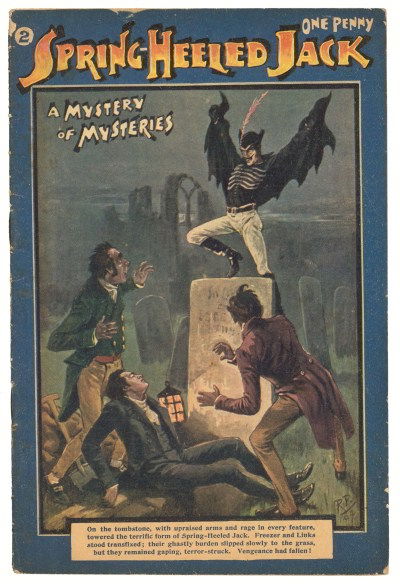
In the early years of the 19th-century London was haunted by ghosts. However, these seemed not to be the traditional spirits of the supernatural kind, but were apparently flesh and blood ‘ghosts’, who harassed honest citizens and made it dangerous to travel outside alone after dark. Largely forgotten today, for a brief period these apparitions were a feared night-time hazard, who would periodically appear and menace people.
Many of these ghosts appeared in the villages around the western edge of London. It was here, for instance, that the Hammersmith Ghost made his first appearance in the autumn of 1803. Manifesting in the shady rural lanes of the then hamlet of Hammersmith, the ghost was clad in a traditional white shroud, and confronted lone travellers at night. One popular rumour was that he had assaulted a woman while she was walking past Hammersmith’s chapel on a winter evening. It was said that the ghost grasped the woman in his arms, whereupon she fainted. According to contemporary accounts, she died two days later from shock.
The haunting of Hammersmith came to public attention in January 1804 when an exciseman named Francis Smith managed to shoot and kill a bricklayer, Thomas Millwood, while out searching for the ghost. Millwood was walking home late in the evening after a visit to his parents’ house; wearing his working garb of dusty white waistcoat and trousers, he was mistaken for the ghost in the dimly lit rural lane where he met Smith. The killing made newspaper headlines nationally and, while Smith was convicted of Millwood’s murder, public sympathy led the home secretary to rescind his death sentence and reduce his punishment to a year’s imprisonment.
The events of 1803 and 1804 were merely the first in a series of ghostly appearances that were to plague the capital in the early 19th century. In 1811, for instance, newspapers carried reports of a ghost that was apparently haunting Kensington, then a village on the fringes of London. The Times claimed that, when caught, this apparition turned out to be the son of a respectable gentleman and, rather than turn him in to the magistrates, his captors pitched him into the nearest horse trough.
The Hammersmith Ghost was to return in late 1824. This new apparition was more violent than his predecessor; one newspaper, The Morning Chronicle, made a complaint that the ghost ‘rarely quits the terrified objects who may happen to come in his way without scratching or seriously wounding them’. The paper also printed one of the more extreme stories attributed to the ghost, which involved it walking into the parlour of a lonely cottage and breathing fire before the startled inhabitant. The activities of this ghost were blamed on aristocratic misbehaviour; Bell’s Life in London, a popular periodical of the time, reported claims that the ghost was the son of an aristocrat and ‘he was playing these pranks for a bet’, having waged that he would ‘walk as a ghost’ for a certain number of nights without being taken or ‘laid’.
At the time of these appearances in London another ghost was reputedly stalking the towns of Hampshire. This was the Southampton Ghost who, according to the claims of the local newspaper, The Hampshire Telegraph, was wandering the streets ‘frightening any individuals he can find alone’. ‘Many stories are in circulation about the ghost, as he is called’, stated the newspaper, which noted that ‘some say that he is ten feet high, and can jump half over a house; all agree that he is a perfect living skeleton.’ Over the following years the Southampton Ghost was to tour many of the towns of Hampshire, making prodigious leaps, which were explained by the suggestion that whoever was responsible was wearing what were called a pair of ‘spring boots’. The local population was sufficiently upset by his appearances that in early 1826 a mob in Southampton seized an army officer who they suspected was behind the ghost’s activities and dragged him to the local prison in an attempt to get him incarcerated.
It is likely that stories reported about the Hammersmith and Southampton Ghosts influenced the narratives that developed around other apparitions. It may not be a coincidence, then, that some of the more peculiar features of these phantoms were to appear in accounts of a ghostly terror which stalked the fringes of London at the end of the 1830s. The first reports, in the autumn of 1837, claimed that a strange ghost had been seen around the villages to the west of the capital. In Barnes he took the form of a white bull and was said to have attacked numerous women. In East Sheen, meanwhile, the ghost took the form of a bear, while in Brentford and Ealing he stalked the inhabitants dressed in steel armour. The fear of this apparition was such that by the beginning of 1838 the Lord Mayor of London was petitioned by anxious citizens who wished him to put a stop to its menace.
As the weeks passed the ghost gained a more definite identity. He became known as Spring-heeled Jack, a name relating to the great bounding leaps he made as he evaded pursuers. In a pair of well-publicised attacks that occurred in the East End of London he was even said to have breathed fire in the faces of young ladies. Despite such outrages he proved to be elusive and it was claimed that again this ghost was a member of the aristocracy in disguise; one letter to the Lord Mayor suggesting that his activities were the product of a wager to scare a number of women out of their wits, through the impersonation of a spectre. Although no single individual was ever held to account for the ghostly manifestations of 1837 and 1838 the notion that they were the product of aristocratic misbehaviour took hold and, as Spring-heeled Jack was later transformed into a Victorian bogeyman, the myth grew up that he was none other than the Marquis of Waterford, a notorious prankster of the 1830s.
The notion that these ghosts were, in fact, bored members of the upper classes was a common theme in the early part of the 19th century. This was a rational way of explaining the appearance of apparently fake ghosts, since who else, other than a member of the aristocracy, would have the time, resources and inclination to create a convincing ghostly appearance? Moreover, the notion that aristocrats were responsible provided an explanation as to why they were able to avoid prosecution, as their money and influence allowed them to evade the law.
These beliefs were a reflection of the underlying social tensions of the time. This was, after all, when radicals were agitating for a more democratic form of politics, less dominated by the aristocracy, while reactionary lords fought to hang on to their power and influence. Symbolic of this were the Hanoverian monarchs, whose members were reputed to have indulged in all kinds of vices. Ernest Augustus, brother of the reviled George IV, was even suspected of murdering his valet in 1810.
In this context, the ghosts of Georgian London can be seen to indicate a certain dislike and distrust of a ruling class which was perceived to be above the law rather than as a reflection of an ingrained belief in the supernatural. No aristocrat was ever publicly exposed as being responsible for impersonating a ghost, yet the connection endured as a representation of popular beliefs about the aristocracy. These ‘ghosts’, which were powerful and aggressive and against which ordinary people were helpless, were the perfect metaphor for how common people saw the ruling classes of Britain.

