

Shackleton in the Antarctic, 1914-1916
The great explorer’s skill and courage rescued a whole expedition from disaster after a struggle that lasted nearly two years. ‘Not histrionics but steady and constant leadership saved Shackleton and his men’.
 It would not be difficult to argue that Sir Ernest Shackleton was the greatest of all polar explorers. But to the eyes of history he toiled always under the shadow of Scott. The circumstances of that explorer’s disappearance with his four gallant companions have made him a national legend and have rightly earned for him a fine monument in London. His return from the Pole was a struggle with inevitable doom. But it is ironical that Shackleton, who brought himself and three men safely back from within a hundred miles of the Pole in 1908 and saved an entire expedition after nearly two years of terrible hardship from extermination, should yet be less heroic in popular imagination than Scott. But fame is ever unequal and it is rightly said that comparisons are odious.
The Pole, however, was not the only Antarctic objective that fascinated Shackleton. When he heard of Amundsen’s triumph he wrote:
“The discovery of the South Pole will not be the end of Antarctic exploration. The next work of importance is the determination of the whole coastline of the Antarctic continent and then a trans-continental journey from sea to sea crossing the Pole.”
Forty-six years were to elapse before Sir Vivian Fuchs’s and Sir Edmund Hilary’s parties, with the aid of aircraft and modem equipment, were to achieve this feat. With the use of one aeroplane, Shackleton could more easily have found a suitable landfall and so avoided disaster.
The first phase, the circumnavigation of the continent, was largely undertaken by the Antarctic navigator, Captain John King Davis. Having disembarked his fellow Australian, Douglas Mawson, and a team of scientists in the Aurora at Cape Denison, Davis made the best use of their delayed return by sailing westward, anti-clockwise, around the continent with the object of exploring the coast between King George V Land and Kaiser Wilhelm II Land. Finally, he landed a party under Shackleton’s colleague, Frank Wild, near the region of earlier German exploration. During the years immediately before the First World War, Germany was Britain’s strongest competitor in the exploration of the Antarctic. Davis’s voyage showed him how the front of the Ross Ice Shelf had receded since the previous explorations nearly a century earlier by d’Urville, Balleny and Wilkes. When, recently, I had the privilege of meeting Captain Davis, in his eighty-first year, I suddenly understood how newly discovered is the world.
But the trans-continental journey was not so easily achieved. Several Europeans, notably the German Wilhelm Filchner, had failed to find sufficient funds for such an undertaking, although he was able to explore more thoroughly the tortured waters of the Weddell Sea. He and Vahsel, the captain of the Deutschland, had failed in 1911-12 to establish a winter base, although on their return, swept helplessly northward by the ice pack, they managed to preserve their ship and even make valuable observations of the behaviour of the current. Moreover, they dispelled the idea, established by Benjamin Morrell in 1823, of the existence of New South Greenland. Vahsel himself was the only casualty and was buried at sea near the Antarctic Circle. Shackleton had the advantage of Filchner’s experience and also that of the other recent Antarctic navigator, William Bruce.
The collection of sufficient funds was no new problem for Shackleton who, apparently working in opposition to Scott, had experienced prejudice during the preparation of his polar attempt in 1908-9. The financing of his second expedition, while not easy, was at least a little smoother than his first. Until Amundsen reached the Pole in 1911, Shackleton, together with Wild, Adams and Marshall, had come nearest to its attainment. They had turned back in 1909 with less than a hundred miles to go; and, on his retum to England, Shackleton’s fame probably exceeded even that of Scott, his old leader of the Discovery expedition of 1901-04. Sir Clements Markham’s prejudice had been dispelled and the Royal Geographical Society received Shackleton’s new Antarctic plans more readily. His most generous benefactor was the wealthy Dundee jute manufacturer, Sir James Caird, who donated £25,000, half the total sum required. The Government gave £10,000, and Shackleton received generous donations from two faithful admirers, Miss Elizabeth Dawson Lambton and Dame Janet Stancomb Wills. Applications to join the expedition poured in, and in addition to the hard core of his loyal Antarctic colleagues, notably Frank Wild, Shackleton set about completing his party from some of the applicants. As a preliminary guide to assessing the worth of each, he sorted them out into three groups: Mad; Hopeless; Possible.
Essentially, Shackleton’s plan was similar to Bruce’s. He intended to land a crossing party on the Weddell Sea coast, and to support it from the other side by a smaller group that would lay depots across the Ross Ice Shelf to the Beardmore Glacier for the use of the crossing party as it descended from the Pole. But unlike Scott’s last expedition, this was not to be scientific, although two subsidiary parties, one moving westward toward Graham Land and the other eastward toward Enderby Land, were to undertake geological and meteorological surveys.
The Imperial Trans-Antarctic Expedition, as it was called, took three ships—a new Norwegian vessel which was renamed the Endurance, after Shackleton’s family motto, the Polaris and the Aurora. Although the latter two, the ships intended for the scientific parties, were re-equipped to cater for every need of their missions, Shackleton’s own vessel took only the most primitive wireless equipment. It had a receiver but no transmitter, for Shackleton foresaw only interference, possibly from his sponsors, when he needed freedom from officialdom and peace of mind to pursue his great objective as he alone understood it. But there may well have been moments, after the loss of his ship and with the possible extermination of his entire expedition, when he regretted this omission.
The completion of preparations and the refitting of the Aurora in Australia and the Endurance in England coincided with the outbreak of the First World War. Without referring to his sponsors, Shackleton offered his entire expedition to the Government. He could have done no more. But Winston Churchill at the Admiralty thanked him for his offer and told him to proceed with his plans. This was unfortunate for Shackleton, in as much as it brought upon him a certain amount of public indignation which was rekindled when, two years later, he had to ask for a relief expedition. Queen Alexandra, who had always taken a keen interest in polar exploration, went on board the Endurance at Plymouth to bid farewell to Sir Emest and his party, and on August 8th, 1914, four days after war was declared, Shackleton sailed for the Antarctic.
In South Georgia he heard from the whalers that it had been a particularly bad year for ice in the Weddell Sea. Nevertheless, he decided to make for Vahsel Bay and postpone his crossing of the continent until the Antarctic summer, from October to March, 1915-16. Shackleton entered the Weddell Sea as far east as possible, at 15° 0’ W., and by New Year’s Day, 1915, the Endurance had covered five hundred miles through the ice pack into the clear waters beyond. Now approaching the ice front of Coats’ Land, he passed the most southerly point of Bruce’s navigation. There now appeared a featureless front of ice, rising to about forty feet, between Coats’ Land and Luitpold Land which Shackleton named the Caird Coast, after his principal benefactor.
Shackleton was now concerned with the problem of finding a suitable anchorage. A landing on the Luitpold Coast would add two hundred miles to the polar journey. Nevertheless, as a precautionary measure, he looked for a spot shielded from the cruel south-east wind and considered a point below a towering glacier which he called Glacier Bay. He was later to regret his decision not to make a landing there, for a sudden fateful trick of the wind turned the Endurance toward the north-west. Now about forty miles from Vahsel Bay on the Caird Coast, the ship was caught in the grasp of two ice floes and became firmly beset. From that moment Shackleton’s dreams of crossing the continent were shattered. Yet from the amazing sequel to this mischance of nature was to flow the supreme triumph of the explorer’s life. Optimism, leadership, buoyant humour, courage, endurance—all those precious qualities which he possessed so abundantly—were to be harnessed to the single purpose of saving his men from the certain fate that appeared to lie ahead.
And so the disastrous drift of the Endurance began. She was swung south-west, north-west, almost within reach of the Filchner Ice Shelf and then to the north-west again.. The hull of the entombed vessel creaked, groaned and cracked as the ice floes tightened their grip. Shackleton had simply to be a passive spectator while this slow strangulation took place. “I cannot describe the impression of relentless destruction which was forced upon me as I looked down and around”, he wrote. “The floes, with millions of tons of moving ice behind them, were simply annihilating the ship.” And when later he wrote, “I pray God I can manage to get the whole party to civilisation and then this part of the Expedition will be over”, one is tempted to think that he was referring to the expedition of life itself, for the wording is curious. He eventually gave the order to abandon ship on October 27th, 1915.
No sooner was the party encamped on a neighbouring floe than the pressure began to break it up and it had to be abandoned. When the men were once again settled on what they called ‘Ocean Camp’, Shackleton called them together and thanked them for what they had individually done to make the abandonment of the Endurance so smooth an operation, and frankly told them of their common plight. He made no attempt to conceal from them his own apprehension. As an experienced leader he had learnt not to underestimate either his men’s instinctive perception or their intelligence. Honesty was the only foundation, so that each man knew that he had a vital part to play in their eventual deliverance. But Shackleton did not confuse this with pessimism, for he was by nature an optimist. Although the disaster was self-evident, the men were reassured, for the ‘Boss’ was able to show them, during the hard months ahead, that he always had a plan for their survival. “A man must shape himself to a new mark directly the old one goes to ground”, he once wrote. But no one, however reassured, could afford to be sanguine, for life was yet far too unpredictable. During the first night at Ocean Camp Shackleton, patrolling the floe alone in the darkness, saw a crack develop across it. He gave the alarm and the tents were immediately moved to the larger portion of the ice.
James and Margery Fisher, in their very comprehensive biography of Shackleton, relate how, next morning, he, Wild and Hurley went across to the wrecked ship to collect petrol. They built a fireplace from the watertank of a lifeboat, boiled milk and took it around the tents. Somebody was heard to complain that he preferred his tea a little stronger. This inspired Wild’s remark “if any of you gentlemen would like your boots cleaned, just put them outside”. Humour, even touched by mild rebuke for ingratitude, was vital and none was more accustomed to handling human beings under natural adversity than Frank Wild.
After the abandonment of the Endurance the process of survival, which was to last for a further ten months, fell roughly into three periods; Ocean Camp, Patience Camp and Elephant Island. Of these, the men’s stay at Ocean Camp was the briefest; for as the ice became increasingly unsafe, they were forced to seek stronger floes. From Ocean Camp, a mile and a half from the Endurance, one of the first — and most melancholy — tasks was to salvage from the vessel any extra items they would need in addition to the basic necessities they had already managed to rescue. Personal gear was restricted to two pounds a man. For Mackim, the surgeon, his sheath knife and carborundum stone were essential; Hussey was ordered to take his banjo; Shackleton recovered two pages from the ship’s Bible and threw away several sovereigns and a gold watch. Cases of food were speared and floated to the surface through holes cut in the deck; planks and nails were salvaged; but precious diaries and specimens belonging to Clark and Wordie were lost forever. Someone found the dress uniform belonging to Worsley, the chief officer and third in command after Wild, and in this Shackleton amused his men with a burlesque. Hurley had the painful task of sorting through his photographs and those he decided to keep make a magnificent record of the early stages of the expedition. The boats had been moved on to the sledges and the young dogs, which had actually been born on the ice, were already able to help in hauling them away to the new camp.
Green, the cook, managed as best he could with the apparatus they got away, and the wheelhouse, moved bodily from the ship, formed the nucleus of a galley and storehouse. Regular meals were ordered by Shackleton, both as the best method of nourishment and as the most elementary way of maintaining morale.
On November 21st the crushed Endurance, which had too long tantalised the men with her presence, at last heaved in the water, remained poised for a moment, and then plunged bows first. The floes moved back across her grave and only the ice headstones told briefly of her departure. The men now set to work with renewed vigour to prepare for the inevitable move to their new camp.
Meanwhile, Shackleton had had an unpleasant situation to handle. McNeish, the carpenter, had abused Worsley. Had Shackleton himself been the butt of McNeish’s remark, he might have been able to laugh it off; but as it had happened to Worsley, who was acting on this occasion as his deputy, he had to take action.
That evening the men were mustered and Shackleton read aloud to them a copy of the ship’s articles. Worsley was a Sailing Master, but the articles applied equally to land and shore while the men were under the Master’s supervision and, in this case, the ice floes were to be regarded as shore. Having briefed the men as to the official authority of himself and Worsley, Shackleton reassured them that they would be able to draw pay to cover the unexpected protraction of their voyage. But for once, alone that evening, he fell into a mood of despondency for he felt that he had been betrayed. The entry in his diary finished:
‘ ... Everyone working well except the carpenter: I shall never forget him in this time of strain and stress ... Wild always same.’
Although later, in the desperate voyage of the James Caird, McNeish was to show his true worth, Shackleton did not recommend him for the Polar Medal which was also withheld from three other seamen.
The sledging of stores from Ocean to Patience camps continued. On January 14th four dog teams were shot. Macklin’s, Hurley’s and strong teams of young dogs were left for the purpose of sledging to the new camp. At Christmas the men had a rare feast, for they had to dispose of much that they would be unable to carry on the next stage of their journey. On New Year’s Eve Shackleton’s diary entry read:
“Ice seems to be rotting away. Thinking makes me not desirous of writing much.”
And on New Year’s Day when, but for their great misfortune, the expedition should have been well into the Antarctic continent:
“I long for some rest free from thought. But thank God we are well & fit & safe.”
At their next camp the floes gradually disintegrated and, as they did so, they carried the marooned men north-west and above the Antarctic Circle. All hope of reaching Paulet Island melted with the ice. For Shackleton this was an unbearably tedious time for he could not even pace up and down the floe, as he had done earlier, to dissipate his frustrated energy. His entry for February 1st, 1916, reads:
“64° .164’ S., 52° .4’ W. No news; S.E. wind, fine weather. Patience. Patience. Patience.”
Hence this was Patience Camp.
Shackleton taught some of his men to play bridge and he played four hands of poker with Hurley every afternoon. After ten weeks Hurley had become “the owner of an imaginary shaving glass, several top hats, several sets of sleeve links, and a library of books.” He had dined at Shackleton’s expense at Claridge’s and had had a box at the opera. Shackleton, however, had won from Hurley dinner at the Savoy and had visited most of the theatres in London, in addition to acquiring "Scores of fine linen handkerchiefs, silk umbrellas, a mirror and a coveted collector’s copy of Paradise Regained..." Shackleton recited poetry at great length and was even remembered for arguing with Hudson about the difference between the Greek Orthodox and Roman Catholic churches. But the subjects of buried treasure and getting rich quick seemed mostly to occupy his more idle moments. The undiscovered corners of the earth held the men’s discussion for hours on end. Back in November, 1915, Shackleton had discussed the prospect of an expedition to Alaska, as Worsley reported:
“We look up all the books on the subject that we can lay our hands on, and are enthusiastic about our next trip before we can definitely settle how the devil we are going to get out of this one.”
By the following March excavations at Endum, copper mining in Cyprus, tea in Paraguay and even the southern Arabian desert had come under discussion.
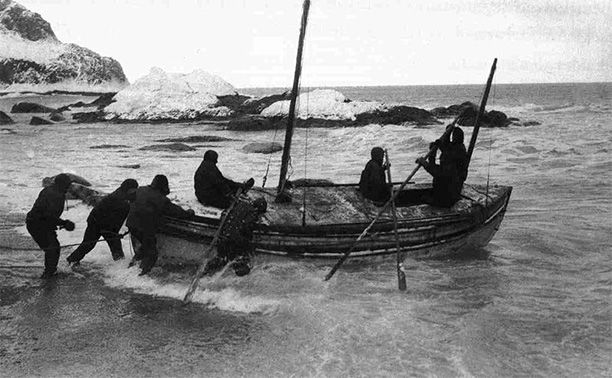
Towards the end of March, 1916, they drifted past the tip of Graham Land, having sighted Joinville Island and been only sixty miles from Paulet Island. Shackleton’s attention was now turned to his three boats, the James Caird, the Stancomb Wills and the Dudley Docker, so called after three of his chief benefactors. At the end of March the last of the dogs were shot and the sledges abandoned in preparation for launching the boats towards Graham Land. The situation now became increasingly dangerous. The men might drift helplessly into the Atlantic if they could not make a landfall before the South Orkneys were passed. They now headed towards Elephant and Clarence Islands and one of these seemed to present their best chance of survival. Shackleton took command of the James Caird and gave Worsley and Hudson that of the Dudley Docker and the Stancomb Wills respectively. On April 9th tents were struck everything was ready for the launching of the boats as soon as the open sea was reached.
At this point Shackleton came near to losing one of his men. It was 11 o’clock that evening when a floe cracked where Holness was lying. ‘The Boss’ himself rushed across and fished him out of the freezing water and, on being asked how he was, Holness merely complained that his tobacco had sunk with his sleeping bag. Throughout the remainder of the night the man was kept on the run up and down the floe for he had no other clothes. Shackleton ordered hot milk and nut food to be served and everyone sat around the fire until dawn. Although Holness was exhausted by his enforced exercise and his clothes were caked with a thin film of ice, he had at least survived the possibility of freezing to death.
The ice floe on which the party spent the last two days at Patience Camp became so fragmented by the warmer seas that it was no more than 90 by 100 by 120 yards and even this was to split again, as Shackleton related in South:—
“Soon after breakfast the ice closed again. We were standing by, with our preparations as complete as they could be made, when at 11 a.m. our floe suddenly split right across under the boats. We rushed our gear on to the larger of the two pieces and watched with strained attention for the next development. The crack had cut right through the site of my tent. I stood on the edge of the new fracture, and, looking across the widening channel of water, could see the spot where for many months my head and shoulders had rested when I was in my sleeping bag. The depression formed by my body and legs was on our side of the crack. The ice had sunk under my weight during the months of waiting in the tent, and I had many times put snow under the bag to fill the hollow. The lines of stratification showed clearly the different layers of snow. How fragile and precarious had been our resting place! Yet usage had dulled our sense of danger. The floe had become our home, and during the early months of the drift we had almost ceased to realise that it was but a sheet of ice floating on unfathomed seas. Now our home was being shattered under our feet, and we had a sense of loss and incompleteness hard to describe.”
On the night of April 10th they had to take to the boats, perched precariously on the floe, where the men lay with the temperature at —4°F and with whales swimming to within an uncomfortable distance of them. For those who did not later take part in the legendary voyage from Elephant Island to South Georgia, the next few days were the worst of the whole expedition. Each time a new crack appeared across the floe a pool of water welled up and floated them clear of imminent disaster. Again and again during the terrible day before they reached the open sea they were saved by this phenomenon of the current. And when at last a pool became big enough, Shackleton ordered. “All right, launch the boats, chuck in the stores anyhow, get in the centre of this patch of water”. Everything was properly stowed and after negotiating two more channels between the floes the exhausted men reached the sea. “I think it was the most marvellous thing that’s ever happened”, said Commander Greenstreet, recalling the incident over forty years later, Hussey said, “We put such absolute faith in the Boss that we knew that if anybody could get us through he’d get us through, and we just did everything he told us. We didn’t worry about anything else.”
But the party had yet to make a landfall which they eventually did after three more days at sea. On April 15th, after the Dudley Docker had become separated from the others, the three boat crews found each other again as they approached a sheltered bay on Elephant Island. It had been an anxious moment. After sea sickness and exposure in heavy seas the men somehow managed to pull the boats ashore. James recorded in his diary:
“Most people were, I think, in a semi-hysterical condition and hardly knew whether to laugh or cry. We did not know, until it was released, what a strain the last few days had been. We took a childish joy in looking at the black rocks and picking up the stones for we had stepped on to no land since December 5th 1914.”
But Shackleton was not satisfied with the spot they had found as a site for their camp, and after allowing his weary men twenty-four hours of eating and sleeping he set about finding a more suitable place. Eventually the boats were rowed to a nearby sandy spit which Wild had discovered and there the tents were set up. The place was named Cape Wild.
Shackleton saw that help was now essential. Food supplies were dwindling and, with the oncome of winter and the return of the ice, seals would become scarce. Port Stanley in the Falkland Islands, 550 miles away, was the nearest harbour, but a boat journey in the face of the north-westerly winds would be impossible. The only alternative was South Georgia which, although it was 250 miles further, could be more easily approached on account of the prevailing wind. It was also known to have several whaling stations around its shores. But the seas of the extreme south Atlantic were the worst in the world during May and with the twenty-foot James Caird, which seemed to have shrunk when Shackleton saw it in its new role of deliverer, the journey would be extremely hazardous. The ‘Boss’ had decided to take Worsley, for he was a superb navigator, and to leave Frank Wild in charge of the party on Elephant Island with instructions to lead them to Deception Island in the event of the boat party’s failure to reach South Georgia. Six men would be taken in the James Caird and for the rest of his crew Shackleton called for volunteers. Eventually he decided upon McNeish, the carpenter, McCarty and Vincent, all experienced seamen, in addition to himself, Worsley and a man named Crean, a petty officer who had been on Scott’s last expedition. The continuing storm prevented Shackleton from setting sail and, when the weather conditions had subsided, McNeish was ordered to make the small boat as seaworthy as possible for its coming ordeal.
During this time, a small incident occurred which showed the leader’s deep understanding of men near the end of their physical endurance. Green, the cook, suddenly collapsed. The strain on him, particularly since the men had arrived on Elephant Island, had been very heavy and he had not failed to provide a meal whenever it had been ordered for his hungry and exhausted companions. A replacement was needed immediately and Shackleton relates his decision with poignant brevity in South:—
‘ ... Then I took out to replace the cook one of the men who had expressed a desire to lie down and die. The task of keeping the galley fires alight was both difficult and strenuous, and it took his thoughts away from the chances of immediate dissolution. In fact, I found him a little later gravely concerned over the drying of a naturally not over clean pair of socks which were hung up in close proximity to our evening milk. Occupation had brought his thoughts back to the ordinary cares of life.’
At mid-day on April 24th the James Caird left Elephant Island on her solitary voyage to South Georgia, and the six men were now embarking upon the climax of their abortive yet victorious expedition. Shackleton divided his crew into two watches of four hours on and four hours off. Of the thee men on duty, one held the tiller, the second watched the sail and the third bailed. The movement of the men to their respective stations was ordered individually by Shackleton because the simultaneous shifting of everyone would have caused catastrophic confusion in such a confined space. Although a tarpaulin covered the fo’castle, and the sides had been built up to a height of seven and a half feet, the water in the bottom of the boat made the prospect of being off duty almost bleaker than that of being on. The only dry spot was right up at the bows where the precious biscuits were stored.
Even in these conditions Shackleton insisted on regular meals. At eight o’clock in the morning Bovril hoosh, two biscuits, nutfood and sugar were eaten. Worsley described the routine thus:
“Crean pricked and lit the ‘Primus’ and put his back against one side of the boat while I put mine against the other. We extended our legs towards each other till we could jam the ‘Primus’ between our feet. Any deficiency in the length of my legs was made up for by Crean’s excess. In this way we held the ‘Primus,’ firm on its base. ... My unworthy hands held the aluminium cooker that was to receive the sacred hoosh, and my duty as a scullion was swiftly, but reverently, to raise it on high whenever the boat gave a madder leap than usual, and so save the precious contents from spilling in the bilges or the ‘Primus’ flame. At the bidding of Crean, the High Priest of Cookery, and tender of the Sacred Flame, Macarty broke in the lumps of ice and stirred the ration. When melted, Crean himself broke up and stirred in the ration— half a pound a man. All eyes, save the helmsman’s, were glued on the cooker; hoosh pots and spoons were ready. As soon as it boiled Crean shouted ‘hoosh’ and blew out the ‘Primus’. The pots shot forward, Crean rapidly, but carefully, filling them in turn. We swallowed it scaldingly hot, having gradually trained mouths, throats and stomachs to a pained acquiescence. So we felt the glorious heat going right through our chilled, numbed bodies and limbs, putting new life into us. The first to finish his hoosh jumped outside and relieved the helmsman so that he might take his while it was still hot.”
Shackleton and Worsley had decided to steer the boat in a northerly direction for as long as possible so that they would have a smoother approach and a more certain run in toward South Georgia, and in this estimate they were remarkably correct. But the sea grew steadily worse as the voyage progressed. After a week Vincent and McNeish, the latter a man of fifty, began to show signs of tiring, despite their determination. McCarty’s optimism increased with every danger and Worsley remembers his habit of handing over the helm with the remark, “It’s a fine day, Sorr!” For Shackleton, a distinct memory was Crean’s tuneless chanting as he manned the tiller.
During the second week, ice settled thickly on the boat and it was necessary to chop it off — a precarious job as the little craft was lifted, crashed and buffeted by the huge waves. As it approached land it was hit by a cross sea and Shackleton wrote at this stage in South of the biggest wave be had ever seen in his twenty-six years’ experience of the sea in all its many moods. The stove wallowed in the flooded bilge and it was two hours before it could be relit. The men’s skin was chafed and they were beyond the point where human endurance could normally be thought possible. Taking a sight, Worsley reckoned that they could not be more than a hundred miles from their destination. Water supplies had dwindled and each man was reduced to half a pint a day. Thirst was now a constant torture.
At last, at 12.30pm on May 8th, after fourteen days in the boat, McCarty sighted the cliffs of South Georgia. But the perilous task of landing in rough weather occupied a whole day of navigation along the coast. At last, when the gale had momentarily subsided, they were able to make a landing in a small cove. Having drawn up the boat, the men made for the rocky shelter, numbed and cramped by their ordeal with the sea. After a hot meal had been served, Shackleton took the first watch and having arranged a rota of hourly duty turned in himself. The next day he and Crean found a colony of albatrosses with their chicks. Four of the young birds with a Bovril stew made a wonderful change from seal blubber, hoosh and penguin’s legs. It was truly a succulent feast.
There now remained the last stage of their miraculous odyssey—the journey overland to Stromness Bay, the whaling station, where rescue could certainly be sought. At 1 o’clock in the morning on May 19th, with a full moon to guide them, Shackleton set off with Worsley and Crean while McCarty stayed behind to look after McNeish and Vincent. This was to be the first time man had ventured across the rugged country of South Georgia. By dawn the three men had climbed 3,000 feet from where they hoped to be able to see their route across the rough mountainous plateau. From here they gauged their position by orientating their chart with the situation of the tiny bays below them and, returning to the glacier above their camp, they took a bearing and made for a ridge between two peaks. After three abortive starts across the island they eventually headed in the right direction.
On the morning of May 20th they approached Husvik Harbour, twelve miles from Stromness. A steep snow slope, which demanded careful step-cutting as they descended it, and a deep snow plateau, where the men nearly sank into a hidden lake, were successfully crossed before the disinherited nomads gazed down in wonder at the whaling station below them. This was their first sign of human life outside that of the expedition since they had left that same bay in December, 1914.
Several of the inhabitants of the little station fled as they saw the three tattered figures approach. The manager, who had long thought the Imperial Trans-Antarctic Expedition to have vanished in the ice, was bewildered when one of the three men who now stood in his office introduced himself as Shackleton. As soon as it received word from Stromness the Chilean Navy sent a tug, the Yelcho, to Elephant Island, but not until the fourth attempt, at the end of August 1916, was she able to cross the heavy seas to reach the marooned men.
But how, meanwhile, had Wild’s men managed to survive the bleak conditions as winter approached? They had built one of the upturned boats on to a stone foundation and in this cramped hut, measuring ten by eighteen feet, the twenty-two men had spent four months. However uncomfortable these conchtions may have been, Wild’s organisation ensured that his party lived as orderly a life as possible. A man called Blackborrow had to have the toes of one foot amputated—an operation which Macklin and Mcllroy carried out with complete success. Hudson had collapsed while they were in the boats, and the First Engineer, Rickinson, had a strained heart. By the time relief came the food was virtually finished and boiled seaweed had become part of their diet.
But on the morning of August 30th at lunchtime Marston, who was standing outside, suddenly yelled: “Ship 0!” Everyone thought that he had called the more familiar cry, “Lunch O !“ and he had to run down the shore to the hut and repeat his cry before the rest, slowly understanding the full significance of what he had said, burst out of the hut, knocking over their hoosh, and gazed incredulously at the sight of the Yelcho. But thinking for a moment that it was about to turn away, Wild and a few others seized that last drum of petrol which they lit atop a neighbouring rise, Penguin Hill. Old rags soon made a beacon flame. To supplement the frozen flag, Macklin sent his jersey up the mast. As the vessel approached, a boat was lowered and Shackleton himself was seen to stand up. The boat drew nearer and he addressed Wild, “Are you all well ?“, to which Wild replied, “All safe, all well”. Hussey described the men’s reaction to Shackleton’s return: “Thank God the Boss is safe!”
The rescue of the party on the Ross Sea coast under Lieutenant Stenhouse, the First Officer of the Aurora, duly followed. The story that he and his ten men had to tell of their encounter with a blizzard which caused the ship’s ice moorings to part, and of their nine-month rudderless drift in the ice, was scarcely less amazing than Shackleton’s. By January, 1917, the expedition had collected together in New Zealand without the loss of a single life.
Not histrionics but steady and constant leadership saved Shackleton and his men. Fine words, glib phrases and a poetic finale are therefore out of place here. But these words may be excused a slight flamboyance for they are as Shackleton himself, the survivor of an experience that overwhelmed pretence, wrote them in South:
‘We had pierced the veneer of outside things. We had ‘suffered, starved and triumphed, grovelled down yet grasped at glory, grown bigger in the bigness of the whole’. We had seen God in His splendours, heard the text that nature renders. We had reached the naked soul of man ...'
Michael Langley has visited several African countries and lived in Nigeria and Zambia where he was a District Officer. Since his return to England, he has written many articles on African affairs and has broadcast talks for the BBC. He contributed articles to History Today in June and December last year. He is a member of Gray’s Inn.


