Despite popular misconceptions and its aristocratic origins, for part of its history opera was inextricably linked with popular culture – no more so than in the 1920s.
In contemporary Britain, both the broadsheet and tabloid press routinely stereotype opera as ‘elitist’. On the rare occasions when opera singers are interviewed on breakfast television or radio, they are invariably asked to defend their art against the dreaded ‘e-word’. The cliché evokes certain key themes: that opera is posh, expensive and removed from real life. It is routinely characterised as a pursuit for the privileged: boozy corporate sponsors who listen to fat, horn-helmeted ladies in opulent surroundings but care little for the music. The supposed tension between the ‘aloofness’ of opera and the ‘authenticity’ of everyday life provides fodder for parody but is a turn-off for potential new audiences.
Register to read more articles for free.
When you register, you will receive the History Today newsletter. Click here to read our Terms of Use.
Despite popular misconceptions and its aristocratic origins, for part of its history opera was inextricably linked with popular culture – no more so than in the 1920s.
In contemporary Britain, both the broadsheet and tabloid press routinely stereotype opera as ‘elitist’. On the rare occasions when opera singers are interviewed on breakfast television or radio, they are invariably asked to defend their art against the dreaded ‘e-word’. The cliché evokes certain key themes: that opera is posh, expensive and removed from real life. It is routinely characterised as a pursuit for the privileged: boozy corporate sponsors who listen to fat, horn-helmeted ladies in opulent surroundings but care little for the music. The supposed tension between the ‘aloofness’ of opera and the ‘authenticity’ of everyday life provides fodder for parody but is a turn-off for potential new audiences.
The stereotypes that surround opera not only fail to represent the diverse reality of contemporary opera-going – opera in a pub, anyone? – but are also oblivious to the art form’s rich historical relationship with so-called ‘real life’. It is true that opera emerged at the turn of the 17th century as a form of private aristocratic entertainment, performed in the palaces of Italian dukes and princes as a way of displaying their wealth to political rivals. But such origins became an irrelevance within a matter of decades: by the 1630s, Venetian entrepreneurs who had staked their money on the new commercial business of opera production competed with one another to get bums on seats. Operas about ancient gods, calculated to flatter the art form’s earliest patrons, soon gave way to works that critiqued traditional power structures and aristocratic excess. By the 19th-century age of realism, operas about ordinary people had become the norm, addressing all of life’s big issues: love, death, war, poverty, politics and more.
Anti-intellectual
Throughout its 400-year history opera has engaged with popular culture in numerous ways. Indeed, in countries such as Italy and Germany, which historically had an opera house in every town, it would not be an exaggeration to say that opera was regarded – at least until recently – as popular culture. Attitudes towards opera have always been more hostile in Britain than in Continental Europe, the result of a complex mixture of anti-intellectualism and a suspicion of things foreign (opera never really took off in Britain as a ‘native’ art form). Yet, even there, opera and popular culture have enjoyed a close and fruitful relationship. This point is particularly well illustrated by examining a pivotal moment in the development of the modern British entertainment industry: the 1920s.
After the First World War, operatic culture in Britain faced more challenging circumstances. Financial difficulties – particularly the introduction of the Entertainments Tax in 1916 – forced many of the touring companies to disband, although a few significant ensembles kept the show on the road. Money and interest were also increasingly being diverted into other activities. Jazz clubs, dance halls and picture palaces all offered new and exciting distractions for a public that had more leisure time and disposable income than before the war. Various forms of spectator and participatory sport were also enjoying what contemporary commentators referred to as ‘booms’ and there was now amusement on tap for those who preferred to stay at home and listen to the wireless. Musical theatre troupes started to draw audiences away from the productions by the touring opera companies and even poached some of their singers. Gloomy voices in the music establishment began to predict the total decline of opera as an art form. Opera, however, proved itself to be perfectly capable not only of surviving these challenges but of finding innovative ways of connecting with the very forms of popular culture that seemed to threaten it.
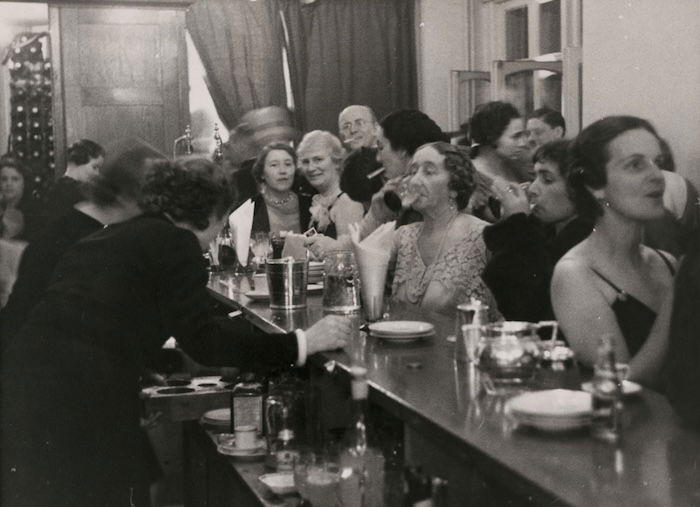
At the bar at the Covent Garden Opera in London, Erich Salomon, 1936. Berlin Gallery, Museum of Modern Art. Public Domain.
On the face of it, the biggest challenge to opera during the 1920s was cinema. At the end of 1929, the middlebrow magazine, Musical Mirror, published a cartoon in which a film producer asks an auditioning opera singer ‘Are you accustomed to singing without an audience?’, to which the singer replies sadly, ‘I am! That’s what brought me here.’ The problem was, of course, an international one: in 1926 Musical News and Herald characterised the Italian opera industry as an old lady in high dudgeon at having been abandoned ‘for the fresher charms of Miss Cinema newly arrived from America’. Cinema posed a threat to all forms of live entertainment, not just the ostensibly ‘higher’ forms of opera and serious theatre: of the 3,300 cinemas that are estimated to have been established in Britain by the end of the decade, many were converted from music halls.
Exaggerated gestures
The relationship between opera and early film was closer than is commonly assumed. When the ‘talkies’ were introduced in the 1930s, film composers borrowed liberally from the musical language of opera – Wagner was a particularly strong stylistic influence – just as they have continued to do to the present day. But film’s debts to opera were numerous even before the advent of the motion picture soundtrack. The exaggerated, melodramatic gestures that typify silent movie acting were borrowed from opera, particularly from the verismo aesthetic of the 1890s and 1900s. And, bizarre as the idea might seem, film studios actually made numerous silent films of operas, or scenes from them. Opera singers in the cinema auditorium were hired to sing along with the projection, as well as performing arias before the screening.
Debates also took place in the 1920s music press about the ways in which film techniques might be incorporated into operatic performance. Prophetically, it was widely anticipated that film technology might at some point in the future be used as a scenic device. There were also discussions about the possibility of projecting the words of an opera onto a screen beside the stage, rather like the intertitles used in a silent film. The idea was not to provide a translation – operas were almost always sung in English anyway, except at Covent Garden – but simply to aid audibility. The concept was picked up with curiosity in the music press, if not with unanimous enthusiasm: some critics viewed it as a democratising strategy, others as an indictment of singers’ diction. Surtitles were not in practice adopted in opera houses until the 1980s and the debate about their desirability continues to rumble on today. English National Opera’s use of surtitles for performances of operas in English regularly prompts arguments on social media and angry letters to the pages of Opera magazine.
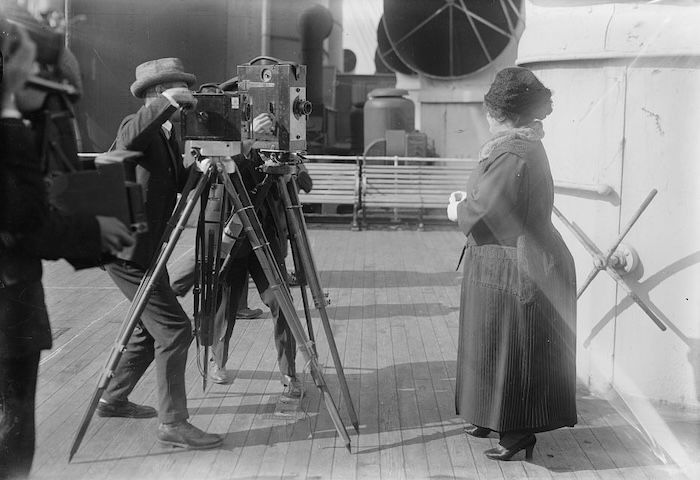
Opera singer Luisa Tetrazzini in fropnt of the cameras, c.1915-20. Library of Congress. Public Domain.
Journalists of the 1920s regularly asked high-profile singers whether they might be tempted to pursue a career in film. Some were open about their ambition, however unlikely it was to come to anything. In 1923 Luisa Tetrazzini confided to an interviewer that her greatest ambition was to be a film actress and, specifically, to appear in a Western alongside the actor William S. Hart. Musical Mirror responded by publishing a cartoon of her dressed as a cowboy and shooting a gun, headed ‘The girl of the golden West’, a pun on Puccini’s opera of the same name. The idea of the ageing and ample-figured Tetrazzini becoming a film star was far fetched, but glamorous young singers in the United States were already appearing on the silver screen: Geraldine Farrar, for example, had starred in Cecil B. DeMille’s Carmen, a silent film of 1915.
Female opera singers – the original divas – had been central to 19th-century celebrity culture and were household names. By the 1920s there was speculation that the prima donna might be losing the éclat she had enjoyed in earlier times, becoming increasingly overshadowed by new types of celebrity, such as film or sports stars. Nellie Melba, the Australian soprano, was reportedly furious at having to share the limelight at a society luncheon with Suzanne Lenglen, the first female tennis celebrity, notorious for her short skirts and daring behaviour. In reality, however, opera singers maintained their star status throughout the 1920s: audience members still camped out overnight to hear Melba sing at Covent Garden.
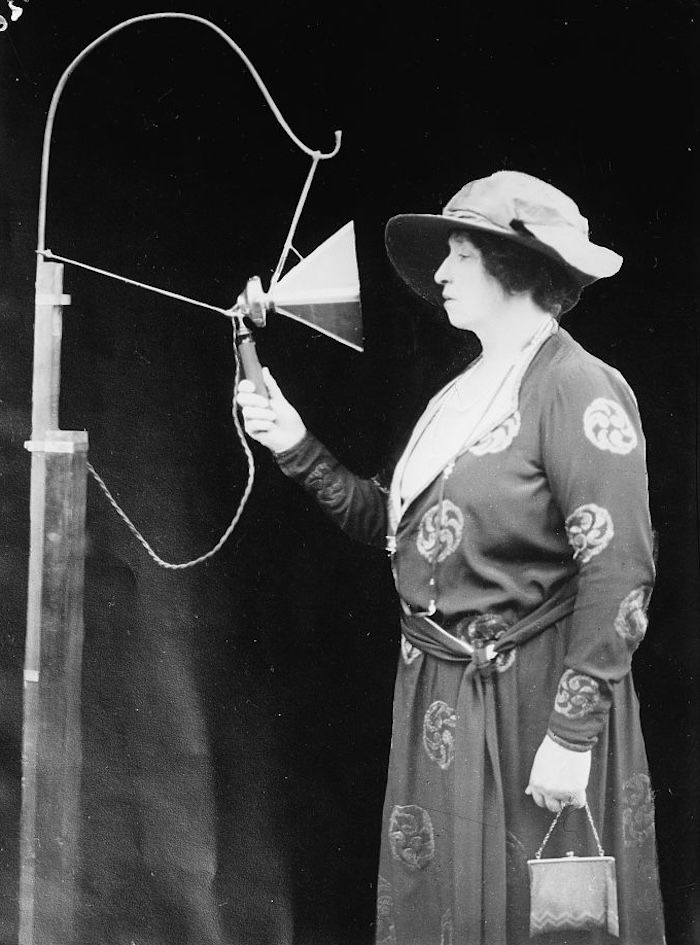
Nellie Melba broadcasting a live recital in on the wireless, 15 June 1920. Library of Congress. Public Domain.
Opera singers provided fodder for the human interest stories that were such a distinctive feature of the burgeoning popular press. Newspapers such as the Daily Mail and the Express published a surprising amount of serious opera criticism during this period. The more popular press, such as the Daily Mirror, also reported operatic news but were more interested in how much stars were paid, their fashion choices and, in particular, any instances of diva-like bad behaviour. A notorious ‘spitting’ incident in Vienna, involving the temperamental Maria Jeritza and a fellow cast member whom she had insulted, received particularly high-profile coverage across the press.
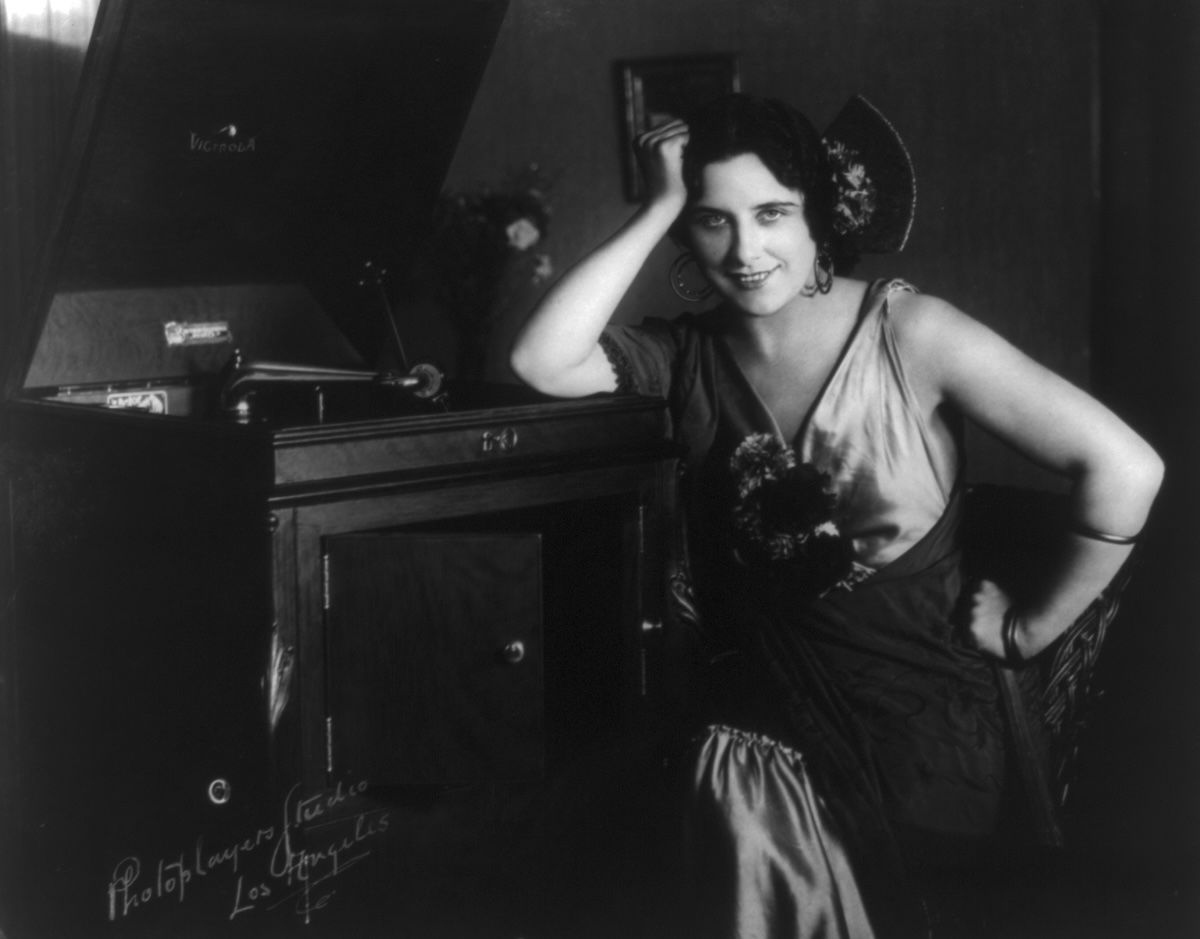
Although classical and popular music were becoming more distinct categories after the First World War, it remained common for opera stars to perform a mixture of different types of music both in the concert hall and on disc. Popular ‘celebrity concerts’ at venues such as the Royal Albert Hall featured a mixture of operatic arias and popular ballads, similar to the present-day ‘crossover’ phenomenon. Opera singers were the original stars of the early recording industry: the sales figures Enrico Caruso achieved and the money he made from recordings were phenomenal. His 1902 recording of ‘Vesti la giubba’ from Leoncavallo’s I Pagliacci was the first to sell more than a million copies. And the press promoted recordings by the Italian-American soprano Amelita Galli-Curci – the biggest recording star of the early 1920s – as the latest ‘must-have’ commodities.
Beginners’ guides
Jazz and opera might appear to sit at opposite ends of a musical spectrum but in reality there were points of connection between the two during this period. The new European jazz operas, such as Ernst Krenek’s Jonny spielt auf (first performed in Leipzig in 1927), were the talk of London, even though they had not yet been heard in Britain. There were signs of an emerging jazz-opera movement gradually making its way over from the US: many ragtime songs made reference to operatic subjects and borrowed operatic tunes. There were even reports in 1923 of Giacomo Puccini seeking damages for plagiarism after learning that melodies from Tosca and Madama Butterfly had been reworked as foxtrots. Refreshingly, there was no fixed notion during the 1920s that opera-going was limited to a particular sector of society. There was widespread interest in and curiosity about opera: numerous beginners’ guides to opera were published and critics’ reviews even appeared in books. As Jonathan Rose has shown in his study The Intellectual Life of the British Working Classes (2001), there was an early 20th-century working-class intelligentsia that was keenly interested in all kinds of ‘high culture’. London’s Old Vic theatre, where tickets were cheaply priced and nobody wore evening dress, had a loyal, solidly working-class audience during the 1920s. Audiences greeted their favourite singers with cheers, rather than reverent silence, and the atmosphere was one of fun.
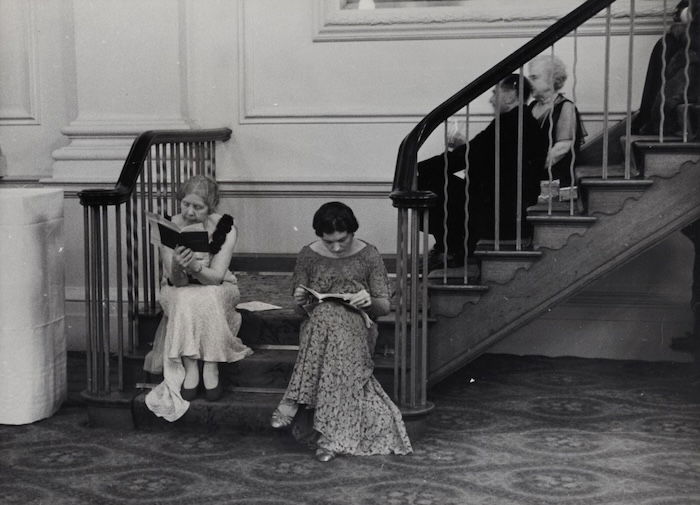
The audience during the interval at the Covent Garden Opera in London, Erich Salomon, 1936. Berlin Gallery, Museum of Modern Art. Public Domain.
Another example of ‘popular opera’ was the residence by the O’Mara Company at the Alexandra Theatre in Stoke Newington in January 1926. The Alexandra was a huge, draughty, multi-purpose theatre, more often used for variety acts than opera. What is extraordinary is that the company was performing each opera twice, back to back, in an evening, which must have taxed its cast to the limits. It was a practice that had been borrowed from music hall: the ‘twice nightly’ system was pioneered by the Stoll-Moss empire of music halls during the late 19th century and allowed the company to pack in double the number of audience members without necessarily paying the performers twice.
There were, then, numerous reciprocal influences in 1920s Britain between so-called ‘higher’ and ‘lower’ forms of entertainment. But were such terms really appropriate anyway? Discussions during this period about whether opera was highbrow, middlebrow or even lowbrow were long, convoluted and often inconclusive, as the terms were used differently, depending on context. It is certainly the case, however, that opera’s enthusiastic boundary crossings and the ways in which it rubbed shoulders with film, jazz, variety acts and popular fiction made it difficult to pigeonhole. Understanding opera’s fluid relationship with popular culture – both past and present – is key to scotching the clichés about opera being forbidding, inaccessible and class-bound. But, in all probability, the peddlers of stereotypes will never want to know.
Alexandra Wilson is Reader in Music at Oxford Brookes University and Co-Director (with Barbara Eichner) of the OBERTO opera research unit.