

This Is Not a Love Story
The correspondence between Mary Hamilton and the future George IV is often seen as evidence of a harmless crush in the Georgian court. It was nothing of the sort.
The correspondence between Mary Hamilton and the future George IV is often seen as evidence of a harmless crush in the Georgian court. It was nothing of the sort.
The correspondence between Mary Hamilton and the future George IV is often seen as evidence of a harmless crush in the Georgian court. It was nothing of the sort.
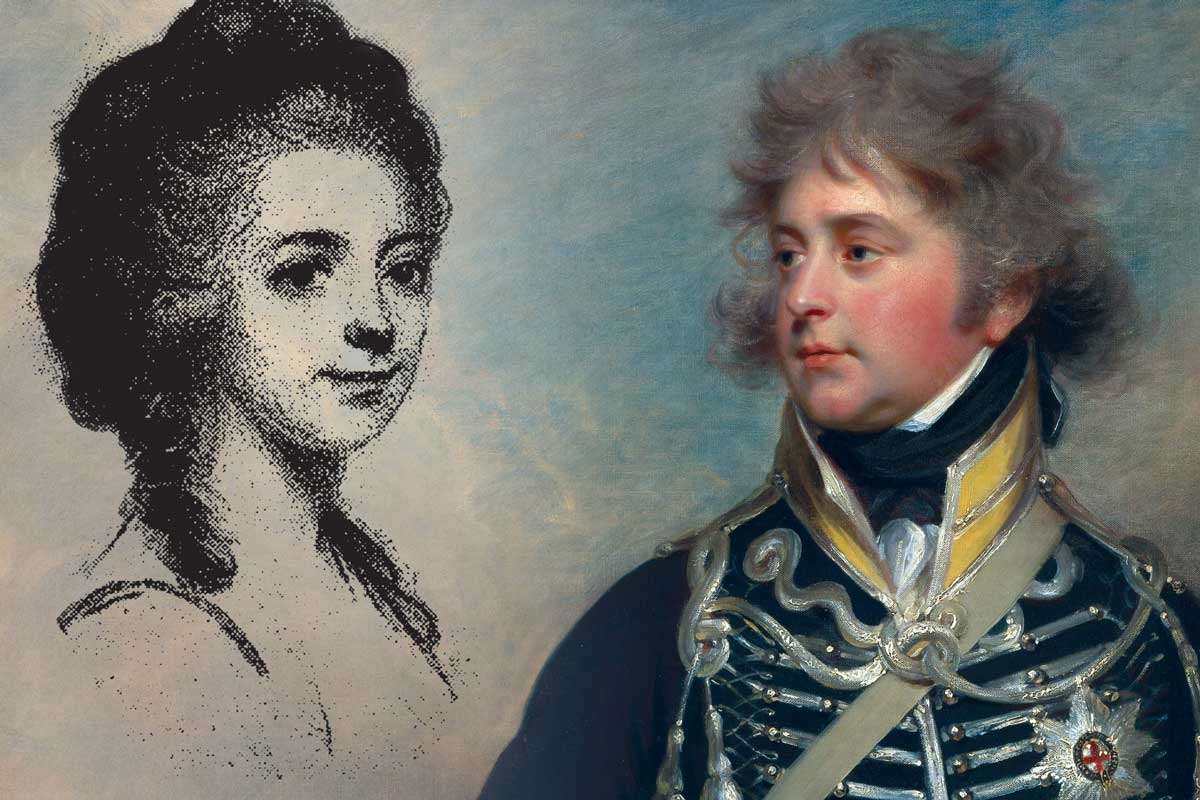
George IV has never been the most popular of British rulers. Historians have passed severe judgement on his spendthrift habits and mistreatment of his wife Queen Caroline. In 2008 he had the dubious honour of being voted ‘Worst British Monarch’ in a poll for English Heritage. The defining image of the prince regent in the public consciousness probably remains Hugh Laurie’s portrayal of a dim-witted, infantile cad in Blackadder the Third.
But if any episode in George’s chequered personal life has tended to wring a drop of affection and indulgence from biographers, it is his infatuation with one of his sisters’ attendants at the age of 17. In his landmark biography, written in 1977, Christopher Hibbert described the adolescent prince’s letters to 23-year-old Mary Hamilton as evidence of his ‘love’ and ‘devotion,’ which were unreciprocated by a ‘cautio[us]’ Hamilton but led to no serious consequences for either party. The prince’s attachment, according to Hibbert, eventually mellowed into feelings of platonic affection, which Hamilton returned. And, he suggested, the two stayed on friendly terms for many years afterwards. More recent biographers have echoed Hibbert’s narrative, focusing with traces of amusement on the prince’s sentimental declarations and only very briefly mentioning Hamilton’s response (‘pious’ and ‘proper’, in the words of Stella Tillyard in 2019).
The main evidence for this view is a series of 139 letters written between Hamilton and the prince over the year 1779 (61 of them in Hamilton’s hand, 78 in the prince’s), which were collated by Hamilton herself and which are now held at the Royal Archives. The Royal Collection Trust describes the collection as ‘love letters’ and popular media coverage of the letters’ digitisation in 2019 jocularly described the prince as ‘lovelorn’ and Hamilton as his ‘secret crush’. There is an implication in this coverage, as in the biographies of George IV, that the episode shows a softer side to the young man who would go on to become the depraved prince regent and unloved monarch.
Such an approach only tells half the story. If Hamilton’s voice is given equal weight with the prince’s, then whatever the pursuit meant to the teenage George, from her perspective it looks remarkably like unwanted sexual harassment. The relentless attentions of her future monarch caused her acute distress and discomfort and left her with feelings about him that were far from friendly.
Hamilton’s own letters and diaries reveal the resourceful ways she kept her admirer at arm’s length to preserve her precious reputation intact. They can tell us a lot about gendered court politics of the late 18th century and the ways that women in such an environment might have coped with unwanted attentions from male superiors. They also prompt us to ask what responsibility we have to amplify new voices from the archives and reshape our national history.
Mary Hamilton, six years older than the prince, was a young lady of noble family but relatively slender financial resources. Much to her surprise, in June 1777 she was invited to court by Queen Charlotte to act as sub-governess to her elder daughters. Two years into this appointment Hamilton was vulnerable and depressed. As well as struggling beneath the weight of her duties, she had recently lost her mother (her father had died some years before) and no fewer than five close friends aged under 40 years old. This was the moment when she caught the 16-year-old prince’s eye and he began to write to her. In a letter of 25 May, he quickly gets to the point:
Your manners, your sentiments, the tender feelings of your heart, so totally coincide with my ideas, not to mention the many advantages you have in point of person over many other Ladies, that I not only highly, esteem you, but even love you more than Words or ideas can express.
Five days seem to have passed before Hamilton replied to the prince’s bombshell. One can imagine that she had to balance a number of considerations in drafting a response. Obviously, she would have wanted to avoid offending or alienating the future king – but she would have been acutely conscious, too, of the dangers of seeming to lead him on. Severe double standards operated in Georgian high society around the chastity of young men and women and the ton could be ruthless to young women whose virtue was in question. Any whisper of an illicit liaison with the prince would have cast Hamilton as an immoral gold-digger, incurred the wrath of the king and queen, shocked and alienated her friends and tarnished her social capital and marriage prospects for good.
Hamilton seems to have decided that honesty was the best policy. On 30 May she responds to the prince’s declaration with a firm negative: ‘I can without injuring my honour accept Your friendship – to listen to more I should justly forfeit the esteem you say you have for me.’ The prince seems, at first, to accept the rejection. On 1 June he replies promptly:
As you say you can not consistently with your honour listen to such proposals, I take heaven itself to Witness that I will not intentionally do anything which I think will displease you, and therefore I will as seldom as possible touch upon a subject which is painful to you.
But, if Hamilton hoped that would be the end of the matter, she was to be cruelly disappointed. Despite his promises, the archive shows that the prince continued to bombard her with letters – carried to her secretly via a mysterious ‘Messenger’ – almost every day over the summer of 1779. He pesters her to cheer up from the ‘melancholy’ she suffered after the deaths of her mother and her friends. He persists in sending her gifts – a toothpick case, a smelling bottle and a bracelet – despite her firm request that he refrain from doing so. Ignoring her pleas for discretion, he sends her twice weekly bouquets of flowers. He pesters her for a lock of her hair: ‘I shall keep it in your absence as the representative of my dear friend & love it accordingly.’ He admits sneaking into her apartments to touch and kiss her possessions. He grills her about where she has been and whom she has seen on her occasional days off. He becomes jealous of her male friends, such as Francis Lord Napier, whom she had known from childhood.

Most dramatically, and unfairly, when Hamilton mentions that she wishes to leave her court post, the prince threatens repeatedly to kill himself if she goes. For good measure, he also hints that he would have no choice but to ‘display the Agonies I should feel’ at her departure – which would of course convince the world that there had been an affair between them and thereby ruin her reputation anyway. He also reports to Hamilton malicious court gossip that he hears about her (including a gentleman disparaging her looks and a lady drawing a mean-spirited cartoon of her as a toad eater, or over-obsequious dependent). On one occasion, he seems to have hinted that he was her only friend in the world.
Unsurprisingly, the prince’s attentions, threats, ultimatums and attempts to undermine her confidence make Hamilton unhappy. She seems to have felt it beyond her power to ignore George’s letters, or to show them to the queen. But she frequently worries about the consequences of the correspondence for her reputation, should it be discovered:
I am tortur’d with some uneasy reflections which I cannot stifle … remember Sir my fame is dearer to me than life. for however innocent the motives which influence, the world would naturally … put a cruel construction upon a secret & clandestine correspondence were it ever to transpire.
She had good reason to worry, since the prince seems to have gossiped about his admiration for Hamilton to a Page of the Back Stairs called William Ramus. Such indiscretion caused Hamilton immense anxiety. Particularly poignant is one letter of the prince’s admitting that a letter he had received from Hamilton (now lost) was stained with tears that she shed as she was writing – and that his behaviour was probably the cause of her misery.
Despite this unhappiness, throughout the correspondence Hamilton responds to the prince’s volatility with admirable calm and resourcefulness. While never swerving from her emphatic rejections of his advances, she does employ a range of shrewd and creative strategies to appease his pique, encourage his discretion and cover her back in case of discovery. She keeps careful records of the correspondence, filing the prince’s letters by date and instructing him to return or burn her own (he seems to have preferred the former option on many occasions, since Hamilton ended up in possession of 61 of her own letters, as well as 78 of his). She returns the gifts he sends her. She is also careful to state repeatedly in writing her objections to his pursuit and to remind him explicitly of his station in life:
You forget surely that Providence has placed you in a situation which it is, & will be your duty to support in every respect, & act up to in every instance.
She also praises his parents (her employers) with great fervour.
By the autumn Hamilton seems to have found a new and interesting way to insulate herself from the prince’s attentions. She cast herself in a new role: as his severe moral adviser. In August he had asked her to ‘make all the remarks you can upon my conduct, give me all the advice you can’. Over September, October and November, Hamilton takes him at his word. She provides a ‘terrible black list’, reprimanding the prince severely about his bad language, vanity and susceptibility to flattery, tendency to boast and ignore advice and extravagant, foppish dress sense (she was particularly offended by his tight shoes and ostentatious shoe buckles). She recommends that he read moral essays about the impropriety of swearing and pours cold water on his enthusiasm for racy novels.

This persona of stern instructor seems to have offered Hamilton some respite from the romantic role in which the prince insisted on casting her – to give her, in other words, a part that she felt comfortable playing. Although occasionally she suffers from ‘a melancholy apprehension’ of trouble and disgrace, her correspondence with the prince from November and early December feels generally more relaxed than it had been. Though frequently scolding or reproaching him for his shortcomings, she appears at some moments genuinely to value his friendship and fear the loss of it: ‘When you cease being interested about me tell me so that I may not run the hazard of having my pride mortified by your contempt.’ She also, for the first time, sends him an unsolicited gift: ‘a Ring set with Brilliants’. He thanks her in emotive terms for this present on 4 December – but the very next day he wrote her a letter that would change the course of their correspondence and mark the beginning of its end.
‘I was delighted at the Play last Night’, the prince writes to Hamilton on 5 December, ‘& was extremely moved by two scenes in it, especially as I was particularly interested in the appearance of the most beautiful Woman, that ever I beheld.’ This was the actress Mary Robinson, an extraordinarily interesting woman in her own right and in later years a very talented poet. The prince admits later in the letter that he has seen her both on and off the stage and considers himself to be in love. He declares his intention to tell Hamilton ‘every thing relating to this affair’ and finishes the letter imploring her to ‘pardon … pity … [and] comfort’ him. Also, not to tell his parents.
Hamilton’s response to this declaration, dated two days later, is concerned but not unsympathetic. In subsequent letters, however, her tone quickly becomes markedly more negative, probably because she had learned what the prince knew all along – that Robinson was already married, with a child. She implores George not to ‘lay yourself open to the world in a character to which you would blush to sign your name’. But the prince shows himself, all of a sudden, newly deaf to her advice. He brushes aside her concerns by asserting that Robinson is unhappy in her marriage (which was true) and jokes about her other lovers, such as his friend Sir John Lade. He also starts to excuse himself for not writing to Hamilton more often or at greater length.
By the middle of December Hamilton seems to feel that it would be best to put an official end to the correspondence between them.
In one of her last letters to him, she writes:
As I plainly perceive my friend that it is a very great inconvenience to you to continue a correspondence with me & as your politeness will perhaps induce you to give yourself the trouble of keeping it up – permit me to tell you I free you from the constraint – Adieu That you may be happy is the first wish of my Heart – & if the knowledge of the steadiness of my friendship will afford you any satisfaction – Know that I shall ever be the same – nor shall I ever deviate from my professions – for they were made with sincerity.
It is difficult to judge the tone of this letter. It is likely that Hamilton did have very mixed feelings about the prince’s fling with Mary Robinson and his sudden coolness towards her. She was probably sincerely grieved for him, since this did not bode well for his moral character and she knew how upset his parents would be. She was also probably a little relieved that he had transferred his affections to a different, less vulnerable object. She may have been chagrined at the swiftness with which he had dropped their correspondence. Most of all, it is possible that she felt afraid. Up to this point, the main card she held in their relationship was the threat of withdrawing her friendship. If the prince no longer cared for that, what was to stop him saying whatever he liked about her?
As far as we know, the correspondence between the prince and Mary Hamilton finished in the year 1779. The prince cantered off down the path of debauchery that Hamilton had anticipated, ratcheting up huge debts and pursuing affairs with Mary Robinson, Grace Dalrymple Elliott, Elizabeth Armistead and Maria Fitzherbert. Meanwhile, Hamilton remained at court until 1782, after which she finally secured permission (on a second attempt) to resign and pursue the ‘independence & Liberty’ she had always craved. With clear feelings of relief and elation, she moved into a house in Clarges Street with her friends Anna Maria and Isabella Clarke. For the next two years she led a frugal, but sociable and intellectually stimulating, lifestyle, making visits to her many friends and dabbling in scientific enquiry and antiquarian research. In 1784 she became engaged to John Dickenson, an old friend and the eldest son of a gentleman with estates in Manchester and Derbyshire. They married in 1785.

In the years following her departure from court, before she married and moved away from London, Mary Hamilton often crossed paths with the prince. We are lucky enough to have her complete diaries between 1782 and 1785, which, along with her letters to other friends, offer some clues about how she remembered her uncomfortable situation at court. Once again, this evidence can be interpreted differently from previous biographers. Christopher Hibbert hints at positive fondness:
The Prince and Mary Hamilton remained on friendly terms, however, and often met in later years … The Prince always spoke of her with affection and respect, and she, when criticisms of his behaviour were voiced in her presence, ‘took his part’ as often as she could.
In fact, Hamilton’s diaries contain accounts of several incidents that indicate she was embarrassed by the prince in public, scornful of him in private and wary of him when they crossed paths. Following her departure from court, she tried to avoid him as much as possible. In Hamilton’s own words, ‘the P[rince] selects & invites the Company either from ye Opera or an Assembly – I take care to keep out of ye way as I am not desirous of being one of ye chosen’. When he pressured her friends to invite her to a ball at Carlton House in the spring of 1784, she tried to excuse herself – and, when that was not possible, she spent the evening on high alert, making sure she was never unchaperoned. On one occasion, she notes that she caught sight of the prince in the street but ‘fortunately he did not see me’. On another, she was not so lucky and the prince flagged down her coach and forced her into a long conversation. She reports that: ‘He kept my hand the whole time, which greatly distressed me as there were many bystanders.’
Perhaps the most damning evidence of Hamilton’s attitude towards the prince lies in the codename that she uses for him: ‘Young Marall’. This might be a reference to John Dryden’s 1667 comedy, Sir Martin Mar-all, or the Feign’d Innocence. Hamilton was fond of Dryden’s poetry and drama and she quotes him on several occasions throughout her diaries, letters and manuscript books. In the dramatis personae for this play, Sir Martin Mar-all is described bluntly as ‘A Fool’. He is, moreover (the plot suggests) a lecher and a coxcomb, mocked by all who know him and is eventually outwitted by a clever servant.
This is, of course, correspondence with a context. Archives do not exist in a vacuum; somebody has always, mindfully or otherwise, kept certain things and discounted others. These letters were kept, preserved and curated by Mary Hamilton and bequeathed to her descendants, before winding up in the Royal Archives. They are not a complete run; there are gaps and mysteries. We know that some of Hamilton’s letters were burned by the prince at Hamilton’s command. Others were returned to her, after which she would have had the option to destroy or censor any that she did not like. Those who held the letters after her death might have censored them further, though there is no particular reason to believe that they did so. We must recognise that we are looking at the record that Hamilton, and others through whose hands her archive passed, wanted to retain.

But we need to be quite careful here. It is all too easy to scrutinise Hamilton’s conduct with almost as critical an eye as her contemporaries and to question the veracity of her statements to an unwarranted degree. Did a friendly word towards George mean that she was leading him on? When she threw in a word of praise among several dozen words of criticism, should this be read as evidence that she enjoyed his attentions? Might her lost letters have contained encouragement, or even reciprocation? And did her horror at his liaison with Robinson, which heralded the end of her friendship with him, smack of jealousy?
There is little reason to believe any of these things. There is little reason to believe, in fact, anything other than what the evidence on the page suggests – that the Prince of Wales harassed Hamilton repeatedly even in the face of her discomfort and distress. But these questions remain because we are conditioned to view women’s stories with a more sceptical eye than those of men. We are trained often to assume the worst of them, where we presume that boys (who will be boys) are well intentioned underneath it all. At best, we gloss over women’s accounts of what happened. At worst, we actively disbelieve them. This story of a ‘disagreeable situation’ at court is not a love story – and we should not call it one.
Sophie Coulombeau is a Lecturer in English Literature at the University of York and Co-Investigator on the research project ‘Unlocking the Mary Hamilton Papers’.


