

The English Earthquake of 1580
Alan Haynes describes how this ‘wondrous, violent motion’ caused widespread alarm and produced a flood of moral and religious homilies.
In the middle of the 19th century it was calculated that some 250 earthquakes affecting England had been recorded by annalists and historians, including several in the reign of Elizabeth I. In 1571 a fissure 40 feet wide had appeared near Kinaston in Herefordshire, and three years later, in February, towns as far apart as York, Bristol, Worcester and Hereford felt a shock. In 1580 came the most powerful earthquake of the period, and one that called forth more than any other, comment and disturbed analysis.
Between five and six o’clock in the evening on April 6th, large areas of the south of England, particularly London and the Home Counties, felt sustained tremors. According to Camden ‘the ground in Kent trembled two or three times’ during the following night. Naturally, for those who experienced it, and even some in the north and west who did not, it was a startling event with strong cosmic overtones.
It had a moral and religious dimension that far outweighed the damage it did, for it dramatically coincided with the beginnings of Pope Gregory XIII’s attempt to displace Elizabeth I through the Jesuit missionaries. Not surprisingly, Puritans and Anglicans alike saw the earthquake as a sign of God’s wrath with sinners of all hues. The result was a barrage of homiletic literature, as well as the special prayer for families in his diocese written by Archbishop Grindal. On April 23rd the Privy Council commended him for the prayer, and asked him to press for its general use.
The pamphlets that appeared on the earthquake were produced with remarkable alacrity by men of some literary standing: Arthur Golding, Thomas Twynne, Thomas Churchyard, Richard Tarlton, John Phillipes, Robert Gittings and John Grafton, all names recorded by yet another writer on the subject, Abraham Fleming, who overlooked Anthony Munday when compiling his list.
He also mentions Francis Shakelton’s ‘A Blazing Star’ that dealt primarily with the comet of the previous October, but Shakelton also refers to the earthquake since it clearly had an eschatological significance: ‘these things therefore which our Saviour Christ hath foreshadowed to be the forerunners of his second coming, are truly verified, and fulfilled already.’
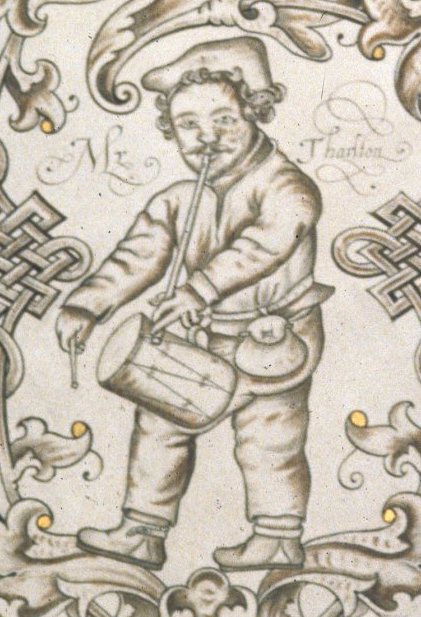
None of the writers worked with greater speed than Richard Tarlton whose ‘A true Report of the Earthquake in London’ would appear to have been published on April 8th, along with other linked prose pieces and a set of verses. Tarlton was of humble origin, and seems to have spent most of his early life in tavern-keeping; but after his arrival in London, his droll features, including a squint and flat nose, as well as a ripe sense of humour, won him a great following at Court and among theatre-goers.
Tarlton became a much-loved low clown and comic actor, secure enough to offer witty reproofs to his patron, the Earl of Leicester. But the professional fool had also a strain of melancholy, and a decade before the earthquake he had even produced a ballad on the floods in Bedfordshire and Lincolnshire:
All faithful hearts come wail,
Come rent your garments gay,
Else nothing can prevail
To turn God’s wrath away.
In 1579 the Stationer’s Register noted a lost work on the extraordinarily heavy snowfalls of that winter. While describing the earthquake itself, Tarlton recorded that two men sitting on a cannon on Tower Hill were thrown off as the cannons bucked with the ground swell; that numerous chimneys collapsed, leaving acrid hearths and smarting eyes, and that the animals of the City roared, including presumably those in the Tower zoo. He also remarked on the fact that the trembling stall-holders in the newly opened Royal Exchange shut up shop, and that in Christ’s Hospital Church, by Newgate Market, someone had been killed.
Of the effect on the theatres of the day Tarlton said nothing, but in the work by Thomas Churchyard, printed with Tarlton’s text under the joint title of‘A Warning to the Wise’, Churchyard included an account:
‘A number being at the Theatre (opened by James Burbage in 1576) and the Curtain, beholding the plays were so shaken, especially those that stood in the highest rooms and standings, that they were not a little dismayed considering that they could no way shift for themselves, unless they would by leaping hazard their lives or limbs as some did...’
It was Arthur Golding, protégé of Leicester and translator of Ovid and Calvin, who tells us in his ‘Godly Admonition’ more about the unfortunates in Christ’s Hospital Church. Thomas Grey, apprenticed to John Spurling, a cobbler living in St Botolph’s parish within Aldersgate, was killed instantly by falling masonry, and Mabel Everitt, a young housemaid, working for the same employer, died several days later. His report on the earthquake itself is remarkably brief, for he devoted much more space to his conclusion that the earthquake was a warning sign from God, like the famine in the previous reign ‘when men were fain to make bread from acorns and food of fern roots’.
Indeed, the earthquake was the culmination of previous instructive and bizarre happenings in nature: monstrous babies, unseasonable weather, comets, ‘the often eclipses of sun and moon’, heavy snows and flood. ‘[He] sendeth us now lastly this earthquake... not so hurtful in present operation, as terrible in signification of things to come.’
Like Golding, who saw the earthquake as ‘rather shaking God’s rod at us than smiting us according to our deserts’, Thomas Tw'ynne also concluded that it should lead to a renaissance of godliness; ‘let every man call himself to an accompt, and look narrowly into his own life’ in the hope of avoiding other calamities.
More usefully from our point of view, Twynne had been educated at Oxford and had then studied medicine at Cambridge, before settling to practice in Lewes, Sussex, so that, by training as well as by inclination, he was a more scientifically engaged observer of phenomena and keenly interested in astrology, being a friend of John Dee.
According to Twynne, the earthquake was felt through south-east England, north-east France and Flanders. If, as seems most likely, the epicentre was near the coast of Kent in the Channel, it is not surprising that east Kent experienced more damage than anywhere else, including that done to churches and to Saltwood and Dover Castles.
Twvnne’s ‘Discourse of the Earthquake’ was dedicated to Philip Howard, Earl of Arundel, and it begins with a historical and general inquiry into earthquakes and what he considered associated phenomena, such as ‘a strange and great exhalative impression in the air’ on March 5th, recorded only by him. ‘The situation thereof was stretching end long from the east to the west over the city of London... and the form thereof was as the shape of the lath of a crossbow without a string.’
These public pronouncements on the earthquake contain little that is personal to the writer; so it is especially fortunate that Gabriel Harvey’s letter to Edmund Spenser, in service to Leicester, has survived. Harvey, educated at Cambridge and a Fellow of Trinity Hall, also aspired to serve the Earl in some capacity. At the time of the earthquake, however, he was not in London, but at a friend’s house in Saffron Walden, playing cards with several other gentlemen and kept company by two ladies.
Harvey genially relates how these two had been laughing and joking with the card-players, particularly, as he modestly notes, himself, and had been making a great deal of noise. ‘ “Good lord,” I said “is it not wonderful strange that the delicate voices of two so proper fine gentlewomen should make such a sudden terrible earthquake?”
Imagining in good faith, nothing in the world less than it should be any earthquake indeed, and imputing that shaking to the sudden stirring and removing of some cumbersome thing or other in the upper chamber over our heads: which only in effect most of us noticed scarcely perceiving the rest, being so closely and eagerly set at our game.’
Then came a dramatic interruption, as the bemused householder stumbled into the room, obviously frightened and babbling of ‘a wondrous violent motion, and shaking there was of all things in his hall’. Harvey naturally could not forbear reporting his own sangfroid as he began to take the whole matter a little more seriously, and he suggested that a servant be sent to town to make inquiries, for ‘if the like hath happened there, as most likely is, and then must it needs be some earthquake’.
This brave statement unnerved the ladies as was doubtless intended, and, most unexpectedly, ‘they that immediately before were so eagerly and greedily preying on us, began now forsooth very demurely, and devoutly to pray unto God’. When one of them suggested that the others should join her prayer, a card-player enquired if she could not pray by herself, and then, turning to Harvey, asked what philosophers thought of earthquakes - whether they were, for example, occasioned by some ‘sensible natural cause’.
Harvey took the opportunity to reflect on the question, wondering if the heavy rains and floods of the previous September, by stopping up the ‘crannies, pores and vents of the earth’, had prevented the escape hitherto of ‘windy exhalations and vapours’. Having whetted their appetites with this notion, he was further pleased when they begged him to expand his comments, which he proceeded to do. As he paused, one of the ladies said that she found his exposition incomprehensible, and the wit neatly replied that he had confidently expected this.
To complete the obscurity of his analysis, he then drew liberally on ancient authorities and added savour with classical tags. At the end of his speech, the gamester, who had prompted him, asked ruefully if it wasn’t time they had supper.
‘And if you be hungered Master H. you shall thank nobody but yourself, that have holden us so long with your profound and clerkly discourse, whereas our manner is to sup at the least a long hour before this time.’
In his letter Harvey went on to say that, rather than scholarly investigation of the earthquake by men of the calibre of Dr John Still, chaplain to Leicester and Master of Trinity, or Dr Bvng, the regius professor of Civil Law in Cambridge, it was more likely that the public would be reading some ‘odd fresh paulting three halfpenny pamphlet; or some Balductum (sic) tragical Ballet in rhyme, and without reason, setting out the right miserable, and most woeful estate of the wicked and damnable world at these perilous days.’
He was, of course, correct in part; but then, as the interest of the Privy Council shows, natural phenomena had to be interpreted in this way, when scientific knowledge of them was so inadequate. Nor was it the ignorant and illiterate who chose to interpret the events as portents, leaving themselves open to the ridicule of the ruling class; church and government were here united in their reception of such calamities as signs from God to be remembered and acted upon. The attack on the Family of Love, later in the year, surely stemmed from this manipulative attitude.

