

The End of the Japanese Fleet, 1945
The last operation of the Japanese Naval Command, writes Albert Vulliez, was a deliberate act of suicide. It was received by the people with a ‘sombre bitterness’. Translated by Patrick Turnbull.
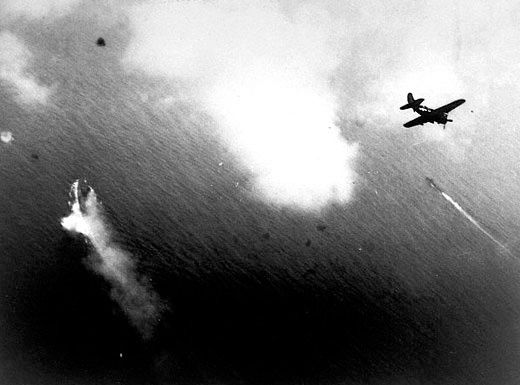 In early April, 1945, encouraged by the serious damage inflicted on the American Okinawa invasion fleet by Kamikaze bombers, the Japanese Naval Command came to the decision to launch operation TEN-GO. It was the sort of decision few but the Japanese would have made, for it meant that, in a last desperate attempt to restore the situation, the only remaining vessels of their Home Fleet, the giant battleship Yamato, the heavy cruiser Yahagi, and eight destroyers, were being sent to almost certain destruction.
Command of the mission was entrusted to Vice-Admiral Ito, a man who had spent most of the war on staff duties. The appointment was significant, for it pointed to the fact that no naval battle, as such, was expected to take place. Before fixing the actual sailing date, however, Admiral Toyada, the instigator of TEN-GO, ordered his representative, Captain Kusaka, to go aboard the Yamato, put the plan before the captain and his senior officers and report on their reactions.
On being given the details, Yamato's captain asked to be allowed to transmit them to the commanders of the Yahagi and the destroyers and to obtain their views before submitting his official reply; but after a brief meeting with his own officers, he told Kusaka that they were definitely opposed in principle, not because they were unwilling to lay down their lives, but because it seemed that the flotilla would be annihilated without the chance of obtaining worth-while results.
As soon as he had been informed of what was afoot, Rear-Admiral Komura, commanding the light flotilla and flying his flag on the Yahagi, summoned his destroyer captains aboard. The minutes of this vital meeting were compiled and miraculously preserved by Komura’s flag officer, Commander Hara.
‘Gentlemen,’ said Komura, opening the conference, ‘You have all seen the signal hoisted on Yamato, ordering us to carry out operation TEN-GO. It is, as I have already told the Admiral, suicide pure and simple. My view has been re-iterated, it appears, by two other rear-admirals, though Vice-Admiral Ito himself prefers to refrain from making any comment.
I have seen many of my men die. My own fate is of no consequence to me. But I am revolted by the idea of such a sterile operation. I have, therefore, called you to express your opinions.’
There was a long silence before someone asked: ‘Has Kusaka been sent to ram these orders down our throats?’
‘He did not mention the word “order”,’ replied Komura, ‘No one can “order” someone to kill himself. It may be his intention. But he didn’t say so. He, as I do, simply wishes you to express your views.’
The same officer said harshly; ‘I was with Kurita at Leyte. That was a stupid operation. This one promises to be even stupider. We will all die, and then who will be left to defend the Homeland?’
This last remark acted as a tongue-loosener. There was a chorus of ‘We think exactly as he does’. Komura did not attempt to interrupt. He remained silent, his eyes half-closed.
This was the moment, Hara noted, that he chose to speak. ‘In my opinion,’ he said, ‘the best solution would be to carry out individual attacks on the enemy’s communications which are dangerously extended. Yahagi has an excellent radar. We could destroy at least half a dozen ships before being intercepted ourselves. This would be a far and away better manoeuvre than the one put up which would come to much the same thing as chucking an egg at a rock.’
Everybody agreed. The other commanders assured Komura that their destroyers were eager to engage in battle, and that no one worried about dying so long as their death served a useful purpose. ‘My ship, Asashimo,’ said one, his voice shaking with emotion, says Hara, ‘asks only to fight and to serve the country well.’
At 13.00 hours Komura left to go aboard Yamato after a lunch at which hardly a morsel was touched, in order to convey the general opinion arrived at in the course of the morning. He returned about 15.00 hours and went straight down to the wardroom. His face was livid. ‘I have agreed to carry out the orders,’ he announced. ‘They come into force at 15.30!’
He glanced round the silent wardroom then went on: ‘I put forward your views and stressed that I agreed with them. But when I had finished, Kusaka explained that it was merely a matter of diversion to draw off the enemy warships and especially the aircraft carriers, while the Kamikazes are let loose on the transports and troop carriers.
He also pointed out that the whole country was indignant that the Yamato, now openly qualified as ‘a floating hotel for imbecile admirals’, should not have fired a single round in anger during the war and be unscratched. At this point,’ Komura continued, ‘Admiral Ito broke in to say “Gentlemen, we are going to be given the occasion to die honourably. A samurai is always ready to lay down his life.” This noble sentiment cut short the discussion. We all promised to obey.’
At this, Hara tells us, he again took it upon himself to act as spokesman and, guessing the feelings of his fellow officers, said: ‘We wish to thank you, Admiral, for having expressed our views. But orders are orders. We will try to do our best.’
Preparations to weigh anchor were speeded up. Men in the sick bays, midshipmen, basically non-combatant members of the crews were put ashore. Most of them begged to be allowed to stay and had to be taken off almost by force.
That evening Komura invited destroyer commanders for a farewell dinner. He had regained his customary good humour; the saké went round liberally. There was a strange air of unreality. Everyone feigned a false gaiety; risque jokes and bawdy stories raised cheers and bellows of laughter. When the destroyer captains left to regain their own vessels, Komura and Hara visited the junior officers’ wardroom.
There, too, the saké circulated freely till 23.00 hours when the evening was officially ended by Komura’s departure. It had been an evening in the purest Japanese tradition, every man present successfully concealing his misgivings and his state of inebriety.
Next day, April 6th, at 16.00 hours, the super-battleship Yamato, the cruiser Yahagi, and the eight destroyers sailed from Tokuya-ma. On Admiral Ito’s orders, the coast of the Island of Kyu-Syu was hugged during the night, till at 04.00 hours of the 7th, the signal was given to alter course due west to draw off enemy planes who, Ito felt, would soon be on his tail.
He was not mistaken. At 11.30 hours, an observation post on the Amami Islands reported ‘250 enemy aircraft direction north’. They belonged to Admiral Spruance’s Task Force 58, already warned of the Japanese sortie by a patrolling submarine. Forty minutes later they were picked up on the Yamato's radar screen, whereupon Ito broadcast the information, at the same time ordering the flotilla to break their tight formation and to steam ‘full speed ahead’.
From the bridge of the Yahagi, Komura and Hara watched the mighty battleship, worshipped almost like a God by the navy and the general public, raising an immense bow wave. In the falling drizzle, the sight of this vessel, its fabulous silhouette, so majestic in outline, carving a way at 35 knots through the waves was, despite the gravity of the situation, a most comforting spectacle.
Those who had not been present at the Leyte disaster were quite unable to believe that such a colossus could succumb to aerial attack. Komura, on the other hand, who had seen the Musachi go down, entertained no illusions.
Twenty minutes after midday, a sudden shower enveloped the ships in an opaque mist. No aircraft could actually be seen, though they were plain on the radar screens, the Yamato’s operators tracing their course and helping the gunners to train every piece on the battleship, even the great 18-inch main armament, preparatory to opening fire the moment they should break from the cloud cover.
Suddenly one of the look-outs on the Yahagi gave the alarm, ‘Two planes ahead to starboard’. At once every gun from every ship opened fire. It was not just two planes diving out of the clouds, however, but twenty, forty, fifty. And immediately the bombs began to fall. The Yahagi and the destroyers zigzagged frantically to try to avoid them, but soon the sea around was being striped by the sinister opaque furrows of speeding torpedoes, while fighters swooped down at regular intervals to rake the decks with machine gun and cannon fire.
At 12.40, just ten minutes after the first plane had appeared, the Yamato was hit for the first time, by a torpedo. Six minutes later, it was the turn of the Yahagi, a torpedo smashing through her side and exploding in the engine room killed every man in it. The vessel carried on for a few minutes under her own impetus, while Hara was bellowing orders to get the engines started up again, not recognizing that the one hit had immobilized her permanently. From then on she would be nothing but a helpless drifting target for any aircraft, torpedo or dive-bomber.
At the same time Komura and Hara could see that, for the moment, the Yamato seemed to be holding her own, thanks to the furious riposte of her A A gunners. From time to time a shout of triumph could be heard above the din of battle as a gunner saw his target suddenly burst into flames, then drop like a stone. Round the helpless Yahagi, near misses were throwing up great spouts of water and exploding bombs sent shudders down her hull so that every bolt and rivet rattled.
Then the inevitable happened. A second torpedo ripped through her stern, its explosion sending shattered bodies high into the air. A few seconds later, a dive-bomber landed a bomb on the forward turret which crashed through the armoured plating to burst close to the shell hold.
Had it not been for the gunnery officer’s prompt reaction in immediately opening a sluice and flooding the compartment, the Yahagi and its whole crew would have been blown sky high within seconds. Instead, she began to settle down by the bows, spitting dense clouds of vapour, smoke and flame. It was obvious, though, that she could not stay afloat much longer.
She was being hit at such regular intervals that, from his position on the bridge, Hara was seldom able to see more than a quarter of his ship at any given moment. Finally, when the smoke cleared for a brief space, he was greeted by the spectacle of a gaping, steaming hole where before had been the turret and torpedo-launching ramps. All the time the hull was sinking still deeper, but slowly, to a set rhythm, as though the gallant ship were determined to die with dignity.
As the sea reached up almost to the bridge and waves washed the blood-soaked decks, Admiral Komura signalled one of the destroyers to draw alongside to take off survivors and then to head for Okinawa to carry on the fight. The Isokaze came racing to obey the call, but within two hundred metres suddenly disappeared - torpedoed - in a column of smoke.
For the Yahagi it was also the end. Soon the sea was dotted with the heads of survivors trying to cling to floating wreckage, and being choked by a spreading thick layer of mazout. Those still able to react turned their eyes towards the Yamato, hoping for succour from her direction. Still steaming through a forest of water spouts, apparently undamaged, she seemed to symbolize their only remaining hope.
Hara and Komura, who had been swept off the bridge just as the Yahagi finally went down, had lost sight of each other. Hara had managed to drift clear of the mazout and was half asleep as he clutched a shattered spar when a brilliant flash of light woke him. He closed his eyes, then opened them. The sea was strangely calm and deserted.
Where a moment before had been the majestic outline of the Yamato was a great column of white smoke mounting skywards. The air was shaken by the thunder of successive explosions, dispelling his last doubts; the great battleship had gone down.
Very near death, Commander Hara was eventually picked up by the destroyer Hatsuchima. After a long spell on the operating table, his dozen wounds dressed, he was overjoyed to hear Rear-Admiral Komura, with half a dozen survivors from the Yamato, was also aboard. It was from one of these latter that he heard the details of the Yamato's last moments.
Though she had been hit at the very beginning of the action by a torpedo and two bombs, the damage appeared negligible. She was not slowed down, nor was her capacity to hit back impaired. By 13.00 hours, her A A batteries had accounted for at least ten attacking aircraft. Three-quarters of an hour later, the second wave launched from Admiral Mitscher’s carriers, with formal orders to finish off the ‘mastodon’, closed in.
During the next half-hour, a hundred torpedo-carrying planes and as many dive-bombers pressed home their attacks from every point of the compass. Soon three heavy bombs struck home; a number of AA positions were silenced by fires sweeping the superstructure. Fresh waves of torpedo bombers moved in for the kill, scoring nine hits on the starboard side.
Soon the Yamato was listing at 30 degrees. From then on catastrophe succeeded catastrophe. A number of 18-inch shells rolled from their cages and exploded between decks. Every effort to get the vessel back on an even keel failed as, one by one, the water-tight hatches gave way.
When he saw that the end was not far off, Ito called the few surviving officers and gave them a farewell address. The Yamato was by then listing at such an angle that he was obliged to cling to the taffrail to keep himself upright. Afterwards Rear-Admiral Arriga, commanding Yamato, helped him to climb the almost vertical deck to reach his duty cabin where he locked himself in.
Arriga then told his batman to lash him to the wheel, to prevent him slipping before saluting his officers and wishing them good luck. Seconds later most of the survivors were hurled into the air by a gigantic explosion, after which the most powerful battleship the world had ever seen sank like a stone.
The Japanese people received the news with a ‘sombre bitterness’. After so many others, yet another illusion was shattered. But perhaps the most significant result of this historic extermination was the order to stop work, issued by the British and American governments, on a number of battleships under construction, each of which would have displaced between 45 to 50,000 tons. This indeed was concrete proof that the era of the ‘dreadnoughts’ was closed, that a new page in naval history had been turned.

