

Robert Boyle and English Thought
Meyrick H. Carré introduces an Irishman who personified the genius of experimental inquiry and did much to influence the Enlightenment in England.
Meyrick H. Carré introduces an Irishman who personified the genius of experimental inquiry and did much to influence the Enlightenment in England.
Cecil secured the peaceful accession of the Stuarts and strove with near success, Joel Hurstfield writes, to solve the vexatious problems that confronted the new dynasty in England and upon the European scene.
As Professor of Arabic at Oxford, writes P.M. Holt, Pococke pursued his scholarly life amid civil war and republican experiment.
Evelyn Hardy visits an English architectural monument of elaborate richness.
Twenty-three crucial years in English history were covered by the arch-episcopate of Thomas Cranmer, whose most enduring monument is the English Book of Common Prayer. By H.A.L. Rice.
D.H. Pennington examines an economic burden that the “poor oppressed people of England” believed no government could relieve them of.
To most modern readers little more than a resounding name, the Kingmaker is here described by Paul Kendall as an “early exemplar of that Western European energy” which was presently to transform the civilized world.
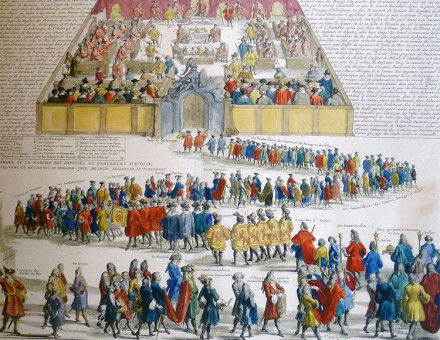
By the Act of Union, the Scots lost their Parliament but gained the freedom of the British Empire.
D.M. Walmsley analyses the plentiful artistic and personal connections between the explorations of the Virginia company and the Bard.
Esther A.L. Moir meets the early English antiquaries— from William of Worcester to Sir William Dugdale—pioneers who laid the foundations of an important form of modern historical scholarship. Travelling up and down Great Britain, They kept a careful record of everything they heard and saw, investigating the monuments of the past and describing the landscapes of their own age.