Zwingli and the Urban Reformation
Michael Mullett looks at the contradictory attitudes and mixed achievements of a courageous reformer.
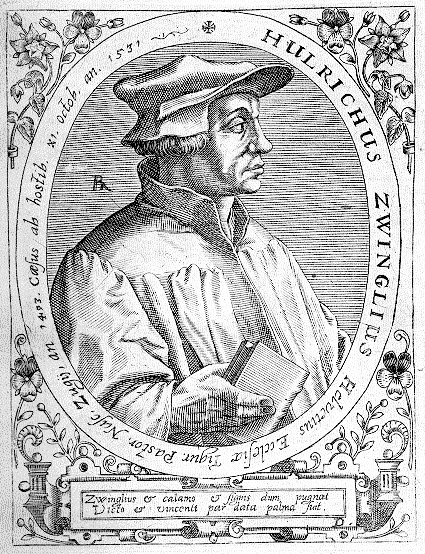
Huldrych Zwingli was born, a few months after Martin Luther, on new year’s day 1484 in the village of Wildhaus in the canton of St Gallen in German-speaking eastern Switzerland. His father was a prosperous farmer and local notable. Like Luther and Calvin, Zwingli came from a family of upwardly mobile people of middling rank in society, keen on education. His uncle was a local priest and he himself was groomed for a priestly career. His education at the universities of Basel and Vienna took in the 'new' learning of Christian humanism - the study of ancient classical texts, focusing on the 'Fathers' (the early theologians of the Church), and on the Bible, read in its original languages of Greek (the New Testament) and Hebrew (the old Testament). His affiliation with Christian humanism drew young Zwingli towards the acknowledged leader of this movement, Desiderius Erasmus (1466-1536), whom he met in 1515 or 1516.
Zwingli was ordained priest in 1506, taking up the benefice of Glarus, whence he moved in 1516 to become priest in residence at the popular pilgrimage centre of Einsiedeln, where his light duties allowed him to deepen his Christian humanist studies, concentrating on the Fathers and continuing to study Greek. His next career move came in 1519 when he became Leutpriester, or town preacher, at the Great Church in Zurich, the leading city of the Swiss Confederation. Here, in this preaching appointment, Zwingli found the opportunity to popularise the biblical viewpoints that he had been developing during his years of Christian humanist study.
When Zwingli came to it, Zurich was a thriving commercial city with a population of between five and seven thousand and a rural hinterland of about 50,000 inhabitants. The self-governing city had a republican constitution based on two ruling councils, a structure designed to ensure that power was rotated. The government exercised considerable control over religion in the city and its countryside. When he took up his appointment in the city, the Reformation in neighbouring Germany was about to reach a further decisive stage, with Luther’s intellectual divorce from Catholicism made clearer than ever at the Lepizig debates of 1519. What was the religious orientation of Zwingli’s preaching at the time and to what extent was he a follower of Luther?
Zwingli's ideas
The first point to make about Zwingi's preaching is that it was based on Scripture, aligning him in that respect with Luther. He preached his way through the Gospels, the Acts of the Apostles and the Epistles of the New Testament. He broke with the traditional Catholic custom of following prescribed readings for each day and went through the Scriptures in an orderly sequence, one section after another. Zwingli was essentially a populariser of the Scriptures, carrying out the programme announced by Erasmus of taking the Bible to the common people in their own language – in this case, the Swiss German of the Zurich area. He delivered his sermons probably extempore, simply and without rhetorical flourish, and was proud of his popular success.
Was Zwingli a Lutheran, either when he took up his post in Zurich or at any point thereafter? The evidence is conflicting. Certainly from 1518 onwards, Zwingli acclaimed Luther as ‘a new Elias’, a ‘David’ or a ‘Hercules’ and helped to import Luther’s writings into Switzerland. Yet Zwingli was also anxious to establish a clear dividing line between himself and Luther, and when he wrote that ‘Luther propelled me to an eagerness’ he was emphasising the German reformer’s catalytic rather than initiating effect on his own rapidly maturing evangelical theology. By 1522 Zwingli was expressing his independence from Luther even more vehemently: ‘I do not want to be called a Lutheran, for I did not learn the teachings of Christ from Luther, but from the word of God’. As far as Zwingli was concerned, he and Luther had come to similar conclusions based on the same source, the Bible, so that both his and Luther's ideas were, as lie wrote in 1523, 'found in the word of God and based upon it'.
However, not only were Luther and Zwingli intellectually independent on one another but they were also doctrinally divergent and indeed opposed one to the other, for they operated from different cultural and educational starting points and their estrangement was to culminate in a deep rift before Zwingli's early death. As a humanist, Zwingli revered the ancient Greek and Latin pagan classics, to the extent of believing that some of their authors were saved, a belief that Luther, who insisted that salvation came only through faith in Christ, never could share. In addition, some of the differences between Luther and Zwingli, especially those arising from Zwingli's quasi-rationalist understanding of Christ’s presence in the Eucharist - seeing it as spiritual and commemorative rather than miraculous, as it was for Luther - may have been shaped by Zwingli's education and work in the enlightened, progressive atmosphere of cities, including his work in Zurich itself. Zwingli leaned towards a kind of Christian rationalism, whereas Luther despised 'that harlot reason'. Thus the Reformat ion that Zwingli was to introduce in Zurich in the1520s was no mere reproduction of the German Lutheran version, but stemmed from different origins and influences.
The theological radical
From 1519 Zwingli in his sermons proceeded to attack essential features of Catholicism which he believed were not justified in Scripture, including prayers offered to saints, monasticism and the doctrine of Purgatory, the intermediate punitive state between heaven and hell from which it was believed papal Indulgences could bring about release. In February 1519 he called for the expulsion of an Indulgence-seller from Zurich, an echo of Luther's 1517 stand against Indulgences and their sale.
Following on from that event, Zwingli was to lead Zurich into the Reformation in the years between 1520, when the city government banned all non-Scriptural preaching, and 1525, when the Catholic Latin Mass was abolished in favour of a simple, German-language Communion service. Zurich thus pioneered the urban Reformation in German-speaking Europe. Zwingli himself was accustomed to thinking in terms of the Swiss political system, in which the local community (the city or the canton) was the basic unit of government. His way of proceeding along the road to Reformation was to begin on the local, civic and cantonal level. As he aligned himself ever more closely with the urban community and government of Zurich, he severed his links with the papacy and the Catholic church, abandoning in 1520 a papal pension he received. At the same time, though he took a canonry in the Great Church, which gave him a Zurich citizen’s voting rights.
The political conservative
Although he rejected all forms of tyranny and believed that unjust rulers might be deposed, Zwingli had a favourable attitude towards political authority in general and to the Zurich government in particular, insisting that 'the gospel of Christ is not opposed to government’, that 'there can be no church without government' and that there was a 'need of government for the punishment of persistent sinners’. He strongly opposed what he saw as the usurpation by clerics of political powers which he believed were properly wielded by secular rulers. 'The jurisdiction which the churchmen have arrogated to themselves belongs wholly to the secular magistracy', he wrote. While he insisted that 'There is no city happier than that were true religion is established', he did not envisage a theocracy, a state ruled by clerics. In fact, Zurich developed the antithesis of theocracy, an Erastian system in which the secular state governed the church. It was probably because Zwingli recognised the extensive authority, including the religious authority, of the state that his career in the city was free of the church-state tension that Calvin experienced during part of his time as reformer of Geneva, and Zwingli helped forge close alliance between the spiritual and temporal spheres. The government gave him its full backing and its order of 1520 that all preaching in the city and its dependent territory must be based on the word of God was a clear recognition of his claims.
Zwingli was particularly sensitive to the government's need to maintain public order and to prevent what he called 'great unrest and disunity' by regulating the pace of religious change in a gradual way. A clear example of this caution comes from the year 1522. In the Lent of that year a group of Zurich citizens in sympathy with Zwingli's views (that the Christian, liberated by Christ from sin, was free of all unnecessary constraints, that practices commanded by the Church but not validated in the New Testament were spurious) broke the Lenten rule of abstinence from meat ordained in the Catholic Church's own internal 'Commandments'. The party, which included Zwingli's friend and supporter the printer Christoph Froschauer, ritually ate pork sausage, a pantomime of emancipation because in popular culture meat-eating, and sausages in particular, were associated with the freedom of carnival rather than the strictness and restraint of Lent. In its underlying message, the sausage meal was entirely consistent with Zwingli's teaching about Christian freedom and the need for clear Scriptural mandates. But it was typical of Zwingli's caution in moving no faster than the government that, although he was present at the party and later, in Choice of Freedom of Food, justified the actions of the sausage-eaters, he did not himself share the meal, for the state had not yet licensed such actions. Instead it had ruled that, although the New Testament forbade no foods, for the sake of good order the fast should be kept up until altered by the proper authority. But who, it might have been asked, was the proper authority in such matters, since in 1522 the Zurich council virtually brushed aside the traditional jurisdiction of the Catholic bishop of Constance?
Zwingli's triumph
In a work of 1522, Archeletes, Zwingli pointed a way towards the resolution of the problem of authority and arbitration; a public debate masterminded by the government and designed to establish the right Christian policies for the governing councils to implement. Such public fora, organised by ruling councils, were a popular way of introducing religious change in Swiss and German self-governing cities during this period. The perceived advantage of a public discussion was not that it would open up controversy but that agreement to abide by the outcome of an expert disputation would silence all religious disputes which threatened the indispensable concord of a city. Zurich was to hold three of these set-piece disputations, in January and October 1523 and in January 1524, and from the beginning the government's leading role in the proceedings and the primacy it gave to concord in the urban community were unmistakable. As the invitation to the first debate put it, 'We ourselves must take care of our subjects and put an end to the disputes which divide them'.
The first of the series of public disputations in Zurich was attended by more than 600 people and was typical of the intense oral and public culture of the German and Swiss cities in the periods of the Renaissance and Reformation. The government made it clear that in the exercise of its leading role in forging a religious settlement it would be guided by Zwingli in his capacity as a theological consultant to the state: 'We shall be present at this conference and shall listen carefully to what is said on one side and the other; after which, enlightened by the insights of our principal theologians and preachers, we shall introduce measures to end this scandal [of civic discord] '.
Zwingli's central advisory function as the leader of the government's 'principal theologians and preachers' was confirmed by his composition of the topics for the debate, set out in sixty-seven articles. These had the over-arching themes of Scriptural rather than ecclesiastical authority and the centrality of Christ, the subject of a third of the articles. Individual clauses repudiated the Catholic Mass as the ongoing enactment of Christ's sacrifice on Calvary and rejected the pope's authority over the church, the doctrine of purgatory, prayers made to the saints, imposed fasting and priestly celibacy. Much of the programme implied demolition rather than construction.
The outcome of the debate was that, defying the authority of the bishop of Constance, the government found in favour of Zwingli and his Scriptural preaching. In July 1523 Zwingli followed up this triumph with his Explanation and Justification of the Articles and a programme of religious, educational and welfare reform was put in place. This included vernacular services and public lectures on Scripture, religious provisions without charge and poor relief, to be funded out of confiscated church property, especially that of the monasteries, closed down in 1524. Yet if we were to pinpoint just one action in which Zurich made the decisive break with its long Catholic past, it would be the suppression of the Mass in April 1525. Its majesty and mystery was replaced by a simple German eucharist, in which Christ was no longer viewed as being sacrificed and eaten but rather commemorated in a symbolic supper by a congregation of faithful Christians under the leadership of a godly pastor.
Zwingli's opponents
Despite the prevalence in government circles of a quest for consensus, opposition to the Zwinglian programme which the councils supported gathered ground just as it was being enacted. The most formidable challenge to Zwingli's religious leadership emerged in 1524-5, when there arose in Zurich a grouping which Zwingli nicknamed 'Anabaptists' ('Re-baptisers'). These insisted on the need for faith and repentance for sin as preconditions for reception of the sacrament of baptism, by means of which people entered the church. Although the early Christian church had recruited and baptised its members in adulthood, in the course of the middle ages the practice of infant baptism had become the norm within Christendom: through it men and women were entered into the church, and thereby into the political community, virtually at birth. In 1524 a small group of Zurich citizens including Conrad Grebel, Georg Blaurock and Felix Manz began to challenge these customs, rejecting the baptism of their children and, in defiance of the government, restoring the New Testament practice of adult, or 'believers’, baptism.
Zwingli was vehemently opposed to this movement, believing that it threatened the ecclesiastical and civic unity of all those in Zurich who shared a common baptism as infants, forming 'a Christian city [which] is nothing other than a Christian church'. Collision with the radicals escalated in 1525-6. Disputations failed to resolve the issue and by March 1526 the government, with Zwingli's full support, instigated the death penalty by drowning for 're-baptisers'. In a string of works Zwingli lashed out as this movement, arguing that Christ had invited little children to come to him, that infant baptism was the equivalent of the circumcisions that made new-born children Israelites in the Old Testament and that baptism of infants was for citizens what their oaths were for soldiers. Yet those who practised believers' baptism were in many ways more Zwinglian than Zwingli on this matter, for there was a time when he had believed that children should not be baptised until they knew the meaning of the sacrament. In fact, the 're-baptisers' were putting into practical effect Zwingli's own pursuit of the spirit and institutions of the early church which had, as we saw, practised believers' baptism, while at the same time they were applying logically Zwingli's own theology that sacraments were signs of faith. Yet for essentially social and political reasons, having to do with the cohesion of the community, Zwingli strongly upheld the traditional infant-baptismal praxis. Executed in and banished from Zurich, the proponents of believers' baptism went on to lay the foundations for the 'radical Reformation', which in the sixteenth century aimed to restore the church of the time of the Apostles.
In the course of the 1520s the 'mainstream' Reformation, with which we may associate Zwingli, made progress in the self-governing Swiss cantons of Schaffhausen, St Gallen, Appenzell and in the League of the Grisons, as well as in the city states of Basel and Berne. These, though, were all independent territories of the Swiss Confederation, exercising their sovereignty in the free choice of religion. Tension was bound to arise over decisions on which religion to adopt in the subordinate 'common territories' which the Swiss Confederation ruled jointly. Central cantons, which were chiefly rural and which remained Catholic while their neighbours adopted the Reformation, insisted that no change should be made in the religion of these subordinate common territories and began persecuting 'heretics' within them, eventually precipitating Zurich's intervention on behalf of oppressed Protestants in one of the common territories, the Thurgau. Now suspecting that Zurich aimed to take over the Thurgau, in the spring of 1529 the Catholic cantons formed an alliance with the Habsburgs, overlords of Germany, rulers of neighbouring Austria and Europe's most powerful and most Catholic royal family. To the Austrian Archduke Ferdinand of Habsburg the alliance opened up the possibility of restoring Austria's ancient influence, or even its overlordship, over Switzerland. Faced with the Catholic alliance, Zurich was largely friendless, even when war broke out in June 1529; for other Protestant cantons, such as Berne, feared that if Zurich overcame the Catholics and the Austrians she might go on to master the whole confederation. Thus Berne announced that she would assist Zurich only in defence. In addition, a widespread feeling that war between Swiss should be avoided took the edge off the build-up of confrontation and when Catholic and Protestant armies faced one another at Kappel in 1529 they refused to fight. The truce granted religion freedom in the common territories.
In the later 1520s Zwingli, as Zurich's Protestant prophet, had necessarily become caught up in the city's involvement in inter-Swiss and international politics. He also became deeply involved in the interactions between theology and diplomacy in relations between Swiss and German Protestants. In 1529 a leading German Lutheran prince, Philip, Landgraf of Hesse, arranged a conference at Marburg within his territory with the aim of cementing doctrinal agreement between German and Swiss Protestants, as a basis for a political and military alliance against the Catholic backlash within Germany. Luther and Zwingli attended in person and, despite hostile language exchanged between them, extensive agreement was found on most clauses of a draft agreement. Ironically, it was on the issue of the traditional Christian symbol of concord, the eucharist, and the nature of Christ's presence within it, that Swiss-German agreement broke down. Luther and Zwingli disagreed radically over Christ's relationship with the eucharist. On this issue, Luther was adamantly literal-minded in his approach to Scripture. The words he inscribed on the conference table at Marburg to set out his position at the opening of his 'colloquy' with the Zwinglian party, 'Hoc est corpus meum – This is my body', were the Latin form of the words that Christ in the gospel had used in the Last Supper to establish the eucharist. For Luther those words were literally and permanently true, and Christ was present in the eucharist really and objectively. Zwingli's eucharistic rnetaphysics operated from a different approach to Scripture over this issue, for in this instance he believed the Bible's words did not have to be taken literally, since Christ had gone to 'the right hand of the Father' in heaven and the words He had spoken in the last Supper were intended to mean 'This signifies my body'. In the face of such fundamental divergences, the quest for a Swiss-German consensus on the eucharist collapsed and the failure to obtain doctrinal agreement thwarted Philip of Hesse's alliance plans.
Zwingli's defeat
Within Switzerland Zwingli's cause encountered opposition as the 1520s gave way to the '30s. When the opposing sides refused to fight at Kappel, Zwingli warned, 'The peace you desire means war'. And indeed war soon came. In 1531 the Protestant League of the Grisons requested the assistance of the entire Swiss Confederation against aggression by an Italian lord believed to be acting on behalf of the Habsburgs. When the Catholic cantons refused to provide aid, Zwingli accused them of reneging on their responsibilities to the Confederation. His response to their recalcitrance was to propose the subordination of the Catholic cantons to Zurich and the control of the whole Confederation by a Protestant condominium made up of Berne and Zurich. In pursuit of these aggressive designs, Zwingli called for economic sanctions against the already impoverished Catholic canton', which responded with a declaration of war against Zurich in October 1531. On 11 October Zurich forces met those of the Catholic cantons, once more at Kappel. Zwingli, in attendance with his city's heavily outnumbered army, was wounded and then slain.
Huldrych Zwingli's relatively short life had ostensibly ended in failure, discord and contradiction. He had fallen in the field of battle when so much of his work as reformer still remained to be clone. A man of the New Testament and a proclaimed disciple of Christ the Prince of Peace, over-involved in militancy, he had been largely responsible for bringing civil war to the Swiss Confederation, which required harmony for its very continued existence, and had pioneered the terrible religious wars that scarred European history in the sixteenth and seventeenth centuries. He had shared with Martin Luther the blame for the breakdown of the projected unity of the churches of the Reformation. Eventually, his distinctive urban Reformation was over-shadowed and, in the 1549 Consensus Tigurinus (Zurich Agreement), was in effect absorbed into Calvin's more famous Genevan system.
Even so, Zwingli's achievement was neither hollow nor ephemeral. His son-in-law and successor in the Zurich ministry, Heinrich Bullinger (1504-1575), worked for many years to consolidate Zwingli's achievement and expand its influence to other parts of Europe, not- ably England, where, in the reign of Edward VI (1547-53) the Zwinglian example was used to guide the process of Protestantisation. Zwingli brought together an advanced form of Erasmian Christian humanism and a sharp sense of the realities of Swiss politics to produce a creditable model of urban reformation.