

Women and Literature in Eighteenth Century England
During the eighteenth century female authors became increasingly numerous and industrious; while as readers, writes Robert Halsband, thanks to the spread of the new circulating libraries, women began to form ‘a significant sector’ of the literary public.
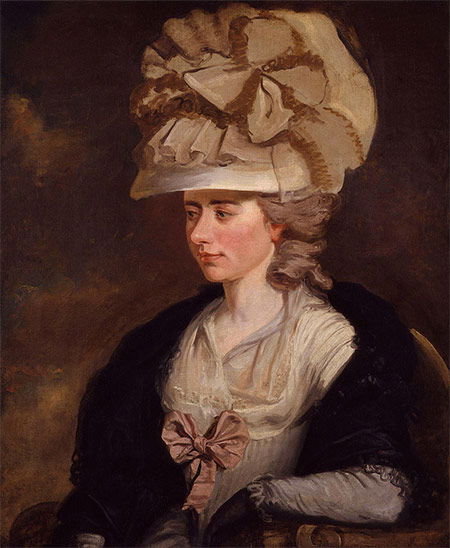
The relationship between women and literature can obviously be investigated for any historical period; but in the eighteenth century it is exceptional. For the first time two connected and concurrent developments took place.
Women emerged as professional writers and journalists, able to earn their living through the sale of their writings.
To do this they practised all the methods available to men: private patronage (mainly from dedications), subscription publication, journalism, and (through publishers) sale of their books to libraries and the general reading public.
As authors they became increasingly numerous and prolific. As readers they also, for the first time, multiplied in numbers so vastly as to become a significant sector of the reading public who, with newly afforded leisure, became omnivorously literate.
This prominence and activity of women in literary life coincided with a steep rise in the feminist movement, whose milestones point the road from Mary Astell’s Serious Proposal to the Ladies in 1694 to Mary Wollstonecraft’s Vindication of the Rights of Women in 1792.
Unlike previous champions, these two writers are not men - whose advocacy, however enlightened, cannot help having a patronizing tinge - but articulate, vigorous women.
It is an oversimplification to speak of eighteenth-century women writers as though they were a homogeneous group. For, in the earlier part of the century, women who wrote for money were regarded as social outcasts; their mercenary motives also directed their choice of genres -fiction and drama rather than poetry.
Eliza Haywood, grotesquely portrayed in the Dunciad, is a prominent example. When Lord Egmont heard a premature report of her death, he neatly summed up her moral and fiscal reputation; ‘a whore in her youth, a bawd in her elder years, and a writer of lewd novels, wherein she succeeded tolerably well.
By the use of these several means she had amassed,’tis said, near 10,000 1.’ Her financial success certainly did not sweeten her reputation. In general the low repute of fiction and of women who wrote it reinforced each other.
Not until, in 1740, the novel had been raised to respectability by Richardson, and not until respectable woman novelists achieved fame - Sarah Fielding, Charlotte Lennox, and Fanny Burney - were the two respectabilities joined.
Before the rise of a reading public large enough to support them, authors of either sex had several paths open to them by which they could earn some money, even if not enough to provide their living. They could dedicate their books to patrons.
This venerable practice obviously appealed to women as more genteel and less tainted by commercialism. Its advantage was that the author received immediate payment, albeit a modest one; but she could hope for further rewards if the dedicatee exerted any power or influence.
Even women of questionable respectability benefited by private patronage. Mary de la Riviere Manly was rewarded with twenty guineas by Lord Bristol for a poem she published in 1719.
Some years later, Laetitia Pilkington, whose raffish career extended from Dublin to London, attempted a similar scheme directed at Lord Hardwicke, newly appointed Lord Chancellor. After sending her panegyric to him, she was invited to call one Sunday; but her total reward was drinking a dish of chocolate with His Lordship.
Private literary patronage for men was bleak and frustrating: but how much bleaker for women since very few government appointments and sinecures could be awarded to them!
One can think of lucrative posts, sinecures or not, given to men as a reward (or an inducement) for their writing. But how many to women? As for the appointment of Poet Laureate: is it even conceivable that that honour should ever go to a woman?
Women writers, like men, had recourse to another method of raising money, publication by subscription. This practice, though begun before the eighteenth century, flourished during that period, serving as an intermediate stage between support from private patrons on one hand, and on the other from the unknown, anonymous reading public for whom the bookseller served as intermediary.
The pioneer woman scholar Elizabeth Elstob published her English-Saxon Homily in 1709 by subscription; and of the 260 subscribers almost half were women. Other women writers issued their works by this method - one of the most successful was Elizabeth Carter’s translation of the works of Epictetus in 1758.
Its list of subscribers is impressive: twelve double-columned pages, headed by the Prince of Wales and his mother, the Dowager; a multitude of peers and bishops; the libraries of several Cambridge colleges but only one in Oxford - perhaps Oxford preferred to read Epictetus in Greek - and literary men including Samuel Johnson, who was a great admirer of her and whose remark about her is too well known to resist being quoted: ‘[She] could make a pudding as well as translate Epictetus.’
Given the advantage of many prosperous friends, a writer could amass a large sum by subscription; and women writers took advantage of this method. Fanny Burney, after her marriage to an impecunious French émigré, General d’Arblay, deliberately set about to raise a sum large enough to buy a house.
In 1796 she issued by subscription Camilla, her long, didactic novel; and although the list adds up to only 300, some subscribed for more than a single copy (Edmund Burke for 15, Elizabeth Montagu for 10); and altogether, with general sales, the edition of 4,000 copies was sold out; so that Mme d’Arblay was able to buy a house that she gratefully named Camilla Cottage.
While eighteenth-century professional women writers later won the feminist praise of Virginia Woolf, she condemns the amateurs: ‘shut up in their parks among their folios, those solitary great ladies... wrote without audience or criticism, for their delight alone.’ (She may have been thinking of the eccentric Duchess of Newcastle.)
There were many other women of more modest rank who wrote for their own delight; and in their own day they had to endure ridicule and discouragement. In one of his later papers Mr Spectator recommends that the best way for a woman to show her ‘fine genius’ is -needlework.
‘I cannot forbear wishing,’ he continues, ‘that several Writers of that Sex had chosen to apply themselves rather to Tapestry than Rhime. Your Pastoral Poetesses may vent their Fancy in Rural Landskips, and place despairing Shepherds under silken Willows, or drown them in a Stream of Mohair.
The Heroick Writers may work up Battels as successfully, and inflame them with Gold or stain them with Crimson. Even those who have only a Turn to a Song or an Epigram, may put many valuable Stitches into a Purse, and crowd a thousand Graces into a Pair of Garters.’
This gentle mockery of women’s literary aspirations tells them plainly enough that their proper concerns are domestic. Women writers are more sharply satirized in The Rape of the Lock, where Spleen is called:
Parent of Vapours and of Female Wit,
Who give th’Hysteric or Poetic Fit,
On various Tempers act by various ways,
Make some take Physick, others scribble Plays.
This picture of women writers condemned and ridiculed is more typical of the earlier part of the century; for they were later given recognition, praised and encouraged.
In 1752 George Ballard published by subscription a large handsome book, Memoirs of Several [64] Ladies of Great Britain... Celebrated for Their Writings or Skill in the Learned Languages, Arts, and Sciences.
Two years later, another champion stepped forth armed with epic verse, John Duncombe in The Feminead: or, Female Genius. (He carefully separates the respectable women from six shameful ones, of whom four were professional writers.)
The biographical dictionaries, however, failed to recognize women’s emergence in the world of literature; Giles Jacob in 1720 and Theophilus Cibber in 1753 give them scant notice.
In Samuel Johnson’s fifty-two Lives of the Poets (1779-1781), although they include some very obscure writers, not a single one is a woman. This was evidently the decision of the booksellers who commissioned Johnson; but, if he had wished to include a woman poet, no doubt he would have been permitted to, since his suggestion for including five men was accepted.
He considered no woman poet worthy of inclusion in his collection. Yet he was certainly struck by the fact that women writers were becoming more numerous and more prolific. In one of his essays (in 1753) he reflects:
‘In former times, the pen, like the sword, was considered as consigned by nature to the hands of men... a female writer, like a female warrior, was considered as a kind of eccentric being, that deviated, however illustriously, from her due sphere of motion, and was, therefore, rather to be gazed at with wonder, than countenanced by imitation... the revolution of years has now produced a generation of Amazons of the pen, who with the spirit of their predecessors have set masculine tyranny at defiance, asserted their claim to the regions of science, and seem resolved to contest the usurpation of virility...
To what cause this universal eagerness of writing can be properly ascribed, I have not yet been able to discover... The cause, therefore, of this epidemical conspiracy for the destruction of paper, must remain a secret ..’
(The puzzling cause may very well be what Johnson himself said of Richard Savage: ‘having no profession [they] became by necessity authors.’)
In later years he was still ‘astonished’ at the ‘amazing progress made... in literature by the women,’ for he well remembered ‘when a woman who could spell a common letter was regarded as all accomplished.’
However astonished he may have been by the progress of women writers, he did not suffer the foolish ones gladly. He was once approached by a woman playwright who importuned him to read her new play before it was acted.
When pressed, he actually refused, telling her that by carefully looking it over herself she could see, as well as he could, if anything was amiss. ‘But, sir,’ said she, ‘I have no time. I have already so many irons in the fire.’
‘Why then, Madam,’ he said (quite out of patience), ‘the best thing I can advise you to do is to put your tragedy along with your irons.’ There is, we must remember, this comic side to the proliferation of women writers.
Some of them, swollen with the pride of female accomplishment, exhibited a kind of overstrain.
‘How the Women do shine of late!’ exclaimed the irrepressible Mrs Thrale, and she then continues:
‘Miss Williams’s Ode on Otaheite, Madame Krumpholtz’ Tasteful Performance on the Harp, Madame Gautherot’s wonderful Execution on the Fiddle - but say the Critics a Violin is not an Instrument for Ladies to manage, very likely! I remember when they said the same Thing of a Pen.’
Far from saying that women could not manage a pen, critics might more justly say that they refused to put their pens down. Horace Walpole complained (in 1788), ‘We have hen-novelists and poetesses in every parish.’
It has been estimated that most of the fiction published in the eighteenth century was written by women (from only 1760-1800 about two thousand novels). Sometimes the author put her name on the title page, sometimes demurely at the end of the preface, and sometimes she shielded herself with ‘By a Lady’ on the title-page. There was evidently no uniform practice.
In the latter half of the century, novels were sometimes dishonestly attributed to women authors because a book by a woman was regarded as more saleable than one by a man.
When, in 1759, Oliver Goldsmith reviewed an epistolary novel ‘By a Lady’, he complained that, although the ladies carried off the glory of this sort, ‘it is plain by the stile, and a nameless somewhat in the manner, that pretty fellows, coffee critics, and dirty-shirted dunces, have sometimes a share in the achievement.’
He promises in the future to regard every publication ‘ascribed to a lady, as the work of one of this amphibious fraternity.’ A writer in the Monthly Review (in 1774) - probably John Cleland - went further in reviewing a novel entitled The School for Husbands.
Written by a Lady:
‘As ladies are generally acknowledged to be superior to our sex in all works of imagination and fancy, we doubt not this is deemed a sufficient reason for placing their names in the title-page of many a dull, lifeless story which contains not one single female idea, but has been hammered out of the brainless head of a Grubstreet hireling.’
In this novel, he continues, many of the scenes convince him of ‘the femality of its Author.’ This practice of ‘literary fraud’, as the Gentleman’s Magazine called it (in 1770), remained widespread.
It was sometimes used, according to one reviewer, ‘to preclude the severity of criticism’; but, he added, since reviewers are generally such ‘churls and greybeards’ the deception was rarely effective.
One of its effects was to encourage critics to analyse what was distinctive in the mind and art of women writers. Compared to men’s, ‘their genius often glows with equal warmth, and perhaps with more delicacy’: this commonplace observation came from the youthful editors of an anthology called Poems by Eminent Ladies (in 1755).
Henry Fielding (in 1747) was more specific in defining the delicacy of women writers; in his preface to a book written by his sister, he stresses women’s advantage in ‘that great and important Business of their Lives, the Affair of Love.’
In similar fashion, when the argument was continued into the next century, William Hazlitt believed that women’s social conditioning encourages in them ‘a quicker perception of any oddity or singularity of character than men,’ and that the ‘intuitive perception of their minds is less disturbed by any abstruse reasoning on causes or consequences.’
In our own day the argument continues in the burgeoning controversy about androgyny.
One may wonder whether women writers had a discernible effect on the subject matter of fiction; it is as speculative a question as that of their sensibility. And, further, were these two elements influenced by the growth of a feminine reading public?
For it is certain that more and more women readers needed to be served by writers of both sexes. With the rising rate of literacy, particularly in the lower economic classes, more women turned to reading of all kinds. Publishers appealed exclusively to this readership with ladies’ dictionaries, ladies’ diaries, and ladies’ magazines.
But their inferior education put classical and learned literature out of their reach. Evidence of this - as well as of their increasing importance as readers - can be seen in this episode. When Conyers Middleton was about to publish a learned work on monument inscriptions in 1743 Horace Walpole offered him some advice:
‘If you design your work in Latin, I am entirely against its being published by subscription, as the language excluding the women would reduce the number too much to make it worth your while.’
Two years earlier Middleton had made a tremendous profit with his subscription edition of Cicero’s life in English; he now took Walpole’s advice, and issued his Latin Monumenta without the patronage of subscribers, many of whom would have been women.
Subscription lists not only tell us something of how authors could gain support but also - and this is unexpected - of the relatively large number of women who subscribed to publications by men as well as by women.
This can be said only tentatively now; when more research has been done on subscription publication, we may discover that in this women played an influential role.
Women’s taste for more frivolous reading is easier to document. From Biddy Tipkin in Richard Steele’s Tender Husband to Catherine Morland in Jane Austen’s Northanger Abbey, they are frequently depicted as readers of silly fiction.
Biddy Tipkin, who has spent all her solitary time reading romances about shepherds, knights, flowery meads, groves, and streams, has travelled widely in the fairyland of the French romances.
But, after Pamela set the vogue for realistic and sentimental fiction, the romances were displaced as reading for the fashionable young woman. George Colman (in 1760) is up-to-date. In the prologue to Polly Honeycombe - tellingly subtitled ‘A Dramatick Novel of One Act’ - he explains:
’Tis not alone the Small-Talk and the Smart,
’Tis NOVEL most beguiles the Female Heart.
Miss reads - she melts - she sighs - Love steals upon her -
And then - Alas, poor Girl! - good night, poor Honour!
Novel-reading by women was regarded not merely as a waste of time but as a positive threat to morality.
While Polly Honeycombe believes that a novel is the ‘only thing to teach a girl life’, her father is convinced that ‘a man might as well turn his Daughter loose in Covent-garden [haunt of prostitutes], as trust the cultivation of her mind to’ - and here he proclaims with upper-case emphasis the source of her nefarious reading - ‘A CIRCULATING LIBRARY.’
The circulating library, which has its origin in the eighteenth century, enabled women, particularly the omnivorous consumers of fiction, to read the many books that they could not afford to buy, or would have considered an extravagance.
The close connexion between circulating libraries and women’s leisure-reading is evident when we note that the earliest-known library was opened in Bath in 1725, and flourished in that fashionable resort for thirty years. Edinburgh and Bristol (at that time a popular spa) were the next cities where circulating libraries were set up.
In Samuel Foote’s The Author (1757) Mr Vamp the bookseller orders his hackwriters to produce some novels, which are ‘pretty light Summer reading, and do very well at Tunbridge, Bristol, and the other watering Places.’
Not until about 1740 was a lending library established in London; and between 1725 and 1760 no fewer than fifteen were set up in England and Scotland. Although some were of short duration, one of them - in Birmingham - flourished from 1750 to 1815.
In Sheridan’s Rivals Lydia Languish sends her maid to every circulating library in Bath to satisfy her insatiable appetite for novels. Its effect is summed up in Sir Anthony Absolute’s remark to Mrs Malaprop:
‘Madam, a circulating library in a town is, as an ever-green tree, of diabolical knowledge! - It blossoms through the year! - And depend on it, Mrs Malaprop, that they who are so fond of handling the leaves, will long for the fruit at last.’
The moral objection to fiction, which has existed as long as fiction itself, was easily transferred to the lending libraries that disseminated it.
Even in the rural areas, where women imitated the sophisticated pastimes of the city, they could borrow novels from country circulating libraries, which - according to one estimate in 1760 -consisted of about one hundred volumes.
Some idea of the sort of books stocked for circulating can be gained from a pamphlet on how to set up such libraries: it suggests that eighty per cent of the stock be fiction; and, while this may have been true of the smaller ones, large libraries contained more serious non-fiction, and catered to men as well as to women readers.
Women’s activity in eighteenth-century literary life extends to still another area, one that would seem more the men’s province. Women played a small but visible part in the book trade. Here, in the tough world of business, they vigorously pursued careers as booksellers and as printers of books, pamphlets, and newspapers.
In London, during the latter part of the century, the numerous shops that sold newspapers and journals, almanacks, parliamentary speeches, plays, and pamphlets were almost invariably kept by women.
A Mrs Green, who kept a stationer’s shop in Fleet Street until her death in 1783, had also enjoyed the appointment of ‘pencutter to His Majesty’. Some of the women in the book trade worked with their husbands, and then as widows continued to carry on the businesses they inherited.
One valiant woman printer named Elizabeth Blackwell, after seeing her husband sent to prison for debt, published by subscription a two-volume work in folio, thereby raising enough money to have him released.
Not all women entered the trade on their husbands’ coat-tails; in Ipswich a spinster bookseller printed and sold books for almost fifty years.
But this is relatively unimportant compared to the other advances eighteenth-century women made that affected the literature of their time.
They emerged into the profession of authorship, sustained (as men were) by patrons, subscription, and the reading public; their activity as writers and readers influenced the style and content of fiction, and stimulated a mode of criticism that tried to identify its womanly element; and they grew to be a significant part of the reading public, probably the dominant group of readers, as they were the writers, of fiction.1
1 This essay is adapted from a lecture delivered at McMaster University’s Association for Eighteenth Century Studies in October 1973.

