

Vesuvius: The Giant's Revenge
In AD 79, Vesuvius erupted and destroyed Pompeii. Were the giants imprisoned in the earth by Hercules breaking out to take terrible vengeance on gods and men?
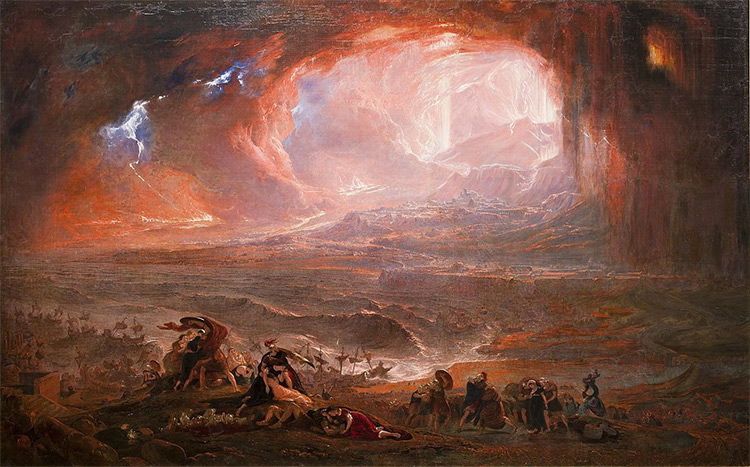 It was early in the eighth century BC that the Greeks came to the bay of Naples, first as prospectors and traders, and finally as colonists. The earliest and most important of their settlements was Cumae, which in its turn founded daughter-colonies at Dikaiarchia (the modem Puteoli or Pozzuoli) and Nea Polis, 'new city', now Naples.
Further round the bay, under Vesuvius itself, were Herakleion, 'the shrine of Herakles', whose name suggests a Greek foundation, and Pompeia, sited at the mouth of the river Sarno in a favourable position for contact with the hinterland.
These were the Herculaneum and Pompeii of Roman times, destroyed in the great eruption of just nineteen centuries ago. The lowest levels at Herculaneum have not been explored, but at Pompeii it is known that the temple of Apollo and the Doric temple in the so-called 'triangular forum' date back to the sixth century BC.
Wherever the Greeks went, they linked their new-found lands with the history of their own people - that is, in our terms, the legendary world of pan-Hellenic epic tradition. The most striking feature of the bay of Naples, its volcanic geology, made them think not only of the fire-god Hephaistos - the Solfatara near Pozzuoli was known as 'Hephaistos' Market-Place' - but also of the Giants, those unruly sons of the Earth who dared to make war on the gods of Olympus, and would have vanquished them but for the hero Herakles.
Much of our information about these western legends comes from the geographer Strabo, a Greek writing at the time of the emperor Augustus. The sources he used were much older, and probably included the sixth-century poet Stesichorus and the fifth-century historians Hecataeus and Hellanicus, whose mythographies he rationalized for his own more scientific purpose.
For Strabo, Vesuvius was extinct. What struck him was the fertility of the land all round it, a phenomenon which he rightly attributed to earlier eruptions. 'The summit is mostly fiat,' he writes, 'and totally sterile, ash-coloured in appearance, with porous cavities of blackened rock looking as if fire had eaten it away; from which we may infer that the place was once on fire, with live craters, until the fuel gave out. Perhaps this is why the surrounding country is so fertile...'
The whole area was called Phlegra, the blazing land. It was a country 'full of sulphur and fire and hot springs', as Strabo puts it: 'some believe it is the thunderbolt-wounds of the fallen Giants that give out such streams of fire and water'. But Strabo is sceptical: the battle of the gods and Giants was located on the plain of Phlegra 'for no other reason, it seems, than that the land is so fertile it was worth fighting over'.
Herakles, as we have seen, was involved in this primeval battle; it was due to him that the Giants were worsted and imprisoned in the uneasy earth. The mythographers accounted for his presence in Italy by elaborating on his tenth Labour, the theft of the cattle of Geryon. At least as early as the fifth century BC, they had him driving the herd back from Spain through Provence to Italy and Sicily.
That was not the quickest way back to Argos, but he made the mistake of following the coast round the Italian riviera - building as he went, so it was said, the first coast-road from Nice to Genoa, distant ancestor of the European autoroute opened this year. Many other local legends were attached to his journey, some, like the story of Cacus and Evander in Book VIII of Virgil's Aeneid, destined to attain the status of classics.
From Evander's town at the site of future Rome, he went south, still driving the cattle. Diodorus of Sicily takes up the story (IV 21.5-22.2, translated by G. Booth, 1700):
Hercules marching from Mount Palatine, passed through the maritime coasts of Italy, as they are now called, and came into the champaign country of Cumae, where (it is said) there were men infamous for their outrages and cruelties, called giants. This place is also called the Phlegraean plain, from a hill which antientiy vomited out fire, like unto Aetna in Sicily, now called Vesuvius, which retains many signs and marks of its ancient irruptions.
These giants, hearing of Hercules's approach, met him in battle array, and, fighting with the force and cruelty of giants, Hercules (with the assistance of the gods) overcame them, and cutting off most of them, quieted that country. These giants were called sons of the earth, by reason of the vast bulk of their bodies. These are the things that some report (whom Timaeus follows) concerning the destruction of the giants of Phlegraea.
Leaving the plains of Phlegraea, he came to the sea, where he performed some remarkable works about the lake Avernus, (as it is called), which is consecrated to Proserpine... Whereas this lake extended as far as the sea, it is said Hercules, by casting up of earth, so stopped up its current, that he made the way near the sea, now called the Herculean way.
While he fought the Giants, Herakles penned up the cattle near Baiae, at a place which ever after was known as Bauli (the modern Bacoli), after the Greek word boaulos, a cattle-pen. That characteristic etymology comes from Servius' commentary on the Aeneid, which also reports Herakles' triumphal procession - pompe in Greek - from which the town of Pompeia/Pompeii took its name.
These legends were interpreted at various levels of sophistication in the Greco-Roman world. The normal way for an historian to treat them was to leave out the obviously 'mythic' elements and rationalize the rest. So Dionysius of Halicarnassus turns the story of Herakles in Italy into a full-scale invasion, leaving out the cattle and the Giants and making the hero the commander of an army and a fleet (144.1, translated by Edward Spelman, 1758):
After Hercules had settled everything in Italy according to his desire, and his naval forces were arrived in safety from Spain, he offered up to the gods the tenths of his booty, and built a small town of the same name with himself, in the place where his fleet lay at anchor (which, being now inhabited by the Romans, and lying in the midway between Pompeii, and Naples, has, at all times, secure havens) and having gained glory, worthy of emulation, and received divine honors from all the inhabitants of Italy, he set sail for Sicily.
When was all this conceived of as happening? Herakles was normally put in the generation before the Trojan War, which orthodox Greek chronology placed in what we would call 1194-1184 BC. Thus Aeneas, coming to Italy after the fall of Troy, is able to hear the story of Hercules (to adopt Virgil's Latin spelling) at first hand from the aged Evander.
Moreover, the wanderings of Aeneas and Odysseus in their turn became part of the pseudo-history of the bay of Naples: Capri was the island of the Sirens, one of whom - Parthenope - had her tomb at Naples; Baiae was named after Baios, a member of Odysseus' crew, and Misenum after Aeneas' trumpeter Misenus; the entrance to hell was placed at lake Avernus, where there was supposed to be an oracle of the dead, consulted by both heroes.
All these are fairy-tales by our criteria; but the extension of Greek mythology into the western Mediterranean is historically important as having originally provided a kind of legendary 'charter' to justify the existence of the Greek cities that were founded along the coasts of Sicily, Italy and southern France.
What of the real history of the cities round the bay? Strabo tells us that Pompeii and Herculaneum were first occupied by 'Oscans5, that is, indigenous Italic peoples speaking the Oscan language, then by Etruscans and then by Samnites. The Etruscans controlled Campania from the sixth century until 474 BC, when they were defeated by Hieron of Syracuse at Cumae.
But two generations later Sabellic peoples from the high inland plateaux of the Apennines occupied the fertile plain. They took Cumae about 420 BC, and a fortiori the other Greek centres must have fallen to them as well. Not that these Samnites were mere barbarians. Their own territory was tribal, but under Greek influence their new Campanian centres remained cities, unlike the villages of their mountain homeland. So Pompeii and Herculaneum became, as it were, bicultural - Oscan-speaking but still strongly Hellenized.
A century later they were under Roman control. After the Samnite Wars, Pompeii and Herculaneum, like Naples, became allies of Rome, and for two hundred years they benefited from the expansion of Roman power. Dikaiarchia, now renamed Puteoli, became the main west-coast port of Italy; Roman roads improved the communications, Roman coastal villas began to spring up round the bay, and by the late second century BC the archaeological record shows that Pompeii was a flourishing place.
But if Rome's allies were prosperous, they were not therefore contented. They did not get enough out of the expansion of the Roman empire, and they were subject to the increasing arrogance of Roman magistrates and commanders, against which they had no redress since they were not citizens of Rome. In the winter of 91-90 BC, the allies rose in rebellion.
Pompeii and Herculaneum were among the insurgents. Though the allies had some successes in the first year of the war, both towns fell to the Romans in 89 BC - after a siege in the case of Pompeii, which was captured by the Roman commander L. Cornelius Sulla. The allies got the citizenship they fought for, but their rebellion was punished.
Sulla was consul the following year, and then, after the civil war and his campaign against Mithri-dates in Greece, he became dictator. As sole ruler of Rome in 81 BC, he had to deal with centres of resistance still hostile to his authority, and he had to reward the veterans of three major wars. He solved both problems at once by settling his ex-servicemen in colonies all over Italy. Pompeii was one of them. 'Enemy' land was confiscated, and the ruling families of the allied city were replaced by reliable Romans.
The Greco-Oscan town now became Colonia Cornelia Veneria Pompeianorum. Its new titles commemorated the founder, Cornelius Sulla, and his tutelary deity, Venus. Not that the love-goddess was a suitable patron for a community at war within itself: the old inhabitants were effectively disfranchized, and the splendid new buildings that were now put up, the amphitheatre and the great square colonnade, were for the use and enjoyment of the new colonists only.
A new covered theatre was also built, by the same two local oligarchs who were responsible for the amphitheatre. One of them, C. Quinctius Valgus, is known from Cicero, and from inscriptions found at other sites, as a great landowner with estates all over southern Italy that he had picked up cheap in Sulla's proscriptions. The other, M. Porcius, was a wine exporter; amphoras with his stamp have been found in several places in southern France, and the wine that filled them no doubt came from vineyards on the fertile slopes of Vesuvius.
Eventually the wounds healed, and a modus vivendi evolved. There seem to have been no equivalent traumas at the next great upheaval in Roman history, the civil wars which eventually brought Augustus to sole power; but a generation after that, local politics were once more fraught with discord. We do not know why, but from AD 41 to 52 no municipal magistrates were elected at Pompeii, and it seems that the city had an 'emergency' government of men appointed from outside by the emperor.
Even when things got back to normal, local rivalry with the neighbouring town of Nuceria broke out violently in the notorious amphitheatre riot of AD 59, when many visiting Nucerians were killed or injured. Tacitus, who reports the fracas, calls it a characteristic example of small-town disorder (oppidana lascivia). It may have been because of imperial disapproval that litde help was given from Rome when the towns were seriously damaged by an earthquake in AD 62. Reconstruction was slow, and much remained to be done seventeen years later when the final disaster struck.
Vesuvius erupted on August 24th, AD 79. Here is Martial's urbane reaction (IV 44, translated by Joseph Addison, 1705):
Vesuvio, cover'd with the fruitful vine,
Here flourish'd once, and ran with floods of wine.
Here Bacchus oft to the cool shades retir'd,
And his own native Nisa less admir'd;
Oft to the mountain's airy tops advanc'd,
The frisking Satyrs on the summets danc'd;
Alcides here, here Venus grac'd the shore,
Nor lov'd her fav'rite Lacedaemon more:
Now piles of ashes, spreading all around,
In undistinguish'd heaps deform the ground,
The Gods themselves the ruin'd seats bemoan,
And blame the mischiefs that themselves have done.
Bacchus and the fruitful vine remind us of the fertility of the area, which impressed Strabo, and the vineyards of M. Porcius, the Sullan magistrate. But Venus and Hercules ('Alcides') are also there: the poet alludes not only to the patron goddess of Sulla's colony, but also to the legendary founder of the doomed towns. Legend and history are not differentiated. Nor are they even in the pages of the sober historian Cassius Dio (LXV1 22.2-23.1):
Numbers of huge men appeared of superhuman size, such as the Giants are represented; on the mountain, and in the countryside and cities around it, by day and night they were seen roaming the earth and wandering through the air... Then there was a sudden, portentous crash, as if the mountains were collapsing. Huge rocks bounced up as high as the very summits; there was fire everywhere and endless smoke, darkening the whole sky and blotting out the sun as if it were eclipsed. Light became darkness, day became night. People thought the Giants were rising in revolt, for now too their numerous phantom shapes appeared in the smoke, and a sound as of war-trumpets could be heard.
Though Dio was writing more than a century after the event, his account may still have some psychological validity. An eye-witness, the younger Pliny, describes the flames, the reek of sulphur, the black and dreadful cloud that descended to blot out everything in utter darkness, and the terrified refugees who believed that the gods were no more. Old legends can sometimes seem apallingly real. In the din and dark and terror of that day, the people of Pompeii and Herculaneum might well believe that the once-defeated Giants had broken out of their prison in the earth and were taking their terrible vengeance upon gods and men.

