

Tata: India’s Industrial Giant
Tata is one of the world’s wealthiest conglomerates, with an especially strong presence in Britain. Zareer Masani traces its origins among the Parsis of Bombay and charts its fortunes in an independent India.
In February 2014 Prime Minister David Cameron opened a major new Jaguar Land Rover engine plant in the West Midlands, describing it as ‘a great story … which epitomises what we need to happen to the British economy’. Its owner is India’s biggest business conglomerate, Tata, and the British public might be surprised that this Indian giant, having also taken over what was once British Steel and Tetley Tea, is now the UK’s largest private employer and its biggest manufacturer, ahead of British Aerospace. Tata’s British connections date back a century and a half, during which time a small family business in Bombay grew into a global empire of almost a hundred companies.
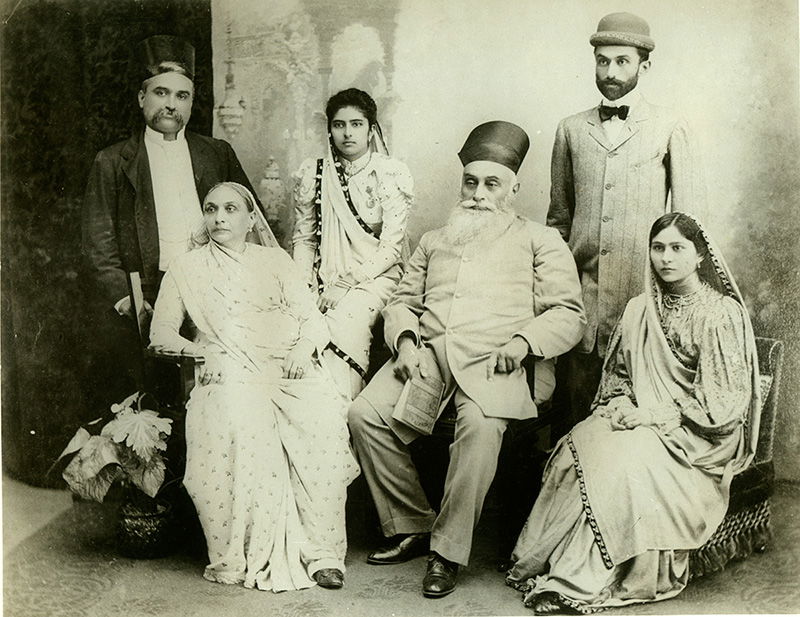
Britons need not travel far to visit the founders of the Tata dynasty. They lie buried at Brookwood cemetery, Surrey, in an exotic trio of mausoleums built in an Achaemenid-revival style, in imitation of ancient Iran, with ceramics of Persian warriors, winged images of the Zoroastrian God of Light and an inscription of the Tata family motto: ‘Good thoughts, good words, good deeds.’ The tombs are the resting place of Jamsetji Tata, the ‘Founder’, and his two very different sons, Dorab and Ratan, both of whom were knighted under the British Raj.
Jamsetji was born in 1839 into the tiny Parsi minority of India’s west coast, descended from Zoroastrian refugees who had fled the newly Islamised Iran of the ninth century. Attracted to the port of Bombay by the commercial opportunities offered under British rule, the Parsis became stalwarts of urban India’s business and professional classes. The Tatas, like many other Bombay merchants, prospered mainly in the China trade, at first exchanging Indian opium for Chinese luxury goods.
Jamsetji was very much a ‘Macaulay child’, the pejorative label applied by nationalists to India’s western-educated elite. His father had him privately tutored in the English-language education recently introduced by the liberal reformer and historian, Thomas Macaulay, and he spent the turbulent period of the Indian Rebellion of 1857, at Elphinstone College, Bombay’s first institution of higher education. Having mastered the coloniser’s language, he became an omnivorous reader of everything, from Dickens and Thackeray to treatises on botany and steel manufacture.
Though he remained loyal to British rule, Jamsetji was critical of what he called the ‘unfortunate perversions’ of Empire, its ‘individual arrogance’ and attempts ‘to perpetrate a new caste domination’. His political manifesto was set out in a letter to the Times of India in 1894. The Parsis, he argued, as migrants to India who had benefited most from British rule, had a particularly large stake in its survival. ‘We are very much alive’, he cautioned, ‘though it may be from selfishness, to any serious risks incurred by our Government through the wanton and selfish behaviour of some part … of the community ruling over us. British rule, in the abstract, is nearly as good as it can be in India …’
***
Jamsetji’s own meteoric career was a demonstration of what enterprising Indians could achieve in this new imperial era of economic globalisation, based on free trade, free markets and secure property rights. The Parsis, unhampered by Hindu caste taboos against overseas travel, were quick to seek out new foreign markets, machines and expertise; and Jamsetji was the most widely travelled Indian businessman of his time. In 1859 he sailed to Hong Kong and Shanghai to expand his father’s trading company. After four years in China he travelled to Lancashire to study its textile industry, which had put Indian handlooms out of business, then back east to Japan, in the throes of rapid industrialisation, and then to Egypt, to study its cotton trade.
This ceaseless travel kept the Tatas well ahead of Indian competitors in their knowledge of the latest foreign trends. Bombay’s merchant princes had been ploughing their trading profits into the new textile factories which were bringing Britain’s Industrial Revolution to India. The Indian mills did particularly well out of global cotton shortages during the American Civil War and the Tatas profited most by importing the latest machinery. Their crowning glory was the state-of-the-art Empress Mills, opened in Nagpur in 1877 and named in honour of Victoria, the newly proclaimed Queen Empress. It was a measure of Jamsetji’s political evolution that a decade later he opened an even more ambitious textile mill, the Swadeshi, named after the new nationalist campaign for Indian-manufactured goods. The Swadeshi relied on Indian, rather than foreign, share capital and aimed to compete with the Lancashire producers of fine British yarn.
 ‘If I am not a native of India, what am I?’ Jamsetji angrily responded to criticism that Parsis, as ‘foreign’ settlers, should not support Indian nationalism. He financed the Congress Party, then committed to Home Rule within the Empire, and plunged into political controversy over the devaluation of the Indian rupee by the Imperial government. When the government compensated its own civil servants for the depreciation of their salaries, Jamsetji complained: ‘It gives with an open hand to those who already have in plenty and takes away from those who have scarcely anything left to give.’
***
Tata patriotism also took the form of fierce resistance to the long-standing discrimination against native companies by British businesses unaccustomed to Indian competition. When the dominant P&O shipping line charged Tatas more than British firms for their freight, Jamsetji fought a sustained and bitter campaign to break its monopoly, lobbying the imperial authorities and even trying to set up a rival Tata Line with Japanese investment. When a Lancashire supplier demanded that Tatas pay a premium on textile machines that were being sold far cheaper to local British buyers, Jamsetji stormed back at him ‘that unless I was placed on exactly the same footing as his other customers in Lancashire, I would never more buy an engine of his, and try to persuade my fellow-manufacturers in India to do the same’.
One story, probably apocryphal, attributes India’s grandest hotel, the Taj Mahal, which still dominates Bombay’s Colaba waterfront, to Jamsetji’s annoyance about the colour bar then operating in some British-owned hotels. This jewel in the crown of Tatas’ present, worldwide chain of luxury hotels was the favoured project of the Founder’s final years – and once the only Indian hotel with electricity. Despite failing health, he personally scoured London, Paris and Berlin to buy the latest bathroom and electrical fittings, chandeliers and lifts for what he was determined would be the world’s most modern hotel.
An English traveller praised Jamsetji’s Bombay mansion as ‘the finest private residence in India’, crammed with foreign exotica that included Palestinian fruit trees, Croatian horses and Italian greyhounds. ‘His purchases’, wrote a biographer, ‘were made, not so much for himself, as to let India know what was new in the great world across the seas.’ His carriages were the first in Bombay to be fitted with rubber tyres, ‘whose silent progress amazed the crowd’, and he bought his first motor car in 1901.
Jamsetji’s attitudes towards modernity were summed up by his response to what might have been a family scandal. In 1902 his middle-aged cousin and business partner R.D. Tata fell in love with a beautiful young Frenchwoman and decided to marry her. It was a major breach with orthodoxy in what was India’s most racially exclusive community. But to everyone’s surprise, including that of the bridal couple, the pater familias arrived in Paris for their wedding, welcomed young Suzanne Briere into her new role as Sooni Tata and defiantly showed her off at a lavish Parsi New Year party on the Thames, attended by 70 prominent members of the community, including two MPs.
The most ambitious of all Jamsetji’s modernising projects came in 1896, when he volunteered half his fortune to endow an Indian science university, provided the government matched his contribution. The viceroy, Lord Curzon, wavered in the face of the enormous sums involved and there followed several years of lobbying by Jamsetji. Curzon eventually yielded and the result was the Indian Institute of Science at Bangalore, the founding nucleus of India’s future silicon valley.
Had the Tatas remained in trade and textiles they would probably have gone the way of most other Indian textile mill-owners in the mid-20th century, shut down by a combination of rising costs, labour unrest and growing competition from a rapidly modernising Far East. But before he died in 1904, Jamsetji had prepared the ground for one of the most ambitious transitions in economic history and one which no other Indian industrialist had dared contemplate. India was to become a major steel producer and Tata was to lead this second wave of India’s industrial revolution, as it had the first.
The seed was sown in Manchester in 1867, when Jamsetji attended a lecture by the Scottish historian Thomas Carlyle and was struck by his comment that ‘the nation which gains control of iron soon gains control of gold’. Jamsetji had already identified Germany and the US as the industrial powerhouses of the future. In 1902 he arrived at the Industrial Exhibition in Düsseldorf in Germany’s industrial heartland, bearing samples of Indian coal and iron ore for testing. Having convinced himself that both were suitable for steel-making, he then took a major study tour of iron works across the United States and returned to India with a leading American geologist, C.M. Weld, in tow as his consultant engineer.
Weld identified the dense forests of Bihar in east-central India as the source for raw materials and spent a year prospecting there. His team, including Jamsetji’s Cambridge-educated son, Dorab, travelled on horseback and camped in tents, encountering heat and dust, monsoon rains and even tigers. They were rewarded with the discovery of hills rich in deposits of 60 per cent iron ore, located conveniently close to the coalfields of Bengal and the port of Calcutta.
When Jamsetji died soon after, Dorab took on the challenge of raising the capital to make his father’s steel dream a reality. In 1906, finding the London money markets reluctant to lend, he decided to risk floating the company on the infant Bombay stock market, buoyed up by the new public appetite for Swadeshi. ‘From early morning till late at night’, wrote an American observer, ‘the Tata offices in Bombay were besieged by an eager crowd of native investors. Old and young, rich and poor, men and women, they came offering their mites.’ Another account compared them with Londoners queuing for first night theatre seats, ‘some of them with stools and lunch-boxes’.
In three weeks more than £1.5 million had been raised (approximately £456 million in today’s money) and by 1913 the number of investors totalled 17,000. It was an enormous popular vote of confidence in the company and it was matched by the transformation of the new factory site from ‘a few tents and thatched huts dotted amidst a jungle clearing’. Within three years an English visitor was describing ‘street after street of commodious one-storey brick houses, all well ventilated, all supplied with running water and lit by electric light’.
India’s first and only planned industrial city was named Jamshedpur in honour of Tata’s founder, who had instructed Dorab: ‘Be sure to lay wide streets planted with shady trees, every other of a quick-growing variety. Be sure that there is plenty of space for lawns and gardens. Reserve large areas for football, hockey and parks.’ Dorab consulted the British Fabians, Sidney and Beatrice Webb, about schemes for labour welfare. The company was among the first in India to introduce free medical care, an eight-hour day, paid leave, accident compensation and profit-sharing by workers. Engineers and supervisors were initially imported from Britain, Germany and the United States; but a deliberate process of Indianisation rapidly reduced their numbers. A century later, Jamshedpur, with a population of nearly a million, is still effectively administered by Tata as a model of urban planning amid India’s chaotic, concrete jungles.
***
The success of Tata Steel led to a major improvement in relations with the Raj. The British head of Indian Railways had scoffed at the company’s ability to make ‘steel rails to British specifications’ and vowed ‘to eat every pound of steel they succeed in making’. A few years later, during the First World War, he had to eat his words when a major shortage of railway lines in the eastern theatres of the conflict meant that Tata Steel filled the gap, supplying 1,500 miles of rail and 300,000 tons of steel to Allied forces, who commandeered almost the entire company output at a quarter of market prices. Tata Steel, founded just eight years before, rose to the challenge and suppressed a strike by its anti-British German technicians, replacing them with Americans. A grateful Viceroy Chelmsford arrived at Jamshedpur’s new railway station in 1919 to offer public thanks. ‘I can hardly imagine’, he declared, ‘what we should have done during these four years if the Tata Company had not been able to give us steel rails … not only for Mesopotamia, but for Egypt, Palestine and East Africa.’ The Tatas’ war effort won them a place in London’s most select circles at a time when India’s budding business tycoons were grudgingly accepted into the imperial elite.
The Founder’s philanthropy, which had left half his estate to the Bangalore science institute, was matched by his sons, who both died childless and left their fortunes to charitable trusts to advance learning, relieve suffering and perform ‘other works of public utility’. For the past 80 years that broad remit has financed activities ranging from nuclear research and free cancer treatment to India’s most prestigious arts centres. The two trusts, chaired successively by Tata family members, still own two thirds of the shares in Tata Sons, the group’s central holding company. It is a federal ownership model unique among Indian businesses, underpinning the Founder’s concept of trusteeship. It has ensured that investment decisions are driven far less by personal whims or quick profits than by long-term strategic goals and that much of the profits continue to be ploughed back into philanthropy.
During the Great Depression of the 1920s Tata Steel survived against all odds because Dorab pledged his entire personal fortune to secure a bail-out loan. The imperial government suspended its commitment to free trade and came to the rescue, joining forces with nationalists in the central legislature to enact a new protective tariff against steel imports. ‘Why foreign steel when Tata is cheaper?’ advertising posters exhorted an increasingly nationalist Indian public. ‘Tata Steel means Indian capital and Indian labour. Use Tata Steel and you help India.’ The appeal paid off: Tata Steel expanded rapidly through the 1930s and 1940s, survived Nehru’s socialism post-independence and remains India’s top listed company.
***
The other major pillar of Tata strategic planning was power generation. Tata Power, now India’s biggest private supplier, originated in Jamsetji’s plan to electrify Bombay by harnessing the hydro-electric power generated by heavy monsoons in the nearby hills of the Western Ghats. Again, it was Dorab who brought the scheme to fruition in 1910, rallying Indian investors to back a series of major engineering feats: boring a mile-long tunnel through a mountain, building three major dams to turn the flow of two rivers and creating a five-mile artificial waterway. In 1915 the new Tata power station was switched on in Bombay’s industrial district, replacing coal with clean electricity.

With Jamsetji’s immediate family extinct by the 1930s, the next wave of innovation would be led by a charismatic, young French relative, J.R.D. Tata, or ‘Jeh’. The child of the controversial marriage of Jamsetji’s cousin, he grew up mostly in France, but was summoned back to join the family business. ‘I had two personalities’, he later reflected. ‘I was an anti-British Indian, but I was a little more of a Frenchman than an Indian.’ In 1938, at the age of 34, he took over as chairman of Tata Sons.
Jeh was a keen aviator and in 1932 he had channelled his private passion into the launch of India’s first air mail service, which grew into its national airline. At the helm of India’s biggest business empire, a virtual state within the state, Jeh led the group into expansionist mode, spurred on by hopes of an independent Indian government backing local industries strongly. Tata Chemicals was launched in 1939, followed in 1945 by another industrial giant, which began by building train engines, went on to trucks and now, as Tata Motors, makes cars for global markets.
Unfortunately for Tata and India the public-private partnership exemplified by Air India did not last long. Nehru and Jeh were increasingly at odds over the prime minister’s socialism. Nehru admonished Jeh: ‘Never talk to me about profit. It is a dirty word!’
By the mid-1950s Nehru was establishing the system that came to be known as the ‘Permit-Licence Raj’, which continued intact into the 1980s under his daughter Indira Gandhi. In 1953 Air India was nationalised, as was Tata’s insurance company. Tata Steel only escaped the same fate because its labour union wired the government to protest. Government obstruction frustrated Tata plans to launch a cheap Indian car in 1959 and a much-needed fertiliser plant in 1967. In 1956 Jeh publicly warned of ‘the potential danger of concentrating enormous power into the hands of a small political-cum-bureaucratic minority’. In 1972, at a Tata Steel AGM, he compained: ‘I doubt that there is anywhere in the world, outside India, any industrial executive in charge of a major enterprise with less real power than I have.’
Tata survived half a century of Nehruvian socialism through a combination of canny diplomacy and a shrewd nose for opportunities to diversify in new technologies. Tata Consultancy Services, the group’s information technology arm, was set up as early as 1968 and Tata Telecom followed in the 1980s, when the government began to liberalise.
In the last decade, it was Jeh’s successor, Ratan Tata, drafted home from the United States to succeed his childless cousin, who led the Tata move into global markets such as the UK. A buying spree targeted big acquisitions such as Corus Steel (a financial drain), Tetley and Jaguar Land Rover (a resounding success), shortcuts to name-recognition and technology that would otherwise have taken years to develop.
Tata, more than any other Indian business, is steeped in its philanthropic history: ‘What came from the people’, Jeh once said, ‘has gone back to the people many times over.’ The Founder, Jamsetji, would also have been proud that his pioneering brand of Indian capitalism, forged under the Raj, has come to the rescue of such emblematic British marques as Jaguar and Land Rover a century later.

