

The Prince of Wales in India
Christopher Hibbert describes how, against the Queen’s wishes, the Prince successfully toured the British Indian Empire at the age of thirty-four.
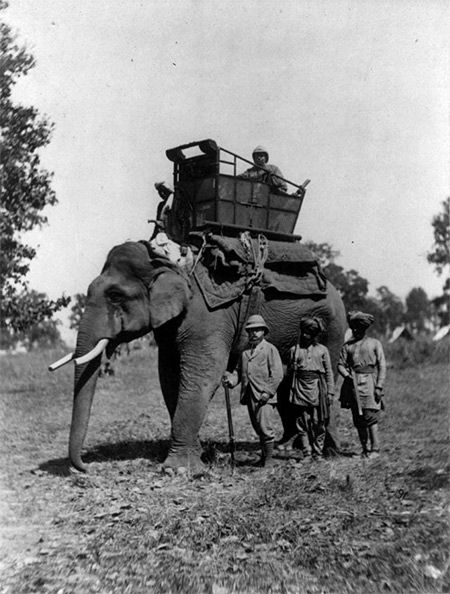
Unknown to both the government and Queen Victoria, in the winter of 1874-75, the Prince of Wales (the future Edward VII) began to plan an undertaking that was to release him for a time from the frustration he felt at his mother's reluctance to allow him any share of her authority. His household gathered what this plan was when the librarian at Sandringham was instructed to collect all the books he could about India.
When the Queen was approached, however, she did not think an Indian tour was a good idea at all. It was 'quite against [her] desire', she told her daughter, the Crown Princess of Prussia. There might be some political advantage, but not much; it was not as if there were any particular crisis in Indian affairs. Besides, even if Bertie's health were up to the strain, he ought not to leave his family for so long; and there could be no question of the Princess of Wales going. In any case, who was to pay for it all?
'Where is the money to come from?' Disraeli, the Prime Minister, also wanted to know after 'our young Hal' had induced his mother to give her assent to the scheme 'on the representation that it was entirely approved by her Ministers'.
'He has not a shilling. She will not give him one. A Prince of Wales must not move in India in a mesquin manner. Everything must be done on an imperial scale etc., etc. This is what she said... [She also said] that nothing will induce her to consent to the Princess going and blames herself bitterly for having sanctioned the scheme without obtaining on the subject my opinion and that of my colleagues.'
In fact, the Prince had never suggested to his wife that she should accompany him; and Lord Derby, the Foreign Secretary, for one, was thankful that he had not done so. For not only would there be extremely difficult problems of protocol to overcome if she were to visit the courts of Indian princes; but, so Derby said, ''Hal' is sure to get into scrapes with women whether she goes or not, and they will be considered more excusable in her absence.'
When she discovered what her husband's intentions were, Princess Alexandra was much put out, protesting, years later, that she would 'never forget or forgive' him for having left her behind. The Prince, himself, was also annoyed when he learned that his mother - who was already pestering him with advice about the food he should eat, the time he ought to go to bed each night, the way he must behave on Sundays - insisted on supervising all the arrangements including the composition of his suite.
It had been 'entirely' his own idea, he insisted; and it was only natural that he should wish 'to keep the arrangements connected with it in his hands'. During an interview with Disraeli at Downing Street he 'manifested extraordinary excitement' as he angrily declined to make any alterations in the names he had chosen.
He would certainly not leave his friends, the Duke of Sutherland and Lord Carrington, behind simply because the Queen disapproved of them. Nor would he withdraw his invitations to Lord Aylesford who was also going as his personal guest, to William Howard Russell, who was travelling as his honorary private secretary, or to Lieutenant Lord Charles Beresford, R.N., who had been invited to go as one of his three aides-de-camp.
In face of the Prince's obduracy, Disraeli felt compelled to give way, afterwards assuring the Queen that he would caution Carrington and Beresford in particular 'against larks'. He also assured her that the Prince would be accompanied by a chaplain and a physician; that her Majesty would be represented by Lord Alfred Paget, her clerk-marshal; and that Sir Bartle Frere would be in general control of the party, taking with him, as secretary, General Grey's son, Albert.
The Prince reluctantly agreed not to include the detachment of Life Guards for which he had asked, or a Russian liaison officer on its being pointed out to him that if he did, other countries would expect to be asked to provide liaison officers of their own. He was, however, to be attended by his stud-groom and valet, a page, three chefs, and twenty-two other servants as well as the Duke of Sutherland's piper.
In addition there was to be an artist, a botanist, and Clarence Bartlett, Assistant Superintendent of the Zoological Gardens, who was both zoologist and taxidermist. Three handsome horses from the Sandringham stables were also to be taken; and, so as to accustom them to the sight of wild beasts and reptiles, they were taken regularly to look at the animals in the Zoo.
Naturally there was trouble over the amount of money to be provided for the expedition as well as over its composition. Reynolds's Newspaper, which attacked the whole 'notion of Albert Edward, the hero of the Mordaunt divorce suit, the mighty hunter' being interested in anything other than 'pig-sticking and women', protested that working men were being robbed so that the Prince of Wales could enjoy himself.
To loud cheers of support from a crowd of over 60,000 people in Hyde Park, Charles Bradlaugh said that the nation did not wish to prevent the brave, moral, intellectual future King of England going to India; 'indeed they would speed him on a longer journey than that'. But they did object to having to pay for such a ridiculous jamboree.
All over England similar hostile demonstrations were held; outraged orators demanded to know why the country was being asked to pay for presents to Indian princes, while the gifts offered in return would become the Prince's personal property. Banners and placards were waved in protest against the Indian visit; and during his travels that summer the Prince himself was made aware of the strong feelings which had once more been roused against him.
Even in royal circles people spoke slightingly of his mission. At Balmoral, after a Sunday morning service, Lady Errol, a Presbyterian attendant of the Queen, remarked to Henry Ponsonby how beautiful was the prayer which had been said for the Prince of Wales. 'Well,' Ponsonby replied. 'I don't know that it was a bad one, but I didn't understand what he meant [by] 'Oh bless abundantly the objects of his mission'.' Lady Errol replied, 'Oh, all the good he may do.' Ponsonby sharply observed, 'The object of his mission is amusement.' 'Yes,' agreed Lord Salisbury. 'And to kill tigers. Perhaps he meant to bless the tigers.'
In spite of all the criticism, however, and in face of strong objection from the Radicals and many members of the Liberal Party, Disraeli persuaded the House of Commons to approve the expenditure of £52,000 by the Admiralty for the transport of the Prince's suite to and from India and of a further £60,500 by the Treasury for the Prince's personal expenditure including presents to Indian rulers.
An additional £100,000 was subsequently contributed by the Indian Government. Yet the Prince, supported by Barde Frere and The Times, maintained that this was far from enough: the Indian princes would present their guest with gifts far more lavish than any that he would be able to afford to give them in return. And, as if confident that the amount of his allowances would be increased when the importance of his mission was recognized, he spoke carelessly to his 'creatures', so Disraeli recorded, 'of spending, if requisite, a million, and all that'.
But although 'a thoroughly spoilt child' who could not 'bear being bored', he was also, in Disraeli's opinion, 'the most amiable of mortals'; and he soon reconciled himself to the amount that the Prime Minister had raised for him without further protest - and, in the event, did not exceed it.
Irritated by quarrels over the number and quality of his companions, over the amount of money to be allowed him, and over his official status in India - where the position of the Viceroy, so the Queen insisted, must on no account be prejudiced - the Prince was also piqued by the attitude of his wife who, refusing to accept her husband's explanation that this was an all-male party, and that 'it was difficult for ladies to move about' in India, continued to complain bitterly about being left behind and appeared to Disraeli as though she were preparing to commit suttee.
Albert Grey, who had equipped himself with a derringer 'to save H.R.H. from assassination', reported her as being 'very miserable', not only because she badly wanted to see India and was hint at being left behind, but also 'because besides the not unnatural fear about his health - in its best day but flabby - there [was] the more uncomfortable dread of the fanatic's knife about the sharpness of which he has received many warning letters'. The Princess was also very upset because the Queen refused to allow her to take the children to Denmark while their father was in India.
Although she later relented, the Queen insisted that a decision given by the judges in the reign of George II gave her the right to prevent the royal children from leaving the country. Taking pity on the Princess, Disraeli consulted the Solicitor-General who gave it as his opinion that the precedent was a bad one, that the Queen ought not to exercise it even if it existed, and that 'to force the Princess to live in seclusion ... 6 months in England [was] a serious matter'.
Refused permission to visit either India or Denmark, the Princess, in Dean Stanley's opinion, looked 'inexpressibly sad', And, as die time drew nearer for his departure, the Prince seemed quite as miserable himself, confessing to Lord Granville that he 'left England with a heavy heart and was so depressed on reaching Calais' that, although he was cheered on his departure by thousands of people willing to show that antagonism to his expensive venture was far from universal, he 'felt seriously inclined to return home instead of going on'.
He continued 'tremendously low' in Paris, Lord Carrington wrote; and even after their arrival in Brindisi, where crowds on the quay greeted the Duke of Sutherland with shouts of 'I'amico di Garibaldi', he had still not recovered his spirits. At Brindisi he went aboard H.M.S. Serapis, a specially converted troopship with large square portholes, which was awaiting to take him through the Suez Canal by way of Athens.
It was 'comfortable but not smart'; and the Prince went to his cabin looking 'decidedly gloomy'. In fact, the whole party, so Lord Carrington told his mother, were 'more like a party of monks than anything else'. There were 'no jokes or any approach to them'. Georgina Frere was given similar news by her father. No shipload of pilgrims 'were ever better behaved', Sir Bartle told her: so far there had been 'nothing which would have been voted out of place at Windsor Castle'. Lord Charles Beresford, a jocular Irishman, attempted to keep up the party's flagging spirits, but there were no games of whist, 'no sprees, or beer fights or anything'. The day after leaving Brindisi the Serapis began to toss in the swelling sea; and 'several chairs were empty at dinner', Albert Grey recorded.
'H.R.H. was the first to go and a suspicious smell of eau de Cologne outside his cabin told the tale.' On recovery he was persuaded by Beresford to go up on deck and join the others who were being weighed. Apart from Beresford himself, very few of them were less than eleven stone. The Prince turned the scales at fourteen stone twelve pounds - which made Grey wonder how he would stand up to the heat of India.
At Cairo the Prince seemed rather less dispirited. He went out of his way to call upon the widow of a former French Ambassador to London, whom he had met and liked when he was a boy - a fat, old, deaf lady whose conversation 'became rather tiring in the hot weather'. And, resplendent in his new uniform of field marshal (a rank to which the Queen had raised him on her last birthday), he invested the Khedive's son with the Order of the Star of India with such 'dignity of manner and grace' that Alfred Grey thought that 'every Englishman, had he been there, would have been proud of him'.
By the time the Serapis had entered the Red Sea on her way down to Aden, the Prince's gloom had been quite dispersed. 'His temper is most amiable,' Grey wrote home. 'He sits mopping away as we steam along with the thermometer at eighty-eight on the bridge at midnight, not complaining like the others of the discomfort of the heat - but congratulating himself as he throws away one wet handkerchief after another - 'What a capital thing is a good wholesome sweat!' ' He even found the energy to play deck tennis.
On the eve of the Prince's thirty-fourth birthday, November 8th, 1875, 'to the tune of much gunpowder and brass bands', the Serapis entered Bombay harbour between two lines of English battleships. The Prince stood on the bridge, acknowledging the cheers and bowing to each ship as he glided past it. He was met by the Viceroy, Lord Northbrook, by numerous less exalted officials, and by about seventy Indian princes and their attendants.
Also there to greet him were two one-armed British officers, Major General Sir Sam Browne, V.C., inventor of the sword-belt, who was to take charge of the transport of the royal party, and Major Edward Bradford, the 'head of the secret police in India', who was to be responsible for its security.
Bradford insisted that the Prince must never be allowed to walk anywhere on his own, and that at night at least one member of his suite must sit on guard outside his bedroom or tent. Unsure of the reception likely to be accorded him, the police were already keeping various possible troublemakers under surveillance and had imposed a censorship on some Indian journals.
In fact, there was no need for such precautions. A few derogatory comments did appear in the Indian press; one paper was published with black mourning bands round the edges of its pages; and a farce, Gayadananda, in which the Prince appeared in a particularly ludicrous light, was suppressed after a few performances. But, on the whole, the Indians were to accord the Prince a friendly reception and to make him feel welcome.
Large crowds cheered his progress from the Bombay docks to Government House, and energetically waved banners on which were written such friendly mottoes as 'Tell Mama We're Happy'. 'There can no longer be any doubt of the extraordinary effect which the visit of the Prince of Wales has produced in India,' The Times reported a few days later. 'From the moment the Prince set foot on the shores of India there has been one continuous demonstration, surpassing all that could be expected or imagined of an Asiatic people.
It was not only the Princes and Chiefs who assembled to welcome him, but the whole population of Bombay swarmed along the road, and as the royal procession slowly made its way through the dense masses which rose from the ground to the housetops ... a welcome was given such as an Indian city has seldom seen.' From Bombay the Prince went on to Poona and Baroda, then to Goa and Ceylon, Madras and Calcutta. After Christmas at Barrackpore, he travelled north east to Lucknow. He went to Delhi in January, then north again to Lahore, then on to Agra, Jaipur and Nepal.
He reviewed parades of native troops; he inspected buildings and railways, coffee and cocoa mills; he visited prisons and the palaces of princes; he attended firework displays and banquets; held durbars, receptions and levees; he watched army manoeuvres and led his own regiment, the 10th Hussars, in a simulated cavalry charge. He presided at a chapter of the Star of India and admitted several princes to the Order.
At Benares he inspected the Maharajah's palace where the sofa on which he sat was afterwards pointed out to visitors with great reverence: 'A broad space (half the sofa) was covered carefully with tissue paper,' Grey noted in his journal, 'and thus the impress of the royal and broad seat of H.R.H. is ever hereafter to be preserved as a holy and sacred relic.'
At Kandy, so the correspondent of The Times of India reported, he 'seemed highly pleased with the novel, splendid and peculiar' cavalcade that was presented for his entertainment. 'First came about thirty men in rich dress beating the tom-tom and blowing (for it cannot be called playing) a sort of squealing, ivory-necked pipe. These were followed by forty elephants, not painted (as at Baroda) but richly caparisoned in cloth of gold or other equally brilliant covering. On every elephant were men waving fans and banners, and each animal also bore a richly decorated howdah which contained the arms and other relics of the gods...
As each elephant approached the Prince it was made to do obeisance either by kneeling or crouching which His Royal Highness rewarded by feeding the monsters with sugar cane ... At intervals were dancers, who, though they looked very much like women, were, I am assured, men.' They all wore bells and bangles; some sang 'strange, weird' songs; others turned somersaults; a few were covered with bright steel armour and wore 'helmets with faces of devils'.
At Delhi, Albert Grey recorded, 'a vast crowd of mingled races were herded in silent expectation ... on the magnificent mountain of stairs [that] approached the gate of the mosque ... At the Prince's approach they all arose at the same moment as if by instinct... like a flight of birds.'
The day before he arrived in Madras, readers of the Native Public Opinion were advised: 'The advent of the Prince is an important event, and it is one which must be celebrated with rejoicings by all classes. The distinction between the conquering and the conquered must be forgotten at least for the time being... Our complexions, costumes, manners, usages and religions are different. We have yet one thing in common... We are all free-born British subjects.'
The rather admonitory tone of the article was unnecessary. The Prince's welcome in Madras was unrestrained; the enthusiasm of the people 'past all description'. 'He appears in evening dress to even better advantage than in his field marshal's uniform,' the Madras Mail reported. 'He has grown stout of late years, and looks therefore somewhat older than thirty-four, especially as, like his father, he is threatened with premature baldness. But his face is his fortune. He has a winning smile that delights both sexes and all classes ... It is gratifying to see how much the natives of high rank have been struck by what they rightly call his 'affable' manner.'
His suite were equally pleased with him. He was 'always so kind and thoughtful', Lady Frere assured Albert Grey's mother; while Grey himself wrote, 'Everyone here is fascinated with H.R.H... and his amiable manners...; both natives and Europeans comparing him with the Duke of Edinburgh [who had visited India a few years before] and Lord Northbrook in a manner that is by no means favourable to these last...
He is never idle for a moment and [exists] on a small allowance of sleep that would make children of many men... Everything he has had to do, he has done with such courtly dignity that he has at all times commanded the respect at the same time that he has enlisted the affection of those present... He is most particular in always being most civil to those whom he hears are deserving of notice from the trouble they have taken on his behalf ... He gives them all a few kind words of thanks coupled with a little offering as a keepsake.'
There was, however, a problem with these presents which - as had been feared in England -were far less valuable than those he received in return. Indeed, the idea was generally prevalent that the Prince's gifts were 'inadequate and of deficient value'. But when the Prince's suite mentioned this to the Viceroy, he 'disagreed altogether', maintaining that 'the value of the presents received by the Prince would not exceed much over £40,000' and that the value of the presents given by him would amount to the same figure.
'Of course,' Grey commented, 'a Viceroy's statement should be accepted as final... and he will be in the House of Lords next session to support his statement ... yet at Madras [alone] the value of presents given to H.R.H. = £20,000 [while] those given by H.R.H. = £8,000.'
The Prince was not to blame for this. But he was culpable, Grey had to admit, in paying insufficient attention to the susceptibilities of Europeans who clung to the 'dignity of precedence' with 'a rigidness almost inconceivable to the home-confined Englishman'. The wife of the Collector, for example, was 'a bigger swell' than the wife of the Deputy Collector, since every woman ranked in life 'according to the salary and position of her husband'.
The head woman therefore thinks [Grey noted in his journal] - and her whole training has made it part of her creed which she thoroughly believes in - that if any woman in the station, in which she reigns supreme, is to receive any honour, undoubtedly and assuredly, it is to be she. Accordingly when the Prince came to India every old Commissioner's wife assured herself that - [even if she looked] like a housekeeper - she would be the woman who could boast hereafter of having valsed with the Prince... The Prince comes.
He opens the ball with a duty dance - that done, in his opinion, duty has been done, too. Conversation with local bosses all day has not made him particularly anxious to continue conversation with local bosses' wives, particularly as they look frumpy and dull. His eyes search round for youth, a sparkling eye, a laughing mouth and a merry face, and not finding them in the Commissioner's wife, he at last discovers them in the wife of the Commissioner's underling, Jones, the junior clerk.
Mrs Jones becomes famous for the evening by the royal attention bestowed upon her, and wins a shortlived position of envy, to be hated ever hereafter by the Commissioner's wife. And this perhaps is the reason why poor honest Jones, who besides being pitied most unrighteously for having so giddy and fast a wife, is retarded in obtaining his promotion, and lingers on on small pay long after his bachelor contemporaries are comfortably provided for.
Grey said that he had heard 'cries of protest from the mighty' in Benares, Lucknow, Delhi and - loudest of all - in Calcutta where society was particularly angry with his Royal Highness and, Grey was 'sorry to say, not without reason'.
His hostess there, Lady Clarke, had invited 'all the Calcutta swells who were pining for royal notice ... So the dinner was more official than private. Calcutta appreciated this fact, not so the Prince,' who asked that the comedian, Charles Mathews - who was appearing there in the farce, My Awful Dad - should be asked to join the party after dinner with his wife. Mathews left the theatre in the middle of the performance, explaining that the abrupt termination of the piece was 'inevitably in consequence of a royal command'.
And soon afterwards, he arrived at Lady Clarke's with his pretty wife, Lizzie, who had been an actress at Burton's Theatre, New York. The Prince immediately retired 'with Mrs Mathews to the verandah and sat there chaffing and smoking cigarettes from directly after dinner until two a.m. - the official Indignants kicking their feet in impatient and envious rage, not thinking it respectful to go before the Prince. Calcutta was furious at this'.
Fortunately there were no 'more than hints about the Prince's neglect of his social duties in the newspapers; and he continued to enjoy his tour with undiminished zest. He wrote rather boring letters to his mother, and more lively, ill-spelled ones to his sons, telling them of the maddening jungle leeches which 'climb up your legs and bight you' and of the fights between wild animals which were staged for his entertainment, making these sound far less unpleasant than most European spectators found them.
His former gloom now quite dispelled, he was unfailingly cheerful and tirelessly energetic, showing less susceptibility to the heat and sun, according to Bartle Frere, than any member of his suite, yet causing constant anxiety to the Queen who, convinced that he was overdoing things, despatched telegram after telegram urging him to take more care of himself.
As those who knew him might well have predicted, to no activity did he bring more zest than big-game hunting. He killed wild pigs and cheetahs, black bucks, elephants, bears and several tigers, two of them over ten feet long. One day in Nepal, in a forest where the local ruler had assembled 10,000 men to act as servants and beaters, he shot six tigers from the vantage of a howdah, some of them 'very savage', so he told his sons, and two of them man-eaters.
On another occasion he 'shot an elephant and wounded severely two others', he announced by telegraph to the Queen. He thought at first that he had also killed one of the wounded ones which fell to the ground. He cut its tail off, as custom required, while Lord Charles Beresford danced a hornpipe on its back; but it suddenly got up again and lumbered off into the jungle.
The tail was taken back to England, when the Serapis steamed out of Bombay on March 13th, together with an extraordinary variety of other trophies including seven leopards; five tigers; four elephants; a Himalayan bear; a cheetah; two antelopes; two tragopans; three ostriches; an uncertain number of heads which Mr Bartlett was kept busy stuffing; skins and horns; orchids and other rare plants; countless presents from Indian princes - precious stones, necklaces, anklets, gold bangles, carpets, shawls, teapots, cups and ancient guns - a Madras cook, expert in the preparation of curry; two Indian officers as additional aides-de-camp; and, for the Queen, a copy of her Leaves from the Journal of my Life in the Highlands translated into Hindustani with covers of inlaid marble.
The Prince's tour, Sir Bartle Frere assured the Queen, had, however, borne fruits far more valuable than these. The Prince, who had behaved 'perfectly throughout', had succeeded in winning the affection and regard of the ordinary people of India as well as the respect of the princes. He had made an impression of 'manly vigour and power of endurance' and had encouraged Indians to believe that he stood to them in the same relationship as that in which he stood to the British.
'If there were any doubts as to the success of the visit these have been completely dissipated,' The Times confirmed, 'and even those who are least disposed to attach much importance to Courtly vanities recognize that in the particular circumstances of India, and having regard to the character of its Princes and people, the visit of the Heir of the British Crown is likely to prove a great political event.'

