

New Orleans Under French Rule
For some sixty years during the eighteenth century, writes Sarah Searight, Louisiana was a colony owing allegiance to the King of France.
The Mississippi delta was one of the last places to be settled on the eastern seaboard of America and one can still appreciate the obstacles faced by the prospective settlers of the eighteenth century. Approached from the sea, it is a grey-green savanna without horizon or landmarks to help the explorer.
The featurelessness of the landscape is occasionally relieved by clumps of shrunken, contorted trees huddled on a bank of shells, but for the most part it is a maze of cane brakes, stagnant water and ‘bayous’—a Gallicised Indian word for the narrow waterways that wander hither and thither through the Delta, some of them tributaries of the Mississippi flowing into sea, others merely tidal reaches.
About fifteen miles below New Orleans the land begins to rise; here the marsh and swamp is overgrown with huge, creeper-entwined trees, until recently the inaccessible breeding ground of millions of mosquitoes. An Ursuline nun sailing up-river to New Orleans in 1726— a week’s journey—described how she and her companions were obliged to camp an hour before sunset every night to escape the attacks of mosquitoes which ‘les unset les autres piquent sans misericorde et leurs piqueures sont tres mauvaises’, while their nights—were disturbed by the noises of exotic creatures in the undergrowth—‘serpans, couleuvres, scorpions, crocodiles, viperes, tacqs, crepeaux’—not the most comforting of environments.
A Spaniard, Hernando de Soto, discovered the Mississippi in 1541, but further exploration was postponed for over a century: Spanish energies were concentrated on consolidating her American possessions elsewhere, the English on settling the Atlantic seaboard and the French on religious and civil war at home. In 1673 a Jesuit priest in Canada, Pere Marquette, and a fur-trader, Louis Joliet, sailed down the Mississippi as far as Arkansas.
Nine years later, acting on their information, another Canadian, Robert Cavelier, Sieur de la Salle, travelled down the river to the mouth in the hopes of establishing a French colony that would be in a position to prey upon Spanish treasure fleets in the Gulf, raising the French flag a few miles up the Delta and proclaiming all the lands through which he had passed as belonging to France—Louisiana, in honour of Louis XIV and his mother, Anne of Austria.
In 1684 he returned to the Gulf with a larger expedition to establish a settlement about a hundred miles inland, but the shifting sands and horizons of the Gulf shore misled him and he never found the mouth of the river, landing instead in Texas, where he was soon afterwards murdered by mutinous companions.
The strategic position of such a colony was lost upon no one. ‘Should the French settle at the disemboguing of the river Mississippi, they would not be long before they made themselves master of that rich province, which would be an addition to their strength very terrible to Europe,’ wrote an Englishman of the period.
Ten years later, a French expedition under the command of the Canadian, Pierre le Moyne, Sieur d’lberville, set out for the Gulf, reaching the Mississippi only just in time to forestall an English settlement: Iberville’s brother Jean Baptiste, Sieur de Bienville, was exploring the river in a couple of canoes and on one occasion rounded a bend to find himself face to face with an English ship and expedition also investigating possible sites.
Bienville coolly informed the captain, Lewis Bank, that a French fleet was just out of sight and that, anyway, the river was not the Mississippi, whereupon the English turned and sailed out into the Gulf again. Iberville eventually placed his colony on the Gulf coast east of the Delta, better placed in relation to the Gulf than up the river but an unsavoury site, battered by the terrible summer storms of the area, decimated by disease and deprivation. ‘Decidedly this colony is a monster without head or tail and its government is a shapeless absurdity,’ wrote one of its governors, Cadillac, some fifteen years later.
In 1717 the Louisiana charter was sold by the Crown to the Company of the West, founded by John Law, a Scotsman remarkable for his vivid financial imagination. This Company—later the Company of the Indies—was set up as a subsidiary to Law’s Banque Générale de France, Law hoping to capitalise on optimistic rumours of fabulous riches in Louisiana. From the colony itself Bienville—Iberville had since died of yellow fever—wrote to suggest moving the colony’s headquarters up the Mississippi Delta.
Bienville had twice tried to build forts farther down the river than the proposed site, but had noted the latter’s advantages when he first sailed up-river in 1699. A narrow waterway, later known as Bayou St. John, ran inland from Lake Pontchartrain, named after the French Minister of Marine, almost to the river, providing a link with the Gulf coast settlements already exploited by a number of Frenchmen who had cleared plantations along the bayou. The site was a few feet above sea level, though well below river-level.
It was supposedly more sheltered from storms than the Gulf, though for the first two or three years houses were blown down almost as fast as they were put up. And it had a better harbour—a deep channel ensured by the headlong rush of the river to the sea—than that provided by the shallow waters of the Gulf.
Bienville’s arguments were sufficiently strong for the Company to be persuaded that a new settlement might inject new life into the flagging fortunes of Louisiana. In 1720 it despatched a party of architects and engineers to Biloxi on the Gulf coast to advise Bienville. One of these, Le Blond de la Tour, drafted plans for the new town and another, Adrian de Pauger, went off to the site to see to their execution.
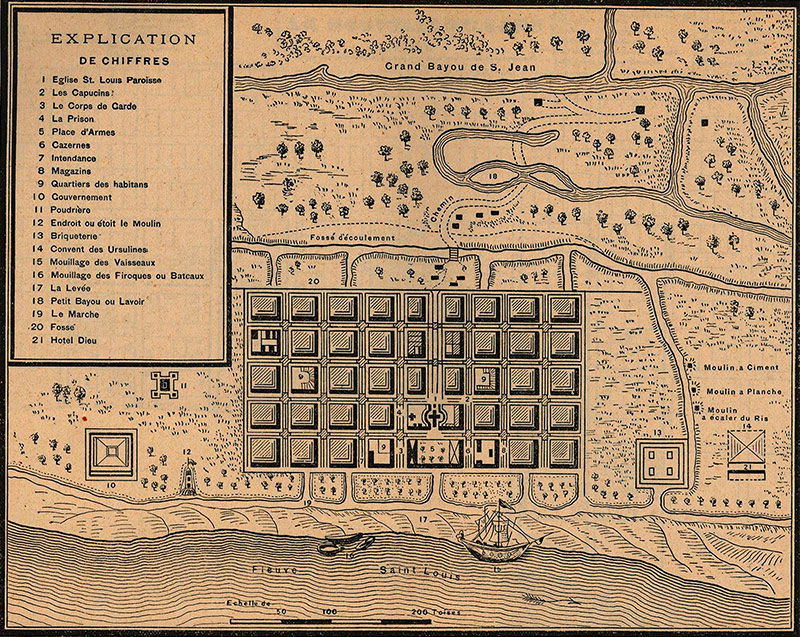
Little remains of French New Orleans, as the settlement was known, except for the lay-out. This divided the cleared area into forty blocks—five deep and eight in length along a bend in the river, enlarged after the 1722 hurricane to seven and eleven, thereby completing the so-called crescent which has given its name to New Orleans ever since.
Each block was divided into five lots and developers of each lot were instructed to surround it with a palisade, leaving sufficient space between the palisade and the street for a banquette, a little levee or dike which served as a pavement, and a drainage ditch as somewhat ineffectual protection against flood. One early visitor, Father Charlevoix, described the plan as ‘very handsome and very orderly’, but ‘it will not be as easy to carry out as it has been to put on paper’.
In spite of his disappointment at the celebrated colony’s appearance in 1722 he declared—with an optimism worthy of Law himself—that ‘this wild and deserted place... shall one day... become the capital of a large and rich colony. Rome and Paris had not such considerable beginnings, were not built under such happy auspices and their founders met not with the advantages on the Seine and the Tiber which we have found on the Mississippi in comparison with which these two rivers are no more than brooks.’
Few of the two hundred or so inhabitants would have agreed with Charlevoix’s enthusiasm at that time. An early water-colour of the settlement shows an untidy village, cramped on three sides by jungle and swamp and on the fourth by the Mississippi on which Indians in glorious war-apparel are prancing in boats: although New Orleans was never in fact attacked by Indians, the colony’s relations with the local tribes were seldom good and, after the massacre of the French garrison of Fort Rosalie in Natchez country in 1729, New Orleans was constantly on the alert against a similar attack.
The French Regent, the Duke of Orleans, would not have been flattered had he seen the ramshackle settlement his protege, Law, had named after him; the grandiose street names, recalling various branches of the Bourbon family and their household saints, were ill-suited to muddy unpaved tracks.
The houses, one storey for the most part, raised slightly off the ground because of floods, were wooden or a mixture of wood and brick. Few had glass in the windows; Governor Perier, writing to the Company in 1726 for crates of pane glass, said: ‘every six months we have to change the linen cloths that are put on the windows because they rot.’ The colony was dependent on supplies from France for the smallest necessities of life.
It is not surprising that Law had the greatest difficulty in persuading people to emigrate in spite of his propaganda; the vast hinterland of Louisiana remained largely unoccupied until the beginning of the nineteenth century and the reluctant few in New Orleans were loathe to leave its relative security. After the crash of his Mississippi Bubble in 1720, disenchantment with Law extended to his colony and his Louisiana Paradise became a ‘vile compound of marshes, lagoons, swamps... peopled with every monster of the natural and mythological world.’
Religious non-conformists, such as the settlers of the Atlantic seaboard, were barred from Louisiana and the Company met its colonising obligations by forcible recruitment from the prisons and brothels of France. ‘The people who are sent here are miserable wretches, driven from France for real or supposed crimes or bad conduct,’ wrote Charlevoix; everyone ‘considers the country as a place of exile.
Everything there disheartens them; nothing interests them in the progress of a colony of which they are members in spite of themselves, and they are very little concerned with the advances which may procure to the State.’ Between 1717 and 1721, over half the women sent to Louisiana were prostitutes.
The only settlers determined to make a success of their gamble were some Germans who found even Louisiana preferable to their war-devastated lands and from their plantations a few miles up-river from New Orleans, appropriately known as the Cote des Allemands, were soon supplying the town with the fresh food it so desperately lacked.
Such a population was hardly conducive to good government. New Orleans’ long history of maladministration had a good grounding during the French period. The titular ruler was the King of France and his Minister of Marine. In the colony itself government was in the hands of the Superior Council which moved its deliberations from Biloxi to New Orleans in 1722.
Membership of the Council varied—there were as many as nineteen members in 1748—but always included the Governor, the Treasurer or Intendant who was also president of the Council, and the Attorney-General—most of these generally appointed from France. Ideally the Council was a check on the Governor; as the man responsible for the colony’s finances the Intendant, for instance, was often more powerful than the Governor, and Bienville during his first governorship from 1720 to 1723 was frequently at loggerheads with the Intendant, de la Chaise, appointed from France.
From 1723 to 1732 the Council was suppressed and Bienville’s replacement as Governor, Perier, was able to effect several administrative reforms. Bienville returned to New Orleans as Governor in 1733, his second administration plagued by Indian troubles which he never succeeded in settling satisfactorily and by the settlers who refused to work towards the self-sufficiency that was essential to the colony’s well-being. In 1742 he was succeeded by the Marquis de Vaudreuil, a Versailles courtier who went on to become Governor of Canada.
Vaudreuil’s administration was notoriously corrupt, but the glamour of his ‘little Versailles’ impressed visitors into writing enthusiastic accounts of New Orleans which it was certainly in need of. Historians, beguiled by the Creole society that was later to become such a legend, are inclined to commend Vaudreuil for bringing a ray of sequined sunshine into the otherwise cheerless lives of the inhabitants, but the precarious economy of the colony inevitably suffered.
Vaudreuil’s successor, Kerlerec, corrected some of the abuses, particularly in the buying of offices and the distribution of provisions —the two principal sources of patronage—not without opposition, however, and an army plot in 1759 to upset his administration diverted much of his attention until his retirement in 1762.
But New Orleans survived in spite of the corruption, the lack of interest—moral and financial—of the home government and the physical obstacles to settlement in the Mississippi Delta. The character of the population improved. No more prostitutes were sent to the colony after 1723 for the very good reason that, as Perier complained, no one would accept responsibility for their offspring and the Company was obliged to take on the charge.
Instead, Louis XV paid for the despatch of filles des cassettes, so called from his gift to each of a dowry, girls of apparently irreproachable upbringing who were allotted husbands on arriving in New Orleans. The Company was responsible for the propagation of Christianity as well as of future settlers. Jesuits from Canada were already at work among the Indians and Capucins since 1724 among the population of New Orleans.
‘Since they will experience great difficulty in establishing the spirit of religion in hearts so ill-disposed,’ the Bishop of Quebec, in whose diocese New Orleans lay, wrote to the Company, it must be prepared to support them and the Company despatched each monk to New Orleans with a supply of wine, meat, flour and ‘twenty-five pounds of large beans, eight pounds of Holland or Gruyere cheese, twenty-four pounds of candles, one and a half pounds of pepper, twenty pots of vinegar, twenty-five pounds of salt and twelve pounds of oil’—an indication of what was scarce in the settlement.
The fathers were very depressed by what they found: ‘almost all the inhabitants live in the most scandalous conditions, and in such a profound ignorance of the truths of our holy religion that they may be said to be ignorant even of the first elements.’ A church was completed in 1726, just in time for the arrival of Ursuline nuns, chaperoning the filles des cassettes for the voyage to New Orleans. The nuns played an important part in the raffish society of early New Orleans.
In addition to their initial duties as chaperones, they sheltered the unwanted offspring of Perier’s prostitutes and opened a school for French, Indian and slave girls. They also worked as nurses in the hospital that adjoined their convent and later in the charity hospital founded in 1736 from a sailor’s bequest. The convent was completed in 1734; the present building, perhaps the only one in New Orleans to survive from the French period, dates from 1754, built after the earlier one had failed to withstand the humid climate.
The bad temper which characterised the secular administration of the town also emerged in the bitter rivalry that developed between Capucins and Jesuits over the former’s monopoly of religious practice in New Orleans. In 1726 the Capucins had to surrender their ‘spiritual care of the savages’ outside New Orleans and its immediate surroundings to the Jesuits who had the financial and human resources to proselytise in the wilderness. The same year the Jesuit leader, Father Beaubois, bought a house in New Orleans where Jesuits, arriving from France or returning from Indian missions, could stay.
This the Capucins considered as assault on their religious privileges in the town. The fact that it was Beaubois, who on an earlier visit to France arranged for the Ursulines to come to New Orleans and on their arrival acted as their chaplain and thence of the hospital, did nothing to allay Capucin fears which soon became part of the factional strife of the Superior Council. Not until the expulsion of the Jesuits from Louisiana in 1763—after the order had been disbanded in France—was the quarrel healed, when the Capucins offered shelter to their homeless rivals while they awaited passages back to Europe.
Beaubois bought a plantation just outside the town at the same time as he bought the town house. Thanks to hard work and careful cultivation, the stretch of land became an example of what could be achieved on the rich alluvial soil of the river lands—one of the richest plantations in the colony. By the 1760’s an English visitor, Philip Pittman, found a continuous line of plantations for forty miles above New Orleans either side of the river.
Other plantations had already spread along the Bayou St. John, linked with the town by a road winding through the swamps: ‘ces eaux dormantes et livides fourmillent de reptiles,’ wrote a poetically-inclined Frenchman about 1760; ‘elles sont ombragées de hauts arbres presses et mutileres, reconverts lugubrement... d’une plante parasite [Spanish moss] [qui] imprime à ces lieux sauvages un caractere etrange de tristesse.’
Much of the improvement in cultivation was due to the growing number of slaves imported into the colony mainly from West Africa—a nearer source of supply, the French colony of Santo Domingo, was discouraged by the authorities because of the prevalence of voodoo practices. About five hundred slaves were imported in 1719 and a slave ‘corral’ and market were built on the opposite side of the river which became known as Algiers, presumably because of the notoriety of the North African city for its slave markets.
A Code Noir regulating to the smallest detail the lives of negroes, free or slave, in the colony was enacted in 1724, along the lines of that on Santo Domingo. Free negroes began to supply the much-needed manual skills of carpentry, building and so on while the negro slaves built up the agricultural prosperity of the colony.
New Orleans itself was also improving. Ten years after its foundation, one of the Ursuline nuns was impressed on her arrival by the fact that most of the inhabitants were wearing velvet and damask clothes while subsisting on a diet of hominy, a kind of semolina made from Indian corn.
By the 1750's, the diet had improved—thanks to Vaudreuil’s extravagances—and a French soldier, Captain Bossu, was so impressed by the inhabitants as to describe them, not entirely accurately, as ‘very brave, tall and well made; they have many dispositions for the arts and sciences... the merchants, tradesmen and strangers who live here enjoy as it were an enchanted abode, rendered delicious by the purity of its air, the fertility of its soil and the beauty of its situation.’
In fact these inhabitants, by now about three thousand of them including slaves, were only just beginning to enjoy a modicum of economic stability and comfort in what many still considered little better than exile. The houses were better suited to the climate, the food supply had improved and flood risk was diminished with the construction of a levee along the river.
As far as the home government was concerned, however, the colony had proved a dismal failure, a drain on resources rather than the source of the raw materials that Europe expected its colonies to provide. Moreover, France lacked the manpower to withstand the pressure of Britain’s expanding seaboard colonies on the great plains west of the Appalachians.
The Treaty of Paris, which ended the Seven Years’ War in 1763, marked the end of French dreams of American empire for the present; France was obliged to surrender to the British her Canadian possessions and all French territory east of the Mississippi except the ‘island’ of New Orleans. A year earlier this had been given to Spain in a secret treaty, together with French possessions west of the river, as compensation for her losses as a French ally.
In spite of rumours, the news of the cession was not released in the colony for another three and a half years, during which French officials continued to govern it. The nonchalance with which France abandoned Louisiana was generally reflected in the colony’s relatively passive acceptance of the news; the rebels against Spanish rule of 1768 were those few planters and members of the Superior Council who felt their authority and growing economic and political independence was obvious enough to be threatened by the new rulers.
One of the more prosperous merchants of New Orleans, Jean Milhet, was delegated by the Council to plead their cause in France in 1765—with no success in spite of the support of the aged Bienville. The arrival in New Orleans of the Spanish Governor, Antonio de Ulloa, in March 1766, seemed to leave no hope for continued French rule.
Ulloa, an eminent scientist and geographer, was ill-suited to discuss the issues with the dissident colonists. It was to Aubry, the acting French Governor, rather than to the Superior Council that he turned to execute the economic regulation of the colony, thereby unconsciously driving at his principal opponents.
The uprising, when it came in October 1768, was marked by a lethargic bloodlessness; Ulloa was as unenthusiastic about New Orleans as were the inhabitants about him and he escaped to Havana aboard a Spanish frigate, leaving the Council in charge.
One of the surviving buildings from the French period in New Orleans, the eighteenth-century Ursuline Convent Spanish dilatoriness in taking over the colony may have led the dissidents to believe they could repudiate the new authority, but there was little hesitation behind Spanish reactions to the repudiation. Alejandro O’Reilly, an Irish soldier in the service of the King of Spain, was already on his way to Havana and was diverted to New Orleans where he arrived six months after Ulloa’s departure.
Popular support for the rebels disappeared in the face of the Spanish soldiery and two weeks later O’Reilly arrested the leaders of the uprising. Five of them were executed after a short trial and the rest sentenced to exile or short terms of prison. ‘Borné et sanguinaire,’ wrote one observer of O’Reilly; ‘demonstrating his perfidious cruelty,’ said another and O’Reilly is harshly treated by many historians today. In the light of contemporary law, however, the rebels could hardly have expected clemency and most of them escaped remarkably lightly.
The history of French New Orleans is far less glamorous than later descriptions of the city’s Gallic atmosphere and ancestry would lead one to believe. Climatically, and in its politics and economics, the town had little to offer during its infancy and its inhabitants had none of the religious or political inspiration of the Atlantic colonies to help them in their struggle against the odds.
Strategically, however, the town was soon to prove vital to the development of continental America; within ten years of the Spanish acquisition of New Orleans the great westward expansion of the colonies would begin and the economic prosperity of the new pioneers would largely depend on exporting their agricultural produce down the Mississippi past New Orleans.
Within thirty years of the failure of the uprising which hoped to prolong French rule in the colony, the French government would be contemplating ways and means to regain its control and thereby , control of American development. For the same strategic reasons, the Americans were to resist that policy to the point of buying Louisiana for themselves.

