

Let Them Eat Meat
Faced with an extortionate rise in the price of kosher meat, Jewish women in New York’s Lower East Side employed protest tactics borrowed from the radical political movements that prospered in their neighbourhood.
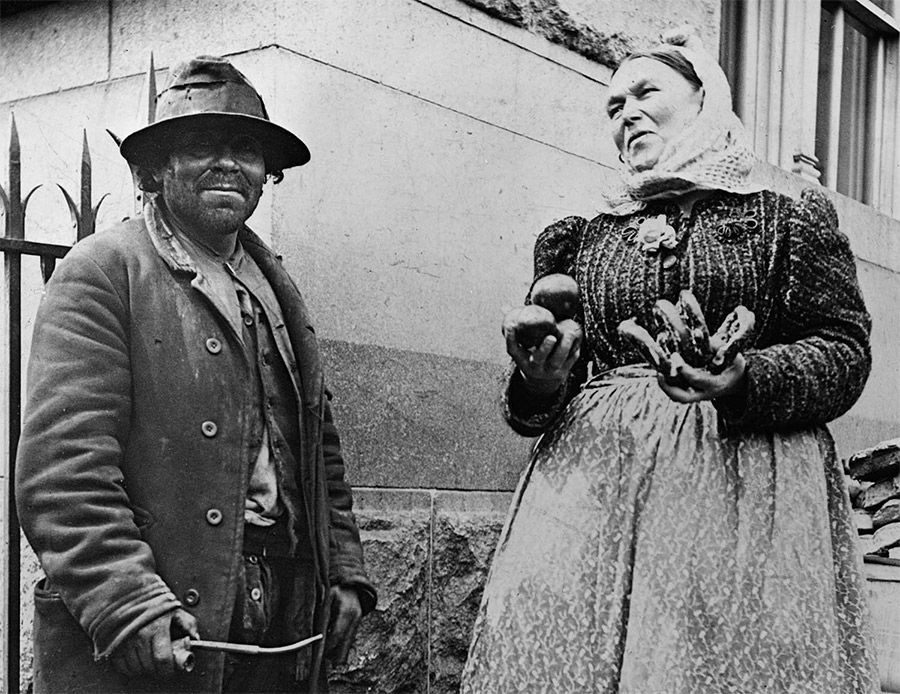 Between 1881 and 1924 over 2.5 million Jews emigrated to the United States from Eastern Europe. Over a third of them settled in New York’s Lower East Side, dubbed the ‘Jewish Plymouth Rock’. For this community, the United States represented economic opportunity and the founding principle of religious freedom. Even in the New World, Jews could still maintain ancient traditions, which included the purchase and consumption of kosher meat.
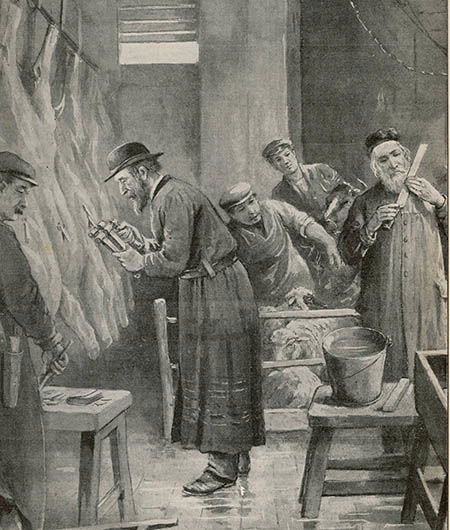
By 1900 the Lower East Side was home to over 131 kosher butcher shops. The meat was delivered by rail from meat houses in Chicago. In 1902, the largest of these meat houses merged to form the National Beef Trust of America. Through the trust, the meat houses could control the price of meat at their discretion. Like the steel and oil barons, the Beef Trust was just one of many Gilded Age monopolies operating without any checks or regulations. In early May 1902, the Beef Trust raised the price of kosher meat by 50 per cent, from 12 to 18 cents a pound.
At first, local butchers refused to sell at the new price. After a week they had to relent. Immigrant women were most affected by the increase. In addition to the responsibilities of home and family, they were often charged with the management of household expenses. In Eastern Europe, the consumption of kosher meat on even a weekly basis was rare, but in the US women could feed their children a richer diet. Assuming they did not turn vegetarian, the price increase seemed to force a difficult choice upon these women: starvation or the consumption of non-kosher meat. Instead of turning to their rabbis, the women turned to politics.
The Lower East Side was rich in political activism. Garment workers were striking for better wages and safer working conditions. Cafes were filled with socialists, anarchists and intellectuals, who discussed and debated politics over tea and coffee. The neighbourhood’s progressive socialist newspaper, the Jewish daily Forward (Forverts), was the leading foreign language newspaper in the country. While the youth drove these movements forward, their immigrant mothers were paying attention. Inspired by the tactics used by various political groups, they launched a door-to-door campaign, urging their neighbours to boycott the butchers. The movement gained traction and within days thousands of East Side women were participating in the boycott.
On 15 May, thousands of them descended upon the neighbourhood butcher shops. According to the historian Paula Hyman, the Herald newspaper reported that ‘an excitable and aroused crowd [mostly women] roamed the streets … armed with sticks, vocabularies and well-sharpened nails’. Other newspapers reported that women were smashing shop windows with bricks and making the meat inedible by throwing it into the street, soaking it in kerosene and setting it on fire. Anyone caught carrying meat on their person was considered the equivalent of a picket-crossing scab and the meat was forcefully taken from them. Amid the chaos, the police were called and dozens of women were arrested and taken to jail for disorderly conduct. Even under arrest, these women did not back down without a fight. According to the Herald, one police officer claimed that, during an attempt to arrest one of the protesters, he was slapped in the face with a moist piece of liver. The riots spread throughout Brooklyn, Harlem and even reached as far as Newark, Boston and Philadelphia. While many papers declared these immigrant women to be ‘dangerous’ and ‘ignorant’, local papers such as Forverts declared ‘Bravo, Bravo, Bravo, Jewish women!’ These women – defined largely by their religion and immigrant status – had embraced the tactics of modern movements as a means of maintaining an Old World tradition. To many, there was nothing more American than that.

While the protests dominated the streets, there was one place that they had not reached: the synagogue. The Lower East Side was home to hundreds of synagogues representing every Jewish community from Eastern Europe and beyond. Many considered the Eldridge Street Synagogue to be the jewel in its crown. Built in 1887, Eldridge Street stood as the first great house of worship built by Eastern European Jews in America. With its Star of David studded façade and its grand Gothic/Moorish interior, Eldridge Street represented the realisation of immigrant aspiration and the formation of a new American-Jewish identity. The synagogue’s congregation embraced many components of American life, from naming their rulebook ‘The Constitution’ to adorning the building with American flags. Eldridge Street’s founders were bankers, real estate developers and businessmen.
Despite these American nuances, tradition remained the guiding principle of the synagogue. Nowhere was this more apparent than in the separation of men and women. Every Saturday, thousands of Jews refrained from work and walked to synagogue. At Eldridge Street, families would ascend the steps, where the men would enter directly into the main sanctuary and the women would make the extra trek to the balcony. From there, women could hear the service, but could not participate. The synagogue was a reminder that the spheres of men and women would and should remain separate.
On 17 May, Shabbat services were underway at Eldridge Street when two women entered the main sanctuary and proceeded to ascend to the bimah, one of the holiest places in a synagogue. One of the women gave a fiery speech about the meat prices and compelled the congregation to join their cause. Soon, the congregation was in uproar. The very idea of women on the bimah discussing financial matters on the holy Sabbath was a shameful and unholy act. Yet, to these women, the price hike on kosher meat was such a great injustice that it prompted a call to action from all members of the community. It was not by random design that the women staged their demonstration at Eldridge Street. In the front rows sat one of its founders, the ‘kosher sausage king’ Isaac Gellis, who had made a fortune in the kosher meat and delicatessen business. We can imagine his discomfort at having his customers attack him for his prices. Not wanting to address the women directly, Gellis called upon the real estate developer and fellow founder David Cohen to talk the women off the platform. While Cohen acknowledged the injustice, he felt that the boycott would turn people towards purchasing non-kosher meat. He suggested they simply buy half the amount of kosher meat. This backfired. In her book Landmark of the Spirit, the historian Annie Polland writes of this moment: ‘There was a tumult. From all sides people yelled, “No meat!” “No meat!” The frightened Cohen left the bimah and the women presumably continued to the next synagogue.’
By early June, the Beef Trust agreed to lower its prices to 14 cents a pound. Later in the year, President Roosevelt would bring a lawsuit against the Beef Trust, leading ultimately to the dissolution of monopolies and ushering in a new era of regulation. The Kosher Meat Boycott of 1902 would not be the last time that meat prices would increase, nor would it be the last time that Jewish women would take to the streets in search of justice. Their actions shed light on the complex, if overlooked, roles that women and immigrants play in changing social history. For a poignant example of a community redefining itself in a new land, we need look no further than a synagogue balcony in New York’s Lower East Side.
Rachel Serkin is Senior Educator at the Museum at Eldridge Street, New York City. www.eldridgestreet.org

