

King Mindon of Burma
For twenty-five years, King Mindon preserved a peaceful and progressive atmosphere in nineteenth-century Burma.
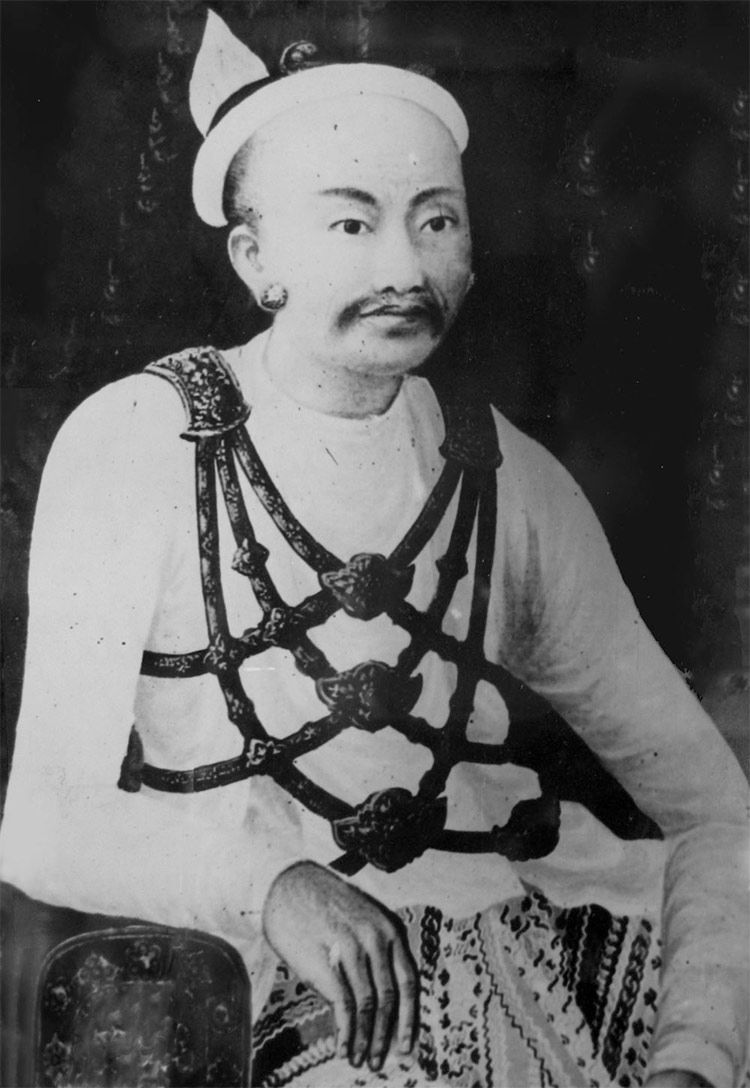
In the century after the establishment of Burma’s last dynasty, by King Alaungpaya in 1752, the fortunes of the kingdom declined from its peak of imperial might. When it seemed reasonable to expect the total eclipse of Burma at the hands of the victorious British army, a new king came to the throne of Ava in 1853 and with him anew hope for survival.
He was King Mindon, whose reign of twenty-five years was, by comparison, a model of good government. Had he been succeeded by a man of equal vision and virtue, Burma, like her neighbour Siam, might have preserved her independence although stripped of her coastal provinces and access to the sea.
The first sixty years of the dynasty was the period of conquest and expansion. The Mons of Pegu were subdued, Ayuthia, the Siamese capital, was sacked in 1767, the Shan States were brought under control and Chinese armies from Yunnan were successfully resisted. Most striking—and perilous—were the Burmese exploits on their western frontier. Under the aggressive but able leadership of King Bodawpaya (third son of Alaungpaya), who reigned from 1782 to 1819, Burmese armies captured Arakan and invested Manipur and Assam. Bengal was threatened.
The East India Company sent Captain Michael Symes to Amarapura in 1795 to secure a frontier settlement. It was the first of nearly a century of British missions to the Court of Ava and it had a measure of success. A dozen years of frontier troubles followed, but ended in some kind of stability in the last years of Bodawpaya’s reign. For the first time British Residents were permitted at Rangoon to superintend trade.
It was an uneasy peace. Bagyidaw, who succeeded his dynamic grandfather in 1819, was a weak king. He was dominated by his leading general, the Great Bandula, who was eager for conquest—even the conquest of Bengal. Raids, skirmishes and the marshalling of large Burmese forces on the Arakan frontier inevitably led to the First Anglo-Burmese War, 1824-6.
Bandula was killed in the fighting. Although the British won every engagement without difficulty, it was a badly managed war and casualties were high. Fifteen thousand soldiers out of the forty thousand commanded by General Archibald Campbell died, most of them from malaria and dysentery.
Although it took another sixty years to swallow the whole of Burma as a province of British India, the Treaty of Yandabo (1826), which marked the end of the war, also signalled the end of Burma’s role as military adventurer. The British annexed Arakan, which might be justified, and also Tenasserim on Burma’s Siamese frontier, which was less obvious and soon became a financial burden on the Company.
The Treaty of Yandabo also provided for a heavy indemnity on the Burmese and the establishment of the first British Resident at the Court of Ava. As an example of Oriental face-saving the official Burmese account of the war is worth quoting:
‘In the year 1186 and 1187 (Burmese calendar) white strangers from the West fastened a quarrel on the Lord of the Golden Palace. They landed at Rangoon, took that place and Prome and were permitted to advance as far as Yandabo, for the King from motives of piety and regard for life, made no preparations whatever to oppose them.
The strangers had spent vast sums of money in their enterprise so that by the time they reached Yandabo their resources were exhausted and they were in great distress. They then petitioned the King who in his clemency and generosity sent them large sums of money to pay their expenses back and ordered them out of the country’.1
The Treaty of Yandabo also opened a chapter in the remarkable story of nineteenth-century genius, a succession of men of the highest ability, a category whose name has been unjustly defamed by the taunt of imperialism. Much of the history of good King Mindon is enhanced by the character of the British representatives at his court—Sir Arthur Phayre, Sir Henry Yule, General Horace Browne, Dr. Clement Williams and others. But first let us bring this rough account up to Mindon’s accession by a glance at his three predecessors and the British envoys who negotiated with them.
First to go to King Bagyidaw’s court was John Crawfurd, fresh from Singapore where he had succeeded Sir Stamford Raffles as the Company’s superintendent. This was not his first encounter as ambassador to an Eastern despot. In 1822 Crawfurd had spent a dreary four months waiting on the pleasure of King Rama II of Siam in an attempt to settle the frontier question affecting the Malay State of Kedah and to improve trade arrangements at Bangkok. His failure with the Siamese was not his fault and if his mission to Amarapura was not entirely felicitous, he did make arrangements for the first Resident.
It was not until 1830 that the first British Resident arrived at the Court of Ava. He was Captain Henry Burney—nephew of Fanny and lately military secretary to the Governor of Penang—who had concluded the first commercial treaty with Siam some four years earlier. At the beginning Burney had remarkable success. His relations with the King were cordial, even intimate.
They went on the river together, discussing all manner of things. Members of the Hlutdaw, the King’s four-member Privy Council, came to the Residence for dinner. These were the Wungyis or Ministers and Burney was himself appointed by Bagyidaw to be a Wundauk, a deputy Minister. All this felicity came to a halt when the King fell into that state of insanity which was the mark of his line. All talk of frontiers and trade came to nothing and the once amiable King became bitter and resentful.
Plots by the chief Queen—for there were many—to murder the King, rumours of troops massing to attack the British provinces, and finally the successful coup d’etat by Prince Tharawaddy to remove his mad brother from the throne brought Burney’s mission to an end. Before he left Amarapura, he got Tharawaddy to promise no executions of royal relatives or former ministers, but the awful blood-bath involving brothers, sisters and cousins, anyone who might compete for the crown, started as soon as Tharawaddy became King. General Horace Browne, later to be the last British envoy to the Court of Ava, had this to say in his Diary:
‘King Tharawaddy had his sane and insane moments. In the former he knew how to make himself agreeable, and thus he is still spoken of kindly by many; in the latter he was a blood-thirsty savage, and so unmindful of the precepts of his religion as to put many to death with his own hand.’
It was not until Mindon that the kings of this Buddhist country respected the central commandment of the religion which forbids the taking of life.
Burney left in 1837, a sick man. In the following year the Company sent Colonel Richard Benson to Amarapura, but Tharawaddy treated him with contempt, denounced the Treaty of Yandabo and threatened war. In less than a year Benson became ill and gave up. His assistant, Captain McLeod, carried on in hopeless conditions.
His Residency was flooded in the summer monsoon, the King and his Ministers ignored him and, with more talk of war, he left the capital frustrated and unwell. King Tharawaddy was delighted; he had got rid of three British envoys in as many years and the hated British Residence was closed, less than ten years after Burney had opened it in such auspicious circumstances.
It was more than twelve years before the Second Anglo-Burmese war broke out in 1852. In the meantime, Tharawaddy became insane and in 1845 was removed by his son Pagan Min. For the next seven years Burma was ruled by a mixture of crime, incompetence and stark murder. General Browne’s Diary sums up the situation:
‘When compared with his son and successor Tharawaddy was a saint. He, Pagan Min, commenced his reign by murdering nearly the whole of the royal family, a hundred persons or more. He was devoted to cock-fighting and debauchery of all kinds and his chief minister was a leader of dacoits. The acts of cruelty and extortion perpetrated in his reign have never been surpassed. With such a government at the capital it is not astonishing that excesses were committed in the distant parts of the Empire, and that the British Government was obliged to interfere to protect its subjects in Rangoon in 1852.’
That was the background to the war. There was no contact with the King, no Resident at Amara-pura. British traders at Rangoon furnished the casus belli. King Pagan’s Governor at the port brought ill-founded charges against two merchants hoping to extort money from them. Lord Dalhousie, our great pro-consul of empire at Calcutta, although not seeking new territory or war, was in no mood to tolerate injury to his fellow-citizens.
‘The Government of India’, he said, ‘could never, consistently with its own safety, permit itself to stand for a single day in an attitude of inferiority to a native power, and least of all towards the Court of Ava’.2 His choice of a man to negotiate with the Burmese was ill-advised, an error which he admitted, for he sent a naval officer, the ‘combustible Commodore Lambert’—Dalhousie’s adjective—with H.M.S. Fox and two Company steamers, and shooting took the place of diplomacy, followed by an ultimatum and then war.
The capture of Rangoon, Moulmein and Bassein proved easy and, when the summer rains ceased, the march north to Prome by Dalhousie’s well-organised army was practically unopposed. He had been told by the Company, and by Palmerston, that he must get a treaty in which the Burmese would acknowledge the cession of the whole region of Pegu, but no overtures of peace, or show of fight for that matter, came from the dissolute King Pagan who was reported to be ‘still cock-fighting’ in Amarapura.
Although opinion at home was far from happy about this latest accession of empire—Cobden argued strongly against it in his pamphlet ‘How wars are got up in India’ —it was a situation that demanded action, and unnecessary retreat was out of the question to the Victorian mind. Lord Dalhousie appointed a Commissioner of Pegu, Captain Arthur Phayre, and told him to proclaim the annexation of occupied Lower Burma.
It was not until late in January 1853, that news came of a change of king at the Court of Ava. General Godwin with his victorious forces was waiting on developments at Myede—fifty miles north of Prome, the original limit of annexation—when two Italian Catholic priests, Father Abbona and Father Domingo, came down the River Irrawaddy to announce a new king and a new policy. They, with all the other foreigners he could lay his hands on, had been put in prison by King Pagan and had just been released by his half brother and successor the Prince of Mindon.
Mindon seized the throne to save his own life. Somehow he had eluded the slaughter of royal rivals at the start of Pagan’s reign of terror, but the Prince of Mindon had by now acquired a reputation for gentle probity and opposition to the war which placed him on Pagan’s execution list. Some Ministers supported Mindon, and the palace with its tyrant was captured late in 1852.
Mindon had no taste for fighting and killing and remained at Shwebo, the home of the Alaungpaya dynasty, during the rebellion. His accession departed from tradition. There was no slaughter of royal cousins or Ministers of the old regime. Even the deposed Pagan was spared and lived in unmerited dignity until 1881.
When Father Abbona and his colleague returned from Myede with the news that the British had formally annexed the province of Pegu, King Mindon was astounded and deeply disappointed. He genuinely believed that the invading army would withdraw after payment of an indemnity, especially since the cause of the war, his wicked brother Pagan, had been removed and he, Mindon, was a man of peace who only wanted friendship with the British. These sentiments were conveyed to Captain Phayre, the Commissioner, and General Godwin, by a Burmese delegation, headed by the senior Wungyi, which sailed down the river some two months later.
The talks were fruitless. What Dalhousie wanted, on instructions from Palmerston, was a treaty in which the Burmese conceded Pegu. But Mindon would on no account sign a document that would record in the chronicles of history that he had given away a large part of the Burmese empire. Mindon never regained Pegu, but neither did Palmerston—nor Gladstone and Disraeli for that matter—get the treaty of cession.
Mindon Min (Min means Prince, but Burmese kings after accession are often referred to in this way) was an exceptional member of his line. Sir Henry Yule, who was secretary to Phayre’s mission to the King in 1855, wrote of him:
‘The King is without doubt a remarkable man for a Burman; but rather in moral than intellectual character, though his intelligence, also, is above average. For the first time since the present dynasty acquired the throne in 1752, if we may not say rather for the first time in the whole history, the Sovereign of Burma is just and mild in temper, easy of access, hears or seeks to hear everything for himself, is heartily desirous that his subjects should not be oppressed and strives to secure their happiness.
He is, in fact, as far as we can judge, a man of conscience and principle... There can be no doubt of his personal popularity. The people speak in terms of admiration of his good qualities and uniformly and with apparent sincerity, declare that they never had a king so just and so beneficent’.3
Mindon was the son of one of King Thara-waddy’s minor wives, a woman of humble origin. He was thirty-nine when he came to the throne. He had been a member of the Buddhist Order of monks, in the tradition that still requires all young men to spend a few months in the pongee chaung or monasteries, and his interest in Buddhism was profound. In this regard it is interesting to compare King Mindon with his contemporary neighbour, King Mongkut of Siam. King Rama IV (Mongkut’s formal title) spent twenty-seven years in the Order before becoming King in 1851 at the age of forty-seven.
He was no more pious than Mindon, nor more scholarly, but his reform of the Buddhist Order in Siam was an achievement not parallelled by Mindon. It is immensely to King Mindon’s credit, however, that he convened the Fifth Buddhist Synod, fifth since the birth of the Buddha in the sixth century B.C., attended at the new capital of Mandalay by thousands of monks from all the countries of Theravada Buddhism.
What is of even more interest is a comparison of the two Kings in their domestic and foreign policies. Mongkut introduced many social, administrative and economic reforms. Mindon did the same. Both kings employed foreign advisers and began the slow process of modernisation. Both had dealings with other European nations and the United States as well as with the British in an endeavour to obtain a position of diplomatic flexibility and independence.
King Mongkut’s treaty with Sir John Bowring in 1855 has its parallel in King Mindon’s with Sir Arthur Phayre in 1862. In each case provision was made for expansion of trade, the acceptance of diplomatic agents at the capitals, and extra-territorial protection for British citizens.
It is always tempting to draw historical parallels. In this instance the temptation is particularly strong for here we have two nations whose circumstances are closely similar. They are both Buddhist, have similar climates and resources and had closely parallel political and social systems. Furthermore, at the period we are considering, Burma and Siam were both confronted by the inexorable power of the British Empire and, as if to meet this challenge, were blessed by two kings possessed of talent, integrity and, above all, willingness to accept the new world.
Yet Siam remained independent and the whole of Burma became part of the British Empire in 1886. The main reason for the difference in fate seems to lie in the personality of kings. For when Mongkut died in 1868 he was succeeded by a son (Chula-longkorn) whose enlightened acceptance of the modern world was a model of leadership, whereas King Mindon was followed in 1878 by the wrong son, Thibaw, whose reign was as depraved, ruthless and stupid as that of his uncle, Pagan Min.
That, of course, is only a small part of the story. Burma had already lost Arakan, Tenasserim and Pegu by Mindon’s time; Siam remained intact. The titles of Britain’s envoys show the difference. In Siam he was a Consul, sent by the Foreign Office. In Burma he was to be the Resident or Agent at the Court of Ava, sent by the Viceroy of India. It was a status which King Mindon bitterly resented. When later he received letters from Queen Victoria and Gladstone, he held them to be tokens of his sovereign independence. It would have been wiser to have had a Consul at Mandalay as well as at Bangkok.
Relations between the Burmese and the British were far from satisfactory in the early summer of 1853. King Mindon was adamant in refusing to sign a treaty ceding Pegu. He still hoped that the British would withdraw, once some indemnity had been paid and it was recognised that he was a good and friendly man.
The British were equal in their resolve to stay where they were in occupation of lower Burma. Rumours of renewed war persisted on both sides. Ignorance of each other’s intentions was complete. Then, by a stroke of good luck, a certain Scottish trader in piece-goods came down the river from Amarapura and told Phayre the true position at the Court of Ava.
He was Thomas Spears from Kirkcaldy in Fife who had just been freed from one of Pagan’s prisons by King Mindon. He had been in Burma many years and was married to a Burmese lady. Mindon liked him and made him his intimate, frequently inviting him to the palace. When Spears decided to go to Calcutta on business, the King seized the opportunity and asked him to communicate to the British authorities his feelings of friendship, peace and willingness to trade.
Thus began an extraordinary episode in which, for seven years, the relations between Britain and Burma became cordial and warm, largely through the mediation of Thomas Spears, British correspondent at the Court of Ava. He was given a salary of 250 rupees a month which was to go up to 400 if he wrote two good letters a month and this he did until he left for home in 1861.
A modern Embassy with its political, commercial and information departments, various special attaches and diplomatic wireless could have done nothing like the job that Thomas Spears accomplished at Amarapura and Mandalay. For one thing, he was in almost daily contact with the source and centre of Burmese government—the King—and was equally the confidant of Phayre and the Government of India. Both sides were in a mood to please and much good resulted.
Great credit is also due to Phayre. As Commissioner in Pegu and as emissary to the Court of Ava he gained the respect and affection of Burmese of all ranks. He had a scholarly interest in Southeast Asia, wrote a History of Burma, and acquired a very good knowledge of the Burmese language. His firm character and devotion to duty combined with his real sympathy with the people made him an ideal man for the job.
Mindon looked on Phayre as his friend, so much so that Dalhousie in a letter to the Commissioner wrote: ‘I will only add my hope that you will enjoy that half mango, which Father Abbona says the King always keeps for you while he eats the other half his royal self’. Two months later from Amarapura came Phayre’s riposte: ‘His Majesty has not yet sent me the half mango but is continually sending little presents. A fossil crocodile’s skull came this morning’.
Through Spears large-scale missions were exchanged between Amarapura and Calcutta. Lord Dalhousie gave a liberal welcome to the Burmese Ministers in 1854 and in the following year Phayre led a grand embassy to the court of King Mindon. He went to Amarapura in style. Several steamers sailed up from Rangoon carrying European infantry and Indian cavalry, a band, and an entourage of senior officers, geographers, geologists, an artist and the mission’s secretary, Captain (later Sir) Henry Yule.
For nearly two months the mission was royally received, lavishly fed and entertained at King Mindon’s expense. Processions of elephants conducted Phayre and his party to the Palace for audience with King Mindon. Shoe-less, but in splendid uniforms, the Mission squatted on the carpeted floor to await the Golden Feet. He appeared in an aperture of the room, reclining on a gilded, couch-like throne and ogling his visitors through a pair of opera-glasses, his chief Queen at his side. Yule describes the King on one of these occasions thus:
‘From the distance, at which we viewed the King, he seemed a somewhat portly man, having features of a much more refined character than are common among his subjects, exhibiting indeed the national physiognomy, but much subdued. His expression was good and intelligent, his hands delicately and finely formed. His dress was a sort of long tunic or surcoat, of a light-coloured silk apparently, but so thickly set with jewels that the fundamental material was scarcely discernible. His cap or crown was a round tiara of similar material.’
Spears, Father Abbona and a certain Antonio Cameratta, a Portuguese in the royal service, played busy parts in the carrying of hints and messages before each formal audience. Discussions covered trade—including trade from China—banditry on the frontier and, of course, the treaty to recognise the cession of territory; Mindon would not hear of this. But if there was no treaty at the end of the long visit, there was plenty of goodwill and a much better understanding of each other.
Good relations continued, even during the Indian Mutiny of 1857. Earlier, when the Crimean War was being fought, there was a great deal of talk in India and Burma about the Russian menace to British power in the East and Mindon was encouraged by certain Armenians at his court to oppose the British, even to go to war.
But Mindon was quite unaffected and asserted his friendship for the British. There is no doubt that , he genuinely liked Phayre and Spears. With such people, his own amity towards them, and his innocence of any part in the recent war, he persisted in the pathetic belief that he would be given back the lost provinces of Lower Burma.
The King built himself a new capital in 1857 at Mandalay, a few miles to the north of Amarapura. Here he raised the Golden City, the Cluster of Gems, and his new palace far enough from the river to escape the whistles of the Irrawaddy Flotilla Company’s steamers.
It was on a grand scale and in the tradition, a rectangle protected by a high wall and a moat, and, within, other defensive walls.The King lavished resources on this Centre of the Universe, with decorated woodwork, jewels and shrines. He built great pagodas and brought many monks to his city. A white elephant had lately been found. With the new grandeur at Mandalay and the King of the White Umbrella a man of benevolence instead of cruelty, it seemed that the time of troubles was past.
Although King Mindon introduced new methods of administration, particularly in taxation and officials’ salaries, there was nothing of the new world in his palace at Mandalay. He had some forty-five wives, many of them accepted with reluctance to please custom, and a large number of children.
His chief Queen, the Nanmadaw (‘Queen of the Southern Palace’), was his half-sister for it was normal for the Kings of Burma to marry their sisters. This lady had the privilege of a White Umbrella and could sit with him on the throne. Mindon’s Nanmadaw seems to have had intellectual tastes, for Dalhousie makes these comments in one of his letters to Phayre:
‘Adverting to your former letter, in which you mentioned the scientific attainments of the Queen, I have requested Mr. Dorin to obtain some scientific instruments... but if I could have procured a pair of Blue Stockings, I would certainly have sent them for Her Majesty in addition.’
King Mindon was astute and progressive in economic affairs. He held a monopoly of important products such as teak, oil and jewels and gained revenue from the growing trade with Rangoon in rice and wheat. Trade was what the British merchants in Rangoon wanted and the Government of India found in Mindon a willing negotiator. He was shrewd and drove a hard bargain. Dalhousie wrote to Phayre:
‘...do your best to find out as much as possible about the Coal in Burma. Our discovery of the article in our own territory will probably make the King more reasonable about it, if he were inclined to be as great a Hebrew in coal as in corn.’
Phayre’s second mission to the Court of Ava was to prepare the way for a commercial treaty and this he got in 1862, together with agreement to station a British Agent at Mandalay. Both Mindon and Phayre preferred a Thomas Spears to any envoy, but once the piece-goods merchant left the capital—in 1861—nobody of his calibre could be found and a permanent official was sent to Mandalay.
The treaty lowered the duties on imports and exports, allowed British merchants to trade more freely in Upper Burma and permitted Mindon to import rice from Lower Burma. But if the treaty made good provisions on paper, there were many obstacles, particularly the reluctance of Royal officials to dispense with or lower taxes at the frontier and the continuation of the endemic custom of ‘dacoity’, the Burmese for banditry and lawlessness.
By the ’sixties there was a new spur to British interest in Upper Burma—the trade route to China. To be more exact there was a revival of interest brought on by French and American competition in the China trade. As early as 1795 Symes had reported optimistically on the possibility of trade through Burma to Yunnan. It was discussed by King Mindon and Phayre in 1855 and again in 1859 and 1862.
The main interest of Britain’s first Political Agent at Mandalay, Dr. Clement Williams—an army surgeon—was the trade route to China He obtained the King’s permission to survey the route by Bhamo as soon as he took up residence in Mandalay in 1862. Early in the following year Williams went to Bhamo to see for himself. He pushed north of the town, had long discussions with Shans, Kachins and other hill tribes— Williams spoke Burmese fluently—on the old trade route into Yunnan and would have pressed on but was suddenly recalled to the capital by King Mindon.
A rebellion had taken place in Mandalay. Mindon, who liked Williams, wanted him back because this would strengthen his position; and unrest might have spread to the north and endangered the British Agent. It was the first of a number of insurrections. The most notable was that in August, 1866, when two of Mindon’s own sons led a band of assassins into the Summer Palace. They killed the Einshemin, the Crown Prince, and two other sons of the King. The King himself was lucky to escape and many foreigners left the capital.
Dr. Williams had not achieved his ambition to pioneer the route into China. The Lancashire cloth-merchants saw a quicker outlet in the Burma road to China and urged the government to press the scheme. By 1869 the Suez Canal was open and a big jump in trade to the East was expected; the French had explored a route up the Mekong River to Yunnan. Most people seemed to agree that the plan must go through and it was more a problem of routes than policy. Some urged the route up the Salween River from Moulmein, others by way of Manipur, but the majority were for the well-traversed Irrawaddy to Mandalay, thence to Bhamo and then over the hills to Yunnan.
After Phayre had retired in 1867 the new Commissioner, Colonel Albert Fytche, concluded yet another commercial treaty with King Mindon (1868) which still further improved trade between the two parts of Burma. These talks also resulted in a British agent being stationed at Bhamo.
This was a stepping-stone to China. In the same year as the new treaty, 1868, Major Sladen, the new Agent at Mandalay, explored the route north of Bhamo and made friendly contact with a Muslim tribe on the Yunnan frontier, the Panthays who were in revolt against the Chinese Emperor. The Panthay Rebellion was to block progress for several years. It was crushed in 1872. In the following year the most ambitious attempt to survey the route was entrusted to Colonel (later General) Horace Browne who was to be the last British envoy to the Court of Ava.
Browne, who had accompanied Phayre on his missions to Mandalay in 1859 and 1862, spoke Burmese well and relished a journey into the unknown. He had favoured the route suggested by Sprye, the Commissioner at Moulmein, which envisaged the building of a railway 500 miles up the Salween valley but, when this was rejected, gladly accepted the Irrawaddy route as far as Mandalay but not through Bhamo. He planned to go due east of Mandalay towards Kyang Hung, ‘a perfect terra incognita and therefore much more interesting to an explorer’. And later in his Diary he says:
‘The country east of Thiennee (on the Yunnan border) is as yet a perfect blank in our maps... Journeying due east brings us to Po-urh, the Chinese district which produced the finest tea, so valuable in Chinese eyes that none of it reaches Europe...'
It was not only trade that quickened the quest for a route to China. General Browne sums it up neatly:
‘There seems to be no doubt that the French will soon be complete masters of Tongking (North Vietnam) and it will then be important for us to have a solid footing at Kyang Hung to prevent their establishing a communication behind our backs with Mandalay. The old King (Mindon) is anxiously looking forward to the moment when he will have free communication with his new French allies without passing through British territory, and be able to obtain from them guns and ammunition and all that his heart desires.’
What was Mindon’s attitude to the expedition? Overtly, he gave it full support. But he opposed the Kyang Hung route which ‘being mountainous and jungly is rough and rugged,’ whereas the Bhamo route was ‘smooth and pleasant’. He added that he would himself send a mission to Peking (in tribute-bearing tradition) and that it would go by the ‘Ambassador’s route’, that is, Bhamo.
The King’s dislike of the Kyang Hung route may have been due to the possibility of exposing the weakness of his rule in the Shan States. His own mission to China, Browne hints, might be to rouse the hill tribes and the Chinese against the British explorers.
The expedition came to nothing but tragedy and a fascinating tale. Mr. (later Sir) Thomas Wade, H.M. Minister at Peking, sent a Chinesespeaking officer, Augustus Margary, right across China to join up with Browne and his party—Ney Elias, his ‘topographer’, Dr. J. Anderson, the naturalist, and fifteen Sikh soldiers. Margary accomplished this feat (the first European since Marco Polo to make the journey) and met the Burma party north of Bhamo. He went back ahead of them and was killed. That was in January, 1874. Soon the whole scheme was abandoned. The great trade route down the Yangtze to Shanghai seemed a better way than railways over mountains.
In the last years of Mindon’s reign his relations with the British became less cordial. But before this he had been much heartened by receiving a friendly letter from Queen Victoria in reply to his own. (It took a year and a half for the Queen to answer!) The letter (September 23rd, 1871) ends in this felicitous manner:
‘By such interchange of good feelings between sovereign states the prosperity of Empires and the happiness of Nations are much promoted, and it will always be a source of great satisfaction to me to receive tidings of the continual welfare of Your Maj esty and of the people who are subject to your rule.
Hoping that you may long be spared to govern the country committed to your care by the Almighty Disposer of events.
I am, Your Majesty’s sincere Friend
Victoria R.’
The next year the Queen sent Mindon her portrait. With great ceremony, scores of elephants, thousands of soldiers, music and gun-salutes, Colonel Browne—much against his political judgement—conveyed this royal evidence of friendship and honour to the King of Burma.
Mindon sent his Kinwum Mngyi (Prime Minister) to London in 1872 but he was presented to the Queen by the Secretary for India, not the Foreign Secretary, a gesture which Mindon resented and rightly regarded as a snub to his independence. It is not surprising, therefore, that he sought and obtained treaties with the French and Italians. From the French he had promises of arms, financial aid and a railway. There were already French advisers at his Court, helping to modernise the Burmese currency.
It was the Shoe Question that brought relations between King Mindon and the British virtually to a close. In 1875 Sir Douglas Forsyth, the Commissioner at Rangoon, voiced indignant objection to having to take his shoes off when he went to Mandalay to settle the matter of Karenni independence. For all these years—eighty in fact, since Symes went to Ava in 1795—British Commissioners, Residents and Agents had taken their shoes off in the royal presence, had squatted on the floor of the Audience Hall and had suffered no loss of dignity.
Now the Victorian sense of power and glory made the guardians of the Indian Empire see things in a different light. No future Commissioners or Agents would take off their shoes at the Court of Ava. And so no British envoys came, for King Mindon would not receive them unless they took their shoes off. And there was no Thomas Spears to act as go-between.
When Mindon died in 1878 the Kingdom of Burma was still independent and there was no reason to expect its collapse. After the killing of his Heir Designate in 1866, Mindon dared not name another and on his death-bed proposed a triumvirate of princes, but the Hlutdaw would not agree. Instead, they supported Thibaw, a weak and useless man, hoping that he might become a constitutional monarch.
But the wicked and powerful chief Queen Supayalat scotched any such wild hopes and Burma fell into the miseries of bloodshed, banditry and corruption. Seven years after Mindon’s death, all of Burma was incorporated in the Indian Empire. Had he lived to be an old man—he died at sixty-four—or had he been succeeded by a son like himself, Burma might have preserved her independence.

