

Jamaica and Britain
Jamaica, writes Morris Cargill, has been a British possession since the times of Cromwell.
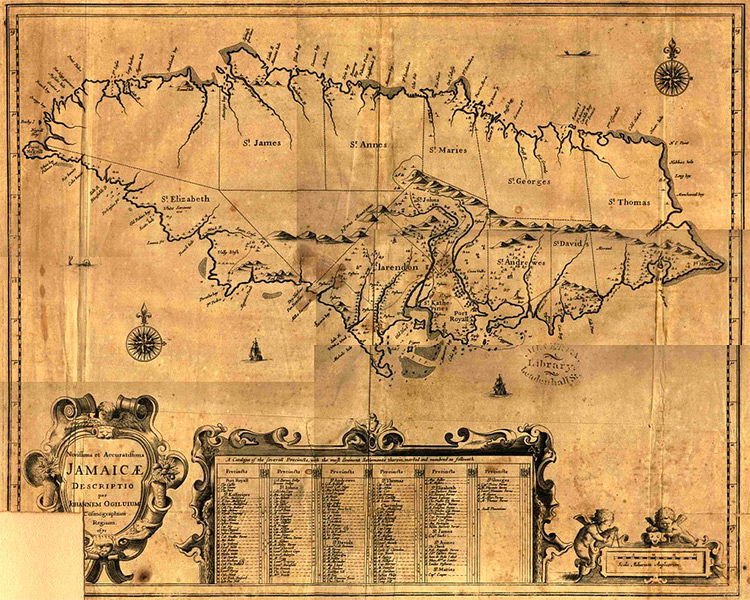 Within its small area of 4,470 square miles, Jamaica contains many of the world’s races and exemplifies a considerable number of its problems. Here may be studied in miniature and at close quarters some of the more agitating social and political stresses of our day.
As everyone knows, Jamaica was discovered by Columbus during the course of his second voyage in 1494, and for the following century and a half remained under Spanish rule. The Spaniards called it Sant’ Jago, but the name did not stick, and eventually the island reverted to its present name, which is a corruption of the Arawak Xaymaca, the Isle of Springs.
The Spaniards made no consistent effort to develop the interior of the island; their interests lay chiefly in the discovery of gold and silver, in which the Central American area proved far richer. After desultory digging in the few parts of Jamaica that seemed promising, they found nothing but some low-yielding copper and iron ores, and their mines were largely abandoned. Jamaica’s geographical position, however, made it an important strategic base on the Spanish Main.
Situated at the southern approaches to the Windward Passage, which runs between Cuba and Haiti, and on the direct route to Europe from the Isthmus of Panama, the island was vital to any European country that sought to dominate the trade routes between Europe and the new Spanish Colonies in America.
Kingston Harbour is one of the finest natural harbours in the world, protected from the hurricanes of the Caribbean by a long arm of land called the Palisadoes, upon the fist of which lay the famous rich and proverbially wicked city of Port Royal.
The nation that held Port Royal, and thus commanded the approaches to Kingston Harbour, could maintain a decisive grip on the Caribbean trade routes. It was the loss of Port Royal and Jamaica to the British expedition, despatched by Cromwell under Admirals Penn and Venables in 1655, that was the major cause of the decline of Spanish power in the West Indies.
During the first years of the Spanish occupation, and before it was recognized that the island would yield little treasure, an attempt at colonization had been made. At the time of its discovery, Jamaica was thickly populated—some estimates run as high as 600,000—by a peaceful agricultural people called Arawaks, who were a type of South American Indian.
These aboriginals were occasionally raided, harassed and massacred by a racially similar but extremely war-like people from the islands of the Lesser Antilles, called Caribs, or Canibs, whose reputation for man-eating has given us the word “cannibal.”
In the long run, the Arawaks would probably have been driven out of Jamaica by their fierce neighbours, but the process was hastened by the Spanish occupation. In the Writ granted him by Ferdinand and Isabella, Columbus had been commanded, among other things, to “bring Christianity to the idolatrous Indians, by force of arms, if necessary.”
This militant evangelism, combined with the introduction of European diseases, to which the natives had no opportunity to build up a resistance, soon destroyed the existing population with a thoroughness that still remains a mystery. Some historians suggest that the Arawaks reacted so strongly to the idea of being conquered and enslaved that they committed suicide by the thousands, or simply lost the will to live.
They possessed few weapons, and apparently offered little or no resistance even to Carib raiders, but the full facts about this short period of history will probably never be known. By the time that Jamaica became British, it is certain that not a single Arawak survived on the island, and no case of mixed blood has been recorded.
From the first, Jamaica had been divided among eight noble Spanish families, who imported negro slaves from the West Coast of Africa to work on their estates. Further immigration from Spain was discouraged, and only the coastal strips were occupied. Thus, when the island was taken by the English, the white and slave population together amounted to no more than a few thousands.
The slaves of the Spaniards fled to the mountains and for more than a century thereafter these Maroons (or Marongs), as they were called, succeeded in fighting off, or evading, all attempts to subdue them. Eventually they were, by treaty, given their autonomy, and to this day flourish in their mountain villages, the earliest exemplars of negro self-government within the British Commonwealth.
Once Jamaica was firmly in British hands, Port Royal became the chief centre of piracy. But “piracy” is a loose word, except in law, and is much misunderstood in modern times. There were, to begin with, the buccaneers, who must not be confused with earlier oceanic adventurers, such as Sir Francis Drake, nor with the outlawed pirates of the eighteenth century.
A group of Frenchmen, who were later joined by Englishmen, Dutchmen and Portuguese, had formed themselves into a kind of religious community, and had set sail for the West Indies to embark upon a new life, from which originally women were wholly excluded. The group settled first upon the island of Hispaniola, the modern Santo Domingo, and lived off the huge indigenous herds of wild pigs and cattle, learning from such natives as survived the art, called “bou-canning,” of curing and preserving the meat and hides.
These buccaneers were peaceful, and asked only to be left alone. Unfortunately for them, Hispaniola became an important supply base for ships because of its plentiful food, and the Spaniards, in their foraging raids, treated the buccaneers with extreme brutality.
Driven from their life of hunting and animal husbandry, the buccaneers took to the sea, united in an intense hatred of the Spaniards and finding, eventually, that savage and unscrupulous attacks upon their enemy were often more profitable than farming. For seventy-five years the buccaneers maintained their roving community as best they could, using other islands such as St. Kitts, St. Christopher and Tortuga as temporary bases, until, in 1655, they joined with the British naval forces and adventurers at Port Royal.
This base they were encouraged to use as a permanent one, from which to continue their depredations against Spanish shipping. Among them were such leaders as the Dutchman Edward Mansfield and the courageous but unscrupulous Welshman Henry Morgan, who gained command of the Caribbean and later became Governor of Jamaica. During this more respectable period, they assumed the official name of “privateers.”
In 1670, the British title to Jamaica was recognised by the Treaty of Madrid, and two years later the Royal African Company was formed with an English monopoly for importing slaves. By 1685 the buccaneers, who had contributed so much to British ascendancy in the Spanish Main, had degenerated into true cut-throat pirates. They were now a menace not only to Spanish but to all shipping, British included, and they had to be suppressed.
In the meantime, the world demand for cane sugar, spices and dyestuffs had been increasing. Although Jamaica had not yielded the gold and silver of Spanish hopes, the British found that it could produce other wealth in the form of sugar, cacao, pimento and indigo. Numerous plantations were carved out of the jungles, and within fifteen years of the British conquest seventy sugar factories, with the help of African slaves, and as many works for cacao and indigo, had been set up and become profitable concerns.
As if to symbolize the new era, an earthquake destroyed the greater part of old Port Royal in 1692, the city sinking, burdened with gold and vice, beneath the waters of Kingston Harbour. Of Morgan’s possessions only a few items, including a beer mug of heroic proportions, still remain. This tankard has been consecrated and now serves as a chalice in the local church.
For the next hundred years Jamaica was the most prosperous of British colonies. Sugar fetched a high price on European markets—a price that, today, would be the equivalent to roughly £500 or £600 per ton. In consequence, enormous fortunes were made, free of course from burdensome taxation. The Jamaican proprietors in the eighteenth century cut flamboyant figures during their visits to London. They travelled about the country in the finest coaches, often accompanied by retinues of a hundred slaves or more, all attired in the most elaborate Every.
Their wives were always accompanied by women slaves, or by Ettle black boys, carefully wigged, dressed and powdered, who were their constant attendants. Sir Hans Sloane, who went for a short time to Jamaica as the private medical adviser to the Duke of Albemarle, added to an already considerable fortune, which helped him to acquire the Manor of Chelsea in 1712.
William Beckford, Lord Mayor of London and critic of George III, was another whose riches were founded in Jamaica. His son spent them on the erection of his fantastic Gothick Abbey at Fonthill. At a later date, the Temple family were to use the profits from Hope Estate near Kingston to re-build their beautiful country seat in Buckinghamshire which is now known as Stowe School.
But this was just the trouble. During its century of prosperity Jamaica, even more than Ireland, suffered greatly from absentee landlords. The vast profits from Jamaican sugar and spices were not retained in the island, to add to its capital resources, but sent to England, where they contributed to the building of English country houses, and the strengthening of English financial institutions.
Jamaica was merely an outpost of empire, an unhealthy spot where malaria or yellow fever, hookworm or yaws, were easily contracted. The population was growing rapidly, but the majority were negro slaves. There were, of course, a number of Scottish overseers, and some English, Welsh and Irish as well. Nevertheless, as Lady Nugent was later to observe, they were “common” men, with a habit of taking negro women as concubines and begetting large numbers of half-caste children.
In these years many Spanish and Portuguese Jews were also settling in Jamaica. They had originally fled the Inquisition and had made for Central America; but at the time when Penn and Venables were fighting the Spaniards for control of the Caribbean, they had reason to believe that the Spanish Church was preparing to extend the persecution of Jews to the American colonies.
Indeed, it had already started in some territories, and the Jews were accordingly joining with the buccaneers and the English to harass the Spaniards in every possible way. It was a Portuguese Jew, for instance, who acted as pilot on Venables’ flagship. Soon after Jamaica became British, a large number of these Jews settled in Jamaica, and many of their families remain in the island to this day.
England in those days was not greatly concerned with the welfare of negroes and Jews, nor with the fate of the handful of British settlers in Jamaica, who probably, in any event, had some good reason for leaving Britain. Hence the flight of capital from the island continued until, at the end of the eighteenth century, the threat to abolish slavery, and competition from other sugar-producing territories, made many Jamaicans fear that their country would soon be altogether ruined.
There had, in the meantime, been two attempts to invade Jamaica. One, by the French and Spaniards in 1782, was averted by the victory of Hood and Rodney off Dominica; and the other, by the French alone in 1806, was frustrated by Admiral Duckworth. There were to be no more attempts, and Jamaica at the end of 1806, secure from external enemies, seemed at the height of her prosperity. There were at that time over 300,000 negro slaves in the island.
But in 1807 the slave trade was abolished. This did not immediately affect Jamaica, for while it was now unlawful to import slaves, the status of those in current ownership remained unchanged. Some twenty years later riots broke out among the slaves and these troubles, which helped to inflame the anti-slavery agitation in England, led to the Emancipation Act of 1834 by which the slaves were freed.
The British Government awarded compensation to the Jamaican planters at the rate of £19 per slave. Unfortunately, there had been a considerable slump in the value of sugar during the previous twenty years and this, combined with the extravagance and profligacy of most of the absentee landlords, had plunged most of them into debt. Hence the compensation paid to them, though considerable, went for the most part to their English creditors.
To make matters worse, many of the slaves had fled into the mountains in the first flush of freedom, and there was an acute shortage of labour. As a final blow, the British Government withdrew in 1846 the tariff protection for Jamaican goods on the English market and thus cut the price of sugar in half.
Estates that had been mortgaged from 1820 onwards were now completely abandoned. The slaves, who had been set free by a political act, found that freedom was meaningless without the economic resources that make freedom a reality. They came back to seek work for wages on the plantations only to find that most of these had been closed. Within a few short years both masters and men had been ruined.
There followed a period of unrest and experiment. In order to soften the consequences of Emancipation, the importation of indentured labourers from India began. This had eventually to be stopped, since the Indians were no more efficient and no better treated than slaves. Neither was the introduction of Chinese peasants from Canton any more successful, for the Chinese preferred to leave the land for shop-keeping and commerce.
Nevertheless, by the end of the nineteenth century matters had somewhat improved. The country was still desperately poor; but Capt. A. W. Baker, of Boston, established the banana on the American market, and with the formation of the United Fruit Company a new era had begun.
Jamaica is still a poor country and has suffered much poverty and neglect in the first part of the present century. For a fleeting period sugar boomed during the First World War, but then again crashed. During the Second World War bananas could not be shipped overseas, though Britain helped with a compensating subsidy. But perhaps the most important event during this period was the civil disturbance of 1938.
It was led by a flamboyant demagogue of small education, but great shrewdness, called William Alexander Bustamante, and it drew attention to Jamaica’s plight. The Colonial Office awoke to the problems at issue, and the island was given a new constitution.
Bustamante and his Jamaica Labour Party were elected to power, which they held for ten years, carrying out a peaceful but far-reaching and constructive revolution of great benefit to the island. Bustamante, now knighted, is today in Opposition, and the present government, nominally Socialist but in effect Liberal, is led by the brilliant and charming barrister Norman Washington Manley.
Jamaica has been given back protection for her bananas and sugar on the British market, and her agriculture is once more in a reasonably heathly condition. The island now faces problems of a new kind. The population, which today numbers one and a half million, is very mixed and predominantly negro or “coloured.”
Though colour prejudice existed acutely among the early settlers and among the comparatively few white Jamaicans at the beginning of this century, segregation has never been practised, and no attitude to the negro has taken shape comparable to that in South Africa or the Southern States of America. As a result, during the last thirty or forty years colour prejudice has been fast disappearing.
Children of all races and colours mix together in day and boarding schools. A large and well-educated coloured middle class has emerged, and from these a new mixed upper class of doctors, lawyers, judges and planters is being formed. Inter-marriage between colours and races has become normal, and it is only in some of the large hotels for tourists, and among a few whites of the older generation in whom ideas die hard, that the lingering relics of colour prejudice are to be found.
The British Colonial Office has now offered complete self-government next year, provided that Jamaica joins with the other British West Indian islands in a Federation, and agreement on this in all important respects has been achieved.
A Commission is sitting to recommend the site for the Federal Capital, and Britain has consented to make a loan, probably of a million pounds, to help build it. There is now a University in Jamaica, the University College of the West Indies, which is making higher education more easily available to all.
Yet, in a sense, the problems of Jamaica, as a nation rather than as merely an outpost of Empire, are only just beginning. Jamaicans do not forget what happened to the slaves when freedom was given them and they nearly starved to death. They know that Jamaica will have to make a reality of her forthcoming independence by earning her way in the world.
One formidable question, perhaps the greatest of all, is presented by the rapid increase of the population, which is doubling itself every forty-five years. Some alleviation is offered by the influx of Jamaicans into England, where twenty-five thousand immigrants arrived within the single year of 1955. This movement of peoples creates new problems for Britain, but without going far to solve those that confront Jamaica.
For the proportion of Jamaican migrants has not been large compared with the growth of population, nor can the English labour market be expected to provide unlimited opportunities for them in the future. It follows that any long-term economic planning in the island involves peculiar difficulties. If the standard of living is to improve, Jamaica cannot remain predominantly agricultural. It will have to industrialize.
To this end the Jamaican government now offers considerable help, including tax “holidays,” to any company or person that wishes to set up new industry in the island. In one respect, at least, the hopes of the Spaniards have at last been realized, for large deposits of bauxite have been discovered and are now being worked under licence by three large aluminium corporations. But capital shortage continues to handicap development.
Jamaica is the second oldest of Britain’s overseas possessions. In 1955, three hundred years of British tradition were celebrated in song and dance throughout the island—a tradition which has given the island no architecture comparable with the grace of Spanish colonial buildings, but has endowed it instead with the rule of law, the incorruptibility of the civil service (now staffed by Jamaicans) and a passion for freedom, justice and tolerance.
On the eve of dominion status within the British Commonwealth, the mood of Jamaica is one of optimism and high hope. Even within the short twelve years of comparative freedom from Colonial Office rule, Jamaicans by their own efforts have brought about a remarkable economic advance. With good fortune and timely financial help from Britain or the United States, there seems no reason why Jamaica should not be entering once more upon another century of prosperity.


