

Jabez Spencer Balfour: A Fraud Abroad
David Rock tells the story of the rise and fall of a late Victorian businessman and politician and the insights his career throws on nineteenth century Argentina.
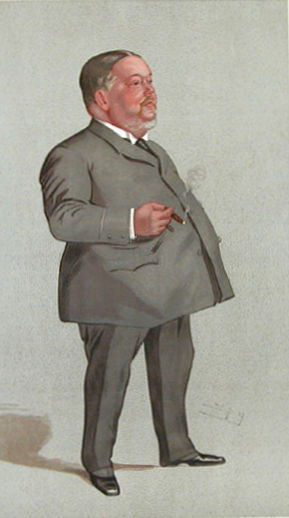
A lengthy file in the British Foreign Office archive survives as one of the few testimonies to the scandalous career of Jabez Spencer Balfour.
A late Victorian financial and property tycoon, Balfour amassed a fortune by exploiting the religious devotion and the temperance crusades of that era. The fall of his empire in 1892 ruined numerous small investors in England and Wales, a few of whom chose suicide rather than face destitution.
When his companies collapsed, Balfour escaped to Argentina, spending more than two years there, mostly in the city of Salta. With its close commercial and financial connections with Britain at that time, Argentina might seem a strange choice of refuge. But British business and the British community were largely confined to the capital Buenos Aires and other cities of the wealthy eastern region. Salta, situated in the arid and remote northwest, appeared a safe refuge.
Balfour's long road to ruin began in Britain in 1872 when he created the Liberator Building Society, a title he selected to indicate an association with the temperance movement, the Nonconformist chapels, and the Victorian doctrine of 'self-help'. He employed his mother's extensive connections with these causes to recruit their supporters as agents and depositors. Under the slogan 'No Speculator need Apply', the Liberator focused on new housing projects in the expanding suburb of Croydon. Elected as Liberal MP for Tamworth in 1880, in a 'Drink versus Temperance' campaign against 'Mr Bass', the famous brewer of that town, in 1883 Balfour became mayor of Croydon. By 1892 he was serving as the chairman of seventeen companies, including the London and General Bank that held the accounts of the Liberator and his other companies.
In the early 1890s more than 2,500 building societies existed in England and Wales, although they still remained relatively new and unfamiliar institutions. 'It is an ingenious idea', commented the Times approvingly, 'which has taken deep root among the lower middle-classes ...the building society promotes the distribution of wealth, and particularly of landed property. Its members acquire the habit of saving, and their children inherit their traditions'.
The newspaper went on to warn against problems among building societies such as inexperienced directors who loaned too large a proportion of their funds and could not pay all their depositors during sudden outbreaks of panic. The societies were vulnerable to fraud as the directors could over-value their assets in order to borrow excessive funds from the banks, while disguising their true financial situations by crooked audits.
In the 1880s Balfour, employing just such practices as the Times had warned about, made a fortune that enabled him to purchase a country estate and an enormous house in Oxfordshire, famous at the time because it was lighted by new-fangled electricity. In 1889 he was re-elected to the House of Commons as the Liberal member for Burnley where he became identified with progressive causes like the reform of the Factory Acts, the extension of the suffrage, and Home Rule for Ireland. As a generous contributor to party funds, Balfour established a prominent position in the party and was tipped for promotion to the cabinet. In Burnley he became a major patron of many local organisations, among them its ambitious football club. Some local Liberals described him after his fall and disgrace as 'the most popular member Burnley ever had'.
Balfour's popularity did not extend to the Conservative party in Burnley where the Burnley Express and Advertiser ridiculed his associations with the temperance movement. Few signs of abstinence from drink were evident in Balfour's personal appearance, as the Tory paper mockingly noted:
A short, bulgy ball of a man, the weight of his short legs makes him waddle a bit. [Balfour has a] rubicund visage shining with good living, [an] aldermanic girth, and sharp, merry little eyes.
Hypocrisy about alcohol proved the least of Balfour's vices, by comparison with the deceptions he practised in his business affairs.
He became adept at the ploy described by the Times of inflating the value of the properties owned by his companies by selling them from one to the other. A prosecuting counsel at his subsequent trial described the basic features of Balfour's business methods:
During the last twelve years of [their] existence... [his companies] made no profit, but in order to attract money from the public, vast sums were made to appear to have been earned, large dividends were paid, and large sums were divided among the directors and officials of the compan[ies]. By this means a constant stream of money flowed in from the public, and for many years averted the inevitable smash.
Much of Balfour's capital came from the Nonconformist chapels. 'Hypocrisy was the dominant note of the Liberator finance', exclaimed the author of a novel written about the fall of Balfour in 1893.
As the Devil Fish wound one of its tentacles around a rock while it cast the other seven around its victim, so the Liberator anchored itself around the Nonconformist chapel and devoured its victims.
Balfour managed to escape detection throughout the 1880s when an economic boom generated a constant flow of new funds into his companies. But his schemes quickly collapsed during the depression of 1890, a crash coincidentally triggered by excessive investment in Argentina by British merchant banks led by Baring Brothers. When the so-called 'Baring crisis' erupted, Balfour claimed he was immune to the disruption of foreign trade and investment. He would not be affected by the
fluctuations and vicissitudes of the Stock Exchange [because] he was glad to think they did not depend on the state of trade in the Argentine Republic... [His] business was one of an extremely home character, dealing with home securities
reported the Times, paraphrasing a speech by Balfour. When credit tightened and interest rates climbed, however, the flow of funds into Balfour's companies was quickly reversed. In September 1892 all seventeen of his companies crashed with assets totalling £40,000 and debts of £7 million. 'Several Dissenting ministers and widows are absolutely ruined', reported the Times. 'The entire savings of many thousands of people in narrow circumstances have been wrecked'. The losses were exceptionally severe in Nonconformist south Wales; where several suicides were reported.
Two months later, in November 1892, Balfour resigned his parliamentary seat and disappeared. His chief business associates in Croydon were brought to trial, convicted, and given heavy prison sentences, but 'the greatest scoundrel of the lot has evaded justice and...prepared for himself a very comfortable existence in foreign parts' as the Times thundered in March 1893. For several months Balfour's trail went cold. 'We shall miss him' the Burnley Express and Advertiser mourned in mock sorrow for their former MP:
Empty his Ample Chair
Never more will blessings on him
Mingle with our
Temp'rance prayer.
Bankruptcy Court officials, however, traced Balfour to Argentina where he had established residence in Lomas de Zamora, a suburb of Buenos Aires. At the end of 1893 the British press reported his discovery. He was living in Argentina 'in callous comfort... entirely unmindful of the hundreds of miserable homes he had left behind in England' trumpeted the Express and Advertiser.
Balfour chose Argentina as his destination because although an extradition treaty had been negotiated between that country and Britain, it had not been ratified either by the British Parliament or the Argentine Congress. British officials even pondered abducting him and taking him to neighbouring Uruguay where an extradition agreement with Britain was already in force. Balfour placed guards outside his house to discourage this plan. Moreover, ships crossing from Buenos Aires to Montevideo, the Uruguayan capital, were subject to a lengthy quarantine before their passengers could be landed or transferred to a transatlantic vessel. These conditions foiled the kidnap scheme.
Balfour remained in his refuge for about six months until the British consulate posted a photograph of him and an unflattering description. He was, it said:
full, fat, flabby...very corpulent, broad shouldered, has the appearance of being weak in the legs.
Balfour then fled from Lomas de Zamora, making the fifty-six hour rail journey to Salta. The British press described Salta as 'a city of twenty thousand with numerous religious edifices and a college' but Balfour demonstrated that the town possessed features more familiar to him when soon after his arrival he became a partner in a local brewery. 'Oh, the irony of fate', exclaimed the Express and Advertiser back in Burnley when this particular illustration of his double-dealing came to light. Compounding the sense of outrage in Britain against a fugitive 'living in semi-sultanic luxury' it became known that a Miss Louisa Freeman, probably the daughter of a director of one of his crashed companies, was living with Balfour in Salta, having fled with him from England.
During his stay in Salta, Balfour kept a diary (tactfully bereft of references to his companion) that he sent to his family in England, excerpts of which appeared in the popular Pall Mall Gazette newspaper. The diary's 'strain of buoyant cheerfulness' further infuriated his enemies in England, but his writings provided a rare and rich picture of the provincial society of Salta during this period. Balfour's background in business, Liberalism and Nonconformity strongly coloured his impressions. At their core stood the Liberal notions of limited government, free and independent associations and self-help, ideas that in Salta were, to say the least, little known. In the early 1890s the city had a reputation as a rigid, aristocratic society steeped in Spanish colonial tradition. Some of Balfour's impressions upheld that picture.
He noted the way young unmarried women were kept under the tight control of their parents so that 'the philandering of our lanes and fields is never seen here'. Nevertheless Salta upheld sharp class distinctions that reminded Balfour of Britain. He observed as well the chronic drunkenness and the impoverished poor, who lived in hovels and worked under conditions that appeared 'a species of domestic slavery'.
Balfour noted the Argentine population's strong dislike of European immigrants, mostly Spaniards and Italians living in Salta. He recorded a duel he witnessed between two Italians, a barber and watchmaker, in which the watchmaker was shot dead. The citizens of Salta, he said, merely shrugged their shoulders at the incident. 'For the dreadful deed itself no horror is expressed'. Balfour added with heavy sarcasm:
People are annoyed that such a crime should have been committed, for the place has a character of respectability... but it was after all between Italians... and at least we can be thankful there is one Italian the less.
More positively, Balfour found Salta a flexible and open society, attractive to someone of his own background. The city appeared
truly, and to my thinking, delightfully Democratic... Some very rich people are quite outsiders and some very poor people are welcomed among the best families. The draper and the grocer have just as much consideration as the lawyer and the doctor.
He described the chief minister of Salta, Antonio Diaz, as a man after his own heart: 'a plain man of business with many irons in the fire'.
The great contrast Balfour encountered between Britain and Argentina lay in the role of government. From his perspective, the government of Salta appeared paternalistic and all-pervasive, although its activities partly stemmed from a public that constantly clamoured for special favours. Strong nations and healthy societies, he insisted, required that government be limited, but in Salta,
the people expect the Government or the municipality to do everything for them, and never think of doing anything for themselves. It is this condition of things, so different to what we have and are so proud of at home, which makes the financial regeneration and political development of the country so difficult...The people look to the Government to provide them with a living, and so countless offices are created... The country swarms with lawyers, and nearly every lawyer is a politician and as such looking for some legal or political post.
Reform leading to 'the restriction of the Government to its proper and legitimate functions' could convert Argentina 'into one of the nchest and happiest countries in the world'.
Balfour had arrived in Salta with a large sum of money and had little difficulty in working himself into an apparently secure position in local society. When his identity became known in the city, the local newspaper, El Pueblo, predicted that 'he will make Salta famous' because he had brought £1 million with him.
But Balfour's enemies had not forgotten him. With, the fugitive financier heading their most wanted list, throughout 1893 British officials in London and Buenos Aires sought to hasten the ratification of the extradition treaty. In Britain Parliament completed this task in July, but in Argentina another six months elapsed before Congress ratified the treaty and Francis Pakenham, the British minister in Buenos Aires, could secure a warrant for Balfour's arrest signed by President Luis Saenz Pena.
Pakenham dispatched Ronald Bridgett, the British consul in Buenos Aires, to Salta to execute the order, and a dramatic legal battle began. With the help of the local police, in January 1894 Bridgett confronted Balfour in the street and placed him under arrest. Bridgett initiated the procedures required for the extradition, and the federal judge in Salta quickly signed the order authorising Balfour's expulsion from Argentina. British officials received the full co-operation of the central authorities in Buenos Aires and their representatives in Salta, but the provincial authorities in the city created numerous barriers to the extradition proceedings. Their power reflected recent political instability that created, as British officials commented, an 'intense sensitiveness of the National Government as to interfering with Provincial Authorities'. In Salta the belief that Balfour had arrived with a fortune provoked complaints against Consul Bridgett on the grounds that he possessed no authority to carry out the arrest in Salta. Balfour's imprisonment, reported his old foe the Burnley Express and Advertiser, had 'aroused the national amour prope, the idea being that a powerful nation is exercising an undue pressure on a weak one'.
In Salta, Balfour's lawyers challenged the retroactive application of the extradition treaty and drew his attention to a law that prohibited the extradition of a person facing criminal charges in Argentina itself. Under this rule, so long as he could fabricate a criminal allegation against himself, he could remain in Salta indefinitely. For several months he remained under a loose guard as British officials grew apprehensive that Louisa Freeman would arrange his rescue and whisk him across the border into Bolivia. The local prosecutor rejected British requests that Balfour be held more securely, observing that his rheumatism would prevent him from attempting the five-day mule trek across the frontier. 'Balfour complains of vermin,' reported Pakenham to Lord Rosebery, the Foreign Secretary, '..and confinement in a cell with a man accused of murder, and want of proper latrines'. The local judge deferred to Balfour's complaints. In April 1894 he was allowed to move into a private house with Louisa Freeman. Months later he was eventually returned to prison, a reversal of fortune that reflected who paid the bigger bribes to the local police and judges. According to an officer from Scotland Yard, 'the only way to get a matter expedited is to bribe every official from the doorkeeper to the Minister'.
In May 1894, probably as a result of another bribe by British officials, the public prosecutor in Salta dismissed the objections to extradition, and Balfour appealed to the Argentine Supreme Court in Buenos Aires. Eventually, in November, in a judgement that cost the British Government £4,000 in legal fees, the Supreme Court unanimously upheld extradition. Balfour, however, gained another reprieve when his business partner in the brewery lodged charges against him in Salta. British officials got round this obstacle with yet another bribe - paying the partner to drop the charges. But the wily Balfour immediately arranged for another charge to be brought against him, this time by Louis Borthwick, one of the few English residents in Salta. The two men made no attempt to hide the bogus character of the allegation. When they appeared in court, 'the public noted the cordial relationship between the accuser and the accused, who chatted with each other in the friendliest terms' as the Argentine newspaper La Prensa observed.
British officials exploited the resignation of President Saenz Pena in early 1895 and the formation of a new national government more overtly friendly to Britain and more forceful towards the provincial authorities. The new government pressured Governor Delfino Leguizamon of Salta to override the provincial prosecutor appointed to review the latest charges against Balfour. Leguizamon bent under the pressure and placed Balfour under federal jurisdiction for transport to Buenos Aires. The governor's decision, it appeared, marked the end for Balfour. Towards the end of March journalists observed him 'arranging his papers, betraying in his resigned expression that he now considers his extradition inevitable'. But the battle was not quite over. Borthwick persuaded the provincial prosecutor to grant another delay by preferring new charges against Balfour. For a second time the British persuaded Leguizamon to override the judge, although the governor insisted that Louisa Freeman, ('la señora de Balfour' as he chivalrously described her), be allowed to accompany him to Buenos Aires.
With Leguizamon's co-operation, Balfour was abruptly transferred from the city gaol to the railway station. But at the last minute, just as he was being bundled onto a specially chartered train bound for Buenos Aires, horsemen galloped along the station plaform to rescue him. The posse consisted of Borthwick, a handful of police,
and a rabble high on oaths and exchanging the most foul language... It seems that no less than five trumped-up charges were being got ready... a piece of rascality which was happily foiled,
as an indignant Pakenham reported to Rosebery. Before it could be stopped, however, the train steamed out of Salta with Balfour aboard. It travelled at top speed because of fears that Louisa Freeman had arranged an armed rescue along the way. Careering across the country for more than two days, the train hit and killed a horseman in an incident that cost the British government another £50 as compensation to his family. Kept under tight surveillance throughout the journey, and locked up for the few days he spent in Buenos Aires, on April 10th, 1895, Balfour finally embarked for England on the steamship Tartar Prince. An Argentine journalist witnessed his surrender to British police officers at the port of Buenos Aires, and Louisa Freeman's swooning farewell to him when he was ordered to be strip-searched. La Prensa reported that she was being forced to sell her belongings in order to return to England.
In October 1895, Balfour was tried at the Old Bailey – just five months after another celebrated case, that of Oscar Wilde, had been heard in the same court. All mention of Argentina was omitted, except for an admission by Balfour's defence counsel of his 'stupendous act of folly in fleeing the country'. Convicted on numerous counts of fraud, he was sentenced to fourteen years imprisonment. 'It was his plausibility,' concluded The Times,
his fecund ingenuity, his specious profession of religion, philanthropy, and political earnestness that assured the success of one of the most impudent swindles on record.
Balfour served ten years of his sentence and was released in 1906. Ten years later, in 1916, he died of a heart attack on a train travelling to Wales. Of Louisa Freeman, last heard of stranded in Buenos Aires, there was never another trace.
David Rock is Professor of History at the University of California, Santa Barbara.

