For most Egyptians independence came with the revolution of July 1952, not with the end of the British protectorate in February 1922. Yet, as the experiences of three patriotic writers show, independence did not mean freedom.
Ask Egyptians today about national independence and they will generally assume you are referring to the coup, or ‘revolution’, of 23 July 1952, which saw the ousting of King Farouk and the establishment of a republic. Some would be familiar with a popular uprising against the British in 1919 from schoolbooks or grainy reruns of old films. The more historically inclined might recall the declaration of independence in 1922 followed by the introduction of a liberal constitution.
Register to read more articles for free.
When you register, you will receive the History Today newsletter. Click here to read our Terms of Use.
For most Egyptians independence came with the revolution of July 1952, not with the end of the British protectorate in February 1922. Yet, as the experiences of three patriotic writers show, independence did not mean freedom.
Ask Egyptians today about national independence and they will generally assume you are referring to the coup, or ‘revolution’, of 23 July 1952, which saw the ousting of King Farouk and the establishment of a republic. Some would be familiar with a popular uprising against the British in 1919 from schoolbooks or grainy reruns of old films. The more historically inclined might recall the declaration of independence in 1922 followed by the introduction of a liberal constitution.
In truth, Egyptians as a matter of course do not celebrate 28 February 1922 because, in the popular view, continued British colonial presence made a mockery of independence. Only after foreign troops left in 1955 and 1956 did Egypt become truly free.
Curiously enough, however, advocates of democracy and human rights will admit that the country’s liberal epoch, between 1922 and 1952, was the high watermark for truly competitive parliamentary politics, freedom of the press, respect for the law and the flourishing of the arts. This all leads to an awkward question: is it better to have freedom without full independence or independence without much freedom?
One way to approach this question is through the overlapping stories of three Egyptian writers who faced this dilemma.
Aboulkheir Naguib
Aboulkheir Naguib’s career straddled two regimes: liberal constitutionalism under British tutelage and, after 1952, the postcolonial nationalist republic. He faced adversity under both, with different results.
Naguib was born in 1913, three decades after Britain had turned Egypt, an autonomous Ottoman province, into a de facto protectorate to secure its financial interests and establish a foothold for the eastern wing of its burgeoning empire. By the time he turned six, the First World War had dismantled the Ottoman Empire and left his country’s future up for grabs. London had made Egypt into a formal protectorate when Turkey joined the Central Powers. Now a group of liberal intellectuals wanted their voices heard. Their leader was Saad Zaghloul, a lawyer who held several cabinet posts. His emissaries toured the country to collect signatures in support of his Wafd(‘Delegation’) Party having the right to represent Egypt at the Paris Peace Conference. Suspicious of grassroots activism, British colonial administrators exiled Zaghloul and his comrades to Malta in March 1919, sparking weeks of mass demonstrations. This civil unrest prompted a British turnabout. Zaghloul travelled to France to seek the support of the allied powers for Egyptian independence. Snubbed, he at least managed to win Westminster’s attention. Lord Milner, Secretary of State for the Colonies, entered negotiations with the liberal patriots. When Zaghloul landed at Alexandria in spring 1921, he received a hero’s welcome.
The Unilateral Declaration of Egyptian Independence on 28 February 1922 was London’s opening gambit. It returned sovereignty to Egypt, except for military and geopolitical affairs. It also allowed its ruler, Fuad I, to declare himself king. When the Wafd held out for more concessions, Zaghloul and his protégé, Mustafa al-Nahass, were shipped to the Seychelles, a more distant and harsher exile than Malta. Nonetheless, British officials understood that they had to loosen their grip.
The 1923 Constitution established a liberal order with the monarch as nominal head of state, an elected parliament to legislate and govern and an independent judiciary. Zaghloul returned to Egypt to lead his Wafd Party to a stunning electoral victory. Winning 90 per cent of parliamentary seats, he presided over the first independent government in January 1924. He died three years later.
As Egypt embarked on this new experiment, the ten-year-old Aboulkheir Naguib developed an interest in his father’s work. He often observed adults engrossed in newspapers. He barely understood what the fuss was about, but he knew his father wrote and he wanted to become a journalist like him. It was a promising profession in the years following independence, as newspapers mushroomed and a fiercely vocal press syndicate launched in the 1930s.
Naguib joined Al-Ahram daily in 1932, four years before the Wafdgovernment, now led by Mustafa al-Nahass, signed an Anglo-Egyptian treaty that seemed to expand the margins of freedom. British troops were reallocated away from major cities to garrisons along the Suez Canal, reducing their visibility and everyday intrusions. This allowed Naguib’s generation to focus on domestic politics. In 1936 a teenager took the throne.
One year is all it took King Farouk to start chomping at the bit. At the end of 1937, the young gambler sent al-Nahass packing and found allies in parliament to stitch together one of many minority governments to keep the popular Wafdat bay. Whatever goodwill he had with the press slowly dissipated. Yet the morning of 6 January 1948 was particularly trying.
‘Collapsing Crowns’ was the title of the insolent article that caught the royal gaze while leafing through Al-Nida, the Wafd Party mouthpiece. Buried in inflammatory rhetoric was a veiled threat: constitutional monarchs who dabble in parliamentary politics should lose their position. The day was spent in a flurry of meetings and telephone calls. In the early hours of the following morning, the offending journalist awoke to the sound of heavy, persistent knocking. His presence was required at court at eight o’clock.
Aboulkheir Naguib’s rotund face, perfectly trimmed moustache and fastidious demeanour did not cry out ‘radical republican’ – nor was he one. Here was a mere newspaperman accused of lèse-majesté, insulting the royal dignity. Naguib responded calmly that his article did not name names; he was simply arguing that, in principle, kings must respect the constitution. After a short hearing, the judge set him free without charge.
A stone’s throw away from the court building, the halls of Abdeen Palace echoed with rage. The king’s chamberlain screamed orders down the telephone line and Naguib was arrested pending a retrial. Using prison stationery, he put pen to paper to publicise his scandalous treatment in Al-Nida. The reading public reacted with shock. Mahmoud Fahmy al-Noqrashi, the prime minister, threatened to resign unless Naguib was released. In a matter of days, the journalist was summoned to the public prosecutor’s office. He was told he could walk out after pledging not to print such treacherous words again. ‘Sir, I do not bargain my freedom’, Naguib replied. Self-censorship violated his sense of journalistic integrity. The reporter returned home vindicated.
Rather than feeling chastised by this minor ordeal, Naguib felt emboldened. Indeed, this and two other skirmishes left him feeling invincible.
The first had occurred two years earlier. Al-Ahram made an appointment for him to interview Ismail Sedqi, a particularly haughty head of government. He arrived on time and sat in the waiting room. After an hour, an indignant Naguib stormed out and reported the slight to his editor, Anton Jamil. The newspaper vowed not to print the prime minister’s name until he apologised to the journalist personally, which he did a few days later.
What came next was even more empowering. In 1950, Naguib launched and edited Al-Jomhur Al-Masri, a radical democratic newspaper that quickly achieved record circulation.On 8 October 1951 he decided to test the limits of press freedom. Mustafa al-Nahass was back in government and, capitalising on the opportunity presented by British retrenchment after the Second World War, he rescinded the Anglo-Egyptian treaty. With the stroke of a pen, the Wafdhad removed the legal cover for British soldiers. So Naguib called upon patriots to shoot the occupiers and offered a reward of 1,000 Egyptian pounds for the head of General George Erskine, their top commander-in chief. Downing Street protested. No one should be free to incite murder. The Egyptian government said its hands were tied because the constitution forbade political intervention in the press. British diplomats, therefore, filed a legal complaint. Naguib was hauled in front of the public prosecutor for a second time. He invoked his right to encourage legitimate defence against occupation and walked free.
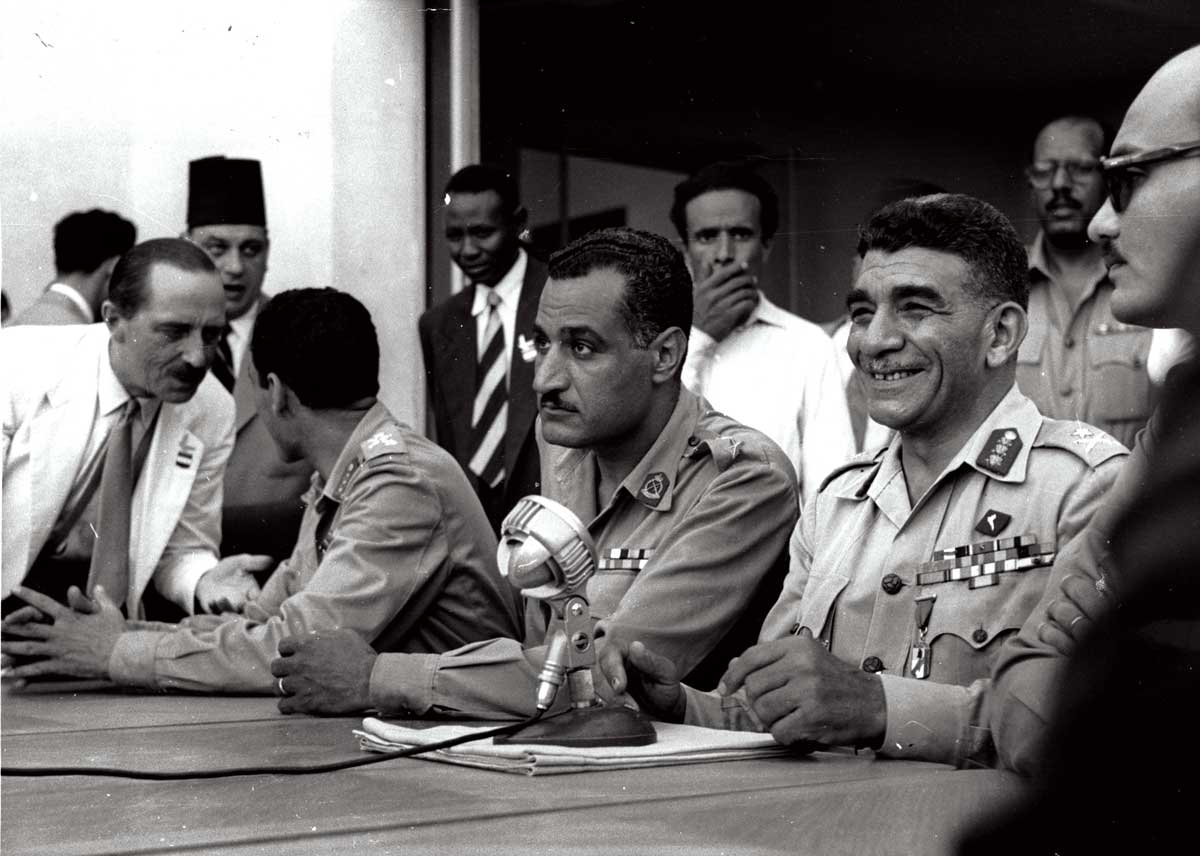
No wonder then that the fiery patriot applauded the coup, or ‘revolution’, that summer. His namesake, General Mohamed Naguib, head of the so-called Free Officers, promised to return to barracks after setting Egypt’s democracy back on track. In less than a year, however, the monarchy was abolished, the constitution annulled, political parties dissolved and newspapers shut down. Worse still, the general was replaced by a ten-man-strong Revolutionary Council led by an irritable lieutenant colonel called Gamal Abdel Nasser. Naguib summed it up perfectly in his boldest – and final – piece: ‘We Ousted One King and Replaced Him with Ten.’
Subpoenaed by the revolutionary authorities, the reporter expected another glorious triumph for freedom – after all, the monarch had departed and foreign occupiers were on their way out. Could someone so popular face injustice at the hands of a government of the people?
Yet this time things were different. Behind a makeshift bench in a darkened hall sat three grim-faced officers. Where were Egypt’s seasoned judges? Why such frenzied reaction to one article? Then he heard the accusation. The clunky phrasing sounded strange, though it soon became a mainstay of political show trials: collaborating with foreign powers to destabilise the country.
During a pause in proceedings, the reporter was ushered, handcuffed, to the second floor where he found Nasser beaming amiably. The Free Officers had long admired Naguib’s patriotic writings, he was told, and wanted to honour him with a prestigious new publishing house. In return, he should not oppose the popular sovereignty he had always championed.
Another bargain, Naguib thought. He decided to stand his ground. Independent journalism defends the people’s freedom, not a kingdom or republic, he told Nasser. The defendant was sent back down and the judgment was swift: death by hanging. This was later reduced to life in prison and 25 years of hard labour, the minimum punishment for high treason.
After Nasser died in 1970, the government granted Naguib an early release due to poor health. Then 60, he stumbled back to life after wasting the best part of two decades behind bars, possibly the longest any Egyptian journalist spent in prison. He also discovered he was bankrupt. Everything he owned had been sequestered, as befitted a traitor.
Years later, a frail Naguib sat in a wooden chair on the press syndicate lawn, puffing on a cigarette and regaling his audience with anecdotes. He then got up, adjusted his spectacles and shuffled out of the main gate. A speeding vehicle ran him over and drove on without looking back. He bled to death on the street.
Mohamed Hassanein Heikal
The same year that Aboulkheir Naguib clashed with the royal palace, another reporter had a chance encounter that changed his life.
Mohamed Hassanein Heikal was a decade younger than Naguib, born months after the 1923 Constitution was drafted. Unlike Naguib, his father was neither a journalist nor supportive of this frivolous profession. Heikal was forced to study commerce to help run the family business. However, his writing talents found an unlikely home in the Egyptian Gazette, the oldest English-language tabloid in the Middle East, founded in 1880 by two Britons.
By the mid-1940s, Heikal had become a skilled war correspondent. After a tour of the Balkans, his next assignment was closer to home. King Farouk had deployed an unprepared army to thwart the emergence of the Israeli state. Heikal commandeered a jeep to reach a besieged unit at Fallujah, near Beersheba. The officer in charge was a tall, brooding infantryman who briskly gave his low opinion of the naval-gazing press and promptly went to bed. Heikal noted down his name: Gamal Abdel Nasser.
A year later, Nasser tagged along when a mutual friend called on Heikal. It was a friendly visit and Heikal, now a celebrated author, presented Nasser with a signed copy of his latest book. They ran into each other again five days before the 1952 coup at General Naguib’s home, where the journalist invited the colonel to continue their debate in his study. Based on what he heard, Heikal was not surprised to learn later that Nasser had been plotting a coup.
Heikal had thrived in liberal Egypt and was on good terms with Mustafa al-Nahass and other Wafd politicians. He also unapologetically retained a touch of ancien régime charm with his cultivated manners, fondness for cigars and religious attachment to golf. Nonetheless, he accepted Nasser’s basic contention that no country can be free in the presence of foreign troops: parliamentary elections may be fair, judges may be autonomous and the press may be self-regulating, but the British still held the reins.
Mohammed Hassanein Heikal with Omm Kolthoum, c.1960s. Alamy.
‘Exhibit A’ was the Abdeen Palace incident which took place on 4 February 1942. According to Nasser, it was this that had inspired the coup. Despite British appeals, king and parliament were united in refusing to declare war on the Axis Powers. Like Nasser, King Farouk was eager to see the British go. Rumours abounded of royal messages encouraging Berlin to chase out the British. The liberal Wafd still controlled parliament, but the palace kept it out of government. As Erwin Rommel’s Afrika Korps approached El Alamein, London decided to press the point.
On that February morning, the British ambassador Miles Lampson issued an ultimatum: Farouk could either invite Mustafa al-Nahass and the Wafd to form a government, or he could pass the crown to his heir. When Farouk refused to budge, the British General Officer Commanding, Robert Stone, stationed tanks outside his palace; the Egyptian royal guard stood in defence. When Lampson arrived that evening with an abdication decree, Farouk capitulated and stood his troops down.
Nasser and his comrades were beside themselves with shame. For them, the confrontation said it all. Egyptian democracy was a sham, just decadent aristocrats and a childish monarch bickering over breadcrumbs. Freedom was impossible until the British were ejected properly.
Heikal not only bought this argument and became Nasser’s confidant, but he made it respectable through a series of historical works, such as his 2010 Regime Fall: Why Was the July Revolution Necessary? A return to the liberal order brought forth in 1922 would have to wait until national independence was guaranteed, first from British colonialism in the 1950s, then from American neo-colonialism in the 1960s.
As time passed, the demand for freedom slipped down the list of priorities. Heikal began to fear it might never happen. So when restless youths, finding solace in a now bygone liberal age, began stirring, Heikal offered his blessing. ‘I stand before you, a man who belongs to a generation that is entering its twilight’, he began a speech at the American University in Cairo in 2007: ‘I feel surrounded by the signs of a new dawn.’ As he headed peacefully towards his 90th year, Heikal heard the rumblings of a coming storm.
The 2011 uprising, often compared with the 1919 revolt in its spontaneity and inclusiveness, demanded a rebirth of freedom. And Heikal, who had profited from liberal Egypt during his formative years, understood. Soon enough, however, Abdel Fattah el-Sisi, another nationalistic infantryman and now the country’s president, convinced him that Western colonialism lay in ambush. Although friends on paper, London and Washington are still scheming against Egypt.
Heikal died contentedly in 2016 having once again stood shoulder-to-shoulder with an officer-turned-president who had convinced him that national independence remains vulnerable. Freedom will soon come, Heikal conceded, but not at the moment.
Alaa al-Aswany
As the centenary of the 1922 declaration of independence beckoned, Aboulkheir Naguib’s long-forgotten travails seeped back into public memory.
Working alongside Naguib at Al-Jomhur Al-Masri newspaper in the 1950s was another ardent patriot, Abbas al-Aswany. He resented British occupation, but relished the opportunity of writing in an open society and appreciated, through a relative who served as minister of education, the dynamism of electoral politics. His son, Alaa, was born in 1957, three years after it was all over and Naguib was already languishing in prison.
Father and son did not have much time together: only 19 years. Still, Abbas made sure Alaa met Naguib and knew his story. Not only that: educated at the Lycée Français, Alaa was encouraged to imbibe the whole aura of Egypt’s liberal decades.
By the time of the political agitation of the early 2000s, Alaa al-Aswany, who had originally trained as a dentist, had become a prolific columnist and bestselling novelist. His nostalgia-drenched The Yacoubian Building (2002) was reprinted 30 times, translated into 23 languages and dramatised in a star-studded film and a less impressive television series. It narrated the misfortunes of a magnificent apartment block built in downtown Cairo in 1937 and brought to ruin by the vulgarities of officers and their cronies after 1952. It was an unsubtle allusion to how the nationalists had stifled Egypt’s nascent liberalism.
Alaa al-Aswany, Cairo, 2006. Alamy.
This theme was central to everything Aswany published: how Egypt’s belle époque was crushed under military boots. It was not wistfulness or melancholy. As his compatriots despaired at ever tasting the freedom their grandparents enjoyed, Aswany wanted to share his opinion that longing for the past was the way forward. And the first step was to debunk the myth that the liberal regime instituted in the 1920s was a hoax.
In Aswany’s view, colonial presence did not derail Egypt’s march to freedom: far from it. Egyptians had drafted a model constitution, elected representative parliaments, established parties, newspapers and civil associations, openly debated the role of religion and minority rights, and witnessed a renaissance in literature and theatre. And when the royal palace proved tiresome, British administrators left the king and his politicians to sort it out between themselves. Indeed, their most blatant intervention, the notorious affair of February 1942, while an affront to national prestige, upheld the constitution and election results against an anti-democratic monarch.
‘See what we have done to each other’, Aswany ended a 2021 lecture on Naguib’s tragedy: ‘The British did not do this to us.’ By the time he delivered this talk, however, Aswany was already a defeated revolutionary.
Some ten years earlier he had been the pre-eminent liberal voice of the Tahrir Square uprising, where more than 50,000 people first gathered on 25 January 2011 to protest against the government of Hosni Mubarak. As the protests grew in size Aswany fought on its side in street protests, newspaper columns and on television. For a few precious months, his idyllic reveries of a free, cosmopolitan Egypt came to life. But there was nothing this feisty dissident could do to prevent another coterie of nationalist officers from dashing his hopes and hounding him into exile, using the same type of trumped-up charges levelled at his hero, Aboulkheir Naguib.
Banned from appearing in the Egyptian press, Aswany took to YouTube. Broadcasting weekly from a nondescript unidentified location, he appeared in front of a bland white wall, wearing thick-rimmed black spectacles and sweating profusely under the camera lights. Patiently, almost obsessively, he performed countless variations on his invariable theme: liberty in Egypt is probable tomorrow, because it was possible yesterday.
Hazem Kandil is Professor of Historical and Political Sociology at St Catharine’s College, Cambridge.