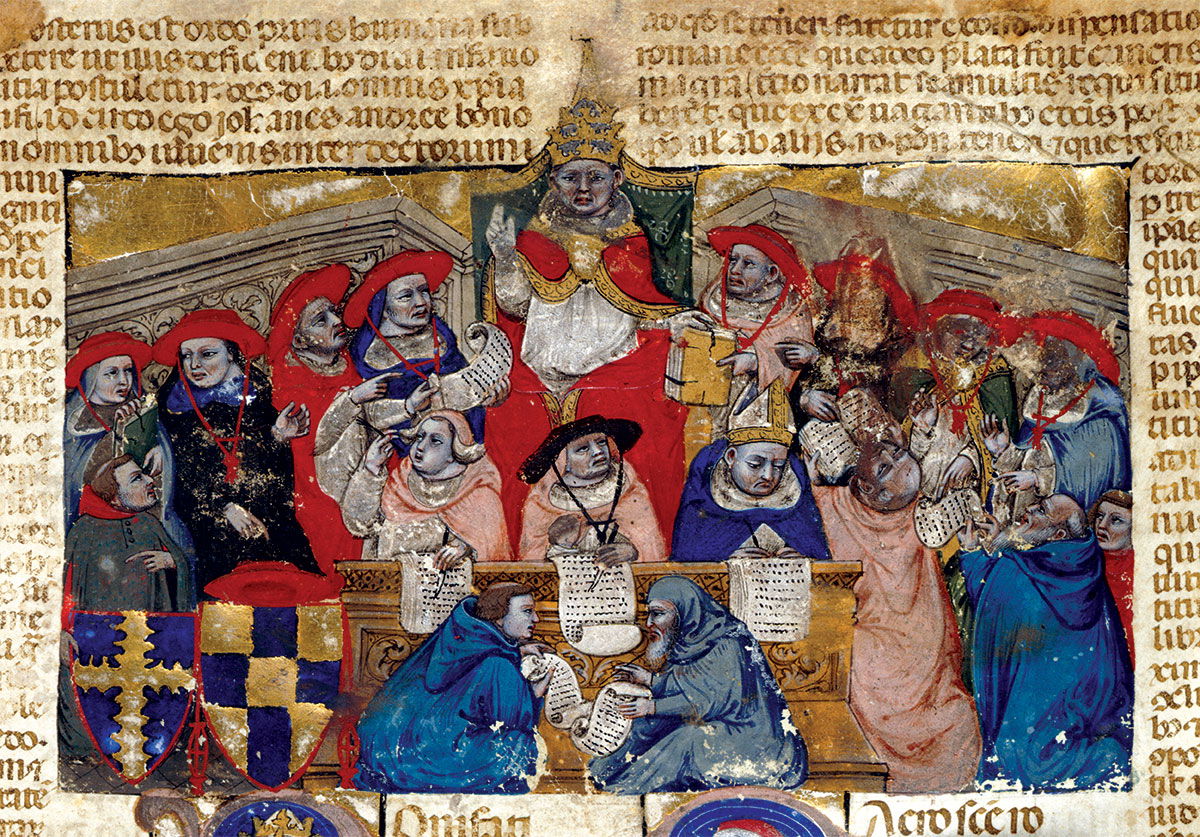
 Easter Day, Rome, 1300. In the Lateran Palace, 24 priests rise before dawn. They don white cassocks and proceed to the pope’s private chambers, where, silently, they dress Boniface VIII in a plain white cope and a pearl-studded mitre. In the intimate chapel of San Nicola, next to the papal chambers, they say Prime and Matins with their pope. Then the white-clad coterie processes through the palace to the chapel of San Lorenzo – the Sancta Sanctorum – and assembles before an icon. Torches and candles burn on the altar. Above, glinting mosaic words declare: ‘There is no holier place in the entire world.’ These priests are the papal chaplains. Joined now by the cardinal deacons and the papal subdeacons, they begin the special ceremonies for Easter Day.
Boniface VIII approaches the icon and removes its cover. The true likeness of Christ – the Acheiropoieta – is revealed, covered, but for its face and feet, by a jewelled silver coating. Boniface removes his mitre, stoops to kiss the icon’s feet and begins to chant: ‘The Lord who hung for us on the Cross is risen from the tomb. Alleluia!’ Two papal chaplains sing in unison with the pope, two others echo the antiphon in response and they continue, each time louder, filling the exquisitely painted chapel with their chant.
So began the curia’s Easter liturgy in the year of the first Roman Jubilee, when all those who visited St Peter’s were granted pardon for their sins. Each task in these rites was a symbolic honour and the papal chaplains took the lion’s share. Performing the pope’s private liturgy was just one of their many duties. Papal chaplains were churchmen, diplomats, lawyers and administrators, high up in the bureaucratic juggernaut of papal government. Many became bishops and cardinals; some ultimately became pope. They were scholars, writers and patrons of art and had households rich in books and luxury goods. This was a powerful, wealthy and prestigious elite that contributed greatly to cultural life in Rome and beyond. Its story over the following century is one of social and cultural change that reverberated in royal and princely courts across Europe.
Around 1306, a formal reckoning of the papal household was made for the new papal chamberlain, Arnoldo de Canteloup. According to this ordinance, the papal chapel comprised 24 clerics who lived in a chaplaincy within the papal palace. They said Mass and the Divine Hours with the pope. One nominated chaplain would serve him at Holy Communion. Another would read while he ate meals. Papal chaplains rode with the pontiff in ceremonial processions and undertook special missions on request. They were helped by a small staff of chapel clerks, treasurers, an ostiary, or porter, and a water-bearer. For their service, papal chaplains received food, drink and stabling allowances from the curia and additional gifts in sweetmeats, spices and cash on designated feast days.
Off the page, the papal chapel was far greater than the 24 priests who lived at the curia. Papal sources name over 250 papal chaplains in the last quarter of the 13th century alone. A small core of papal chaplains served in the chapel for many years. Most came and went for varying periods. Some, who never visited the curia, held the office in name only. These were wealthy men, partly thanks to the generous allowances that resident papal chaplains received from the curia, but mostly because they drew income from an array of endowed church livings, not to mention their own families’ landed wealth.
Political agents
Through the latter decades of the 13th century, the papal chapel was a place where private liturgy met government and the same men who served the pope in the divine office were also his political agents. Popes gave these prestigious courtiers important duties in government, both at home and abroad. Papal chaplains often undertook diplomatic missions at other courts, their authority conferred by the pope himself and reinforced by their own cultural capital. In 1291 Philip IV of France arrested all Italian merchant bankers in France, including several from the banking families that served the curia. In response, Pope Nicholas IV sent his chaplain Matteo ‘Protonobilissimus’ de Neapoli to the French court to negotiate the papal bankers’ release, with a formal letter extolling the chaplain’s academic prowess, bearing and probity. At the regional level, papal chaplains enforced papal mandates, delivered messages and examined diocesan disputes. The pope often appointed his chaplains as collectors of the papal tenth – the tax of one tenth of a cleric’s income that funded the Crusades. This extensive network of chaplains deployed in strategic fiscal and political positions carried papal authority to courts and dioceses from Scandinavia to Sicily.
The pope also appointed papal chaplains at other courts to strengthen allegiance with the curia’s allies. Nicholas IV and Boniface VIII appointed at least ten chaplains in England and Scotland, several of them senior members of Edward I’s household, to reinforce ties with the English crown at a time when papal relations with France were strained. Boniface VIII explained the benefits of these positions in 1298 when, presumably at Edward’s request, he invited John of Droxford, keeper of the royal Wardrobe and later bishop of Bath and Wells, to become a papal chaplain. This appointment – Boniface wrote – would recognise Droxford’s eminent position at Edward’s court and enhance his status and career. Droxford, like many chaplains abroad, never travelled to Rome. His papal chaplaincy was honorary, its conferral a diplomatic manoeuvre. Honorary papal chaplaincies could also recognise notable service. The royal clerk William Greenfield was a great Anglo-papal diplomat. He was involved in negotiations with the kings of Aragon and Naples in 1289 and 1291, in 1290 travelled to the curia to negotiate the papal tenth for the English crown and in 1296 was a commissioner for the truce agreed between the kings of England and France at Cambrai. In 1299, Boniface VIII made Greenfield a papal chaplain for his important peace-making.
Each pope’s political interests left a territorial stamp on the papal chapel. Nicholas IV appointed many members of the Papal State’s seigneurial families to his chapel – especially scions of the powerful Fieschi and Colonna dynasties – to strengthen papal influence in the region. Boniface VIII appointed magnates from his own family seat of Anagni, from Velletri and from other towns in Lazio, in a deliberate attempt to strengthen municipal support for the papacy across the Papal State. His successor, Benedict XI, stopped recruiting chaplains from the Papal State completely, preferring individuals from the Veneto – notably his own birthplace of Treviso – from Tuscany and abroad. Neither Boniface VIII nor Benedict XI appointed papal chaplains from the Regno (which at the time covered much of Southern Italy and Sicily), thereby denying those from these Angevin territories a papal chaplain’s access to the pope and foothold at the curia.
Men of law
The growing demands of papal government made the papal chapel one of Europe’s great centres of legal scholarship in the late 13th century. As the machinery of papal authority swelled, so too did the huge volume of legal appeals submitted to the curia. Papal chaplains met much of the resultant need for curial auditors and the papal chapel acquired a particular association with law. Throughout the 1280s and 1290s, papal chaplains were deployed as judges in hundreds of legal cases both at the curia and across Europe. New papal auditors would often be inducted into the papal chapel when they arbitrated in their first case. The curia’s most senior judge was always a papal chaplain.
The papal chapel’s special association with law brought together experts who had studied in Europe’s flourishing universities, especially Paris, Bologna, Cluny and Laon. Many were doctors in civil or canon law and, of these, at least a score taught law at universities during their careers. Some produced original legal works of their own. The curial judge, papal chaplain and doctor of law Huguitio Borromeo de Vercellis wrote a scholastic analysis of two great canon law collections: Gratian’s Decretals and Gregory IX’s Liber Extra. Papiano della Rovere, as bishop of Novara, wrote statutes on doctrine and liturgy drawn from the ordinary of the papal chapel which, as a former papal chaplain, he knew intimately. The papal chapel also turned out several of Europe’s greatest legal minds, especially those associated with Boniface VIII’s great collection of decretals, the Liber Sextus of 1298. The distinguished canonist Johannes Monachus was a papal chaplain before he became papal vice-chancellor in 1288 and produced a famous commentary on the Liber Sextus – the Glossa Aurea. So did the auditor litterarum contradictarum Guido de Baisio. And, of the three eminent canonists who collaborated with Boniface VIII on the Liber Sextus, two – Berengar Fredol and Guillaume de Mandagout – were former papal chaplains. For their decisions on petitions and appeals submitted to the curia, to high-level contributions that shaped canon law itself, legal specialists were prized and rewarded at the 13th-century curia. The papal chapel saw a flourishing of legal thought and practice that is unparalleled in the household chapels of other European courts.
Master debaters
Legal scholarship was just one of many disciplines to be found in this seat of learning. Eyewitnesses recount that Urban IV’s papal chaplains would sit at the pope’s feet after ceremonial meals and entertain him with scholarly debate. This vignette is charming but truthful, for the papal chapel provided a position at the curia for many academic luminaries, notably renowned scientists and physicians. One eyewitness was Campano da Novara, a renowned astronomer, mathematician and physician, whom the Franciscan natural philosopher Roger Bacon considered one of the greatest mathematicians of his time. Already famous for his edition of Euclid’s Elements, Campano became a chaplain of Cardinal Ottobono Fieschi in the early 1260s and a papal chaplain in 1264. He wrote all his subsequent works – notably his magnum opus on planetary theory, the Theorica Planetarum – from the financial and social vantage point of the papal chapel, and died esteemed and wealthy in 1296. Many cardinals also employed physicians like the young Campano in their households and the papal household brought together the very best. William of Moerbeke, an important translator of Aristotle and the ancient Greek physician Galen, was a chaplain and personal confessor to six popes from 1267 to 1277. Simon of Genoa, author of the most important medical dictionary of the time – the Clavis Sanationis – and translator of Arabic medical texts, was papal chaplain and physician to Nicholas IV. Simon was both contemporary and friend of Campano da Novara: in his preface to the Clavis Sanationis, Simon thanks Campano for encouraging him to write the work and for reviewing it. Boasting such prominent scientists, the curia became a powerful centre of scholarly exchange, which included even the most famous scholars of optics and ophthalmology of the time, John Peckham and Witelo.
Men of letters
Curialists amassed great libraries. Although the volumes are now largely lost, we know what some of these libraries contained thanks to inventories that have survived, appended to their owners’ wills. These inventories are a fractional record of the many medical and scientific texts that circulated at the curia. The papal library, for example, contained the most important collection of Greek scientific texts ever assembled before the Renaissance, including works by Heron of Alexandria, Archimedes and Aristotle. These book collections also reveal curialists’ wider scholarly interests. They contained Bibles, biblical commentaries, patristic texts, histories, saints’ lives, works of civil and canon law, texts from classical antiquity and more. Books moved continually around the curia, given as personal gifts in wills to valued friends and servants. A library was valuable stock and whole collections could move from person to person in financial transactions; the papal chaplain Cristoforo Tolomei de Senis used his library as security on a loan from Cardinal Pietro Peregrosso. When Cristoforo died in 1298, the debt unpaid, Peregrosso received the precious library in its entirety. So notable was the collection that the powerful cardinal Pietro Colonna bought it wholesale when Peregrosso’s assets were sold after his death in 1295 and many volumes later reappear in Colonna’s own library inventory.
Because these bibliophiles were all priests, their wills and their appended inventories gloss over any secular narrative literature they owned, though curialists presumably enjoyed such texts. The epitaphs inscribed on popes’ and cardinals’ tombs suggest a penchant for sophisticated rhetorical wordplay which would have run wild in the many secular works that were never inventoried. That said, two authors associated with the papal chapel – Bonaiutus de Casentino and Giacomo Gaetani Stefaneschi – give us some insight into literary taste at the curia as, thankfully, their writings made their way into the papal library where they have survived.
The poet Bonaiutus de Casentino spent much of his career as collector of the papal tenth in Eastern Europe. For this, and perhaps also his literary service to the curia, Benedict XI appointed him a papal chaplain in 1304. De Casentino’s poems celebrate landmarks in Boniface VIII’s pontificate and commemorate the pope’s family members. Laudatory in the extreme and explicitly intended to curry favour, these works evidently circulated at the curia and many were presented as gifts. The papal chaplain Berardus de Camerino learned that de Casentino was composing a hexameter poem about the curia’s flight from the torrid Roman summer of 1292, requested its completion and duly received the verses as a gift. The poet himself sent a hymn and sequence to the papal physician Accursinus de Pistoia, intended for Boniface VIII’s entertainment while the pope was blood-letting. De Casentino’s scribe compiled his master’s works in the late 1290s and presented them to the papal library.
Giacomo Gaetani Stefaneschi was the most prolific figure in cultural life at the curia. He started his Opus Metricum, a biography of Celestine V, in the early 1290s while he was a papal chaplain. The rest of his literary works followed his elevation as Cardinal of San Giorgio in Velabro in 1295. They include a historical account of the first Roman Jubilee, a life of St George (the patron saint of Stefaneschi’s titular church) and an account of the miraculous saving by the Virgin Mary of a man condemned to death at Avignon. Stefaneschi also wrote a compendium of the papal chapel’s liturgy, which captures in fine detail the rituals that chaplains performed at Mass and on feast days: what they wore, which texts they spoke and chanted, where they rode in cavalcade through Rome. Stefaneschi’s narrative works are valuable histories of the curia and, with their highly abstruse style, are precious textual survivors of this sophisticated and often rarefied cultural milieu.
Taste-makers
As a cardinal, Stefaneschi commissioned major works from the preeminent artists of his time. For Old Saint Peter’s basilica in Rome, he commissioned a double-sided triptych from Giotto (now in the Pinacoteca Vaticana) and the Navicella mosaic in the entrance arcade (destroyed when the basilica was rebuilt in the 17th century). A fresco at the Lateran basilica depicting Boniface VIII announcing the 1300 Jubilee – just a fragment survives today – may also be the work of Giotto, commissioned by Stefaneschi. From Pietro Cavallini, Stefaneschi commissioned a fresco for the apse of San Giorgio in Velabro and, from Simone Martini, frescoes for the porch of the cathedral of Notre Dame des Doms and for the new papal palace at Avignon. (Stefaneschi’s brother Bertoldo also commissioned Cavallini to create a mosaic cycle depicting scenes of the life of the Virgin, which still glints away in the apse of Santa Maria in Trastevere.) This is not to mention the fine miniatures in the manuscripts of Giacomo Stefaneschi’s own literary works, especially those produced at Avignon, which are superb examples of an Avignonese master of Italianate illumination known only as the Master of the Saint George Codex.
As a prime stepping stone to the upper echelons of the Roman Church, the papal chapel played a part in the formation and spread of artistic taste. At his elevation, a cardinal chose the design of the seal he would use to authenticate documents. Stefaneschi’s seal, an amalgam of northern and Roman Gothic stylistic devices and Stefaneschi’s own innovations, is an example in miniature of tastes acquired at the curia as a papal chaplain. Stefaneschi’s later artistic tastes left their mark largely in Rome and Avignon, where he made his major commissions as a cardinal. Other papal chaplains took Roman artistic tastes with them when they left the curia for diocesan positions elsewhere. The canonist and cardinal Berengar Fredol, who collaborated with Boniface VIII on the Liber Sextus, was a papal chaplain of Honorius IV and Nicholas IV. He founded a chapel in the church of Saint Nazaire in Béziers, southern France, which he had painted with frescoes in the style of Pietro Cavallini. Simon Matifas de Bucy, promoted from papal chaplain to Bishop of Paris in 1289, brought 13th-century Rome to Paris. He died in 1304 and his tomb monument was built in the chapel of Saints Marcel, Nicaise and Rigobert in Notre Dame. Above de Bucy’s effigy and under a gabled canopy, a fresco depicting Matifas and Saint Rigobert kneeling before the enthroned Virgin and infant Christ directly recalls Roman tomb style of the late 1200s.
Tombs in Rome show that papal chaplains made influential artistic decisions from their own rung of the ladder. Their greatest legacy was not in their own tombs, but in those of cardinals and popes. A cardinal or pope’s will said little, if anything, about tomb design, so artistic decisions fell to their executors, who were commonly their chaplains in life. Hadrian V named his chaplain Percivallus de Lavania as an executor soon before his death in 1275, leaving Percivallus to choose the anonymous sculptor who designed the tomb erected some 15 years later in San Francesco at Viterbo. Similarly, two papal chaplains, Guillaume d’Essai and Guillaume de Polleio, were executors for Cardinal Guillaume de Bray. They chose Arnolfo di Cambio as sculptor, who created in San Domenico at Orvieto an innovative design that set a precedent in expense and style for many later tombs.
Big band
At the time of the 1300 Jubilee, the papal chapel was a cultural melting pot that included prominent lawyers, diplomats, scientists, theologians, writers and artistic patrons. It was also about to undergo remarkable change: a century later, it consisted of 12 salaried singers. What caused such a profound transformation?
There are traces of musical culture at the 13th-century curia. Two volumes of liturgical music in the papal library contain polyphony of the Notre Dame school, which flourished in Paris in the late 12th and early 13th centuries. Some cardinals also had books of music in their libraries. However, these were collection items, not intended for performance in the papal chapel. Papal chaplains would have studied abstract classical harmonics – the mathematical proportions between the musical intervals – as part of the quadrivium at university. They also had a working ability in singing, enough to perform the liturgy, learned as priests and from an education that for some began at a cathedral song school. But papal records of the 13th century identify only one papal chaplain as a singer: a Nicolaus de Spoleto, who is styled ‘cantor’ in a roll of the curia’s householders written in the 1270s and who was perhaps recognised as the chapel’s leader in sung liturgy. There was, in fact, little call for special musical skill among papal chaplains, because a separate group of singers – the Roman schola cantorum – sang much of the curia’s liturgy.
A new chapel
Significant changes followed in the 14th century. When the curia moved to Avignon in 1309 it left the schola cantorum behind in favour of local singers employed ad hoc. More importantly, the papal chapel was divested of its legal function in all but a symbolic sense.
In the 1330s the curia created a new office for its judges, the Rota, which still serves as the curia’s highest appellate tribunal today. By this time, the curia formally recognised honorary papal chaplains with a title and status of their own, distinct from papal chaplains. From this point on, judges of the Rota were appointed as honorary papal chaplains. Serving papal chaplains were assigned a lower rank in the papal household and were divested of their former governmental and legal duties, so stopped working as curial judges altogether. These changes, bureaucratic at first sight, had important cultural ramifications.
Relieved of their legal, governmental and diplomatic duties, papal chaplains no longer needed so rigorous an education and such high social standing. As a result, specialist musicians entered the chapel. The first papal chaplain known to have composed music appeared on the payroll in 1378: Matheus de Longariga. Earlier, under Clement V, new papal chaplains arrived from northern France and Flanders and it is tempting to think that they brought from their cathedrals and chapels the avant garde practices of the ars nova school of polyphony.
This new type of courtier – the salaried court chaplain as professional musician – emerged in court chapels across Europe while, beneath the surface, administrative and financial efficiency replaced pure patrimonial favour as a means of regulating a large, complex court society. Apparently, singers in Henry III’s chapel royal rivalled Europe’s best. Under Edward I, the chapel royal developed a well-defined structure with chaplains ranked by status on the royal payroll – a structure that developed further under Edward II. The Sainte Chapelle at Paris also started to employ singing clerics in the 14th century and shows signs of comparable structural formalisation. Together with the royal and princely chapels in Burgundy, Spain and elsewhere, these choirs would rival cathedrals as centres of polyphonic singing. Music was by no means a court chaplain’s sole function. They still held relationships with multiple lay and church institutions and often retained functions beyond the chapel in domestic court life and government. But, for the first time, a singer’s musical skills could now secure them a prominent place in court society.
The papal chapel’s transformation into a musical jewel in the papal tiara is a story of great cultural change. The clerics who in 1300 celebrated Easter with the pope in the Sancta Sanctorum left behind a rich legacy of art, literature, science and law in the crucible of late 13th-century Rome. Over the following century, the curia became one of the first European courts to give specialist musicians a prime position in its chapel, intimately connected with the pope’s daily life.
To what extent did common preconditions – particularly financial and bureaucratic rationalisation – precipitate comparable cultural change at courts elsewhere in Europe? A book on that question begs to be written. At its heart are those white-clad chaplains, processing towards the Sancta Sanctorum on Easter morning.
Matthew Ross’ doctorate was on the papal chapel from 1288-1304.




