More than 5,000 people were interviewed during the Great Inquisition of medieval Toulouse. What did this mean for those ordinary people called to give evidence?
Ironically, when we speak about inquisitions, people have come to expect the Spanish Inquisition. But inquisitions into the beliefs and behaviours of the laity started in earnest more than two centuries before this late-15th century institution.
Register to read more articles for free.
When you register, you will receive the History Today newsletter. Click here to read our Terms of Use.
More than 5,000 people were interviewed during the Great Inquisition of medieval Toulouse. What did this mean for those ordinary people called to give evidence?
Ironically, when we speak about inquisitions, people have come to expect the Spanish Inquisition. But inquisitions into the beliefs and behaviours of the laity started in earnest more than two centuries before this late-15th century institution.
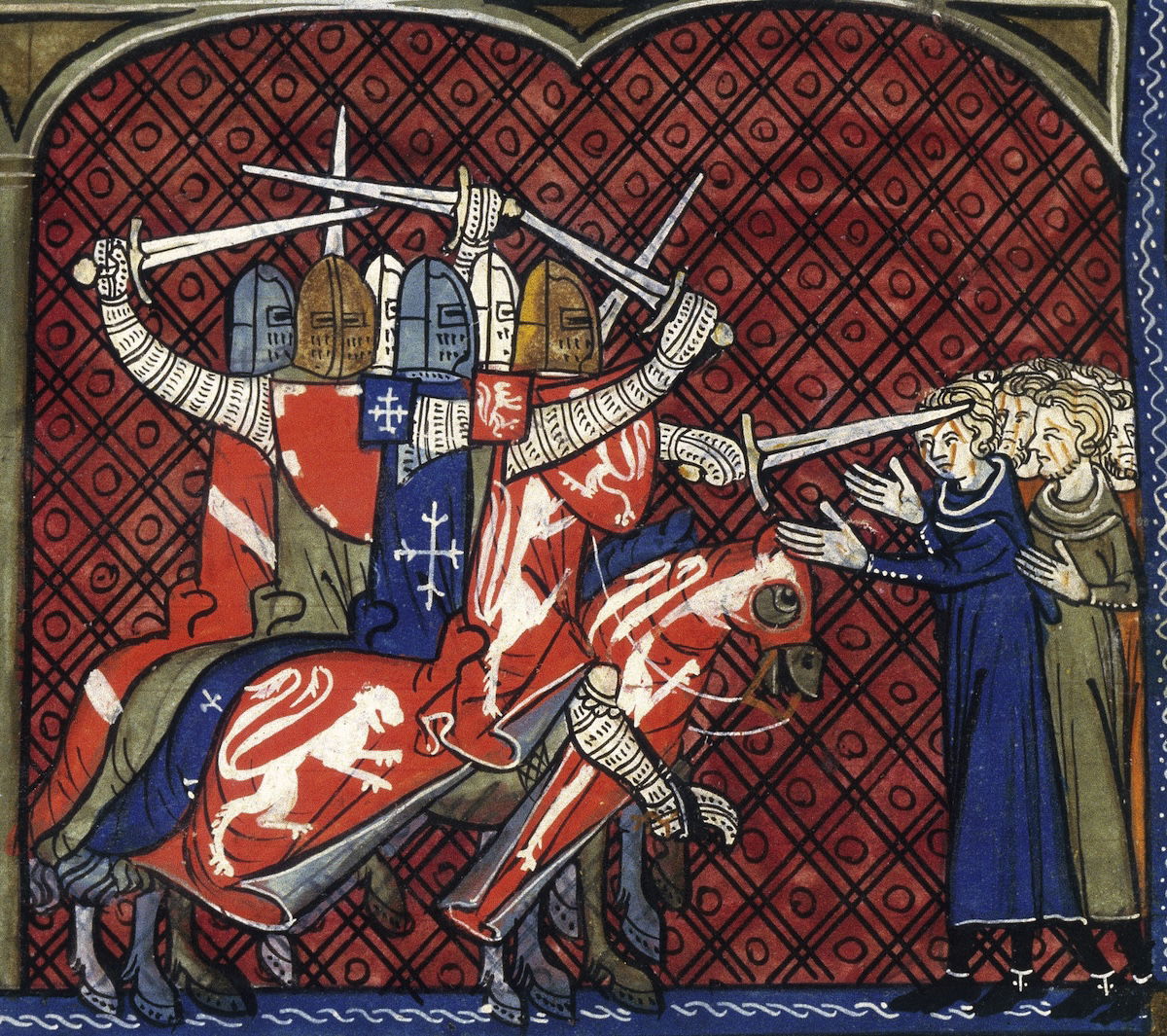
In 12th-century Europe the ecclesiastical hierarchy had grown increasingly concerned about the apparent rise of heresy. It seemed that heretics were infecting the general population with their ideas and practices. The language of disease was used almost ubiquitously to describe the outbreak: the 12th-century Augustinian William of Newburgh, for example, referred to a group of foreign heretics that arrived in England in 1163 as a ‘pestilence’. In the same year, the Council of Tours labelled the heresy that was spreading in Toulouse a ‘cancer’. The Church tried several approaches to combat heresy and heretics. These included preaching and debating, public condemnation at councils, and occasionally handing them over to secular authorities for public execution. Following the extraordinarily bloody Albigensian Crusade of 1208-29 – a series of military campaigns on the lands of southern France with the stated ambition of eradicating heretics and their supporters in the lands between Beziers and Bordeaux – the papacy introduced a new method: the first papal inquisitors were sent to Languedoc in 1233 to root out the clandestine heretical networks that seemed to have survived the Crusade. This was the inquisition into heretical depravity. Inquisitions were soon established across Europe in any place that a bishop or papal representative perceived a threat of heresy, that is, any view held obstinately that is counter to the orthodox view espoused by the Church.
The largest of these investigations in the Middle Ages was held at the vast Romanesque abbey of Saint-Sernin in Toulouse between May 1245 and August 1246, following a century-long struggle between the Church and heresy in the area. Remarkably, in this short period in Toulouse, more than 5,000 men and women, from over 100 villages, were interviewed about their relationship to heresy and heretics. This investigation has been called the ‘Great Inquisition’; given the scale, it seems an appropriate title. Perhaps even more remarkable than its size, a 13th-century manuscript, a copy of the original inquisition register, has survived. Since 1790 it has been preserved in the Bibliothèque Municipale of Toulouse, having been removed from the Dominican Convent of Toulouse in the wake of the French Revolution. It is by far the largest and most complete piece of inquisitorial evidence from the 13th century.
A page from Bernard de Caux’s Inquisition records, 13th century. Bibliotheque du Toulouse. Public Domain.
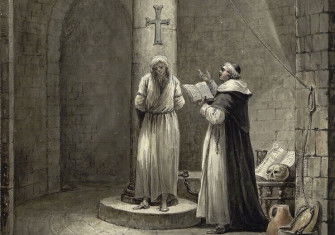
Two inquisitors carried out the inquisition, the Dominicans Bernard de Caux and Jean de Saint-Pierre. The scale of the operation was huge, but they had support staff such as notaries and scribes to aid the process the details of which are recorded in the register. The responsibility of an inquisitor, in the first instance, was to ask questions such as ‘did you see any heretics?’, ‘where, when, and who else was there?’, and ‘did you eat and drink with the heretics or give them anything?’ Recognising the potential flaws in their methods, Bernard and Jean would end their interrogations with the questions ‘did you ever swear to keep silent about all of this?’ and ‘did you ever conceal the truth?’
Each deponent would begin by swearing to ‘speak the truth about the living and the dead concerning the crime of heresy’. The length and detail of depositions vary greatly, depending on how much engagement a person had had with heresy, or, of course, how much they were willing to admit. A fairly typical answer was given by Arnold of Na Comdors, on 22 June 1245, who said that he had never seen a heretic ‘except as prisoners’, and added that he did not believe in them or ever hear their preaching. Conversely, some witnesses had several examples of interactions with heretics and offered detailed accounts of their beliefs and behaviours. A knight, Raymond Ademar of Lanta, had seen heretics, both men and women, dozens of times. He had heard their preaching, eaten apples with them, and believed they were good people and ‘friends of God’. Raymond added, however, that he had changed his mind on the heretics after hearing Fulk, the bishop of Toulouse, preaching.
How to be an inquisitor
As the 13th century progressed, inquisitorial manuals – a sort of ‘how-to’ guide for inquisitors – would give them a rough structure to steer the process. These were produced by inquisitors, for inquisitors, through their experiences of the new process of inquisition. From at least the 1240s these manuals circulated widely across Europe, informing inquisitors on best practice approaches to their inquisitions, and a handful of them survive today. The manuals would instruct inquisitors on how to summon individuals of interest, offer advice in relation to penance and punishment, and suggest the basic model of interrogation. But, often, the inquisitor would take a particular interest in something a deponent said and then pursue a line of questioning in that direction – this is, in part, why we have some of the more peculiar examples given below.
Contrary to popular assumption, the use of torture was not synonymous with inquisitorial interrogation from the beginning. Those interrogated in the inquisition at Toulouse in 1245-46 would not have been subjected to torture. Only in 1252 did Pope Innocent IV authorise the use of torture as part of inquisitorial interrogations and, even then, it was used as a last resort. It certainly was not as ubiquitous as popular depictions would have us believe.
The followers of the heretic Amaury de Chatres being burned in 1210, from the Grandes Chroniques de France, c.1460. Bridgeman Images.
Once their investigations were complete, the inquisitors would issue the sentences against the people implicated in heresy. The sentencing powers of 13th-century inquisitors included the ability to excommunicate and imprison. They would issue penances. They might force those found guilty to wear yellow crosses to distinguish them from their good, Catholic neighbours, or send them on an arduous pilgrimage to a distant cathedral where the relics of a long dead saint might bless them with some of the virtues they lacked. The inquisitor Peter Cellan, following an inquisition in Quercy, South-West France in 1241-42, sent several people found to be associated with heresy on pilgrimages to far flung places such as Santiago de Compostela, Canterbury, and Constantinople. Sometimes, in particularly scandalous, unapologetic cases of heresy, the Church would hand the guilty party over to the secular authorities to be executed. In the 1230s the chronicler and inquisitor William of Pelhisson recounted an episode in the city of Albi in which inquisitors condemned the heretics Peter of Podiumperditum and Peter Bomacip to be burned – this execution, William informs us, terrified many other heretics and brought great joy to the faithful. The first case of heretics being burned following a judicial process occurred in 1022 at Orléans, but death by burning became a more common punishment for obstinate heresy from the 13th century. We might think of this as a final attempt to purify the souls of the condemned, a literal representation of the cleansing flames of purgatory, or possibly, the eternal fire of hell. Whatever the supposed symbolic reasoning, it was a public act that drew crowds and served as a cautionary spectacle for a heretically minded onlooker. However, it should be said that, despite many of their peers choosing to do so, as far as the surviving records inform us, the inquisitors at Toulouse, Bernard and Jean, did not send any heretics to be executed. For particularly implicated offenders, those who were especially credulous of the beliefs and supportive of the actions of heretics, the most severe punishment that they issued was ‘perpetual imprisonment’, removing them from their community. This punishment was given to Pierre Guilhelm de Rocovila for his historic association with high-profile heretics, and to the noble woman Algaia de Villeneauve-la-Comptal, in part because she missed the opportunity to confess during the period of grace offered at the start of the inquisitorial proceedings.
Other beliefs are available
Traditionally, the heretics pursued by the inquisitors, recorded in the pages of this manuscript, have been called ‘Cathars’ by historians. But this appellation, though used in some contemporary texts, is not found in the manuscript. The term Cathar, likely from Greek, meaning ‘pure’, was a name for an ancient heresy, mentioned by Isidore of Seville in his Etymologies, a sort of medieval encyclopaedia. The name was recycled to refer to the heretics of the 12th and 13th centuries by some contemporaries, including the great scholar Alan of Lille, who claimed they were called Cathars because they had a ritual in which they kissed a cat below the tail. It has since become a useful, catch-all term for heretics who allegedly held dualist or pseudo-Manichaean beliefs – that is, the belief that a ‘good’ God created the invisible, or spiritual world, and a ‘bad’ God created the material world. Rather than Cathar, the term heretic was enough for the Toulouse inquisitors, and their readers, to recognise the group or groups in question. The people interrogated knew the group of heretics with which Bernard and Jean were concerned by the name ‘bon hommes et femmes’ or the ‘Good Men and Women’. Another group are occasionally mentioned in the records of this inquisition, the Waldensians. They were a far less extreme heretical group who regularly quarrelled with the Good Men and Women; the Waldensians, in their early years, broadly agreed with the views of the Church, but they fell out of favour when they proved to be disobedient to the Church by continuing to preach without permission from local bishops. We might think of these groups as offering the laity an alternative avenue to holiness than the formalised Church. In their daily behaviours both groups emulated the lives of the apostles by dressing humbly, preaching, and begging for alms. Demonstrating voluntary poverty was& a practice that drew great admiration and respect in the early 13th century, so much so that the papacy authorised the Church’s own, very similar, movements in these years: the Orders of the Friars Preacher and Friars Minor, or, as they would come to be known, the Dominicans and the Franciscans, were formally approved in 1216 and 1223.
St Dominic and the test by fire of heretic and orthodox books, from Le Miroir Historial, by Vincent de Beauvais, 15th century. Musée Condé, Chantilly/Bridgeman Images.
In the inquisition of 1245-46, we can also see examples of alleged heretics practising medicine. There was a rumour that a heretic had in his possession a ‘book of medicine’, and the heretics Arnaut and Pons Faure were sought out by one deponent because they were ‘the best doctors’. From other inquisitorial records, it is clear that heretics, both men and women, regularly practised medicine. Presumably, this was one aspect of the pastoral and spiritual care they offered to the laity in their communities. While there is nothing specifically heretical about practising medicine, people were forbidden from engaging with heretics for any reason and inquisitorial records across the 13th century show family members bringing their sick relatives to heretics in the hope that they would be cured.
As for the alleged beliefs of the heretics found in the depositions, we can see some quite shocking claims that contradict the beliefs and sacraments of the Catholic Church. Willelmus de Rozengue said, when questioned at Toulouse, that he had believed that God did not make the visible world, and that there was no salvation to be found in marriage and it should be considered prostitution. Paul Vidal went so far as to say that ‘the Devil made visible things’. A woman named Ramunda admitted to once believing that God had not made visible things, the consecrated host was not the body of Christ, there was no salvation found in baptism or marriage, and that when a priest celebrates the Eucharist the bread does not become the body of Christ, but remains bread, and that the bodies of the dead will not rise again. Some of the deponents admit hearing these things from heretics, but deny ever believing them. Some say they used to believe it, but not anymore.
Up for debate
Beyond heretical beliefs, the register gives us an idea of the people’s conception of heresy and heretics as an ongoing concern. Many of the events described in the testimonies happened in the distant past. Several older deponents refer to events that happened ‘before the Crusaders came’, a reference to the Albigensian Crusade. The period before the crusade in these recollections seemed to be a far more religiously fluid period, where heretics could operate more freely than in later years. One deponent, a notary named Pons Amiel,remembered that, around the year 1208, two heretics stood in the town square of Laurac, about 20 miles east of Carcassonne, and participated in a public debate. The Good Man Izarn of Castre debated with the Waldensian Bernard Prim in front of a large group of townspeople. Public debates between Waldensians and the Good Christians were not uncommon and it must have been an unmissable piece of entertainment in the streets of the village to have these two holy men argue over the true faith. The historian Peter Biller suggested in 2016 that, for the laity, this sort of theological debate was the equivalent of television and football. Public debates between Catholics and these two groups were also common; before the Crusade debating had seemed a plausible strategy to stop the spread of heresy and had formed an important aspect of the Church’s early approach to the problem. The future St Dominic, from Caleruega in Spain, debated with heretics. While travelling through the Languedoc with his mentor, Diego, bishop of Osma, the pair realised the extent of the problem of heresy in the region and so stayed in the area preaching and debating with heretics. Dominic is said to have performed several miracles in the region, including a famous scene where heretics were unable to burn a book containing his orthodox arguments after a public debate. Several of the deponents questioned in the ‘Great Inquisition’ remember seeing and interacting with him.
In the records of the inquisition of 1245-46, people remembered heretics, on several different occasions, debating topics such as marriage, the resurrection, and the law of Moses. One deponent, Raymond Bru, made a habit of debating with heretics. He told the inquisitors that he travelled to a ‘house of heretics’ in Avignonet, a village 30 miles south-east of Toulouse, with the intention of debating with them and that whenever he saw heretics he debated or had ‘bad words’ with them. He told the inquisitor that he did not believe they were good men, that they had good faith, or that they were truth-tellers. The heretic Arnaut Petrona’s mother, Pitrella, remembered having to go to a house to drag her son away from an impassioned debate between him and a group of Good Men. Pitrella claimed that she feared her son would have been killed by the heretics if she had not acted.
Some of the stories found in the manuscript show how severe the implications of interacting with heretics could be for a community. Around the year 1223 Aimersent, a pregnant adolescent, had gone with several other people to hear two heretics preach in the house of a local knight. Following the lengthy sermon, the heretics approached Aimersent and loudly declared that she was carrying a demon in her womb. Everyone laughed. But Aimersent did not find it funny. She felt humiliated by the heretics’ words. She told the inquisitor that from that moment on, she did not love the heretics. She adds that her husband was repeatedly abusive towards her as he wanted her to love the heretics.
St Dominic and the Albigensians, panel from an altarpiece by Pedro Berruguete, 1490s. Prado, Madrid. Public Domain.
Aimersent’s deposition is particularly revealing because it also gives us an insight into how inquisitors could turn villagers into conspirators. There are several examples of villagers swearing oaths of silence in solidarity with each other. But perhaps the most shocking example of this sort of plot comes from Aimersent’s deposition. Before her meeting with the inquisitor Aimersent had been approached by a group of men who demanded that she remain silent in her deposition about anything that might implicate them. Rather than acquiesce to their demands, Aimersent declared that she would tell the truth to the inquisitors. For her disobedience, William, the lord of Cambiac, locked her inside a wine barrel. When her young son attempted to stop the lord he squeezed the boy into the barrel as well. Aimersent and her son spent all night locked in the barrel until a ransom for release was paid in the morning. Frustratingly, the outcome of this case was not recorded. While the men were brought in, they received only general examinations with no reference made to Aimersent’s evidence.
In contrast to this cruel example, some of the stories can appear humorous nearly 800 years later, but were probably less so for those involved. In his deposition, Peter Bernard Prosat, an acolyte of the Church, claimed that Bernard of Quiriès, the lord of Mas-Saintes-Puelles, deliberately urinated on his tonsured head. This alleged incident occurred in the house of the local scribe, Peter Gauta, in front of several other men from the village. According to the aggrieved acolyte, this went beyond a personal act of disrespect, and shamed and condemned the whole Catholic Church. But there are two sides to every story and in this instance the inquisitorial records preserve both. According to Bernard it all started with a simple game of dice. As the game intensified, the players gathered around the table started to swear. Shocked by this vulgarity, Bernard decided to act quickly and decisively. His urination was not an attack on the Church, he was simply showing his contempt for the players’ cursing. He had intended to localise his urine to the table itself; he did not see if he had hit the tonsure of Peter, who was sat with the players, but if he had, it was unintentional and unfortunate. Whether or not the inquisitors believed his somewhat implausible justification is unknown – the resolution of this case was, as with Aimersent’s, also not recorded.
An unknowable world
When we read these texts, it is important to remember that these stories are found in written depositions, not as verbatim transcripts. They have been curated and redacted to include what the inquisitor deemed noteworthy and can only offer a pastiche of the original, spoken depositions. Moreover, they have been translated into Latin, the administrative language of the clerical elite, far removed from the vernacular dialects of Occitan that the deponents spoke. That said, the anecdotes contained in the depositions do offer us something of an otherwise unknowable world and, for a moment, we can observe the impressionistic contours of people that have left no other imprint on history besides their brief encounter with an inquisitor.
At Toulouse in 1245-46 inquisitorial procedures were in their infancy. Primarily, the questions were focused on people’s actions and their beliefs only examined at a superficial level. As the 13th century became the 14th century and beyond the processes became more refined and the investigations more intensive. Inquisitors became not only interested in unravelling actions, but also in gaining a deeper understanding of beliefs and thoughts. Examinations began to focus on specific aspects of people’s faiths and behaviours, even extending to questions such as magic, Judaism, and women’s religious movements like the Beguines.
We can, nevertheless, see that the people in the records of the Great Inquisition had a complex relationship with heresy and heretics. The heretics formed part of their community, they were healers, preachers, brothers, sisters, aunts, and uncles. The 13th-century Chronicle of William of Puylaurens likely captures the general feeling of the people of Toulouse towards heretics with this anecdote: a knight, when asked by the bishop of Toulouse why he and his comrades had not attempted to expel heretics from their territory replied: ‘We cannot; we were brought up with them, there are many of our relatives among them, and we can see that their way of life is a virtuous one.’
Joshua Rice has a PhD in Medieval History from Royal Holloway, University of London.