

How To Champion Democracy
Is it possible for dissidents to bring peaceful change to repressive regimes?
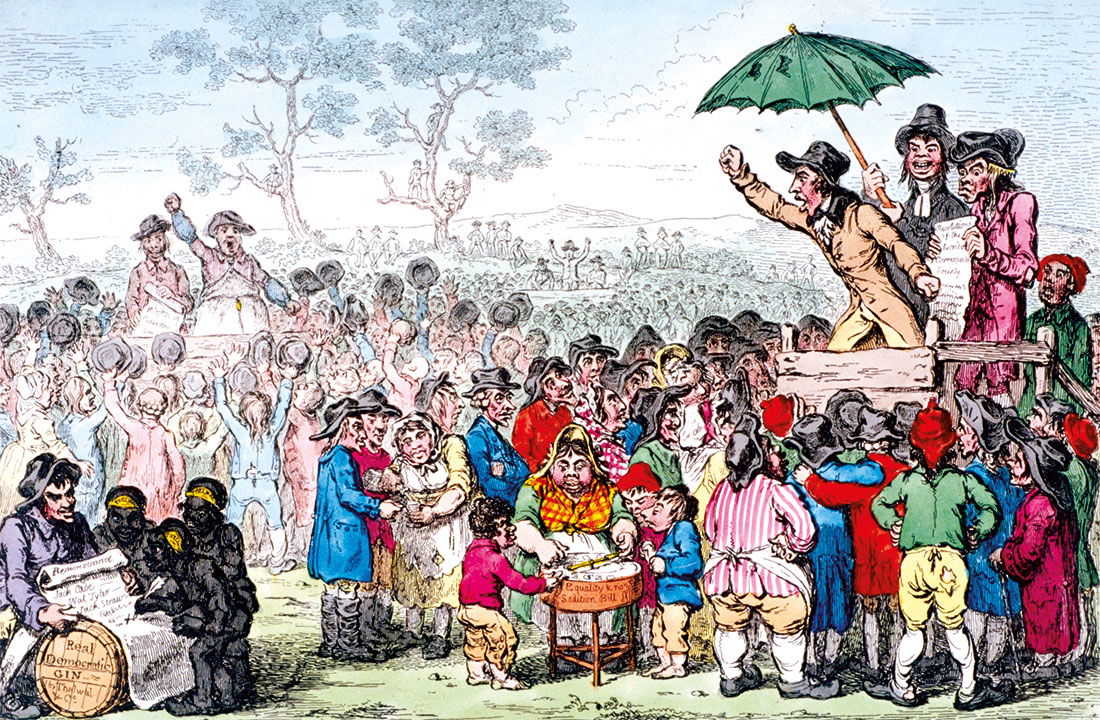 A community’s heritage is not owned just by powerbrokers and ‘winners’. The fabric of the past is woven by everyone – including those who championed radical changes but were unsuccessful. John Thelwall was one such visionary. He was at various times a published author, democracy campaigner, public orator, political theorist, state prisoner on a charge of high treason, small farmer in mid-Wales, novelist, poet, teacher of elocution and political journalist. He was rarely despondent for long. Nonetheless, his main political quest was unsuccessful. The introduction of manhood suffrage was not achieved in Britain until well after his death. (And votes for women, mooted by a few visionaries in the 1790s, took even longer to realise.)
There is much of interest in all aspects of Thelwall’s polymathic career, but especially his non-violent championing of democracy. It poses the question: how can dissidents, living under repressive regimes, press peaceably for changes to the political system? The answers have ramifications for radical dissent in all eras of history. That, for example, was the challenge faced by Nelson Mandela when seeking to end apartheid in South Africa. Unlike him, not all dissidents succeed.
Friends and allies
An obvious first move for radicals is to find others to campaign with. This is how Thelwall began. He was not the founder of the London Corresponding Society (LCS) in 1794 but, as an unsettled, middling-status young Londoner with radical views, he was soon drawn to participate. The LCS was organised to campaign for the adult male franchise. It drew support from tradesmen, respectable artisans and radical professionals, such as Thelwall, who had some legal training. The LCS founder and secretary, Thomas Hardy, was a boot- and shoe-maker. He and Thelwall became lifelong friends and allies.
The LCS struggled to recruit mass support, despite its links with a network of similar reform groups across Britain. Most ordinary people in the 1790s were too preoccupied with problems associated with warfare and soaring food prices to be stirred to regular campaigning. It was true that, in a few large constituencies, such as Westminster and Norwich, the freeman franchise included voters from among the lower orders. Yet their roles seemed exceptional. It was simultaneously the era of the rotten boroughs, seats controlled by oligarchic patrons. The government thus had strong support in Parliament, which claimed to represent ‘the people’, albeit without a democratic franchise (as do various non-democratic regimes today). It was hard to mobilise sufficient external pressure to achieve reform. Nonetheless, the LCS was generating enough momentum to alarm the government, which sent spies to infiltrate its meetings.

Thelwall emerged as a leading orator and recruiter for the LCS. His vitality, strong voice and histrionic gifts allowed him to communicate effectively at outdoor meetings, where there was no sound amplification. No direct records survive of stump speeches from the era before sound recording. But it is clear that passionate, free-flowing oratory can be intensely compelling. Having heard John Thelwall lecturing in Norwich in 1796, one critical listener (a young lawyer) admired his arguments but complained about his delivery: ‘He raves like a mad Methodist Parson.’ Thelwall seemed too noisy, too passionate. Nonetheless, the comparison with the first Methodist preachers was revealing. The emergence in the 18th century of this religious movement, initially within Anglicanism and then as a separate dissenting church, owed much to the influence of outdoor preaching by Wesley, Whitefield and, subsequently, a string of field ministers. But Thelwall did not have a public platform for long. Nor was he able to recruit a phalanx of fellow orators. In 1795 the government of William Pitt the Younger banned large open-air protest meetings, under the Seditious Meetings Act.
Echoing Thomas Paine
What can an orator do, when deprived of his mass pulpit? Thelwall took to travelling the country giving historical lectures, which lightly disguised his calls for reform. He also took up his pen. Books lacked the immediacy of oratory, but reached a wider potential audience, especially as Britain’s literacy rates by 1800 were high and rising. In this context, one mighty trumpet blast for reform came from Thomas Paine, whose Rights of Man (1791) encapsulated its message in its terse title.
Joining the fray, Thelwall revealed himself as a feisty political journalist. His most important manifesto was his Rights of Nature (1796), echoing the language of Paine. Thelwall argued that people’s rights were innate and not for governments to control. What’s more, all individuals should be freed from extreme want and given access to education. In the long run, he decided, too, that socio-economic change would change British politics. Thelwall was confident that democracy would succeed:
Whatever presses men together, therefore [e.g. into towns or factories], though it may generate some vices, is favourable to the diffusion of knowledge, and ultimately promotive of human liberty. Hence every large workshop and manufactory is a sort of political society, which no act of parliament can silence, and no magistrate disperse.
It was well for Thelwall that he was an indomitable optimist. Another way for radicals to ‘bear witness’ is by enduring imprisonment for their views. He did not seek that outcome. Yet in 1794 he found himself, with a number of fellow radicals, including Hardy, in prison on a charge of high treason. If found guilty, the penalty was death by hanging, drawing and quartering. Nonetheless, Thelwall remained defiant, a tone that pervaded his Poems Written in Close Confinement in the Tower and Newgate, published the following year.
Already, when first called before the Privy Council for cross-examination (with the prime minister Pitt the Younger in attendance), Thelwall refused to be intimidated. The clerk’s transcript of his interrogation would read almost comically, had the matter not been so serious. Thelwall confirmed his name and its spelling, but he then refused to answer any questions. As Pitt spluttered ‘What is it? What is it? What?’, Thelwall turned his back on the collected privy councillors and studied a picture on the wall.
Popular celebrations
A sensational outcome followed when the treason trials came to court. In November 1794, the first case ended with the acquittal of Hardy. There were popular celebrations in London. Pitt’s government decided to clamp down on mass meetings instead. As a consequence, Thelwall’s time in gaol, awaiting trial, was brief. Nonetheless, it indicated one way by which dissidents can ‘bear witness’. Enduring harsh imprisonment without flinching takes stoicism and courage. But, if that experience is known to the wider world, it is a potent way to fly the flag for an alternative vision. The harshest tyrannies, accordingly, keep their political prisoners in secret.
One of the 20th century’s most famous prison testaments is that of Nelson Mandela, who was detained by the South African authorities from 1963 to 1990. During that time he gained an accelerating tide of domestic and international support. A little over four years after his release, he became the first president of a new South African democracy.
On the other hand, prison testament does not always succeed. In China, the democracy campaigner Liu Xiaobo was arrested on charges of subversion in 2009 and remained in custody until his death in 2017. His award of the Nobel Peace Prize in 2010 did not soften official attitudes. Nonetheless, Liu Xiaobo continued to publish from prison, where he defined his oppositional stance nobly:
The greatness of non-violent resistance is that, even when man is faced with tyranny, and the resulting suffering, he responds to hate with love, to prejudice with tolerance, to arrogance with humility, to humiliation with dignity, and to violence with reason.
Confronted in 1797 with political failure, Thelwall tried a different tack. He withdrew to rural life, to live simply in search of cultural renewal. His views remained unchanged. Yet he realised that the cause needed long-term advocacy, not immediate action. He never sought a revolutionary uprising; the bloody unfolding of the French Revolution confirmed mainstream Britain’s condemnation of violent politics as seemingly too dangerous and too volatile – in short, simply too ‘French’.
Pragmatically, therefore, Thelwall purchased a small farm in mid-Wales and set up as a farmer. In this quest for ‘simplification’, Thelwall was influenced by his youthful friends, the poets William Wordsworth and Samuel Taylor Coleridge. Unlike them, however, between 1797 and 1800 Thelwall farmed the land with his own hands. A townee with no agricultural training, he was assisted by his knowledgeable brother-in-law. ‘I dig – I cart dung & Ashes – I thresh in the Barn – I trench the meadows when the fertilizing rains are falling’, Thelwall explained, with a beginner’s enthusiasm, to Hardy in 1798. Nonetheless, Thelwall continued to write, pouring out poems, plays, a novel, letters and an autobiographical memoir.
This project also foundered. The weather was constantly cold and wet, in what turned out to be three of the worst years of the 18th century from a farming point of view, while Thelwall’s literary output did not gain him the mass audience he desired. He was a bracing writer and, at times, a moving poet. He proved, however, too much of an impatient activist to rise to the poetic heights of Wordsworth and Coleridge. To Thelwall’s mortification, his 1801 volume entitled Poems Chiefly Written in Retirement was panned by literary critics and its sales were poor. Thereafter, he became more cautious in what he published, though he still persevered; there is no doubt that today he would have thrown himself enthusiastically into social media.
Thelwall’s country retreat turned sour. His final words about his ‘boorish’ neighbours were some of the surliest that this cheerful man ever penned. He concluded that his ‘experiment in uniting together the characters of the Farmer and the Poet’ was ‘ill-starred’. Nonetheless, Thelwall’s retreat may be compared with other cases among defeated dissidents. In Czechoslovakia, after the failure of the Prague Spring in 1968, the reformist president Alexander Dubček withdrew into obscurity. He lived near Bratislava and worked in the forestry service. Just over 20 years later, however, he was re-energised by the Soviet Union’s weakening hold upon his country. At the start of the Velvet Revolution in 1989, Dubček appeared dramatically at the side of the dissident future president Václav Havel, standing on a balcony overlooking Prague’s Wenceslas Square. The public applause was rapturous and Dubček went on to participate in the country’s new democratic government, until his death in 1992.
No second act
For Thelwall, however, in very different circumstances, there was no second act in front-line radicalism. The democratic movement, weakening after 1795, was declared illegal in 1799, when the LCS was banned. Liberal supporters of reform, such as Wordsworth and Coleridge, became politically more conservative. They distanced themselves from Thelwall, with sniping criticisms (he remained silent in reply). And there was no international democratic movement to offer overseas support.
Instead, Thelwall put his head down and made a successful living as an elocutionist. He taught rhetoric and helped people with speech impediments: giving a voice to the silent. When in funds, he launched in 1818 a new radical newspaper, The Champion, while in the 1820s he lectured to working-class audiences in the new Mechanics’ Institutes. Yet, even when the British democratic movement slowly revived, Thelwall did not do a Dubček and regain his appeal. He seemed a figure from an earlier era – even his notoriety was fading. In fact, Thelwall lived to see the passing of the Great Reform Act in 1832 and wrote a jubilant letter to Hardy to celebrate. Full democracy, they both knew, was still to come.
Each dissident career has its own trajectory and context. Champions of non-violent change against repressive regimes have many options: from oratory and organisation to political journalism, prison testimony, a manifesto, tactical retreat, cultural politics, adult education and sheer pertinacity. Boldly, doggedly, optimistically, John Thelwall tried them all.
Penelope Corfield is Emeritus Professor of History at Royal Holloway, University of London and the author of Time and the Shape of History (Yale, 2007) and Power and the Professions in Britain 1700-1850 (Routledge, 1995).


