The colony of New South Wales did not have its own parliament until 1856, but it did have a tradition of public dinners and politically charged toasts.
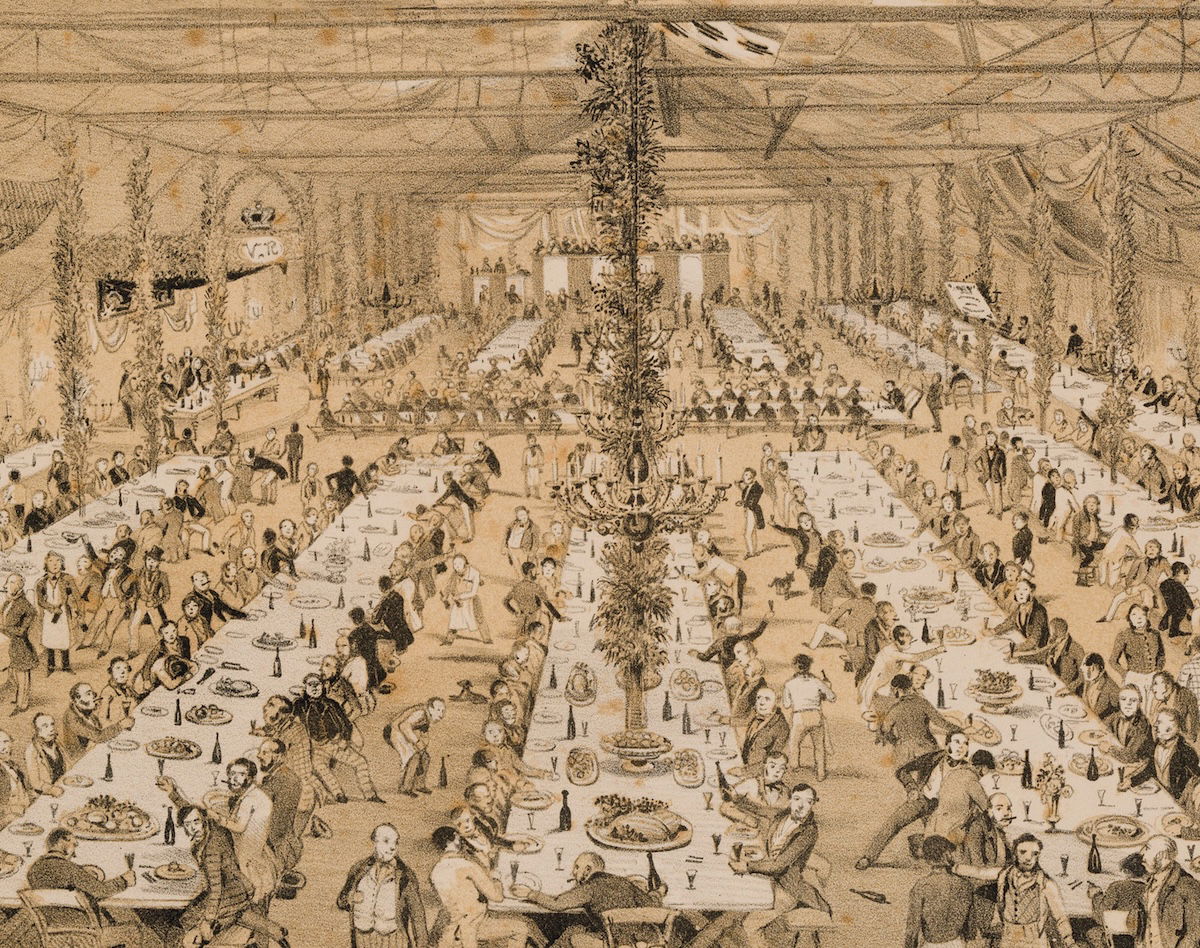
On Monday 7 November 1825 more than 100 gentlemen assembled at Nash’s Inn in Parramatta in the colony of New South Wales to bid farewell to their departing governor, Sir Thomas Brisbane, at a celebratory dinner. On his arrival, wearing his dress uniform as a veteran of the Peninsula Wars, Scottish-born Brisbane was greeted with a rendition of ‘See the Conquering Hero Comes!’ and led the company in procession to the tables. The chairman of the dinner, William Wentworth, the first locally born barrister in the colony, gave grace and food was served at seven o’clock. After dinner, the cloth was drawn and the real business of the evening began: a series of formal toasts, led by the chairman, in loyal celebration of Britain, the colony, and its rulers, but also, on this occasion, to advocate for democracy.
Register to read more articles for free.
When you register, you will receive the History Today newsletter. Click here to read our Terms of Use.
The colony of New South Wales did not have its own parliament until 1856, but it did have a tradition of public dinners and politically charged toasts.
On Monday 7 November 1825 more than 100 gentlemen assembled at Nash’s Inn in Parramatta in the colony of New South Wales to bid farewell to their departing governor, Sir Thomas Brisbane, at a celebratory dinner. On his arrival, wearing his dress uniform as a veteran of the Peninsula Wars, Scottish-born Brisbane was greeted with a rendition of ‘See the Conquering Hero Comes!’ and led the company in procession to the tables. The chairman of the dinner, William Wentworth, the first locally born barrister in the colony, gave grace and food was served at seven o’clock. After dinner, the cloth was drawn and the real business of the evening began: a series of formal toasts, led by the chairman, in loyal celebration of Britain, the colony, and its rulers, but also, on this occasion, to advocate for democracy.
The dinner and its toasts were highly politicised, not least because of the importance of governors in colonial society. From its establishment in 1788, authority in New South Wales was concentrated in a single ruler, appointed by, and accountable to, the British Crown, but often acting independently given that communication back and forth to London often took more than a year. Equally important was New South Wales’ demography: it was a convict colony (approximately 40 per cent of the population were still under sentence) and an intensely masculine society (less than a third were women), obsessed with social rank, with the governor serving as a key arbiter of status. While previous governors, notably Brisbane’s predecessor Lachlan Macquarie, had hosted formal dinners for officers and officials, the event in November 1825 was the first time a governor had accepted an invitation to a dinner of this kind. Given the colony’s growing population of emancipists – former convicts, freed upon completion of their sentence – many of whom were now wealthy and aspired to respectability, Brisbane’s willingness to dine in public with such men was a significant and controversial gesture.
William Wentworth, by J. Allen, 1804. State Library NSW. Public Domain.
During Macquarie’s term in office (1810-21) colonial politics had increasingly become a contest of influence between two rival factions, each opposed to the concentration of authority in the figure of the governor. The ‘exclusives’, the landowning elite, favoured a strict social and political divide between masters and convicts. They were challenged by a faction of ‘emancipists’, former convicts and their allies among the so-called ‘native-born’ and growing numbers of poorer free immigrants, who increasingly campaigned for full British liberties – a free press, trial by jury, and taxation by representation – for all free men. Though Macquarie was far from a democrat, he was seen by both sides as an ally of the emancipist cause, in part because he chose to appoint some prominent former convicts to official positions and invited them to dine with him. Under Brisbane, and in the absence of any such representative institution, these political struggles played out in the courts, the recently freed press, and the wider public sphere – including in toasts given at public dinners.
Rival dinners
The politicisation of Brisbane’s farewell began as soon as the idea of a send-off was first mooted. In early October a self-selected committee of stewards, all large landholders and prominent exclusives, invited a ‘chosen party’ of colonists who they deemed ‘the gentlemen of the colony’, none of whom had been transported to New South Wales, to dine with the governor. However, following complaints from prominent emancipists, a separate group requested that the sheriff – a new and important role in the colony, responsible for enforcing court orders and managing jails – chair ‘a public meeting of the inhabitants’ to consider an address of farewell. When the sheriff, John Mackaness, obliged, Wentworth used the meeting, held on
21 October at the courthouse on Macquarie Street, Sydney, to challenge the ‘exclusionist’ principles of what he deemed a ‘secret conclave’ who presumed to speak for the colonists as a whole. At his urging, the meeting voted their approval of an address that called on Brisbane, on his return to London, to lobby the British government to grant the colony ‘those two fundamental principles of the British Constitution, Trial by Jury, and Taxation by Representation’.
After Brisbane agreed to this request, a second public meeting voted to organise a rival dinner, open to all ‘gentlemen’ who bought a ticket, and elected a group of stewards, including ‘a wealthy Commoner’ – D’Arcy Wentworth, William’s father – as president. D’Arcy had recently retired from his position as the colony’s first police magistrate, but while he was not a convict he had notoriously been strongly encouraged to leave London in 1790 by his patron and distant relative, Lord Fitzwilliam, after narrowly escaping conviction for a series of highway robberies. In consequence, despite their wealth and influence, the Wentworths were always excluded from some parts of colonial society in the same manner as most emancipists.
Thomas Makdougall Brisbane, by Simon Jacques Rochard, 1819. Yale Center for British Art. Public Domain.
Brisbane initially sought to avoid taking sides in this squabble and agreed in principle to attend both dinners while suggesting a compromise whereby the emancipist stewards would be invited to the dinner of the exclusives. But this compromise was peremptorily rejected by the original committee, who cancelled their event in a public advertisement in the first colonial newspaper, the Sydney Gazette, that stressed that they refused to dine with ‘certain individuals … whose presence had not been anticipated by the Subscribers’. Seizing the moment, Wentworth and his allies deliberately framed the sole resulting dinner as a milestone for colonial politics because it united the colony in public celebration and rejected the politics of exclusion. His friend Robert Wardell, who edited the newly established Australian, called this ‘Grand Public Dinner’ the ‘first fete which the inhabitants of New South Wales, generally, had ever joined in’.
This was hardly accurate. Many of the colony’s social elite, including most military officers and a significant proportion of the original guests, declined to attend the new dinner. Public dining implied – and was understood to imply – a level of equality among the diners that was intolerable to the exclusives, concerned as they were about the stain of convictism. Revealingly, John Macarthur Jr, a large landowner and leading exclusive who was actively involved in the cancelled dinner plans, went so far as to send a list of every diner to Lord Bathurst, secretary of state for War and the Colonies, with comments on each individual’s character and morals, particularly highlighting those who were emancipists. Notably, he described William Wentworth and his father as ‘too well known to require a description’.
‘Brisbane and Freedom For Ever!’
In William Wentworth’s astute hands, the dinner, and especially the toasts, were staged as a performance of loyalty by an assembled public of model citizens, entitled to call for political reforms. As tradition demanded, Wentworth, serving as chairman due to his father’s illness, began with a toast to George IV (accompanied by a rendition of ‘God Save the King’), then offered another to ‘the Duke of York and the Army’, ‘the Duke of Clarence and the Navy’, before proposing ‘the health of His Excellency, Sir Thomas Brisbane, and may he soon be seated in the hall of his fathers!’ In a speech of thanks, Brisbane interpreted the occasion as a personal vindication by ‘the people of the Colony’ from the slight of his official recall – he had clashed with the Colonial Office, and resented their implied criticism of his administration. But significantly, Brisbane also claimed that Britain’s greatness was a result of her free institutions and promised to lobby the Crown to extend them to the colony, before proposing ‘Happiness and Prosperity to New South Wales’.
Wentworth then led toasts to the incoming governor, Ralph Darling, to the memory of Governor Arthur Phillip (1788-92) ‘the Founder of the Colony’, and to the recently deceased Macquarie, who had died in London in July the previous year, which was drunk ‘in solemn silence’ and followed by the Scottish song ‘Auld Lang Syne’. In celebrating these two former governors, the assembled colonists were actively inventing a kind of Whig tradition of colonial history through commemorating their heroes: Phillip as founder and Macquarie as the emancipists’ friend. In a similar move, at around the same time native-born colonists began holding an annual public dinner on what was then known as Foundation Day – 26 January, the date, in 1788, of the official ceremony that established the colony – and toasting to ‘the land, boys, we live in!’
Notice of a public dinner for Captain Charles Sturt, 7 September 1838. State Library NSW. Public Domain.
More explicitly political toasts followed. Proposing a toast to ‘Trial by Jury as established in England’, Wentworth delivered a rousing speech attacking the ‘expiring faction [who] opposed the free principles of the age’. Echoing the invented tradition, he claimed that New South Wales was established as a reformatory in which freed convicts, granted land, would redeem themselves, becoming ‘the yeomanry of the country’, and reclaiming the rights they lost on conviction. Robert Howe, editor of the Gazette (and himself the son of a convict), then spoke effusively in praise of Brisbane for his actions in ensuring ‘the liberty of the press’. Less than a year earlier Wardell had begun publishing the independent Australian, and Brisbane had responded by releasing the Gazette from its former official censorship. It is partly for this reason that we know so much about this dinner, since the occasion itself and the controversy around it were widely reported in both papers.
At ten o’clock, after three hours of dining and drinking, the guest of honour left the table with his entourage and was again honoured in a second toast to ‘Brisbane and Freedom For Ever!’ But even after his departure, the toasting continued, with the diners drinking to the original chairman, D’Arcy, and his son, William; calling for a ‘House of Assembly, as the most powerful engine of augmenting our prosperity’, ‘Civil and Religious Liberty all over the world’; and praising the chief justice, Francis Forbes. The political spirit of the event was captured in a celebratory ode written for the occasion by an emancipist poet, Michael Massey Robinson. Robinson praised ‘the trophies of freedom … dispers’d through the civilis’d world; Wherever Britannia’s flag was unfurl’d’ and called for ‘Emancipists!’ to ‘swell the proud goblet – full charge, now or never! / Whilst the toast is Our BRISBANE, and Freedom for ever!’
Toasting traditions
The ritual of toasting – honouring an individual, cause, or sentiment through drinking – has a long history in Britain, and by the 1820s it had a distinctive political resonance when deployed in public. During the 17th century the related practice of ‘healthing’ – drinking as a means of well-wishing – was widely practised by royalists but condemned and banned by Puritans. After the Restoration, drinking the health of the king became a test of loyalty and was often used to weed out perceived traitors.
Loyalty remained an essential element of the toasting ritual in the 19th century. Formal toasting always began with the monarch (and often also other members of the royal family) and proceeded hierarchically through toasts to other leaders and institutions. But the performance of loyalty in the toasting ritual helped to legitimise other political messages and could be subverted to radical ends. In a telling colonial example, there was intense controversy in the New South Wales press in 1827 following a dinner organised by the Turf Club, but largely attended by critics of Governor Ralph Darling (Brisbane’s successor) who resented his failure to support their campaign for democracy. To show their displeasure, the assembled diners failed to cheer during the compulsory toast to the governor and ordered as a musical accompaniment a song whose title and chorus embodied their wish that he would depart: ‘O’er the Hills and Far Away’.
Beyond displays of loyalty, toasts were also made in the form of ‘sentiments’: drinking to a cause or for an outcome. Sentiments could be more overtly political and were seen to speak for the views of the assembled company, as in the radical toast to ‘the people, the only source of legitimate power’ which echoed the republican arguments of the American rebels and the Declaration of Independence. When delivered in a public setting, such toasts were intended, and perceived, as a serious threat to the traditional political order.
‘The Brilliants’, by Thomas Rowlandson, 1801. Trustees of the British Museum.
In colonial Australia public dinners were a particularly significant site of such political toasting, precisely because they were made public through the medium of the press. By the 1820s such dinners were frequently advertised and reported, and used for a range of purposes, from celebrating anniversaries such as Foundation Day, to ethnic pride in the honouring of St Andrew’s and St Patrick’s days, raising money for charities, and bringing together public societies. But even when dinners were not explicitly linked to a political party or cause, the publication of the toasts – sometimes, as with the farewell dinner, in full, but more commonly in a list of the individuals and sentiments honoured – made them political, a shorthand for the views of those who organised and attended.
More broadly, the public who attended such dinners came to symbolise – and were often seen to speak for – the wider public who read about their toasts. Indeed, dinners were often carefully staged with this in mind. Radicals from the late 18th century increasingly used public dining as a means of organising and publicising their activities because dinners largely evaded repression under the series of Seditious Meetings Acts that were used to stifle dissent in Britain during the Age of Revolutions. By the 1820s, and increasingly thereafter, all sides of politics used public dinners as a means of political organising. Public dinners expanded in scale and popularity throughout the Empire and, at their peak in the mid 19th century, close to 1,000 gentlemen would often gather to eat and drink together, with their deeds reported in the press. For example, in 1856 a ‘National Banquet’ was held at the Prince of Wales Theatre in Sydney to celebrate the granting of responsible government and an elected legislature for the colony, at which 600 gentlemen dined while 500 ladies observed the proceedings from the relative privacy of the boxes.
Gentlemen drunks
In New South Wales in the 1820s, public dinners never took overtly radical forms. In general, the colonists were more concerned with securing their rights as Britons than with challenging the government. But, as the farewell to Brisbane illustrates, the tradition of loyal toasting was used to legitimise calls for political reform. Brisbane’s farewell dinner set a precedent and helped to establish the framework for future political debate and the controversies that would haunt Darling’s governorship. Shortly after his arrival, some six weeks later on 17 December, Darling reported back to Lord Bathurst that by hosting the farewell dinner the emancipists had ‘proved their strength and influence’.
Despite this, Darling would set himself against the emancipist cause: he sought to restrain the pace of political reform but, in a similar pattern to England, his efforts to control the increasingly hostile press and silence his critics through regulation backfired. His Newspaper Duty Act of 1827, which sought to make the growing press unprofitable by requiring publishers to hold a licence and pay stamp duties, was found to be unlawful by Justice Forbes, and the Blasphemous and Seditious Libels Act of the same year only antagonised his critics. E.S. Hall, editor of the Sydney Monitor, the third and most radical colonial newspaper, followed the lead of his hero, the English journalist and pamphleteer William Cobbett, and when sentenced to jail under this legislation continued to publish critical editorials from his cell. Public dinners served as a key forum in this campaign against Darling, allowing opponents to display their hostility while demonstrating their loyalty, by toasting the governor in sullen silence, a calculated insult which the Monitor gleefully reported as a ‘frank expression of public opinion’.
But public dining in New South Wales had a political significance that went beyond the toasts themselves. In the context of a colony that lacked free institutions, dinners were a means to stage a vision of a more open colonial society and a more democratic politics. The press reporting of Brisbane’s farewell illustrates this political symbolism. Writing in the Gazette, Howe claimed that the governor had chosen ‘very judiciously’ to attend ‘that Dinner, representing by its Guests the Commonwealth at large’. Similarly, Wardell claimed in the Australian that ‘when a public dinner is talked of every one naturally feels a desire to join in it’, and claimed that from this date it would be impossible to tell ‘any class’ of colonists ‘that they are not fit to be jurors, that they are not fit to appear at a public dinner, that they are not fit to be invested with political existence’.
Governor Ralph Darling, by E. Edgar, c.1827, from an original by Linnell. State Library NSW. Public Domain.
Just as importantly, the formal elements of the dinner – notably the election of stewards and a chairman – and the protocols of public speaking, deliberately echoed a parliament. While the toasts endorsed the traditional hierarchies of British society, the dinner was also democratic and rule-bound. The chair was elected (by universal affirmation) and his authority came from a well-understood but unstated code of conduct and was endorsed by the public for whom he spoke. Public dinners helped expand the political category of ‘gentlemen’ – a form of proto-citizenship – and affirmed a kind of fraternal solidarity among them. The assembled gentlemen were unified by their participation in a shared ritual, noisily and publicly asserting their political voice.
Moreover, this ritual was conducted with alcohol – and copious amounts of it. Based on what was reported, the guests at Brisbane’s farewell drank wine with dinner and then performed at least 16 separate toasts, each of which required them to drain their glass. No one who participated left such dinners sober. By getting drunk together gentlemen demonstrated a collective trust and equality, reinforcing the fraternal bonds they formed. But this kind of public drinking was also a test of civility and restraint. Despite getting drunk, gentlemen were expected to constrain their behaviour within acceptable norms: to be convivial but not disorderly. The successful performance of intoxicated self-control was symbolically powerful, because only men who could govern themselves were fit to have a say in government.
The dinner was deliberately staged to mount a political argument, to present the assembled diners as a model public. But as such it is also highly revealing of colonial politics and the obvious limitations of 19th-century democracy. Leaving aside those who self-excluded, the diners were all male, ethnically British, and came from a limited social elite of wealthier emigrants, emancipists, and the ‘native-born’. No women, Aboriginal people, or convicts under sentence were present or welcome. As with its dinners, the colonial public was exclusively composed of white men.
Lowering the standard
The Rev. John Dunmore Lang, a Scottish-born Presbyterian clergyman and politician who published one of the first histories of the colony in the 1830s, An Historical and Statistical Account of New South Wales, regarded Brisbane’s farewell dinner as a crucial turning point in colonial politics. Brisbane dining with the emancipists was, he wrote, ‘tantamount to an authoritative lowering of the standard of morals throughout the territory’. He lamented that the governor had assumed ‘a right to dictate to reputable men as to who should be invited to their company or society’. For Lang, this error had empowered emancipists with a dangerous sense of entitlement, which threatened colonial progress and morality. Indeed, it helped to form the political character of the emerging colony, which he characterised as a ‘blustering and rather offensive affectation of liberty and independence’.
Ironically, Lang’s own political campaigns centred on asserting precisely this liberty and independence. Lang won office in the 1840s and 1850s as a candidate of working men and consistently argued for subsidised emigration to a democratic Australia as the solution to poverty in Britain. He even threatened that the Australian colonies would declare themselves republics if Britain did not grant them representative and responsible government. But his was a moral vision of a democracy of sober and industrious migrants – not drunken former convicts.
Lang’s characterisation of the farewell dinner reveals its political importance. By dining with the emancipists and sharing their toasts to British liberties, Brisbane legitimated their status in colonial society and helped their political campaign. But the democracy the colonists would eventually establish, like that they imagined – and drank to – was deeply loyal to Britain and highly restricted in its citizenship.
Matthew Allen is Senior Lecturer in Historical Criminology at the University of New England, Armidale, and the author of Drink and Democracy: Alcohol and the Political Imaginary in Colonial Australia (McGill-Queen’s University Press, 2025).