The Colonels’ Failed PR Coup
A British public relations company in cahoots with sympathetic MPs was unable to whitewash the military regime that seized power in Greece in 1967.
In the modern era, relations between states have usually been conducted through diplomatic envoys. Since public opinion has become more important to policy makers, however, governments have increasingly resorted to outsourcing. Regimes with an image problem tend to hire public relations professionals, who undertake to ‘cultivate’ a sympathetic foreign audience for a fee. One such PR operation targeted opinion formers in Britain and beyond. The project backfired because of the actions of a young British historian.
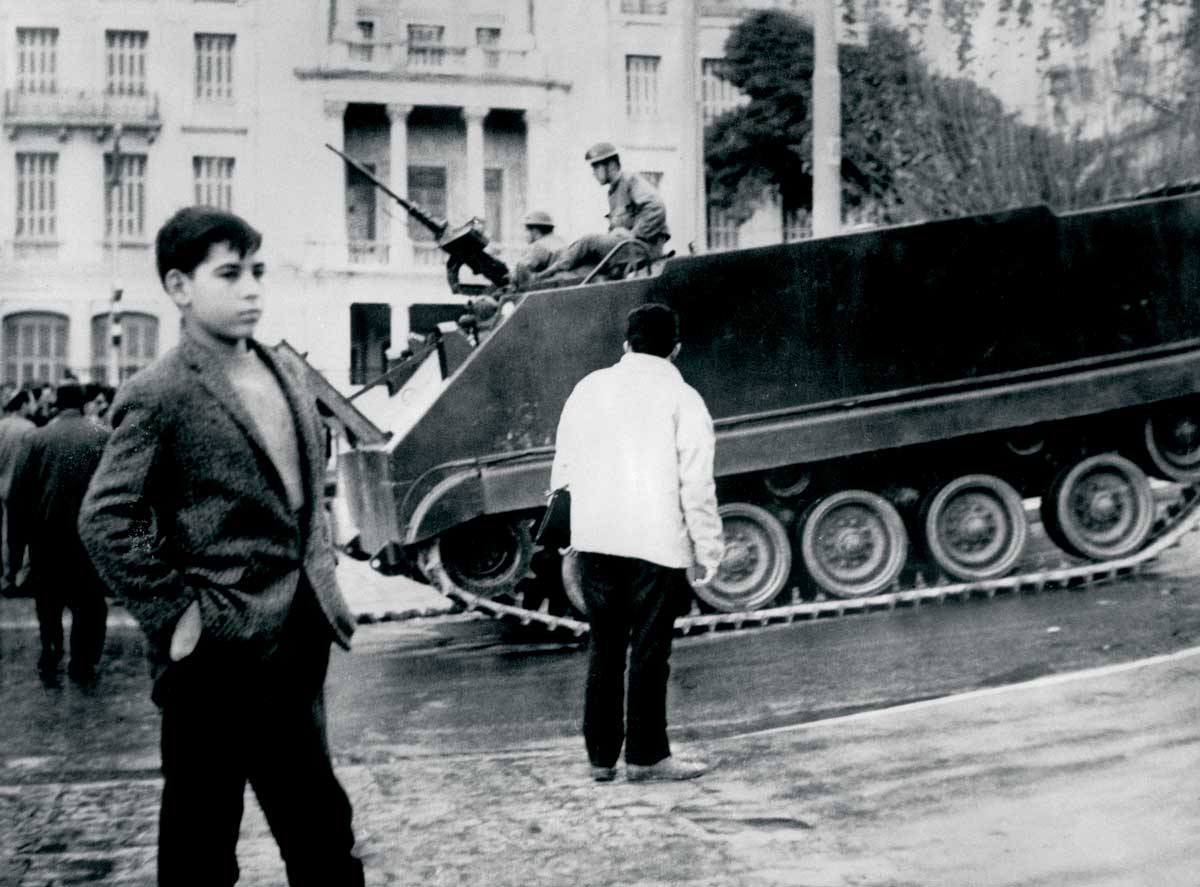
Greece, a country with a parliamentary system dating back to the 1840s, succumbed to a coup d’état in the early hours of 21 April 1967. Its ringleaders were mostly middle-ranking army officers (hence their collective dubbing as ‘Colonels’ or the ‘junta’). Deeply mistrustful of liberal institutions, the conspirators moved in order to call a halt to the general elections scheduled for May 1967, which their former political patrons, the party of the Right, was predicted to lose.
The incident was widely perceived as an aberration by the standards of both Greece and its western partners. Under British and, subsequently, US tutelage, Greece had managed to transition from dictatorship, war, occupation and civil war to relative stability and economic advance while restoring the essentials of parliamentary democracy. For the Americans, who had provided massive aid and advice since the late 1940s, Greece was a showcase of how to defeat communism without sacrificing representative government. Greek democracy, however imperfect, could fit into new collective institutions premised on respect for human rights and the rule of law, such as the Council of Europe (CoE) and the European Community (EC).
The military coup in 1967 threatened to change this overnight. The Colonels tried to justify it chiefly as preventive action against the usual suspects, the Communists. The fictitious story of a leftist conspiracy failed to dissuade the US administration, egged on by Congress, from imposing an embargo on heavy armament deliveries to Greece until constitutional government was restored. Criticism was also voiced within the CoE, the EC and NATO. If NATO was unlikely to prioritise democratic principles over strategic imperatives (as indicated by the membership of Salazar’s Portugal), the EC could and did pinch the regime in Athens by freezing the 1961 Association Agreement and withholding further funding of the Greek economy.
Unlike the ‘hard’ security implications of an adverse reaction from NATO or the economic sting of the EC, the effect of CoE action against the Greek dictatorship was primarily moral. Yet one could not exclude the possibility of the Council’s sanctions causing a domino effect on other international organisations, leading them to re-examine their stance towards the regime in Athens. After the governments of Denmark, Norway, Sweden and the Netherlands – three of them Greece’s partners in NATO – initiated a process likely to result in expulsion from the CoE, the Colonels had an incentive to try to appease opinion in key countries by means short of restoring democracy.

Unlike its predecessors, the Greek dictatorship was exposed to the full effects of revolutionary improvements in mass transport and communications technologies: its activities could now be monitored by an expanding network of observers in the printed press, radio, newsreels, television, as well as the hundreds of thousands of foreign visitors at a time when tourism was becoming a major pillar of the Greek economy.
Regime facelift
While determined to hold on to power indefinitely, the Colonels, some of them with a background in intelligence and psychological operations, embarked on an effort to revamp their image abroad by means of facelifting tactics. Their early claim that they had intervened in order to save king and country totally collapsed when, in December 1967, the young King Constantine attempted a counter-coup which failed, forcing him into exile. For a while, the regime’s international status looked uncertain, until the US, followed by the UK and other NATO allies, confirmed recognition of Colonel Georgios Papadopoulos’ government. But the real disaster for the junta’s image proved to be the reports of widespread torture against political opponents held in prison cells and detention camps across Greece. Such information, corroborated by victims’ testimonies before the European Commission on Human Rights, added to the pressure within the CoE and others to impose sanctions.
In reaction, the junta settled upon a two-pronged strategy: first, to dangle the prospect of a return to parliamentary rule at some point in the (unspecified) future; and, second, a public relations campaign. The first task was entrusted to Panagiotis Pipinelis, a veteran diplomat and former prime minister, whose ultraconservative realism led him to accept the post of minister for foreign affairs. The second task would be given to foreign professionals specialising in the booming PR industry.
In the US, Athens gave the lion’s share of its PR campaign to a well-established firm, Thomas J. Deegan, for the annual amount of $243,000 (around £1.4 million today). Full-page advertisements appeared in US newspapers, justifying the 1967 coup as an inevitable response to the ‘red menace’, dismissing accounts of torture as communist propaganda and portraying Greece as a safe haven for foreign capital.
In Western Europe, the Colonels’ search focused on the UK, for several reasons. Some two decades after its retreat from predominance in Greece, the UK was still considered an ally worth cultivating, not least on account of its prominent role in NATO and the CoE. Although Prime Minister Harold Wilson found it hard to conceal his disapproval of the dictatorship, his government had opted for a ‘working relationship’, based on strategic and commercial considerations. Therefore, the junta deemed it vital that Britain should not change course and join those seeking to censure Greece in international forums, not least the CoE.

Moreover, British opinion mattered not only because of its potential impact on Wilson’s foreign policy but also because a section of the Greek public had access to British newspapers and, more importantly, regularly tuned in to Greek broadcasts on the BBC World Service, a habit dating back to the years of Axis occupation. London was also in ‘striking distance’ from Scandinavia and the Netherlands, the prime movers of reaction against the regime in the CoE. This, in turn, owed much to the activity of a British-born international non-governmental organisation dedicated to combating human rights abuses. Amnesty International, whose international secretariat was based in London, sent two lawyers, a Briton and an American, to investigate the treatment of political prisoners in Greece. Their report, published in January 1968, confirmed the deliberate, officially sanctioned use of torture as an interrogation technique and greatly contributed to the subsequent outrage in Western media.
Uninhibited campaign
The junta’s PR contract of £100,000 per annum (now £1.72 million) did not go to a veteran in the field, as was the case in the US, but to a relatively obscure bidder, Maurice Fraser and Associates. Its founder was the son of an Egyptian-born correspondent of London newspapers and his English wife. Based in Fleet Street, Fraser was depicted in a diplomatic report as ‘a small time but imaginative public relations entrepreneur with a background of having done PR work for Britain’s casino owners’. He offered to wage ‘an energetic and “uninhibited” campaign’, promising to persuade British MPs to accept a visit of goodwill to Greece; to sponsor a ‘historian or author of international repute’ to write a history of modern Greece to the Colonels’ taste; to plant a friendly editor in a position of influence in a Scandinavian English-language newspaper; to arrange a contact in the BBC to soften its ‘hitherto hostile attitude’; to persuade Jesco von Puttkamer, a friend of German foreign minister Willy Brandt, to elicit some sympathy for the regime; to secure the distribution of Greek propaganda material in British media and cinemas; and, as an insurance against criticism in Westminster, to employ a ‘full-time lobbyist’ who should ‘have a British MP secretly on his staff’.
In July 1968, after Wilson publicly used the term ‘bestialities’ to describe the junta’s treatment of its domestic opponents, a further item was added to Fraser’s inventory: putting pressure on Whitehall through stories in the press to the effect that Athens was about to cancel deals with British firms, ranging from the procurement of armaments and rolling stock to the construction of a nuclear plant.
Notable exception
Fraser’s team carried out much of its mandate, with one notable exception: Puttkamer turned down approaches to mediate with Brandt. On another count it was only partially successful: their first choice for a commissioned history, Hugh Trevor-Roper, the Oxford Regius Professor of Modern History, declared himself ‘too busy’. It may be no coincidence, however, that, in 1969, the 542-page Greek Passion came out, designed to rewrite recent Greek history and refute the ‘campaign against Greece’, as the title of its first chapter made clear. Penned by Kenneth Young, former editor of the Yorkshire Post and political adviser to Beaverbrook newspapers, the book would eventually be withdrawn from circulation following a successful libel suit on account of a passage judged defamatory of the BBC World Service.

Fraser was more successful in promoting the junta’s cause in Westminster. During the Easter recess of 1968, he arranged for an all-party group of five MPs and their wives to visit Greece as guests of the regime. Two of them, Gordon Bagier, Labour MP for Sunderland South, and Russell Johnson, Liberal MP for Inverness, stayed on in order to visit a detention camp on the island of Leros. They subsequently assured a specially arranged press conference in Athens that political detainees were treated humanely, no evidence of torture was evident and that the military regime was nowhere as harsh or unpopular as presented in the foreign press. Back in Britain, the group reiterated its dismissal of the ‘biased’ coverage of events by British media, the BBC in particular. They also professed to accept Papadopoulos’ word of honour as a ‘soldier and an officer’ that he intended to restore democracy. Finally, they spoke against the economic isolation of Greece, which put British commercial interests at risk.
The visit was deemed a success and, five months later, Fraser arranged for a follow-up: a party of 13 MPs visited Greece in late September, on the occasion of a predictably rigged referendum that purported to give the junta a veneer of constitutional legitimacy. This ‘observation mission’ was completely sidetracked, however, by the controversy provoked by the revelation of Fraser’s services to the Colonels in the British media. This twist of events owed much to a historian’s hand.
An agent of history
On the eve of the 13 MPs’ visit to Greece, Eleni Vlachou, owner of two leading conservative dailies in Athens, who had fled to London after the coup, got hold of a document leaked from Papadopoulos’ office to the former prime minister Konstantinos Karamanlis, who lived in self imposed exile in Paris. Intending to publish it in the Hellenic Review, an émigré journal she edited, Vlachou entrusted its translation into English to Richard Clogg, a young scholar who would become an authority on modern Greek history. In addition to his links with Greek anti-junta activists, Clogg often contributed to the BBC’s Greek broadcasts. He ‘almost fell off [his] seat with excitement’ when he realised what he was holding: the Greek translation of the fifth report from Fraser to Papadopoulos, which, among other things, revealed that a British MP was, through Fraser, in the junta’s pay.
Clogg decided to pass the report to John Barry, a contributor to the Insight column of the Sunday Times. Tipped off, Fraser obtained an injunction from the High Court, less than an hour before the Insight story went to press. According to Clogg, Fraser’s action immediately transformed ‘what might have been a relatively minor story into a cause célèbre of major dimensions’.
The Sunday Times lost no time in defending its right to ‘publish and be damned’ before the Appeal Court, claiming that it was ‘a matter of public importance’ to reveal the techniques of foreign political persuasion in Britain. Before the appeal was heard, the Greek regime announced that it would not renew Fraser’s contract, which was due to expire at the end of the year. At about the same time, the Labour MP Ivor Richard revealed in the Observer the most sensational part of Fraser’s report: that his firm employed ‘a British MP working behind the scenes with the object of influencing other British MPs’.
Upon learning of the Appeal Court decision to rescind the injunction, the Greek regime released the text of the report. A few days later, on 6 October 1968, the Sunday Times published its story on Fraser’s activities, but it was the Sunday Telegraph, for which both the PR man and his father had worked in the past, that published the English original of the report in full, as a spoiler.

After a few months of exchanges over the merits of bringing MPs’ outside interests to full public view – at least one former president of the Institute of Public Relations found nothing wrong with a PR firm hiring an MP to covertly influence other MPs – publicity reached a new high when, in mid-February 1969, Fraser attempted to halt the airing of an investigation into his firm’s activities by Thames Television’s This Week. Although his writ succeeded in preventing the revelation of the MP in Fraser’s pay, the presenter, John Morgan, revealed that his programme had evidence of the identity.
There followed the public admission by Gordon Bagier that he had accepted ‘a retainer as parliamentary consultant’ to Maurice Fraser and Associates. He denied that he had lobbied his colleagues in the House on behalf of the Greek regime, adding that many MPs indulged in ‘business or professional activities’ without prejudice to their conduct in Parliament.
It was a hollow claim which, however, appeared to assuage his party’s whip and his constituency, which kept re-electing Bagier to his seat until his retirement in 1987. Still, reactions in the press and from within the Labour Party led Harold Wilson to recommend an enquiry into the question of MPs’ outside interests. The resulting report acknowledged the impropriety of MPs’ lobbying and voting on behalf of such interests ‘for a fee, payment, retainer or reward, direct or indirect’, but it rejected the idea of a register, open to public inspection. Only in May 1974, in the wake of the scandal that cost a leading Conservative, Reginald Maudling, his post as Home Secretary, did the House of Commons pass a resolution stipulating its members’ obligation to register the sources (though not the amounts of income) from outside employment. As Clogg noted, the Colonels-Fraser-Bagier connection ‘had contributed powerfully to making the case for such a register irresistible’.
Backfire
The junta’s PR campaign in the UK backfired. Its scandalous outcome made British MPs wary of its blandishments and contributed to the Labour government’s decision to reverse policy and support the expulsion of Greece from the CoE. As Wilson put it in Parliament: ‘What happened in Greece constitutes an insult for every person who loves Greece, for the Greek people and the idea of democracy.’ On 12 December 1969, the Colonels withdrew the country’s membership ‘voluntarily’ rather than face the ignominy of expulsion.
A moral defeat, such as the one suffered at the CoE, was unlikely to topple the Greek dictatorship. It did not even spell a change in the British government’s ‘working relationship’ with the Colonels. Papadopoulos’ rule ran its course until, following a half-baked attempt at a transition to semi-civilian control, it was replaced by an even more brutal regime. Rather than seeking respectability abroad, through PR operations or otherwise, it soon embarked on a reckless course designed to win over nationalist opinion at home. The result was a national humiliation over Cyprus, which spelled the end of the junta and the return of democracy to Greece. Those who had fought against the junta by revealing its practices and speaking up for its victims could draw some satisfaction from the fact that the Colonels’ public image abroad had remained abysmally poor throughout their seven-year misrule.
Ioannis D. Stefanidis is Professor of Diplomatic History at the Aristotle University of Thessaloniki.