

The Book That Can’t Be Read
Despite recent claims, the Voynich Manuscript remains one of history’s biggest mysteries.
The past is full of unsolved mysteries. Gaps in the historical record leave countless details unknown and tantalising puzzles to be solved. Some puzzles, however, seem to fall more readily into the preserve of enthusiasts – or ‘scholar adventurers’, as Richard D. Altick termed them in his 1950 book of that name.
For those working in the field of medieval manuscripts, perhaps the most notorious of these mysteries is the so-called Voynich Manuscript, a late medieval book of modest proportions, written in an undecipherable script. We do not know who wrote the manuscript. Nor do we know why or for whom it was written, or what it is about.
It was acquired in 1912 by the antiquarian book dealer, Wilfrid Voynich, and it is by his name that the manuscript is now commonly known, although he referred to it as the ‘ugly duckling’ of his collection.
Voynich is as much an enigma as his manuscript and mythologised his own past – arguably without need. In his youth he was arrested for his role in the Polish social-revolutionary party, Proletariat; 18 months later he was exiled for five years in Siberia, from where he escaped, using a forged passport, going on the run, via Mongolia, to Europe; he then sold his last possessions, his glasses and waistcoat, in exchange for passage to England. Turning his back on political activism, he became a dealer of antiquarian books in London – initially with more enthusiasm than talent, but by the time of his death in 1930 he had built a decent reputation. His mystery manuscript remained unsold after his death, in a vault, until an institution willing to pay a suitable fee could be found. It is now held in the Beinecke Rare Book & Manuscript Library at Yale University, who have an unofficial policy never to endorse any theory for its decoding. That has proved no deterrent.
Illustrious owners
It has all the hallmarks of a mystery worthy of The Name of the Rose (Umberto Eco did, in fact, visit it). In its history it has been tied to Roger Bacon, John Dee, Leonardo da Vinci and the Holy Roman Emperor Rudolf II, who reportedly bought it for 600 ducats. Voynich’s theory was that Roger Bacon, the natural philosopher, was the anonymous author – this has been disproved by radiocarbon dating, which shows the calfskin parchment to be early 15th-century, antedating Bacon’s death by at least 200 years (and preceding da Vinci). The association with Dee is due to his interest in ciphers, codes and angel conversations – in 1994, Deborah Harkness found a new Dee manuscript, The Book of Soyga, in which Dee reports asking his angels about ‘his strange book, which he could not read’. Dee’s son is also reported as saying that his father had ‘a booke … containing nothing butt Hieroglyphicks, which booke his father bestowed much time upon: but I could not heare that hee could make it out’. The connection cannot be sustained, though.
‘Voynichese’
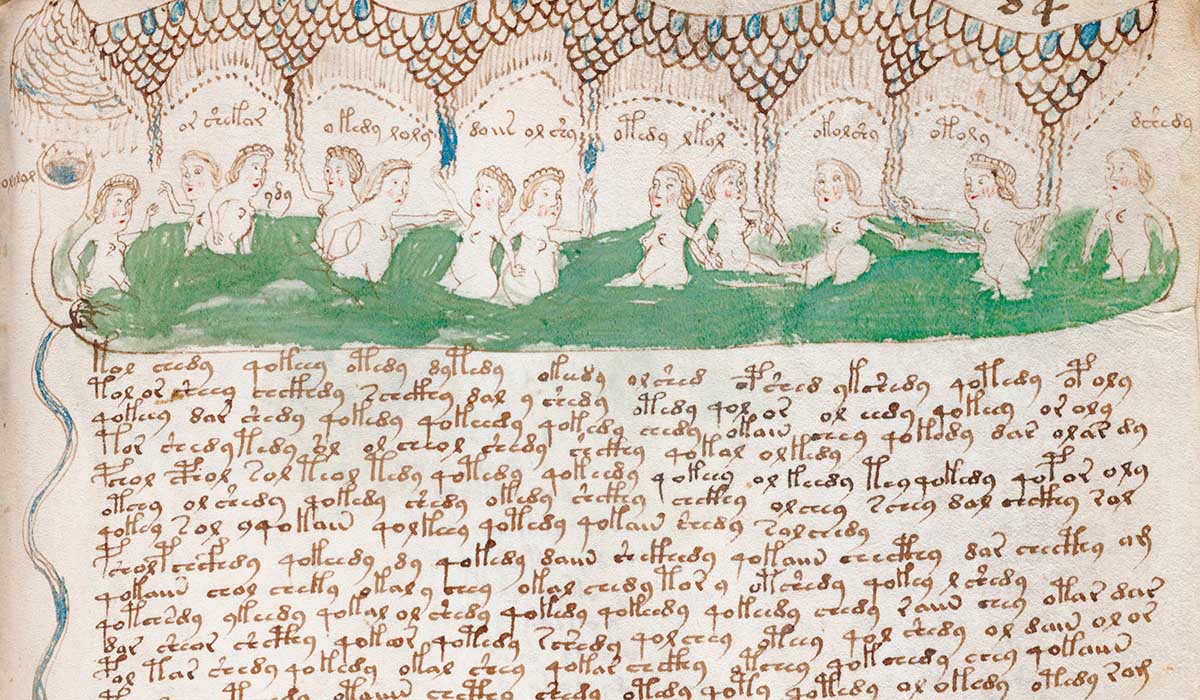
Almost every page of the manuscript has an illustration of some kind, which are beautiful and evocative, albeit ‘naively’ drawn. These illustrations suggest that the book falls into four sections, covering botany, astronomy, balneology (healing baths) and pharmacology or alchemy. The ‘writing’ that accompanies these images is in an unknown language and written in an unknown alphabet and script (known as Voynichese). Recent pattern analysis shows that it is an encoded language of some kind, rather than just a random string of symbols, but it has so far defied all attempts at decoding and translating. In 1976 Prescott Currier identified two distinct scribes at work in the manuscript and showed that they seemed to be writing in different languages or dialects. This year, Lisa Fagin Davis, Executive Director of the Medieval Academy of America, has, through analysis of the script, refined Currier’s work to identify four different scribes, who seemingly wrote in collaboration.

The writing looks familiar and to the untrained eye is probably indistinguishable from any other late-medieval script. It seems tantalisingly close to knowable. Perhaps that is part of its appeal. The illustrations, too, seem to have parallels in the imagery of more traditional manuscripts – the pages of botanical images surrounded by text look very like contemporary Italian herbals, for example. The plants, though, have not been identified as any known species, despite repeated attempts; the astronomical maps do not resemble any recognisable constellations; and the balneological scenes, of naked women in pools of green liquid which flows through seemingly organic pipes, do not have parallels in any known manuscript and are entirely open to the viewer’s interpretation.
Codebreakers
Perhaps the earliest attempt to decipher the manuscript comes from what seems to be its second known owner (the first being Jacobus Horčicky de Tepenec, pharmacist to Rudolf II, who wrote his name on the first leaf). Georgius Barschius, an obscure 17th-century alchemist and legal scribe, was known to have had the manuscript by 1637. In April 1639 he wrote, during his correspondence with Athanasius Kircher at the Jesuit University in Rome: ‘A certain riddle of the Sphinx, a piece of writing in unknown characters, I thought it would not be out of place to send the puzzle to the Oedipus of Egypt to be solved.’ Kircher repeatedly failed to reply to Barschius’ appeals for a translation, presumably because he found it an impossible task.
The most renowned modern attempt to translate it was by the historian William Romaine Newbold, who went on a lecture tour with his theory, to great acclaim. Following Voynich, he believed that the manuscript was the work of Roger Bacon, who, with an incredibly powerful yet miraculously antihistorical microscope, had encoded each character in the Voynich writing with minuscule Latin letters.
After Newbold’s death his theory was, sadly, completely debunked. The patterns he had identified proved to be nothing more than misreadings and wishful thinking: ‘the products of his own intense enthusiasm and his learned and ingenious subconscious’, wrote his friend and debunker, John Matthews Manly. Then, as the Second World War drew to a close, the Department of Ciphers at Riverbank, Illinois, literary codebreakers turned military, focused its attentions on the Voynich Manuscript. By August 1962, however, they, too, had failed to come up with a solution and the Washington Post announced ‘“The Most Mysterious MS” Still an Enigma’.

Recent attempts are no less concerted,but continue to fall short in various ways. The Voynich Manuscript is a puzzle that requires knowledge of history, linguistics (medieval languages in particular), codicology (the study of manuscripts), art history and palaeography (the study of scribal handwriting) – as well as familiarity with medieval thought on botany, astronomy and medicine. So far, no theory has managed to satisfy any one of these.
Abbreviation marks
One of the reasons the script looks so decipherable is its familiarity: its letter forms share much in common with the Roman alphabet – compared with the variety of forms writing systems can take, such as, for example, Egyptian hieroglyphs, cuneiform, Arabic or runes. It is perhaps for this reason that in 2017 a ‘solution’ was announced in the TLS which hinged on the fact that many of the Voynich symbols look similar to scribal abbreviation marks – adapted letter forms that indicate that part of a word had been dropped. Medieval scribes used abbreviations to speed up writing and save space – efficiency of both time and materials. Many of these abbreviation marks have been catalogued in Adriano Cappelli’s 1899 Dictionary of Abbreviations. Still a core reference work for any scholar of medieval Latin manuscripts, Cappelli’s dictionary covers abbreviations from across the western medieval world and in different contexts. No one scribe would have used all of them indiscriminately: ninth-century Visigothic scribes used a certain combination, which was distinct from scribes in 15th-century Italy. Cappelli compiles all of them in one place; the current edition catalogues some 14,000 abbreviation marks. This 2017 theory harvested any mark in Cappelli, from any context, that looked similar to those in Voynich.
According to the theory, each identified abbreviation mark is expanded and those expansions are spliced together to make strings of letters, which can be interpreted as something like Latin. Unfortunately, in the single translated sentence given to demonstrate this process, the abbreviation marks identified do not match up with the forms given in Cappelli, the expansion into Latin seems creative at best and the Latin produced is grammatically incorrect. To take a brief example: a sequence of four characters in Voynich is transliterated into the abbreviation marks for the Latin e, t, d and ris, which are then expanded into ‘et de radicis’ (this would translate as ‘And of/from of the root’). When abbreviation marks for ‘et’ already exist, however, it is unclear why the scribe would have chosen to use what looks like the abbreviation mark for ‘erit’; the ‘o’ which apparently stands for de does not appear in Cappelli, although multiple other abbreviations for de do; nor does the symbol for ris, which is inexplicably expanded to ‘radacis’ (or ‘radicis’ – the spelling is inconsistent). The method is neither replicable nor consistent and does not seem to produce viable text.
A more recent attempt, which made headlines this year, instead theorises that the language is a form of either ‘vulgar Latin’ or ‘proto-Romance’, for which the Voynich Manuscript is the last surviving evidence. Rather than being in a code or cipher, it is simply a lost language and writing system.
In the simplest terms, as speakers of a language spread out and splinter off, the languages they speak will diverge – the manner and degree to which they change will be affected by any number of factors including the level of contact the new groups maintain with each other and the relationship between them. Animosity between two communities might lead them to differentiate themselves from their neighbours through their language, for example. After the Roman Empire came to an end and as the territories were divided up into kingdoms, the Latin that was spoken across the region developed and started to form characteristics that were distinct to kingdoms, regions and communities. It is these divisions that ultimately gave us what we now call the romance languages: Italian, Spanish, French, Portuguese and so on. The differences between these languages are not random, however: a speaker of Italian and Spanish will be aware of the correspondences between the two and how one might ‘translate’ an unfamiliar word from one into the other by analogy with what they already know about each language.
Words in two languages that share a common ancestor but which later diverged are called cognates. By comparing cognates across a language family and looking for patterns of change, we can trace back and reconstruct a common ancestor. The words pulled together for this ‘proto-Romance’ language, however, could not have co-existed as they exhibit sound changes that happened at different times – and some come from Slavic, Arabic and Greek. This means the ‘proto-Romance’ produced exhibits all the changes and patterns of the languages drawn upon, rather than having its own internally consistent patterns, as one would expect from a naturally developing language. While proto-Romance languages did exist, they were much earlier than the 15th century. By the early 1300s, Dante was writing in Tuscan Italian, for example.

As with the 2017 theory, this ‘solution’ falls down in producing a workable translation. One of the few examples given is of an apparent caption surrounding what looks like a red cloud leaving a pipe, which is interpreted as reading ‘omor néna’, ‘killed baby’. ‘Omor’ is found in modern Romanian as the noun ‘murder’; ‘néna’, meaning ‘baby’, is found in modern Spanish – both words apparently unchanged since the 15th century, despite ‘omor’ being an import to Romanian from the Slavic verb umoriti. Grammatically, too, this translation does not hold up – in that there does not appear to be any attempt at grammar.
More troublesome is that, when one looks at these words in the context of the whole page, they do not seem to belong together as a coherent caption. It is also interesting that despite the close linguistic ties to Latin and the Romance languages envisaged in this theory, suggesting the speakers of ‘proto-Romance’ were closely connected to the world around them, the writing system they chose to use was unique and not the Roman alphabet used by the rest of the Romance-speaking world.
Unsolvable?
Medieval manuscripts have always held an allure in the popular imagination. Their writing and imagery hold the promise of arcane knowledge, of kings, queens and magic. But, while most have given up their secrets, Voynich remains a mystery.
It is perhaps thanks to Wilfrid Voynich trying to drum up interest (and thus cost) in his ugly duckling that his manuscript is now one of the better-known historical mysteries. On top of that, each time a new solution is announced the media rushes to share it, giving it a self-perpetuating popularity and mystique.
Like Hieroglyphics and Linear B, the language of Voynich holds great promise. Find the right key and whole worlds could be unlocked.
Kate Wiles is Senior Editor of History Today and researches medieval manuscripts and languages.


