

The Anglo-Irish Treaty of 1921
Michael Morrogh explains the significance of Lloyd George's answer to the Irish question.
The story is a familiar one. Two sides battling in out in Ireland, nationalists and Unionists. The British government uneasily in position as the sovereign power. Public opinion abroad generally is on the nationalist side, though largely ignorant of the small print of events. The British line, at first, is that the disturbances result from a small minority of ‘gunmen’, unrepresentative of the majority of Irishmen.
As the situation hardens, and the killings continue, the Prime Minister decides to intervene. A truce is arranged on the understanding that a meeting will be held between the government and the two combatants. Respective leaders are summoned to Number Ten in London. Objections are raised against the participation of nationalists prominent in the IRA and explicitly linked with the killings of security men and British soldiers; there is also a demand that the IRA should surrender its arms before negotiations commence. Both conditions eventually are dropped – a sensible policy since otherwise no meeting could have started. After many late night sessions, brinkmanship on both sides, the British Prime Minister in last-minute communications with the Unionists, and the Irish delegation in touch with their power bases back home – finally the treaty is signed and a settlement for Ireland produced.
The date could be 10 April 1998, when Tony Blair and the Unionist and Nationalist representatives signed the Good Friday Agreement. In fact it is 6 December 1921 and the Treaty that concluded the Anglo-Irish war. As always, Irish history seems to be moving in circles.
Origins of the Treaty
The 1921 Treaty arose, quite simply, out of the demand of the majority of Ireland for independence. Ever since the days of Daniel O’Connell, the catholic population – the overwhelming majority confession in Ireland apart from the north-east – had expressed its desire for some form of self-government. At first, the movement was respectable and constitutional, pressing for self-government, known as Home Rule, but not full independence. In modern parlance this was akin to Scottish devolution, complete with its attendant difficulties. (One such today is the West Lothian Question about continued Scots representation at Westminster; the first to identify such an anomaly in fact was Joe Chamberlain in his speeches against Irish Home Rule in 1886.)
It is true that there had also been more violent nationalist enthusiasts, generally known at Fenians, working for a completely independent Irish republic, but their movement was prone to splits and their attempts at risings uniform failures.
By 1914 the Irish Home Rule party was in the happy position that the British government had passed a Home Rule bill – though it was suspended for the hostilities, and with the temporary exclusion of the north-eastern counties with protestant, Unionist, majorities. But the more extreme nationalists refused to be counted out of the picture. In Easter 1916 they proclaimed the Republic of Ireland, and although quickly suppressed, their political wing, Sinn Fein, reaped the rewards in the 1918 General Election. After gaining an overwhelming majority in Ireland (always excepting the north-east), Sinn Fein proceeded to establish its own parliament and government. Initially bemused for some months, the British authorities then attempted to extinguish this challenge, sparking a guerrilla war from 1919 to the Truce in July 1921.
The Negotiations
The issue which faced the two sides in that second half of 1921 was the status, and size, of this new Ireland. Clearly something more than the old Home Rule had to be offered to the resurgent nationalists. And what was to be done about the recalcitrant north-east, which so valued its British culture? The government, in fact, had partitioned Ireland into six counties and 26 counties by its Government of Ireland Act of 1920, giving both areas Home Rule, run by Belfast and Dublin respectively. Though rejected by the South, Home Rule was accepted, reluctantly, by the Unionists of the North, the more quick-witted of them realising that this provided them with an inbuilt majority in Northern Ireland.
The Irish delegation at Number Ten proved their realism by accepting this division of Ireland – for the time being. Had they not done so, negotiations could not have commenced: the north of Ireland would have returned to its openly belligerent mode of pre-1914. Division meant that Unionists in the South and nationalists in the North would have to be sacrificed, but pragmatism dictated this compromise. The British Prime Minister, David Lloyd George, encouraged this acceptance by implying – with all the misty Welsh obfuscation at his considerable command – that a subsequent boundary commission would shave off large amounts of this Northern Ireland and hand them to the South, leaving the North too small to operate as a viable unit and thus eventually open to unification with the South.
The Irish delegation also might have preferred not to spend too much time thinking about the awkward example of the Unionists in the north, since their very existence, coupled with the principle of self determination, meant some modification to the nationalist Irish case. At all events, it is interesting that neither during the negotiations, nor the subsequent debate of the Treaty provisions in the Irish Parliament, the Dail, did the subject of Northern Ireland preoccupy the participants.
Of more concern was the political condition of the new Ireland. The British were unlikely to offer full independence; and, moreover, they would demand some sort of participation within the Empire. Inevitably such would mean a denial of Republican status – the holy grail for which the men of 1916 had fought and died. Perhaps this was one reason why the Irish delegation was not led by the self appointed President of the putative Irish Republic, Eamon de Valera, the only surviving commandant of the 1916 rising. He left the sacrifice of the Republic (and consequent loss of popularity) to the original founder of Sinn Fein, Arthur Griffith, who now headed the delegation along with Michael Collins, the hard man of the guerrilla movement and master of urban warfare.
Collins quickly demonstrated he was no mere terrorist by his sophisticated negotiating and skill on paper; before long he was the dominant man of the Irish side. Facing him was the full panoply of the British inner cabinet, which besides LG included Winston Churchill and Lord Birkenhead. It was Collins and Griffith who were to persuade their colleagues to accept the unavoidable compromise.
The Treaty
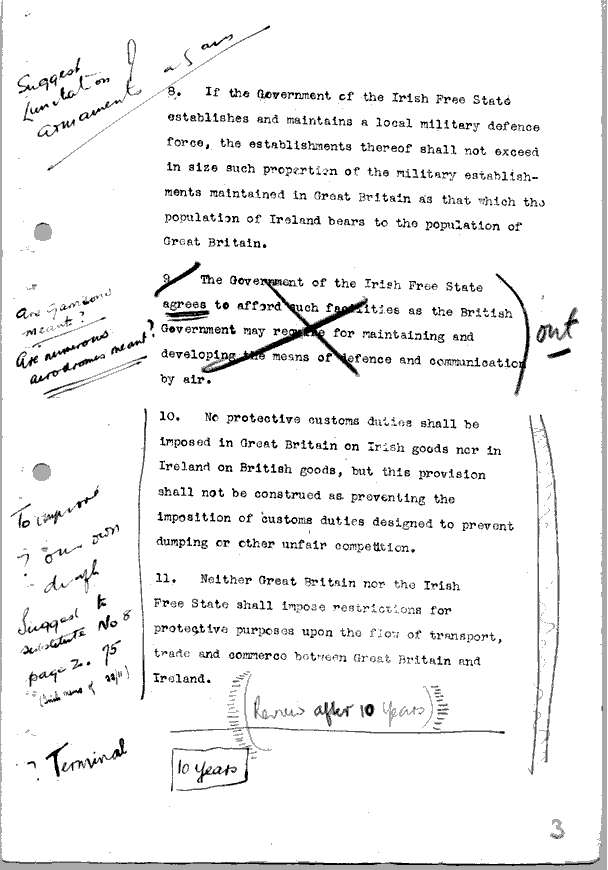
The terms were that the British agreed to concede dominion status (equivalent to the constitutional status of ex-colonies like Canada) to the south, now to be known as the Irish Free State. The Head of State would remain the King, with a Governor-General as his representative in Dublin. Various office-holders, including parliamentarians, would have to take an oath of loyalty to the Crown. Three ports in the south would remain British territory for reasons of imperial security. Ireland was designated as within the British Commonwealth, though its precise obligations in this area remained undefined
On the Irish side, the nationalists won complete independence for home affairs and practical independence over foreign policy. But the oath of allegiance had to be swallowed – and this proved to be the sticking-point for many. Michael Collins argued that the Treaty was just the first step towards what could become full sovereignty: in time the Irish would achieve their full ambitions. In the early hours of 6 December 1921 – following a melodramatic ultimatum by Lloyd George – the Irish delegation, slowly, one by one, signed the Treaty. Collins’s own comment on this came in a letter to a friend the next day: ‘early this morning I signed my death warrant.’ That was no melodrama.
The Aftermath
Collins was anticipating the reaction to the Treaty back home. Although the delegates were put to the test in the subsequent bitter debate and then General Election in the South, the pro-Treaty position won a narrow majority in both cases. That should have been that; but the anti-Treaty forces now moved into open hostilities against the new Irish government and a vicious civil war took place from 1922 to 1923, Collins himself falling in an ambush.
Eventually the Free State imposed its authority and the Treaty was secured. But not for long. The Anti-Treaty forces split, and the majority, led by de Valera, entered constitutional politics in 1926 as a new party, Fianna Fail, leaving the purist republican rump behind. Such a move involved taking the oath of allegiance to the Crown – the issue largely over which the civil war had been fought – but de Valera was just waiting to get into power. Once achieved, in 1932, he then proceeded to take full advantage of the Statute of Westminster the year before which allowed the dominions (and thus Ireland) full rights to legislate for their own affairs. Promptly the oath was abolished and then in 1937 Ireland’s constitution produced. The Free State became Eire and left the Commonwealth. It moved, finally, to its present formulation of the Republic of Ireland in 1949.
Nevertheless, the Anglo-Irish Treaty of 1921 may be said to be still in existence in that it conceded, in effect if not to the last absolute jot de jure, the independence of southern Ireland. And quite as important, its division of Ireland into two states remains. Various arrangements concerning the position of Northern Ireland have been made before the Good Friday Agreement of 1998; and doubtless some will be made hereafter. But perhaps that too will stand, eventually, the test of time.
Michael Morrogh teaches history at Shrewsbury School and is the author of The Irish Century (Weidenfeld and Nicolson, 1998).
Timeline
- 1905-8 Founding of Sinn Fein
- 1914 Home Rule Bill becomes law, but is not operated
- 1916 Easter Rising in Dublin
- 1918 Victory for Sinn Fein in General Election
- 1919 Dail Eireabb set up; Anglo-Irish war
- 1920 Government of Ireland Act
- 1921 Truce signed in July; negotiations began in London in October; Anglo-Irish Treaty signed on December 5th
- 1922 Irish Free State set up


