

Evliya Çelebi: Traveller's Tales
To mark the 400th anniversary of his birth, UNESCO has declared Evliya Çelebi a ‘man of the year’. His Seyahatname, or Book of Travels, is one of the world’s great works of literature. Caroline Finkel celebrates a figure little known in the West.
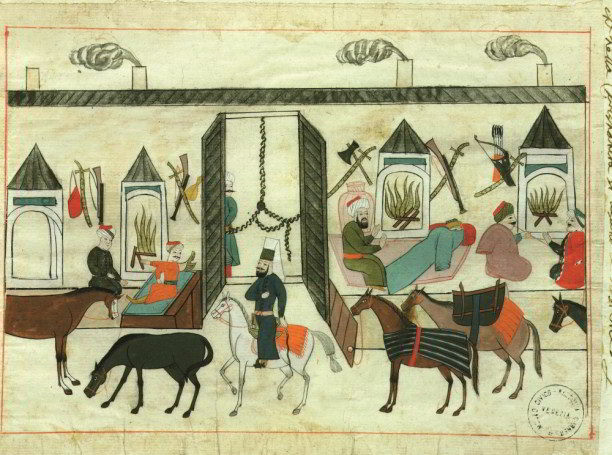
Everyone has their favourite guidebook – James Boswell for Holland or the Hebrides, old Baedekers for Italy perhaps, Iain Sinclair for Londons central and greater. For Ottoman historians it might be the relevant part of Evliya Çelebi’s Seyahatname or Book of Travels. Whether for a stroll around Istanbul, an excursion within Turkey or an expedition to the furthest reaches of the sultan’s domains, this monumental work by a 17th-century gentleman-adventurer is the indispensable vademecum without which so many aspects of the past would remain lost.
Evliya Çelebi (çelebi is roughly equivalent to ‘gentleman’) was a courtier of the Ottoman sultans. He was born in Istanbul in 1611 and between his first expedition in 1640 and his death around 1685 he spent most of his life travelling. He traversed territories from Crete to Poland, rode across landscapes far up the Nile and around the Sea of Azov and visited cities, towns and villages between modern Austria and Iraq. He lived when the Ottoman Empire was at its greatest extent and arguably still at the height of its power.
This year marks the 400th anniversary of Evliya’s birth. UNESCO has acknowledged his remarkable life and the achievement of the Book of Travels by recognising the event. At almost 2,400 folios Evliya’s is the longest travel account in Islamic literature and possibly the longest ever written. It is the most frequently quoted source for 17th-century Ottoman history, yet only now is it becoming familiar to readers outside Turkey.
Evliya Çelebi came from privileged stock; his father was the sultan’s chief goldsmith and his mother was from Abkhazia. Like others of his class he studied in the medrese and became an accomplished reciter of the Koran as well as an adept prayer-caller. Cultured Ottomans knew Persian and Arabic in addition to Turkish and Evliya informs us that he learnt fluent Greek and Latin from a non-Muslim craftsman in his father’s shop. Thanks to his links to the court he caught the eye of Murad IV (r. 1623-40), who brought him into Topkapí Palace where he studied, among other subjects, calligraphy, music and singing. The sultan encouraged his talent in these arts as well as in poetry and particularly appreciated his humour and witty repartee. A close relationship developed between the two and, Evliya tells us, Murad declared him to be his ‘boon companion’.
Evliya eschewed the life of a royal favourite, however. By the age of 20, he writes, his excursions to the towns and villages and parks in the immediate vicinity of Istanbul had given him a desire to see more of the world. Seeking out the company of dervishes, he listened with fascination to the tales of distant places told by these wandering holy men. He despaired, however, of being able to break free of the stifling embrace of his family until, one night, he had a dream that portended the course of his future life.
Evliya dreamt that he found himself in a congregation of the saints of early Islam, among whom the Prophet Muhammad appeared and prepared to perform the morning prayer. He asked Evliya to call the prayer and, after it was over, invited him to come before him. Evliya intended to beg the Prophet’s intercession – Sefa’at in Ottoman Turkish – but through a slip of the tongue asked instead for seyahat, or ‘travel’. ‘Predictive dreams’ are a familiar device in Ottoman writings. Evliya recounts them on several occasions in his Book of Travels, but nowhere to greater effect than when ascribing to higher authority how he came to spend his life on the road.
 It was another ten years before Evliya was able to set out on his first journey, in the company of a friend who was visiting the former Ottoman seat of Bursa, across the Marmara Sea from Istanbul. During this time he composed a historical guide to the city, as one of the Prophet’s Companions had urged him to do in his dream. This comprises the first part of his Book of Travels, along with a lengthy and colourful account of the parade of Istanbul’s artisans before Murad IV on the eve of the sultan’s campaign of 1638 to retake Baghdad from the Ottomans’ arch-enemies, the Safavids of Iran.
Once back from his trip to Bursa, made without informing his family, Evliya set sail for the north Anatolian coast with a friend of his father who had been appointed governor of the province of Trabzon. From there he continued in the entourage of various government officials to the Caucasus and the Crimea, travelling also to the Iranian city of Tabriz as envoy to the Safavid governor. Evliya writes that he served as prayer-caller to the commander-in-chief at the Ottoman siege of Azov in 1641. He purports also to have visited Syria at this time and to have been present at the siege of Chania, the initial engagement in the long war fought between the Ottoman Empire and the Venetian Republic for control of the island of Crete, that began in 1645.
Such serendipitous travel set the pattern for Evliya’s future expeditions. He usually travelled as a functionary in the entourage of an Ottoman grandee engaged on state business and, when charged by his patron with specific tasks, used such opportunities to tour the region where he was based. In addition to his incidental duties of prayer-caller, Koran reciter and boon companion, he served as tax collector and customs clerk, tutor and imam, peace envoy and courier. Only rarely did Evliya set out on a journey for his own pleasure or, presumably, at his own expense.
In 1648 Evliya travelled overland to Syria in the service of the governor of Damascus; he went as far south as Gaza and returned home by a circuitous route through Anatolia almost two years later. When his mother’s kinsman Melek Ahmed Pasha (1588-1662) was briefly appointed grand vezir in 1650 he remained with him in Istanbul and on Melek Ahmed’s dismissal followed him to Ochakiv (on the Black Sea coast of modern Ukraine), where the pasha was subsequently posted, and then to Sofia, when Evliya had his first chance to travel in the eastern Balkans. Melek Ahmed became Evliya’s habitual patron. In 1655, when he was sent east, Evliya joined him there and spent eight months travelling in Iran and Iraq, recording all that he saw.
Over the next few years Evliya Çelebi participated in campaigns in Transylvania, Wallachia and Moldavia, whose ruling princes, nominally Ottoman vassals, periodically displayed independent tendencies or sided with the Habsburgs. During this time he also travelled in Poland and Ukraine. He continued to serve under Melek Ahmed, except for a short period when he fell out with officials in the pasha’s entourage and left his service for that of Grand Vezir Mehmed Köprülü (c. 1575-1661), the strongman who had been brought into government to deal with the widespread breakdown of order of mid-century.
Evliya rejoined Melek Ahmed Pasha in Bosnia, where he was governor, and travelled extensively here too, as well as in the western Balkans and Hungary. In 1662, shortly after Melek Ahmed sent him to Albania to collect money he was owed, the pasha died. Although now without a patron, he writes that he was content to be free of family attachments and, after another short stay in Istanbul, he set out in spring 1663 with the army under the new grand vezir, Mehmed Köprülü’s son Fazíl Ahmed Pasha (1635-76). Evliya was trained as a cavalryman in the sultan’s regiments and was caught up in the long struggle of central government against rebels of various hues in Anatolia. He also saw action at several of the major military engagements of the time. Notable among these was the battle of St Gotthard in 1664, where the army of the Habsburg commander Raimondo Montecuccoli (c. 1608-80) routed the Ottoman forces. Montecuccoli’s victory was the culmination of years of war between Ottomans and Habsburgs or their proxies and in 1665 Evliya was posted to Vienna as a member of the mission that ensured peace between the two empires for almost 20 years.
Evliya’s long and lively account of Vienna and its court is one of the highlights of his Book of Travels. He was amazed by St Stephen’s Cathedral, especially its library, comparing it with the library of a mosque in Alexandria where, he reports, you could hear even Korans being eaten by moths, worms and mice. He describes the marble floors of the cathedral, contrasting them with the carpeted prayer halls of mosques, and the functioning of the organ, the paintings and statuary.
In Vienna Evliya watched with wonder an operation to remove a bullet lodged in the head of a man wounded at St Gotthard, as well as a tooth extraction; three of his own teeth had been dislodged when he was hit by a javelin while playing equestrian sports and these were stabilised by the surgeon. He immodestly reports that his knowledge of Jerusalem, which he had visited in 1658, was greatly superior to that of some priests with whom he talked. Moreover, he writes, Emperor Leopold I (r. 1658-1705) was so impressed that he gave him bolts of fine fabric and 13 German clocks. Evliya saw men and women together in social gatherings; the women drank and chatted with him and his companions without their husbands in tow, behaviour he found disreputable.
Following his stay in Vienna Evliya went to the Crimea again, then followed the northern Black Sea coast eastwards, crossing the Straits of Kerch and heading up the Volga via Saratov to Kazan. He returned to Istanbul in 1667.
In 1669 the Ottomans finally took the Cretan fortress of Candia (modern Heraklion) after a 21-year siege. Evliya was there to see the victory, having travelled from Istanbul via Thessaloniki to Athens and around the Morea before boarding ship at Corinth. Evliya’s description of the Parthenon as he saw it in 1668, when it functioned as a mosque the like of which, he informs us, he had seen nowhere else, is of great importance because almost 20 years later it was blown up when Morosini’s cannon ignited the Ottoman ammunition dump within. He had the honour of calling the first prayer after Candia fell to the Ottomans before departing on a second mission to Albania and then returning to Istanbul.
Evliya Çelebi was now almost 60 years old. He had journeyed with little pause for 30 years, keeping an intimate and entertaining record of his adventures and misadventures alike. At last, in 1671, after six months ‘imprisoned’ in Istanbul, he embarked on the journey that would satisfy the desire of a lifetime. This was the fulfillment of the Muslim obligation of pilgrimage to Mecca. Three months earlier he had dreamt that his late father, Dervish Mehmed, and his teacher, Evliya Efendi, gave their blessing to this enterprise and he set out with three companions, eight servants and 15 pure-bred Arab horses. The journey from Istanbul to Mecca usually took around 100 days, plus time lost to bad weather or delay – but Evliya meandered through west and south Anatolia to places he had not visited before and took more than twice as long to reach his goal.
Evliya never returned to the capital, but based himself thereafter in Cairo, the second great city of the Ottoman Empire. The Book of Travels concludes with his expeditions in Egypt and beyond – including a survey of Cairo to match that of Istanbul.
In 1672, on a tour of inspection in the Nile delta, Evliya relates that he found himself in a small boat off the mouth of the river and prayed that he might travel to its source. He was warned of the difficulties ahead but set out undaunted, with letters from the Ottoman governor of Egypt for the ruler of Funj in the north of modern Sudan. When he reached an unidentified place called Cersinqa, south of Sennar on the Blue Nile and, he writes, 32 stages from the river’s source, he heard that the Mountains of the Moon were now controlled by the Portuguese and inaccessible. A dream convinced him to turn back. A magnificent, five-and-a-half metre long Nile map in the Vatican Library is the only other work besides the Book of Travels ascribed to Evliya. We assume he lived his last years in Cairo and died there.
The Book of Travels is unique within the context of Ottoman literary output during Evliya’s time or any other. He is the only Ottoman known to have left such a detailed account of his wanderings, but whereas other contemporary writings can usually be ascribed to a genre, Evliya’s work defies easy categorisation. It encompasses history and geography, architecture both secular and sacred, plants, music, linguistics, medicine, folklore and ethnography, local social and cultural mores, produce and food and a host of miraculous and comic happenings that Evliya heard about or witnessed. It is also a deeply personal account of a life spent on the move. In modern travel writing the author’s preoccupation with self at the expense of the places he visits is often more jarring than illuminating; Evliya, by contrast, never patronises his subjects and first person references in his narrative never crowd out his commentary on the worlds he is discovering on his reader’s behalf.
Evliya’s narrative style can be as delightfully rambling as his travels. His work follows a more or less standard format, but frequent digressions give it a richness that is lacking in the writings of his fellows and entertain and engage in a manner they cannot match. His Book of Travels is unique for other reasons: his is often the sole evidence we have of buildings that are no longer extant – not only the Parthenon mosque, but a host of others. He writes of individuals at both ends of the social spectrum who have left no trace elsewhere, in particular his hosts on his travels and the local holy men whose shrines he made a point of visiting; he describes a wealth of local customs of which there is otherwise no record; the immediacy of his ‘war reporting’ from the thick of battle has no counterpart in other Ottoman writing.
Most of all though, Evliya is the ‘people’s historian’; no other Ottoman writer was so curious about those he met along the way. In Turkey, at least, he is esteemed by those whose localities he once visited, who take pride in this connection to their past. When I and some friends travelled the first part of his 1671 pilgrimage route in 2009-11, on horseback and on foot, we were amazed to learn that local people knew what Evliya had written about their towns and villages centuries ago.
‘Marvels and wonders’ – happenings that defy rational explanation – greatly intrigued Evliya. In Anatolia he saw a child with a hugely swollen head, ‘like a pumpkin of Adana or a cabbage of Van’ (both provinces of Anatolia) and a girl who, so she related, had been picked up by a passing elephant sent as a gift to the Ottoman sultan by an Indian ruler and became pregnant after spending three hours in its belly. Evliya saw the corpse; she had been killed by local officials. In Hungary he saw a Tatar youth who had changed into a donkey and in Egypt heard of men who had intercourse with crocodiles.
Such anecdotes may have been drawn from a stock of largely oral tales familiar to the society of Evliya’s time and deployed to effect as he saw fit. These human dramas could, of course, have been dreamt up by Evliya himself and embellished to divert his readers when he felt his narrative needed enlivening. His frequent allusions to everyday, familiar objects would have allowed his audience to imagine more easily what he was describing. Vegetables are a favourite comparison, as in his portrayal of the Habsburg emperor, whose ‘nose was like an aubergine of the Morea’ and whose fingers resembled the cucumbers of a famous market garden in Istanbul. Evliya refers several times to Justinian’s basilica of Hagia Sophia – Ottoman Ayasofya – proposing, for instance, that the Great Mosque of Sultan Bayezid I in Bursa is ‘the Ayasofya of Bursa’. Whether enumerating the number of mosques in a city or regaling his readers with tall stories Evliya remains faithful to the literary format of his time, the requirement of writers that they entertain as well as instruct. It is likely that his fictions would have been as obvious to his contemporaries as they are to casual readers today.
Apart from the unifying cultural layers of Islam and Ottoman governance in many of the places Evliya travelled, the lands through which he passed would have seemed as exotic to his readers as the jungles of Borneo are to most people today. Although few in his time strayed far, Evliya Çelebi was only one of many who regularly criss-crossed the empire and ventured outside its limits as they went about their business. Pilgrims, merchants, tax collectors, military men and bureaucrats all travelled extensively, yet to the best of our knowledge no one compiled an account to compare with Evliya’s.
Today we can reach our destination by ignoring what lies ‘in between’. But past voyagers could not omit the ‘empty quarters’ – sea, steppe, forest and desert. Nor were they insulated from the elements. Evliya’s near-fatal shipwreck in a storm in the Black Sea when he returned from his first lengthy excursion in 1641, a horror story he tells with great verve, put him off sailing forever. However when he made his pilgrimage to Mecca it was unthinkable that he would not visit Cyprus; he embarked from the south Anatolian coast only for his ship to be attacked by three infidel vessels as soon as it reached open water and he never saw the island. His journeys through the lands of Eurasian steppe peoples such as the Nogai, Kalmucks and Circassians were fraught with danger from marauders and, apparently, cannibals, as well as extreme cold and a brush with mortality when crossing cracking ice at the mouth of the Kuban river – ‘about as broad and deep as the Golden Horn’. Forests were welcome hideouts for bandits as well as rebels and Evliya was anxious for his safety on numerous occasions, even close to home. The Nile desert held all sorts of terrors, particularly a variety of wild animals, but Evliya put his fears aside on one three-day hunting expedition, when his party bagged 70 elephants and 16 rhinoceroses, as well as leopards, panthers and giraffes.
For whom did Evliya write? At various points in his Book of Travels he records his motivation to travel and document everything he saw and we must assume that his intended audience was his educated Ottoman peers. Things did not turn out as he might have hoped though and his manuscript languished in private hands in Cairo until 1742, when it was sent to Istanbul as a present for the powerful Chief Black Eunuch el-Hac Besir Aga, overseer of the imperial harem of Topkapí Palace in the reign of Sultan Ahmed III (r. 1703-30) and his successor Mahmud I (r. 1730-54), who had ties to Egypt. Besir Aga was a bibliophile and as soon as he received the gift he commissioned some copies. Most volumes of the original manuscript and various volumes of these copies survive. The first two books, concerning Istanbul and Evliya’s earliest expeditions (1640-48), were published in English in 1834 and 1850 by the Habsburg diplomat and orientalist Joseph von Hammer-Purgstall (1774-1856). In the mid-19th century short extracts from the Istanbul volume were printed in the original Ottoman Turkish, but the work was not considered important enough to merit full publication.
The first attempt to print the complete text came at the end of the century. But this was during the reign of Sultan Abdülhamid II (r. 1876-1909), who greatly feared for his personal safety and the continuing existence of the empire. He employed an army of censors to prevent the dissemination of any information that might encourage free-thinking. The resulting version of the Book of Travels was heavily censored, in keeping with directives from the palace in the spirit of the Papal Index; two examples of excised material were Evliya’s account of the deposition of Sultan Ibrahim in 1648 and his description of tools of torture employed in Iran.
Apart from a few fortunate scholars with access to Evliya’s original manuscript and its copies, this very unsatisfactory edition of his text served as their source for over a century. Between 1996 and 2007, however, the Book of Travels was transcribed from the Ottoman into the modern Turkish alphabet and this is now the definitive version. Because Evliya’s language is barely intelligible to Turks today, an edition in the modern Turkish language has also been published. Plans are afoot for a facsimile edition of the autograph. In addition, excerpts from the Book of Travels have been published in a variety of languages, in both popular and academic editions. In 2010 a generous selection of extracts from all volumes appeared in English.
The foremost interpreter of Evliya Çelebi has observed that scholars have hitherto approached the Book of Travels ‘as though it were a huge mine, with numerous unconnected passages ... they have probed the text, found the vein they were seeking, and extracted the ore, leaving all else behind’. The publication of Evliya’s magnum opus in an authoritative edition marks the start of a new era. Now we can see the work as he intended it and Evliya Çelebi studies can begin in earnest. One day the complete text of his masterpiece will be translated into English and then many more people can take pleasure from seeing unfamiliar worlds through the eyes of this most companionable and idiosyncratic of travellers.
From the archive:
Pilgrim's Progress: Propelled by Faith
A sea voyage in the 12th century was a perilous undertaking, as a Spanish Muslim courtier’s account of his crossing of the Mediterranean demonstrates. Yet, explains David Abulafia, it was also a test of one’s religious devotion, whether Muslim or Christian.
Europe and the Turks: The Civilisation of the Ottoman Empire
Bernard Lewis writes that the fall of Constantinople in was no “victory of barbarism, but rather of another and not undistinguished civilization.”

