

Europe's National Currencies
Jonathan Williams and Andrew Meadows review the history of the various currencies that were replaced by the Euro.
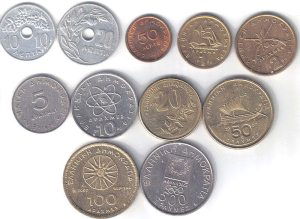 For Frank, Mark, Drachma, Lira... read Euro. On October 28th,1971, a motion carried in the House of Commons launched Britain into its turbulent membership of the European Economic Community, or the Common Market as it was often called. Amid the acrimonious debate that had preceded the vote, the Bank of England had begun the issue of a new £5 note. On the back was featured the Duke of Wellington and a vignette of English soldiers fighting the French. The new note may not have been directly inspired by the events of the day. Nevertheless, currency and its designs can be revealing symbols of national aspirations. As tangible, everyday objects coins and banknotes also act like no other medium to separate the citizens of one state from those of another. The French are not the only nation that speaks French, but they have been the only one in Europe to use the French franc.
The French franc is arguably the oldest of the twelve national currencies to be supplanted by the euro. The franc was a child of the Revolution. The upheaval that brought death to the monarchy and the old regime in France also gave birth to a brave new world of metrication and decimalisation. The franc was a product of both. By the law of 16 Vendémiaire, Year 2 of the Republic (October 7th, 1793) it was laid down that the weight of the new currency should be defined in terms of the kilogram (initially one hundredth). A further law of 18 Germinal of the following year (April 7th, 1795) provided for the decimalisation of the new currency and the naming of it as the ‘franc’. Thus from its inception, the franc was a material sign of the progress marked by the Revolution, a token in everyone’s pocket of the new Republic. The franc is not, of course, alone among European currencies in the position it holds within the political development of the nation.
Like the franc, the German mark is only as old as the nation-state that produced it. The mark was first chosen as the currency of the German empire after its formation in 1871. The German states had previously been divided between a thaler-using zone in the north and a gulden-using zone in the south. The mark survived from the Middle Ages as the principal currency unit of the free Hanseatic cities of the north, Hamburg and Lübeck, and it was preferred as a neutral name for the new imperial currency. The mark barely survived through the establishment of the Weimar Republic and catastrophic inflation of the early 1920s, its name expanded to Reichsmark in 1924. Thus it remained until 1948, when a new mark was introduced by the Allies as the currency of the Federal Republic in West Germany. It was to be called the deutsche Mark, meaning ‘German mark’ (the word Deutschmark is an English invention). The introduction of the D-mark, which involved a vigorous reduction in the money supply after the massively inflationary over-production of the wartime era, utterly transformed daily life. The memory of June 21st, 1948, when it first entered circulation, remains with Germans of that generation to this day, as it was immediately followed by the reappearance overnight of goods in the shops that had not been seen outside the black market for many years.
For the new Germany, the D-mark became a prime symbol of internal stability, as well as of integration with the West. It has also, along with the Bundesverfassung (the Federal Constitution), been one of the few acceptable tokens of national pride, as the emblem and motor of the Wirtschaftswunder, the ‘economic miracle’ that saw Germany become the most powerful economy in Western Europe. For Germans the abandonment of their mark in favour of the euro is a real leap of faith in the vision of a united and peaceful Europe in which they have invested so much. Many, however, are deeply reluctant to lose it, and had the decision been put to a referendum, the result might have been close indeed.
Things are rather different in the countries of southern Europe where generally weak currencies have symbolised prevalent political instability and economic stagnation, or failure. Italians are quite happy to wave goodbye to the lira – their currency since the proclamation of the Kingdom of Italy in 1861. Yet here too issues of national identity come into tension with apparent economic advantage. While Greeks are pleased to have made it into the Eurozone, they are not without reservations. They have made much of the fact that their currency, the drachma, is the oldest in the world. Drachma was indeed one of the earliest and most widely used denominational names in ancient Greece. But it had passed out of general use for the best part of 1500 years until its antiquarian revival in 1833 as the name for the new currency of the Greek kingdom, founded in that year. Nevertheless, the drachma, though scarcely an unalloyed success as a currency, is still a central symbol of the Greeks’ national story, whether taken back to antiquity or only as far as the nineteenth century, and some are understandably hesitant about giving it up. They are also rather resentful that some of their Aegean islands have been left off the maps of Europe on the new currency!
Will the euro succeed? The answer hinges at least in part on the willingness of the peoples of Europe to lay aside the idea of currency as an indispensable attribute of the nation. And the signs are that they will. A historic change is taking place on the Continent in popular attitudes towards the nation-state – while in Britain we watch, and wait.
- 1795: The franc is introduced as the currency of France
- 1816: The guilder is established as the currency of the new Kingdom of the Netherlands
- 1833: The franc is adopted in newly independent Belgium
- 1833: The drachma returns as the currency of the new Greek kingdom
- 1848: Luxembourg changes from the guilder to the franc. The Luxembourg
and Belgian francs are tied to one another in a monetary union in 1921 - 1860: Finland granted its own currency, the markka, within the Russian Empire
- 1861: The lira issued as the currency of the new Kingdom of Italy
- 1869: Spain adopts the peseta after the revolution of 1868
- 1873: The mark is first issued as the currency of the unified German Empire
- 1873: Denmark adopts the krone in the Scandinavian Monetary Union with Sweden, whose new currency is called the krona (Norway joins in 1875, with the krone)
- 1910: Newly republican Portugal adopts the escudo
- 1924: After hyperinflation, Austria introduces the schilling
- 1928: First issue of Irish coins. The Irish pound remains tied to sterling until 1979
- 1948: The German mark (D-mark) is introduced
Jonathan Williams and Andrew Meadows are curators at the Department of Coins and Medals, British Museum.

