

Britons in the Spanish Civil War
The British Battalion of the International Brigades, formed to defend the Spanish Republic against the forces of General Franco, first went into battle at Jarama in February 1937. It was the beginning of a bruising, often dispiriting campaign.
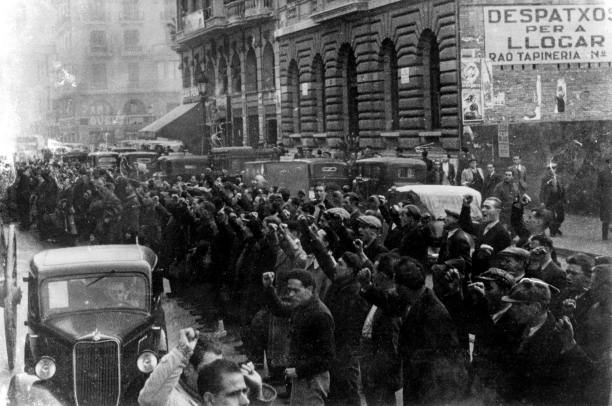 In the chilly dawn of February 11th, 1937, around 500 men from Britain, armed with rifles and machine guns, began clambering up a ridge overlooking the River Jarama, a few miles south-east of Madrid. For seven months Spain had been embroiled in a brutal civil war, sparked by an uprising of right-wing generals against the country’s elected government. The British were there as part of the International Brigades, a force of foreign volunteers who had come to fight for the Spanish Republic. Although some Britons had been involved in earlier battles, this would be the first action by a fully-fledged British Battalion and most of its members had never been under fire before.
The troops advancing towards them in the valley below were all battle-hardened veterans belonging to General Francisco Franco’s Army of Africa and were made up of 600 Moorish Regulares, colonial troops from Spanish Morocco with a fearsome reputation for close-quarter butchery. They were joined by 1,300 members of the Spanish Foreign Legion, whose motto was: ‘Viva la Muerte! – Long live Death!’. The British, by contrast, had received little training and were short of both weapons and equipment.
Jason Gurney, a young sculptor from London who was one of those on the ridge, summed up the odds: ‘It was a formidable opposition to be faced by a collection of city-bred young men with no experience of war, no idea how to find cover on an open hillside, and no competence as marksmen.’
The war in which they were now caught up was the culmination of years of political turmoil. Spain had long been a divided society, where the gulf between haves and have-nots, landless peasants and landlords, workers and factory owners, secular and religious, left and right was marked by frequent bloodshed. A Republic had been declared in 1931 and a Popular Front coalition of left-wing parties had won a narrow election victory in February 1936, but the violence continued. On July 18th the generals launched their uprising.
They claimed to be rescuing the country from chaos and Communism and were supported by the Catholic Church, most of the middle class and Spain’s own blue-shirted Fascist party, the Falange. They also had the backing of some 70 per cent of the army, though many conscripts turned against their officers rather than join the revolt and throughout Spain left-wing political organisations mobilised their own militias. What the generals had intended as a swift coup d’etat was now to become a bloody and prolonged civil war.
Franco, quickly emerging as leader of the Nationalists, appealed to Hitler and Mussolini for help. They responded with generous supplies of guns, tanks and planes as well as ‘volunteers’. To the dictators Spain was a useful testing ground for new weapons and tactics. The Spanish government also sought foreign aid, but the western democracies, urged on by Britain, tried to contain the conflict by denying arms to both sides. Initially ‘non-intervention’ was supported by the opposition Labour Party, but liberal sentiment became increasingly outraged at the prospect of a democratic government being overthrown by an unholy alliance of reactionary generals and Fascist dictators. As Denis Healey, then a Communist undergraduate at Oxford, put it: ‘Spain was so real that it hurt.’
Second best in supplies
A number of volunteers, including some from Britain, enlisted in the left-wing militias almost as soon as the uprising began. One of these early recruits was Felicia Browne, a 32-year-old painter and sculptor and committed Communist, who was shot dead on August 28th while trying to blow up a rebel ammunition train, the first British fatality of the war. But it was not until September, when Stalin decided to back the Republic, that it began to receive arms and equipment, though never in such quantities as to match the aid sent by Hitler and Mussolini to the Nationalists. At the same time the Communist International (Comintern), the Moscow-based bureaucracy that dictated policy to Communist parties outside the Soviet Union, initiated the recruitment of the International Brigades.
Eventually some 35,000 volunteers, mainly from Europe, the United States and Canada, would serve in the Brigades, with most of the organisation coming from the Comintern, which furnished the Brigades with the bulk of their senior officers. Recently declassified MI5 files list the names of 4,000 British and Irish volunteers, but the security service seems to have included sympathisers, as well as combatants, and a more likely figure is around 2,500. In almost two years of fighting about 500 would be killed and 1,200 wounded.
The vast majority of the British volunteers were working class, though with a sprinkling of middle-class intellectuals, and came predominantly from London and the industrial regions of the country. They were mainly in their 20s and well over half were members of the Communist Party of Great Britain (CPGB). A few had military experience and some of the ex-public school recruits had been in the Officer Training Corps (OTC), but the only fighting most of them had done was in street battles with Oswald Mosley’s British Union of Fascists.
The usual procedure was for would-be recruits to be vetted by an official at the CPGB offices in King Street, near London’s Covent Garden. Those selected would be given rail tickets to Paris, where they would receive a final vetting and a medical examination, before embarking on the final stage of the journey to Spain. In January, 1937, the British government made it an offence to fight for either side in the Spanish conflict, so the volunteers were advised to proceed with caution. Some were, indeed, stopped and questioned by Special Branch detectives at Victoria Station or the steamer terminal at Dover, though no one was ever arrested, probably because a court case would have been politically embarrassing for the government.
Until February, 1937, the volunteers crossed the border into Spain by train or bus, but the French authorities then began to apply the non-intervention rules more rigorously, so that the volunteers had to be smuggled on foot across the Pyrenees, a journey that was not without its dangers, especially in winter.
The first volunteers arrived at the International Brigades training base at Albacete in October, 1936. They had been there barely four weeks when they were rushed north to join in the desperate defence of Madrid. The British volunteers, still too few at this stage to form a unit of their own, were divided between French and German battalions. Among those who joined the Germans was 18-year-old Esmond Romilly, the maverick nephew of Winston Churchill. He had decamped from Wellington College at the age of 16 and spent the previous two years running a left-wing bookshop in London’s East End.
The French Battalion included the young Marxist poet John Cornford, a great grandson of Charles Darwin and son of a Cambridge professor, who was grazed in the head by a piece of shrapnel during the fighting in Madrid’s academic enclave, the University City. But he had recovered sufficiently to join the newly formed British No. 1 Company, 150 strong, when it took part in an abortive attempt to capture the village of Lopera, near Cordoba, at the end of December. Here he was shot dead on the day after his 21st birthday by a Moorish sniper who targeted the white bandage he was still wearing. The CPGB secretary Harry Pollitt is supposed to have joked to the poet Stephen Spender that, if he went to Spain and got himself killed, it would give the party its Byron. The party now had its Byron.
No. 1 Company was rushed back from Lopera to Madrid to help contain a major rebel offensive that had been launched to the north-west of the city, at Las Rozas. Of the 150 volunteers who had left for Lopera on Christmas Eve only 67 returned to Albacete in January. However a fresh influx of volunteers soon pushed the numbers up to 450, enough to form a battalion. Its first commander was Wilfred McCartney, a former army officer and left-wing journalist, who had just been released on parole from Parkhurst prison, after having served 10 years for passing military secrets to the Russians.
Bolshy Brits
McCartney’s tenure was not a success. Many of the volunteers had little respect for military authority and spent the nights in wild drinking bouts in Madrigueras, the new base for the British. There were few weapons available and in training exercises large wooden rattles were used to simulate the sound of machine-gun fire. Military training was interspersed with lectures by political commissars (PCs). Following the example of the Red Army, the PCs were Communist stalwarts who operated at all levels of the Brigades and were responsible for discipline, morale and political education. The British, often more bolshy than Bolshevik, nicknamed them ‘political comic stars’ and usually preferred a game of cards to a discourse on the class consciousness of the Spanish proletariat.
 Another problem for McCartney was the disaffection of Irish members of the Battalion. Most of them had been in the IRA and suspected that two senior British officers, including McCartney himself, had served with the Black and Tans. Eventually, after a near-riot, the Irish were allowed to leave the British Battalion and join the Americans of the Abraham Lincoln Battalion, training in nearby Villaneuva de la Jara.
The final calamity for McCartney came one evening as he and Peter Kerrigan, a senior PC at Albacete, were comparing revolvers. Kerrigan’s gun went off, wounding McCartney in the arm. The shooting, though bizarre, was almost certainly an accident, but some suspected that it was designed to get McCartney out of the way. Whatever the truth of the matter, he was forced to relinquish his command and the Battalion was taken over by Tom Wintringham, a Great War veteran and founder member of the CPGB, whose quiet authority had won him wide respect and who was known as ‘the English Captain’.
Wintringham had little time to lick the Battalion into shape. Only four days after his appointment, it was ordered to the River Jarama, which the Nationalists had crossed on February 11th, intending to cut the Madrid-Valencia road, the besieged capital’s only lifeline to the rest of Republican Spain. The Republican command was determined to prevent this at all costs and a large force, including the newly formed 15th International Brigade, to which all the English-speaking volunteers were attached, was thrown into the attack.
A losing battle
The British ordeal began at about noon on February 12th, when the advancing rebels opened up with artillery and machine-gun fire on two low hills which the British had occupied. After about five hours of intensive fire and with casualties steadily mounting the volunteers were forced to retreat across the valley and back to the top of a nearby ridge. The Battalion’s own machine-guns were set up here, but had remained unfired throughout the day because they had not been provided with the correct ammunition. It was not until almost sunset that this finally arrived – just as the Moors were massing for an assault on the ridge. Caught totally unawares as they charged across the open valley, they were ‘mown down’, in the words of one volunteer, ‘as if a scythe was going through them’.
On the British side the dead included the Marxist writer Christopher Caudwell and his friend, the speedway rider Clem Beckett. Also killed was George ‘Lofty’ Bright, a carpenter from London, who, in his 60s, was the oldest of the volunteers. Among the injured was the youngest of the volunteers, 17-year-old Ronnie Burghes, who had been shot through the left arm. The minimum age for recruits was officially 18, but Ronnie’s mother was Charlotte Haldane, who for a time had acted as the staging officer for the British volunteers passing through Paris and she had insisted on her son’s right ‘to fight for Spain and freedom’.
The battle for the ridge resumed on February 13th and was almost lost in the afternoon when Bert Overton, the commander of the company protecting the right flank of the machine-gunners, panicked and fled through the olive groves with most of his men. What happened next is not entirely clear. According to the version that has become part of Jarama folklore, the machine-gunners were tricked into surrendering by Nationalist troops who advanced on their unprotected flank singing the Internationale and giving the anti-Fascist clenched fist salute. Some volunteers have confirmed the story, while others have dismissed it as myth and it may be a classic product of the ‘fog of war’.
Either way, the loss of the machine-guns was a devastating blow and Wintringham led a bayonet charge of 40 men – including a now chastened Overton – in an attempt to retake them. The Nationalist troops simply cut them down with the guns they had just captured. The English Captain received a serious leg wound and only six of the 40 men made it back to the British line. The rebels renewed their attack on February 14th, this time supported by captured Russian tanks. The 160 men who remained of the British Battalion began streaming away from the front.
With the Nationalists now poised for a final breakthrough the shattered Battalion was rallied by its new commander, Jock Cunningham, a former sergeant in the Argyll and Sutherland Highlanders, who had been the ringleader of a mutiny over poor pay and conditions while serving in Jamaica in the 1920s. Inspired by Cunningham’s dynamic leadership the men fell into step behind him and marched back the way they had come, joined by stragglers from other units. This time there was no mistaking the strains of the Internationale, belted out as they approached the enemy lines. The Nationalists, convinced that they were being attacked by a much stronger force, fell back and both sides resumed their original positions. With the collapse of a Republican counter-offensive on February 27th the whole of the Jarama front settled into a stalemate that was to last for the rest of the war. Of the 500 British volunteers who had gone into action on February 12th, about 150 had been killed and a similar number wounded. About 30 had been captured.
Hero and villain
On March 17th Cunningham was wounded and replaced as commander of the British Battalion by the huge and intimidating Fred Copeman. A former heavyweight boxer in the Royal Navy, Copeman was a fearless and energetic figure with a propensity for self-aggrandisement. Soon after taking over the battalion he managed to acquire his own car, together with a driver, and with machine-guns mounted fore and aft. The driver was Alexander Foote, who would later become the key radio operator with the Lucy network, the Soviet espionage ring based in neutral Switzerland during the war.
To some volunteers Copeman was something of a hero, but not to Gurney, who described him as ‘a great bull of a man’, who ‘charged around the place threatening to beat everybody’s brains out, and looking as if he was quite capable of doing it’. It was under Copeman’s command that the British Battalion went into action in July 1938 as part of a Republican offensive to capture the heights around Brunete and encircle the Nationalist forces besieging Madrid. At first good progress was made, but poor planning by Republican commanders and the overwhelming firepower of the Nationalists led to yet another stalemate. After two weeks of fighting in the scorching heat of midsummer, the British Battalion was reduced from 331 men to 42.
The disaster prompted bitter recriminations. Many on the Republican side had fled during the fighting, including members of both the International Brigades and the Republican army. But there was a widespread feeling among the volunteers, including the British, that the Spanish troops were cowardly and unreliable. The volunteers also resented the way in which they had been flung into battle without proper preparation or support. Wally Tapsell, political commissar of the British Battalion, openly declared that the commander of the 15th Brigade, Colonel Gal, ‘isn’t fit to command a troop of Brownies, let alone a People’s Army’. Gal threatened to have him shot for insubordination and it was only the intervention of the belligerent Copeman, backed up by the British machine-gun company, that prevented Gal from carrying out his threat.
As viewed from Moscow the real reason for the Brunete debacle and, indeed, for most of the Republic’s military reverses, was the deliberate sabotage of ‘Trotskyist’ Fifth Columnists. This obsession with spies and traitors was described by a German volunteer as ‘the Russian syphilis’ and nowhere was it more virulent than in Barcelona, where in June Communist-controlled security forces had suppressed the revolutionary but anti-Stalinist POUM (Workers’ Party of Marxist Unification) and imprisoned its leaders. One of those caught up in the crisis was George Orwell, who had enrolled in the POUM militia and was forced to flee the country with his wife and two companions.
Political witch-hunting did nothing to improve morale among the volunteers, who continued to desert at an alarming rate. The problem was exacerbated by a government decree incorporating the International Brigades into the Republican army, which meant the volunteers were obliged to stay in Spain until the war was over. Desertion was rife throughout the Brigades, but a report from Albacete at the end of July 1937 singled out the British Battalion for particular criticism. The battalion, it noted, ‘has fallen victim to a wave of collective desertions, which has begun to effect (sic) the American battalions. The officers are not excluded from this process of demoralization’. Some men simply wanted a break from the bloodletting; others were desperate to escape the war altogether and descended on one or other of the Republican ports in the hope of finding a British ship that would take them home. According to one estimate almost 300 men succeeded in returning to Britain without permission. Hundreds more tried to escape but were recaptured.
In some battalions captured deserters were shot, but the death penalty was applied only rarely in the British Battalion and then only when lives had been put at risk. The usual punishment for absconders was up to 90 days in a labour battalion, digging trenches or latrines. Bill Overton, who had disgraced himself at Jarama, was one of those set to work in a labour battalion, though he was blown up by a shell before he could complete the punishment. The suspicion among the British was that he had been deliberately placed in a dangerous part of the line.
Beginning of the end
The rout at Brunete was just the start of the Republic’s misfortunes. At the end of October, 1937, Franco captured the Asturias and Basque regions, giving him control of all of northern Spain. The following April his troops, using flame-throwers for the first time and strongly supported by the Germans and Italians, reached the Mediterranean, driving a wedge between Catalonia and the rest of the Republic. Among the many British casualties of the April fighting was Wally Tapsell, gunned down and killed by an Italian tank that he had mistaken for one from his own side.
In July, 1938, government forces launched what would be their final offensive, attacking across the River Ebro and aiming to reunite the two Republican zones. As so often before, the attack at first made good progress but was then beaten off by the superior firepower of the Nationalists. On September 23rd, after five hours of relentless air and artillery attacks, the British positions were overrun by tanks and infantry and the remnants of the battalion were withdrawn.
It was the British Battalion’s last action. Two days earlier the Spanish premier, Juan Negrin, had announced the Republic’s intention to repatriate all foreign combatants in the forlorn hope that the League of Nations would be able to persuade the Nationalists to do the same. In military terms the withdrawal of the International Brigades would have little effect since the influx of new volunteers had virtually ceased and a majority of members of the Brigades were now Spanish. In the British Battalion they outnumbered the British by more than two to one.
On December 6th most of the British volunteers, 305 in total, left Spain. Arriving at Victoria Station the following evening they were greeted by a crowd of some 20,000, including the Labour Party leader Clement Attlee. For the volunteers it was a time of mixed emotions. Their joy at being home could not disguise the fact that the cause they had given so much for was clearly doomed. Franco’s moment of triumph came on March 28th, 1939, when his troops paraded through Madrid. For two-and-a-half years the battlecry of the beleaguered city had been: ‘No paseran! – They Shall not Pass!’ Thousands of Nationalists now came on to the streets, shouting: ‘Han pasado! – Have passed!’
However the much bigger war against Fascism was soon to begin and many of those who had fought in Spain were keen to join in. Some found they were not welcome in His Majesty’s Forces, but others were allowed to play their part. Tom Wintringham established a guerrilla training school for members of the Local Defence Volunteers, the forerunner of the Home Guard, though he was later eased out as chief training instructor and joined the Home Guard as an ordinary recruit. Orwell also joined the Home Guard, serving as a sergeant in the St John’s Wood Battalion. Esmond Romilly, who had been invalided home from Spain with dysentery and had later eloped with the young Jessica Mitford, became a navigator in the Royal Canadian Air Force. He was shot down and killed over the North Sea in 1941, aged 23. Ronnie Burghes served in the infantry and received a piece of shrapnel through one lung at the Battle of Caen in 1944. Fred Copeman ran the Air Raid Precautions in Westminster, giving several lectures to the Royal Household at Buckingham Palace. He was awarded the OBE in 1948.
Like many who had fought in Spain, he became bitterly disillusioned with the Communists. For some the final break came with the Soviet-German Pact of August 1939. For Copeman it occurred in November, 1938, a few months after his return from Spain, still suffering the effects of a stomach wound picked up at Brunete. Working at the CPGB’s headquarters in London, he was infuriated when an official refused to pay a tailor’s bill of £3 10 shillings for suits purchased by former Brigaders. True to form, Copeman ‘tore into him like a thunderbolt’ and the man ran from the building with a bloody nose. Harry Pollitt refused to back him and Copeman ‘decided there and then that this was the end of the Communist Party for me’.
No regrets
No matter how drastically their political views may have changed few veterans regretted the time they had spent in Spain. Jason Gurney, who had been shot through the hand with an explosive bullet and was unable to continue his career as a sculptor, tried to make sense of it all in his memoir, published in 1974, the year after his death at the age of 63: ‘Even at the moments of the greatest gloom and depression, I have never regretted that I took part in it. The situation is not to be judged by what we now know of it, but only as it appeared in the context of the period. And in that context there was a clear choice for anyone who professed to be opposed to Fascism. The fact that others took advantage of our idealism in order to destroy it does not in any way invalidate the decision which we made.’

