

The British and the Risorgimento
Was Britain's reputation as the champion of Italian independence really warranted? Giuseppe Garibaldi was undoubtedly popular with Britons, but Peter Clements is sceptical.
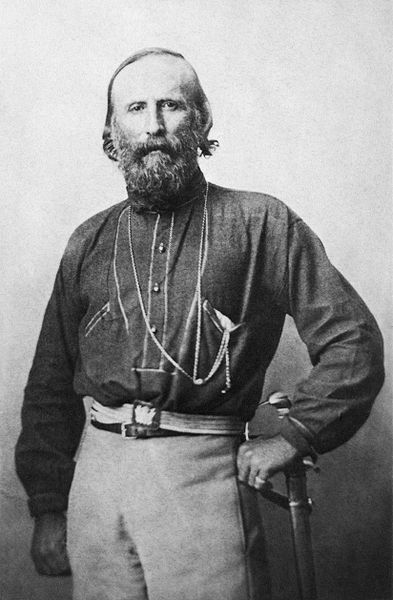
When Garibaldi was relaxing in Tennyson's garden during his visit to England in 1864, a wild-looking female suddenly appeared. Taking her for a gypsy, he is alleged to have sent her on her way – ironically with a biscuit. The lady was in fact the famous and eccentric photographer Julia Margaret Cameron who, upon hearing of Garibaldi's presence, had rushed from her nearby home desperate to take the great man's likeness.
This was just one incident in what appeared to be a triumphant tour of England for Garibaldi. Exactly why he came is uncertain, but he said it was in part to thank the English people for their support in the Risorgimento. This support seemed to have been consistent and of long standing. Certainly England had acted as something of a haven for Italian political exiles throughout the nineteenth century. How far this hospitality – together with undoubtedly sympathetic noises – had actually translated into concrete support for Italian independence, as opposed to accolades for Garibaldi personally, is the principal issue to be discussed in this article. It will be argued that, despite the support of individuals and the sympathies of the general public, the policies of British governments towards Italian unification were at best pragmatic. Inevitably the foreign policy of any country will normally be based on its own perceived best interests. In this context, Paul Hayes has argued that 'the interests of Italy were always seen through the filter of how they could be reconciled to British interests.'
Italian Exiles in England
The land and culture of Italy had long been of interest to the literate classes in England. As a result they particularly welcomed the first generation of Italian political refugees. Most came in the early 1820s after the failed Neapolitan and Piedmontese uprisings. Many were men of real talent. They included Gabriele Rossetti for example, the Dante scholar and father of two famous children (Christina and Dante Gabriele Rossetti). However, for every Rossetti there must have been many who made little or no impression in England and who went home, or to more favourable climes, as soon as conditions made this possible.
Perhaps the most noted Italian refugee was Giuseppe Mazzini, who arrived in 1836. Mazzini had joined the Carbonari secret society in 1828 but became disillusioned with aims which seemed vague except for the expulsion of the Austrians from Italy. In 1831 he founded 'Young Italy', designed to create one united, democratic, republican nation. This was a very ambitious aim in a land of seven different regions in which only Piedmont was actually ruled by an Italian monarch. Austria ruled Lombardy and Venetia and dominated the duchies of Parma, Modena and Tuscany. The Pope governed as a temporal ruler over the Papal States, while Naples and Sicily were ruled by a Bourbon monarch. Few people spoke Italian, and loyalties were intensely local – Sicily indeed had rebelled against Neapolitan rule in 1821, seeking independence for itself rather than Italian unity. While members of Young Italy tirelessly spread propaganda and fomented revolt, many of their early efforts were farcical. One general entrusted with the money to finance revolution in Piedmont gambled it away in Paris. Yet through his leadership of Young Italy Mazzini's fame spread throughout the peninsula.
Within Italy, however, there were alternative models for unification. Gioberti, for example, advocated a federation under the presidency of the Pope, while Piedmont sought to dominate Northern Italy by expelling the Austrians. Mazzini had been in exile since 1830; indeed he founded Young Italy in Marseilles. On his arrival in England he must have felt like one of many penniless revolutionaries with few prospects except poverty in a strange land. However, because of his renown, he soon found influential patrons and was lionised in literary and radical circles.
The affair which brought Mazzini, and co-incidentally the cause of Italian nationalism, most to public attention in England was the opening of his mail by the Post Office on the orders of the Home Secretary in 1844. The resulting public outcry led to committees of investigation in both Houses of Parliament. Greatly embarrassed by the affair, the Prime Minister was clearly lying when he asserted that the contents of Mazzini's mail had not been passed on to the Austrians. Even if the information did not directly lead to any executions, this was only because the Austrians already knew of the plots Mazzini referred to in his letters.
British Policy towards Unification
Official British policy towards Italian nationalism had been largely pragmatic. In 1815, at the Congress of Vienna for example, Castlereagh had both favoured an Austrian-British friendship and sought to preserve Italy from the French influence he feared independence would inevitably bring. The result was it best neutrality in the various revolts. Behind the scenes, however, Palmerston, who dominated British foreign policy in this, period, did try in particular to encourage despotic Italian regimes to reform; this, it was hoped, would make their subjects less likely to rebel against them. These attempts were wholly unsuccessful. Wider issues informed Government policy. It was believed, for example, that a strong Austria was needed to check Russian designs in the Balkans. Revolts against Austrian rule in Northern Italy, it was believed, could spread throughout the Habsburg dominions, which in turn would mean that Russia would be able to exert her influence in eastern Europe unchecked. Hence Italian revolts were not to be encouraged.
By 1848, however, Palmerston was beginning to realise that Austria's ability to control all its possessions was overstretched. He was even beginning to think that if Austria was expelled from Italy it would be more able to stop Russian expansion on its eastern borders. Nevertheless the 1848 revolts came as a shock: Palmerston had no idea of the depth of anti-Austrian and pro-nationalist feeling by this time in Italy.
Only with Austrian power in Italy in tatters in 1848 did Britain support the idea of a strong Northern Italian state as a bulwark against French influence. Palmerston suggested that Austria cede Lombardy to Piedmont, while Venetia should be given autonomy.
However, the Austrians came back, defeating the Piedmontese, who had made war on them, at Custozza in August 1848. This enabled them to take back their Italian possessions. When the Piedmontese broke the armistice in March 1849, the Austrians defeated them at Navarra, and their King, Charles Albert, seen as the champion of unity, abdicated. A Sicilian revolt was put down ferociously by King Ferdinand of Naples; he used the event as an excuse to suppress his own constitution and oppress opponents. The revolt in Rome of November 1848 led to French troops restoring the rule of the Pope the following July. It appeared that Britain's policies of supporting reform and minimalising foreign involvement had both been thwarted. Interestingly, it was possibly Palmerston's frustration with the failures of his policies which had led him to send arms to the Sicilian rebels before they were suppressed This led both to a public apology (apparently on the orders of Queen Victoria) and his enduring (and largely undeserved) reputation as the champion of Italian revolutionaries.
Unfortunately the iniquities of many Italian regimes would simply not go away. Gladstone alerted the British government and public to the appalling conditions in Neapolitan prisons after his visit in 1850. However, his concern was humanitarian rather than supportive of Italian nationalism. Indeed he was only slowly won over to that eventuality; certainly he was influenced initially by those such as the French politician Guizot who wrote to him that the choice lay between tyrants who would keep order and revolutionaries, like Mazzini, who would not. Gladstone must indeed have been speaking for widespread informed opinion in Britain when he argued that unity should come about as a result of a gradual process of reform. This was much at variance with all but the most moderate of Italian nationalists.
Help from Britain?
How far individuals involved themselves in the cause of unification in England varied. Any evaluation must, in part, be conjecture because many of their activities were secret. Some of the earlier exiles like Rossetti largely stayed out of active politics. Mazzini of course dedicated his life to Italian unification and by mid-century was very much regarded in England as the pre-eminent Italian revolutionary. Unfortunately he was regarded as too 'cloak and dagger', too sinister a figure for the British to take widely to their hearts.
Felice Orsini was found to have plotted the assassination of Napoleon III in England. He carried an English passport and five bombs, which later tests showed had been made in Birmingham. The Emperor was naturally furious at the English authorities' apparent unawareness of the plot. He tried to influence the House of Commons to pass Palmerston's Conspiracy Bill, which would have restricted the right of political refuge in England. Yet the Bill failed, in part because of resentment against this pressure An accomplice of Orsini was cleared to loud cheers in an English court of law. The Emperor must have been further angered when, after he had helped Piedmont fight the Austrians in 1859 and finally achieved their expulsion from the peninsula, Britain loudly condemned the secession of Savoy and Nice to France – again fearing French influence in Italy.
Before widespread interest developed in Garibaldi, the known impact of active British help in the Risorgimento was quite small. Mazzini certainly received less money than he had hoped from English sympathisers. For what it is worth, the British government estimated that about £20,000 had been donated before the end of 1852.
Garibaldi and the British
Garibaldi's invasion of Sicily and Naples in 1860 captured the imagination of the British in a way that no other Italian exploits had. Already, from the time of his defence of the Roman republic in 1848, Garibaldi had been feted as a hero in Britain. He had received a hero's welcome in Newcastle in 1854; this was somewhat to his bemusement as he had in fact arrived in the port as captain of the Commodore to collect a cargo of coal. As the decade wore on he became more and more a cult figure whose exploits were eulogised in books and poems of varying quality. It was easy then for the landings of the 'Thousand Redshirts' to grip the public. The Society of the Friends of ltaly sent money to be spent on arms and uniforms, and newspapers such as the Newcastle Daily Chronicle appealed for donations. It was estimated finally that about £30,000 was raised in Britain for Garibaldi's invasion. The Times correspondent Nandor Eber sent reports which combined the best of war reportage with glorification of Garibaldi:
'It is 2 p.m., and I am writing to you with the bombshells flying above my head through the air ... Garibaldi's star, so far from being on the decline, seems rising brighter every day and ... if Sicily becomes free it will be owing to him.
Some British volunteers were actively prepared to fight with Garibaldi. Exploiting his physical resemblance to Garibaldi, for example, Colonel Peard is alleged almost single-handedly to have tricked the Neapolitan forces into evacuating Salerno. Jessie White Mario nursed wounded fighters and, according to The Times correspondent, remained 3 6 hours in the first aid hospital at the Battle of the Voltuno and made 14 or more journeys to bring back the wounded.
The British Foreign Office also helped Garibaldi – largely by what it did not do. Lord John Russell, who had privately told Queen Victoria that there was nothing morally wrong in overthrowing the government of Naples, refused to accede to French demands to stop Garibaldi from crossing the Straits of Messina onto the mainland. He also refused to join with other monarchies in condemning the invasion. Of course Russell's policy was not entirely altruistic; he realised friendship with the new Italian government would facilitate trade between the two countries. However, one commentator said British support was worth an army of 100,000 men.
Garibaldi's visit to England in 1864
This then is the background to Garibaldi's visit to England in 1864. According to Denis Mack Smith, Garibaldi was 'in his time the most widely known and loved figure in the world'. He was feted wherever he went, and a provincial tour taking in at least 3 0 of the major cities was planned. Nevertheless Garibaldi's presence was in fact an acute embarrassment to the British government, not least because of the protests by the newly united Italian government itself In 1862 Garibaldi had led a march to capture Rome before being defeated by the Italian Government, opposed to such a move, at Aspromonte.
Official reactions to Garibaldi's visit can be found in a spate of letters between members of the Government and Queen Victoria. The Queen was concerned at both the enthusiasm with which Garibaldi was received and the embarrassment which might be caused foreign governments if he attacked them in speeches made in England. Palmerston meanwhile assured the Queen that the attentions of the aristocracy were keeping Garibaldi away from the society of those agitators 'who would have endeavoured to use him for their own purposes'.
Her Majesty, however, was not so sure; Garibaldi had been visiting foreign exiles and revolutionaries like Mazzini and Louis Blanc, the French socialist. She went on to worry about what her fellow sovereigns might feel about accolades accorded to one who sought their demise.
Palmerston recognised that Garibaldi had all the qualifications for making him a popular idol – dash, bravery, charisma – and, very important in the Britain of the mid-Victorian period, hatred for the Pope. He saw that it would have been impossible to dampen his reception among the lower classes. John A. Davis has shown why Garibaldi should have been so popular at this time. There Was, for example, an increasing awareness of foreign affairs and injustice abroad. In this scenario, Garibaldi was a hero because he fought against injustice ill the form of oppressive Italian regimes. There was moreover an ambiguity over Garibaldi's beliefs which inade him effectively all things to all men; apparently a radical and democrat, he nevertheless showed his loyalty to King Victor Emmanuel by handing over to him his conquests of Naples and Sicily.
The Visit and its Aftermath Garibaldi
was wildly popular with the working classes. An estimated half a million turned out to cheer him on his arrival in London. Servants at Stafford House, where he stayed, are alleged to have made a fortune selling small bottles of soapsuds said to have come from his washbasin. Leading trade unionists were instrumental in organising receptions for him. The great man himself may have been no democrat – he favoured what he termed 'honest dictatorship' – yet the point is that he was perceived as one. Although Palmerston had successfully turned Garibaldi over to the rich and famous to keep him away as far as possible from radicals, he must have been on tenterhooks that he might escape the net – and that his very presence might exacerbate dissent among the working classes at a time of economic hardship caused by the American Civil War and a resurgence of interest in political reform. Garibaldi, however, disappointed many who had hoped he might offer some support to British radicals: he stated that England already had individual freedom, freedom of conscience and freedom of speech – and presumably was not therefore in need of further reform. He also disappointed many by his acceptance, and apparent enjoyment, of the aristocratic society which had embraced him and 'neutralised' any problems he could have caused in more radical company.
In the event, it was a relief to the government when Garibaldi sailed away on 9 May 1864. Queen Victoria wrote to her daughter 'Garibaldi – thank God – has gone!'
Various reasons have been offered for the curtailment of the visit. Possibly it was because of poor health, or possibly it was due to the advice imputed to Gladstone, who as Chancellor of the Exchequer was concerned that his presence was costing businessmen lucrative contracts abroad, that he had outstayed his welcome. Some historians have suggested Garibaldi was disillusioned in England; he realised that little political support would be forthcoming. However, others have suggested that his provincial tours could have raised considerable amounts of money for the completion of Italian unification. Possibly his health was not up to an arduous tour. Probably his reasons for leaving were multi-causal.
In any event, interest in Italian affairs and Italian exiles waned as new issues such as imperialism and the growing power of the newly united Germany began to pervade the public consciousness. Italy and Italian nationalism had ever been seen through the funnel of British interests and what the British perceived as their own sense of fair play. While there did appear to be much sympathy and even theoretical support for Italian unity, particularly in the face of atrocities in Naples and elsewhere, there was little widespread understanding of the complexity of Italian politics. Garibaldi was often seen as a follower of Mazzini, for example, even though their programmes were different. If there was hero worship for Garibaldi it was due more to his own exploits and personality than what he really stood for, which again was imperfectly understood. British support for Italian nationalism was, in other words, more shadow than substance. The activities of committed individuals notwithstanding, any British reputation as the continuous active champion of Italian independence must be very seriously questioned.
Peter Clements teaches History at Benjamin Britten High School. He is the author of Prosperity, Depression and the New Deal (Hodder and Stoughton, Access to History, 1997).

