The Bourbon Restoration
Following Napoleon’s defeat at Waterloo, France’s Bourbon monarchy was restored. It was the first, fragile step in a diminished state’s return to the family of European nations.
The summer of 1815 was a turbulent one in France. On June 18th, the Battle of Waterloo brought to an end Napoleon's attempted comeback in the Hundred Days. Returning to Paris, he declared 'All is not lost' while taking a bath in the Elysée Palace, but he enjoyed scant support and was obliged to abdicate.
A visitor who went to see him to tell him to give up found Bonaparte 'calm and serene with a faint but gracious smile – he spoke with firmness and precision'. Instead of trying to get to America as some suggested, he threw himself on the mercy of the British, ending up in his second exile on the bleak South Atlantic outpost of St Helena.
At this point, two centuries ago, the victorious Allies – Britain, Austria, Russia and Prussia – would determine the fate of France. Their occupation army numbered 150,000 men. Their troops pitched their tents along the Champs-Elysées and frequently drunken British soldiers reeled through the streets of the capital insulting the French.
The Austrian chancellor, Metternich, came from Vienna, Tsar Alexander from St Petersburg and, from Berlin, the 72-year-old Prussian Marshal Blücher, whose intervention had been decisive at Waterloo. Wellington ruled as a pro-consul; he presided over weekly balls and annoyed farmers outside the capital by importing his pack of hounds and hunting with them over fields without warning or compensation for the damage caused.
In September the Allies held a victory march in the Champagne region followed by a series of banquets orchestrated by the chef, Carême, an ardent Bonapartist who adapted to the changing circumstances. The meal began with 300 plates of oysters followed by three soups, 56 plates of hot and cold hors d'oeuvres, 28 plates of beef, 112 plates of turbot, veal heads, chicken and vols-au-vent, 28 plates of roasts and salad, 56 plates of vegetables and 56 plates of desserts.
National treasures, which French armies had seized on their conquests, were reclaimed. The Prussians were the most set on revenge, looting at will. Occupying the Place du Carrousel at the end of the Louvre, they trained their cannons on the royal palace. Blücher proposed to blow up the Pont d'Iéna, commemorating Napoleon's victory over Prussia in 1806. Wellington posted a British soldier on the bridge, guessing correctly that Blücher would not risk killing him.
The Iron Duke oversaw the assembly of a government headed by the one-time revolutionary turned foreign minister to Bonaparte, Talleyrand, despite the king's dislike for him. Given his sinuous record as a go-between with the Allies against his master, the emperor, nobody trusted the gout-ridden survivor, but he seemed the best pilot in uncertain times.
***
Wellington also ordered the appointment as minister for police of Joseph Fouché, the one-time agent of the Terror and regicide, who had served Napoleon before intriguing against the emperor in 1814, re-joining him in the Hundred Days, negotiating secretly with the Allies and then stage- managing Louis' entry into Paris in 1815. The king had to accept, even if he remarked that he was handing over his virginity. Seeing Talleyrand making his way to a royal audience leaning on Fouché's arm, the writer- politician René de Chateaubriand described the pair as 'vice leaning on the arm of crime'.

While these two escaped paying the price of their pasts, revenge was sought against some who had served the Republic or the Empire. Fifty thousand officials lost their jobs and 12,000 officers were put on half pay. Members of the Convention who had voted for the execution of Louis XVI were banished, though a blind eye was turned to Fouché, who now showed his habitual lack of scruple by drawing up a list of people to be purged: 'He forgot none of his friends', Talleyrand remarked.
Since both the republican and imperial models were discredited and unacceptable to the victorious Allies, a royal restoration was inevitable; Wellington warned that there would be no peace in Europe unless the Bourbons mounted the throne again. The Congress of Vienna, held to define European frontiers after two decades of war, reversed Napoleon's conquests but was otherwise generous to France.
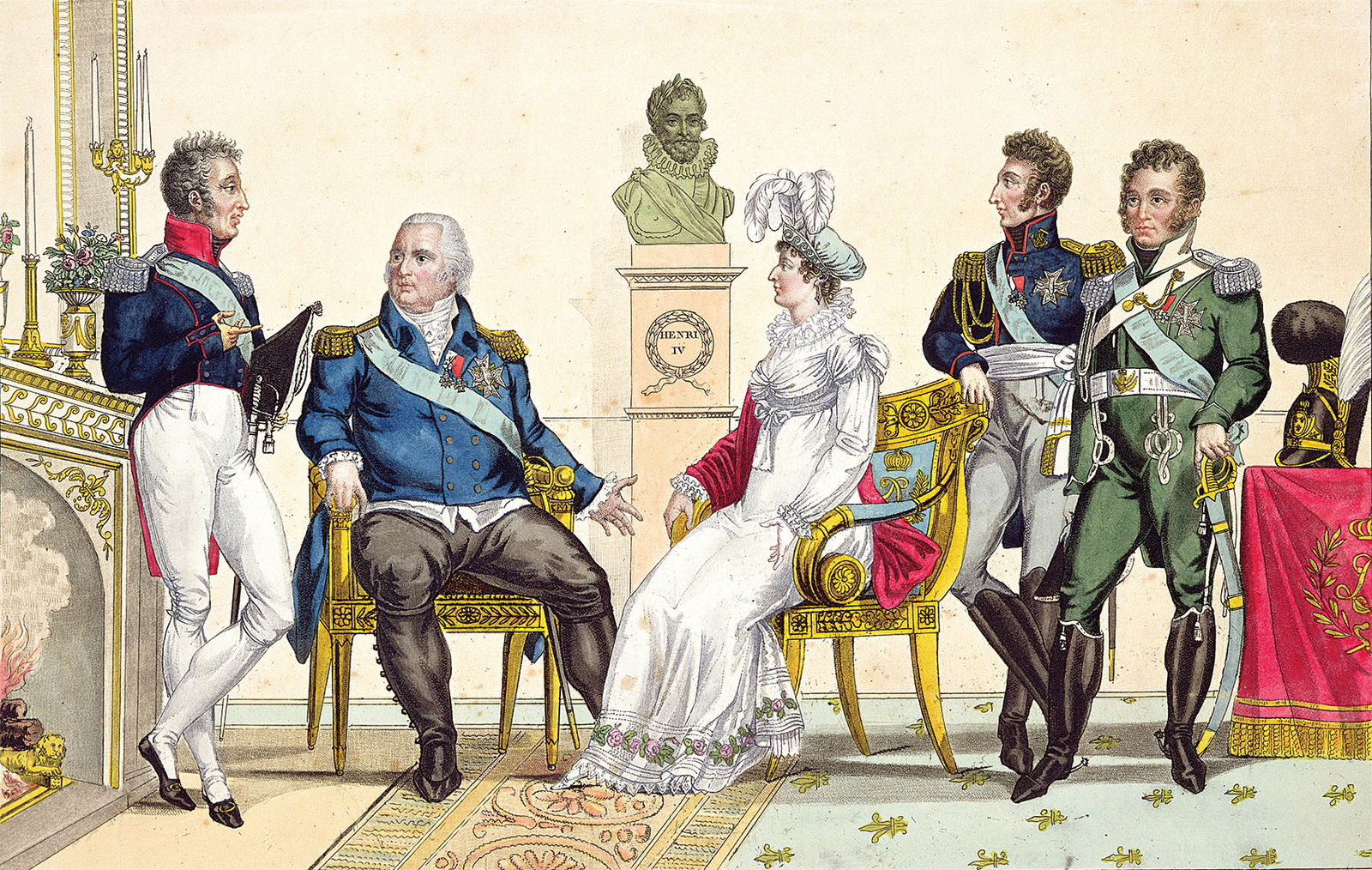
The new monarch, Louis XVIII, had made a poor fist of it on his first return from exile in Britain in May 1814. He surrounded himself with appointees who had been out of government business for more than two decades and the first restoration was brought to an abrupt end by the Hundred Days. Louis fled once more, to return three weeks after Waterloo. The crowds cheered as he was driven in his carriage to the centre of Paris on July 8th, 1815. A National Guard sergeant kissed his hand. The Treaty of Paris, signed with the victorious Allies, assured Parisians that they would 'continue to enjoy their rights and liberties'.
Louis moved in to the Tuileries Palace, with its succession of halls and apartments stretching down what is now the rue de Rivoli to the Louvre. Night-time balls were held in the gardens laid out by the great designer Le Nôtre. When the authorities tried to stop them to protect the lawns, the monarch called from the window 'Dance on the grass!'
The surrounding buildings were lit up at night. There were firework displays. Musicians strolled the streets. A charity kitchen fed the poor in the St-Antoine district. The restored monarch went to see plays at the Comédie-française and, each morning, courtiers gathered to listen to his stories, as he sat in a large armchair and gave them every opportunity to appreciate his wit.
***
Louis Stanislas Xavier Bourbon, grandson of Louis XV and brother of Louis XVI, became heir to the throne when Louis' son died in prison in 1795, probably of tuberculosis. Born in 1755, he had been a frustrated figure as Comte de Provence, dabbling in business but politically powerless. Fleeing Paris in 1791, he joined émigrés across the Rhine who participated in the abortive invasion of France. Then came 15 years wandering around Europe, including two in remote Courland in the Baltic, after which he came to rest for seven years in England.
Supporters dubbed him le Désiré (the desired one) but he lacked charisma and sought to avoid trouble. A heavy eater whose only exercise was whist and billiards, he grew extremely fat. Though usually calm, he could fly into sudden violent rages. In his sixties he suffered from diabetes, severe gout, varicose veins and skin ulcers.
His marriage to Marie-Joséphine of Savoy was a distant, childless affair; she suffered two miscarriages. An intelligent woman with a sharp tongue, she was ugly, washed rarely and became a heavy drinker. Her husband had a succession of close and witty women friends, including the clever Madame de Balbi, whose husband was in a lunatic asylum and who shared the king's taste for cards, and the well-rounded, amusing and somewhat fierce Countess de Cayala, a woman better known for her wit than her ideas but who knew how to be good company for the ailing monarch. A contemporary observer quoted the queen as saying that these relationships remained chaste. When asked to give sexual instruction to a royal duchess, she commented: 'If I tell her only what the King taught me, she will not know much.'
Rejecting Napoleon's view that he should exercise despotic rule, Louis fancied himself as father of the people, refusing to be 'king of two Frances'. He proclaimed his intention 'to call round our paternal throne the immense majority of Frenchmen whose fidelity, courage and devotedness have brought such pleasing consolation to our heart'. To try to forge unity in what remained of the armed forces, he presided over a banquet for 1,200 men given by the royal guards for the formerly Bonapartist Garde Nationale; at a return dinner at the Odéon theatre, he watched as 3,000 guests ate their way through Portuguese hams, turkey, quail, partridge, chicken, duckling and 600 plates of desserts all washed down with a bottle of wine for each person.
With a charter setting out rights for the richer sections of society, the king sought to win over bourgeois liberals and some Bonapartists, although, with an electorate for the legislative chamber limited to 75,000 men, democracy was still far off. Voting for the Chamber of Deputies was on a rolling basis with staggered five-yearly polls. A new upper house mixed old and new figures.
Civil rights, religious toleration and press freedom were guaranteed. Conservatives were reassured that 'abuses' would be controlled by Article 14 of the Charter, which enabled the crown to decree ordinances for state security in times of danger. Most importantly for the middle class and richer peasants, purchases of land taken from aristocrats and the church were left in their ownership. A police report found that barely ten per cent of the French favoured a return of the ancien régime.
Still, the king showed the limits of his tolerance by insisting on the white royal flag in place of the tricolour and dating his reign from the death of his brother's son in a revolutionary prison. Ministers needed majority backing in the Chamber but, when they presented proposals to the throne, they said simply 'Here is our opinion', to which the sovereign replied, 'Here is my will'. Royal statues were restored. Streets and squares reverted to old names. Church building underlined the monarchy's identification with Catholicism. The column erected by Napoleon to his glory in the Place Vendôme was torn down.
Ignoring the king's desire for national unity, royalists in various parts of the country exacted their revenge for events since the Revolution of 1789. In the region of Lyons, where Napoleonic sentiment still ran high, a portable guillotine was moved around rural areas. When General Charles de la Bédoyère, one of the last commanders to have left the battlefield at Waterloo, went to see his wife on his way to exile in Switzerland, he was recognised, arrested and shot. Marshal Ney, 'the bravest of the brave' in Napoleon's words, was sentenced to death and executed near the Luxembourg Gardens in Paris after himself giving the order to the firing squad to shoot; one of the 12 crack marksmen aimed wide.
Widespread violence by royalists and local criminal gangs led Fouché to warn the king that 'France is at war with itself.' The 'White Terror' in the Midi region in the south, where savagery between rival factions was rooted in the see-saw violence of the revolutionary era, saw brigands murdering and pillaging at will. Violence spiralled out of control in Marseilles and turmoil spread to Toulouse, Nîmes, Béziers and Uzès.
***
As well as the humiliation of defeat, France was suffering from manifold social and economic ills in the summer of 1815. In towns and villages alike, life was harsh for most people, 60 per cent of whom were illiterate. Infected water and lack of hygiene spread disease. Despite the efforts of the Jacobins to advance education nationwide, most people outside the Paris area communicated in the local patois; the port city of Toulon was known as 'the northern colony' because it was the only southern town where the national language was spoken by a majority of inhabitants.
There were great empty, silent spaces. Stepping down from a coach at a staging post just 13 miles from the provincial capital of Bourges in central France, the writer Stendhal was struck by the sense of 'complete isolation', while, a little later, the German poet Heinrich Heine found Brittany 'a wretched, desolate land where mankind is stupid and dirty'.
Rural people faced the continuous threat of bad harvests and hunger. Much of the countryside, where 90 per cent of the population lived, was a backward patchwork of small farms, hamlets and country towns, isolated by poor communication, high hills and mountains, wide rivers, swamps and forests. There was little to do except work and sleep.
Lack of transport and paved roads impeded the distribution of food and goods and peasants held on to what they had for fear of famine. Meat was rare; a pig had to support a family for a year. Peasants depended on the local nobility or teachers and priests to mediate with the authorities on their behalf and lacked a concept of a world beyond their immediate surroundings. Some men escaped to become day labourers in towns or travelling pedlars, but women were confined to the most humdrum, restricted existences.
The demobilisation of hundreds of thousands of troops swelled the underclass. Ex-soldiers joined outlaw bands that roamed the countryside. The Allies imposed financial indemnities on an economy that had been weakened by the demands of Napoleon's constant war-making and the effects of the British naval blockade. National output was below that of 1789. Eastern France had been devastated by the fighting.
Wages were low and farming stagnated. Barter was common in rural areas. For the better-off, income from land and interest from state securities took precedence over other forms of investment. Trade was at half the level of the mid-1780s. Banking and finance were hobbled by regulations and an unadventurous spirit. Only seven shares were quoted on the Paris stock exchange. Though the state debt was low, government credit was limited and capital remained scarce. The new regime was obliged to raise funds by a forced loan and pawning royal forests, but still faced a budget deficit of 300 million francs.
The Catholic church lost no time recovering from the setbacks of the revolutionary period, in which nearly all its 4-5 million hectares of land holdings had been confiscated and the priesthood had been reduced by more than 20,000 during the anti-Christian crusade from 1789 to 1793. The royal regime espoused religious values. Divorce was banned in 1816.
***
Despite its sufferings and exile during the Revolution, the nobility still possessed at least a fifth of all land; some aristocrats who fled abroad had used agents to secretly buy property requisitioned from their peers or from the church. On their estates they tapped in to pro-royalist sentiment among peasants and small holders, who had been alienated by the taxation and conscription of the Jacobins and the empire. But the promise and achievements of the Revolution were not forgotten elsewhere; the east of the country was indifferent to the Bourbons and, as would be seen with the Second Revolution of 1830, Paris remained a potential seedbed of revolt. As the writer Charles Louis le Sur put it, whatever its excesses, the Revolution would 'leave for ever great models as well as salutary lessons'.
Still, the election of the Chamber of Deputies in August 1815, on a tiny franchise, gave 'Ultra' loyalists to the throne 350 of the 402 seats. The new Chamber of Deputies was, the king remarked, more royalist than himself: he called it La Chambre Introuvable (The Unobtainable Chamber). The Ultras looked to Louis' brother, the Count of Artois, as their leader and anticipated the day when he would succeed to the throne. Their dislike of Talleyrand and Fouché led to the pair being dropped.
The new head of government was Armand de Vignerot du Plessis, fifth Duc de Richelieu, a grey haired, 48-year-old pipe-smoker with a yapping voice. He was a favourite of the Tsar after fighting in the Russian army against his fellow countrymen and serving as governor of the Crimea; he wore black boots and a black cravat in the Russian style. Having spent 24 years abroad, he did not know any of his ministers and was at the mercy of the Ultras, who pushed through legislation favouring the old nobility and clergy and instituting press censorship.

At the end of November 1815 a white-faced Richelieu signed the definitive peace agreement dictated by the Allies, lamenting that 'all is finished (by) this fatal treaty'. But, despite two decades of war, the conditions were far less draconian than hoped for by the Prussians. Although France lost some colonies to Britain, border modifications were minimal. French frontier fortresses were to be dismantled but were not taken over by the victors. The indemnity was set at 700 million francs, plus settlement of claims from individuals who had suffered from France's invasions. The occupation army was to remain for three to five years under Wellington's command, its food paid for by France. The Allies reserved the right to cooperate against any revival of 'revolutionary principles'. Russia, Prussia and Austria proclaimed their Holy Alliance and Britain joined them in the Quadruple Alliance.
France found a friend in Russia after Louis invited the Tsar to stay at the royal palace and served up three banquets, the cooking done by 35 chefs under the still-Bonapartist chef, Carême, who reflected that he had 'never done anything so beautiful; anger made me a genius'.
Alexander worried that the Ultras would provoke fresh revolution and his lobbying ensured that France held on to Burgundy, Alsace, Lorraine and Franche-Comté in the treaty. 'If France is still France, it is thanks to the Russians', wrote the Comte de Molé, another political survivor who had been Napoleon's justice minister but then held office under the Bourbons. Faced with Britain, Austria and Prussia, Russia 'had every interest in our remaining a power of the first order', as Molé noted.
France was on its way to being re-integrated into the European system. This reflected the country's continental importance; Europe could not function without it. The path to national recovery was faster than might have been expected in the summer of 1815, but what was plain was that the Hexagon between the Alps and the Atlantic, the Mediterranean and the Channel could no longer aspire to dominate Europe as it had sought to do under Louis XIV and Bonaparte. It had entered a new phase in its history with new challenges and the underlying question of how it would digest the heritage of the revolution which had been replaced in 1815 by restoration, but whose legacy remains vibrant to this day.
Jonathan Fenby's History of Modern France, from the Revolution to the Present Day was published in September 2015 by Simon & Schuster.