

Alexander the Great's Little Star
Frank L. Holt looks at the legends and realities of Alexander's bride from Central Asia, the world she lived in and the power struggles that ensnared her.
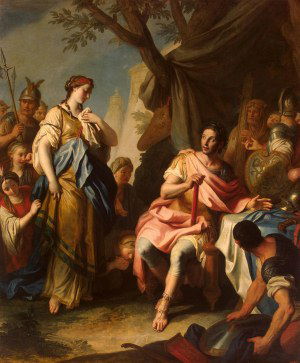
Perhaps no figure in human history has so overshadowed the age into which he was born as Alexander the Great of Macedonia. In his lifetime of less than thirty-three years, this extraordinary king inspired a legend that has now outlasted twenty-three centuries and even shows signs of gathering strength. Alexander the Great of antiquity is thus Alexander the Greater today. And it is not only in history and literature that his fame looms larger and larger. A decade ago, when Greek archaeologists unearthed a royal tomb said to be that of Alexander's father, Philip II, its contents became the centrepiece of an international exhibition with an indiscreet title: 'The Search for Alexander', If the young Alexander did indeed complain that he might never compete with the fame of his father, this grave has now (for the second time) laid his concerns to rest.
The total eclipse of his great father is only one example of Alexander's rise to pre-eminence. The shadow cast by the Conqueror has fallen across a very impressive crowd indeed. What might have been the 'Age of Philip', the 'Age of Demosthenes', or the 'Age of Aristotle' has become instead, irrevocably, the Age of Alexander. Though no man ever deserved his renown more than Alexander of Macedonia, this 'Great Man' approach to history (like the 'Great City' approach to archaeology) can obscure the past as a whole. In the case of Alexander especially, the 'Great' view from the top has too often inspired the 20-20 visionary. We must, therefore, lower our sights and have an occasional look around. There were, after all, many others of interest in this Age of Alexander. In fact, the German scholar Helmut Berve published in 1926 a monumental two-volume work which included biographical sketches of over nine hundred of Alexander's companions and contemporaries. His catalogue naturally includes such men as Demosthenes (#263), perhaps the greatest orator of ancient Greece, and Aristotle (#135), perhaps the greatest thinker. But if our duty as historians and archaeologists is to probe the past from many angles and many levels, then we ought to see Alexander's Age through the eyes of #688 as well.
Her life occupies little more than a page in Berve's mammoth encyclopaedia, but her sad and often savage story offers us considerable insight into a world torn apart by Alexander's 'greatness'. She was Alexander's captive, then Alexander's queen. It was her fate to be Alexander's widow far longer than she was Alexander's wife, and finally to be murdered because she was the mother of Alexander's heir. Her name was Rauxsnaka, meaning something like 'Little Star' in Persian, but to the Greeks (and so to us) she was called Roxane.
Naturally, her story (like her name) comes down to us from the Greek point of view rather than the Persian, and the meaning of her story (oddly reflected in her name as well) is generally lost in the blinding glare of Alexander's own stardom. Her side of the story is not easily seen, and so often we are lulled by the romantic stories of love at first sight and a life of leisure and royal splendour. But was it really the good fortune of this young 'Barbarian' girl to catch the king's eye in central Asia and so to be thrust into the wild centre of events which ended one era and began another? The answer may have little to do with romance, unless we happen to believe that all is fair in the love of war.
Roxane's story began somewhere in central Asia, and ended all too soon in distant Macedonia where she and her son, Alexander IV, were assassinated. At both extremes of her life, archaeological discoveries of recent years have given us fresh glimpses. In Soviet Central Asia and Afghanistan, archaeologists have uncovered at last the material culture of Roxane's Bactrian-Sogdian homeland. Numerous archaeological missions – French, Soviet, Afghan, and others- have braved the rigours of this environment to unlock its ancient secrets. The chance discoveries of the nineteenth century (the famed Oxus treasure now in the British museum is a notable example) have given way to the systematic surveys and sophisticated
At Takhti-Shanghin (the ‘Throne of the Stone’) near the Soviet-Afghan boarder, a treasure trove of temple offerings has lately been excavated which illuminates at last the Persian artistic traditions in Central Asia. Similar digs at Leninanbad, Smarkand, Ai Khanoum (Afghanistan), and elsewhere show the early development of this far frontier of the Persian empire. This work has disclosed the riches of this regions material culture, and forever destroyed the old notion that ‘civilisation’ was first introduced here by Alexandra and the Greeks. Instead it is clear that Sogdiana and its environs were enriched by at least some urbanisation and irrigation – the work of Roxane’s ancestors. The debate now is whether or not a flourishing civilisation preceded the arrival of even the Persians into central Asia!
It had been in the reign of Cyrus the Great (599-530 BC) that Sogdiana and Bactria were brought under Persian control. From that time on, Bactria-Sogdiana formed a single province, or satrapy, within the vast empire of Cyrus and his successors. There were nearly two dozen of these Persian satrapies altogether, from the Aegean coast in the West to the Indus valley in the east. In each, a satrap acted as governor and agent of the great king of Persia. During Roxane’s youth in the last half of the fourth century BC, the satrap of Bactria-Sogdiana was Bessus, kinsman of the great king, Darius III, himself. It is apparent that Bessus relied heavily in his duties upon the co operation of local aristocrats, particularly those in the northern reaches of sogdiana. These Sogdian nobles were like noble chieftains who ruled their own scattered districts while playing heed to their satrap and king. In the early days of Darius III and Bessus these chieftains bore names not yet famous: Spitamenes, Ariamezes, Dataphernes, Catanes, and Oxyartes - the father of Roxane.
Roxane was probably under ten when these matters began to change. The routine of a satrapal government was broken in the Autumn of 332. By a royal call-to-arms. Bessus received orders from Darius to muster all available men and bring them at once to Babloynia. There the king was making preparations to stop once and for all serious invasions to his empire. The intruders were and army of some 37,000 Greeks and Macedonians, moving steadily down the coast of Syria and Palestine toward the satrapy of Egypt. These troops had launched their attack upon Persia in 334 coming ashore in Asia Minor (modern Turkey) on the far western edge of the empire. There the invaders had defeated some satraps who had been ordered by Darius to meet the danger. The next year, 333 Darius himself had led his defenders at the seaside battle of Issus but his army was routed and he himself barely escaped. When his enemy refused to negotiate a truce, Darius decided at last upon full mobilisation and so now he was summoning even the satraps and soldiers of the eastern empire to help stop the onslaught of a young king named Alexander.
At this point, though, the great peril facing the Persian Empire was still half a world away from Roxane. She may well have been completely ignorant of affairs so far away, except now for the knowledge that Bessus was taking troops to help the king. But such alarms were sounded from time to time, especially since satrapies like Egypt in the west were prone to revolt and had occasionally to be reconquered. There seemed little chance that the current problem, whatever its nature, would intrude directly upon the inhabitants of the eastern empire. As before, the local levy would march away, and later some would return to tell their tales to those who had been left behind. This was probably the case for Roxane's father and three brothers in 332.
All was well when the men reached their rendezvous with Darius in Babylon, although Bessus had apparently aroused the suspicions of his king. It was said that the satrap was ambitious, and that his Bactrians were dangerously powerful. Darius was therefore dubious as to whether they were to be fully trusted. Yet, unruly though Bessus and his troops might be, the approach of Alexander made every man indispensable.
It was on October 1st, 331 BC, that battle was finally joined. Darius had moved his huge army north along the River Tigris to intercept Alexander's advance from the coast. At Gaugamela the forces met. The Persian plan of battle relied heavily upon Bessus, for his 10,000 cavalry were to bear the brunt of Alexander's attack, and, if possible, turn the enemy's flank. In the dust of battle, the Bactrians fought desperately but were unable to drive home their assault. Alexander parried the thrust and penetrated the Persian line. As the fighting continued, Bessus found himself rut off from Darius and the main Persian army. His situation was hopeless and his casualties high, so the Bactrian satrap broke off the engagement and withdrew from the battlefield. The day was lost in any case; Darius had also fled.
This was not the worst of the news brought back to Bactria-Sogdiana. The hopes of the empire shattered with his army at Gaugamela, the great king was forced to suffer further tragedies. Together with Bessus and the others who had escaped to the mountains of Media, Darius endured the reports of his enemy's relentless march down through Mesopotamia. One by one the great cities of Persia fell: Babylon, Susa, Persepolis. The heart of the empire was cut away from the vanquished Persian king. Darius' hold over his subjects was being lost as well. When Alexander resumed his pursuit of the king in the spring of 330, Darius retreated further toward the east. He planned, it seemed, to reach safety in the resolute strongholds of Bactria. But Bessus and his men seized the initiative and 'arrested' the king. Then, as AIexander's ominous advance was announced by dustclouds on the horizon, the Persian prisoner- king was murdered by the accomplices of Bessus. Alexander captured no more than a corpse, for the Bacteria’s got away. Alexander had not heard the last of Persian kings, for the Bactrians got their way: Bessus now was free at last to become great king himself.
This was the news brought home by Bessus after two years away from his province. Roxane must have been old enough now to appreciate the danger: the empire was falling; Darius was dead; and his killer (her kinsman) was now the new king. Worst of all was the certainty that Alexander and his army would follow Bessus into Bactria-Sogdiana. The war was no longer half a world away.
Roxane and her family, along with many other civilians, no doubt anticipated the danger and sought refuge in the mountainous hinterlands of Sogdiana. This understandable effort to escape the path of Alexander's army has been misrepresented in most classical sources. To the invaders, these Persian subjects seemed no better than wild beasts. They lived like savages in caves and crude shelters, quite unlike the settled sophistication of Mediterranean civilisation. This unfair judgement has led many to believe that only the arrival of Alexander brought true civilisation to the Bactria and sogdiana. That is simply not the case, as archaeological explorations have demonstrated. We must now correct the view of the ancient soucesin this regard, remembering that they describe the abnormal conditions of a world at war.
Indeed, we must remember how unnatural was everything for everyone involved. The natives were thrown into disarray by Darius’ death, Bessus’ plans and the presence of a Macedonian army. The invaders, too, found themselves in an alien environment to which they could not be reconciled. In fact the ranks of Alexander’s army were devastated on a number of famous occasions by freak snowstorm or sandstorms there. These men from the Mediterranean complained openly and often of their misfortunes in so strange and hostile place.
As Alexander pursued his rival to central Asia, Bessus the betrayer was himself betrayed. Oxyartes joined the other Sogdian nobles in this dramatic decision. The royal insignia were stripped from Bessus, and the man who would be king was delivered in chains to Alexandra. In Persian fashion, the nose and ears of Bessus were hacked off, and he was later executed for daring to usurp the Persian throne now claimed by Alexander.
The Sogdian world of Oxyartes’ family was now in the eye of the storm. A strange lull followed the bitter events that had beset this land in the past few years, a calm that would soon be broken by the worst destruction yet. The trouble started again when Alexandra and his army reached the Jaxartes River. This was the frontier of Alexandra’s newly won realm, with nomadic Scythians beyond. In an attempt to secure the boarder area the king decided to drive a wedge between the Sogdians and Scythians by founding a garrison-city there called Alexandra-Eschate (Alexandra ‘the furthermost’). This decision to seal of the empire was ill-conceived, for it violated the old age customs of these peoples. Under the Persians, Sodgiana had become a transitional zone between sedentary Bactria and nomadic Scythia. The Sogidans were integral to both cultures, and not willing to abide by this colonial interference by Alexandra.
The War which resulted was the longest and most of Alexander's career. The king himself was immediately wounded, and his warriors swiftly launched severe reprisals: all seven of the old Persian cities on the Jaxartes frontier were destroyed, and the surviving population enslaved to the Greek and Macedonian settlers of Alexandria- Eschate. The warfare escalated until it spilled from Scythia southward across Sogdiana into Bactria. Thousands of Alexander's men were lost; tens of thousands of the natives were killed or captured as slaves.
After nearly two years of this systematic slaughter the war began to settle down with signs of exhaustion among natives and newcomers alike. Late in the year 328, the leading figure among the Sogdian fighters was betrayed and beheaded – by his own wife, we are told. When the war-weary, blood-stained woman brought the head of her husband, Spitamenes, to Alexander's tent, the Macedonian king allegedly banished her from the camp lest she offend his 'mild-mannered' troops with her savage ways.
Shortly thereafter, in the early spring of 327, there came another sign that the fighting might finally be brought under control – at least for a while. When storming the mountain citadel of a stubborn Sogdian chieftain, Alexander's army captured a number of civilians hiding there. Among them was the family of Oxyartes, including young Roxane herself. Alexander first saw her at a banquet, where she and other Sogdian maidens performed a native dance to entertain the king and his staff. Roxane was said to be one of the most beautiful women in all of Persia, and Alexander allegedly fell in love at first sight. The king, however, acted with more restraint than was customary for ancient conquerors. He did not ravish Roxane, but rather announced that they were to be lawfully married immediately. A loaf of bread was brought forth, sliced with a sword, and tasted by Alexander and Oxyartes. With so much ceremony and no more, the two men sealed a most extraordinary fate for a young woman of fifteen or so.
What was it about Roxane that moved the Macedonian, now aged twenty-nine and nine years a conqueror-king, to take a wife at last? Why her? Why here? Alexander had refused to marry and beget an heir when advised to do so at the beginning of his reign. He had refused to marry into the family of his Persian toe, Darius III. He had rejected a marriage alliance offered by a Scythian king only months before he met Roxane. Some scholars have concluded that Alexander was simply indifferent towards women, at least until Roxane awoke his desires. Others insist that the king never cared for women at all (except for strong mother figures), but preferred men or Persian eunuchs. Like so much else about Alexander, his sexuality remains a subject of great controversy.
Whether love and romance were involved at all in Alexander's one- sided 'courtship' of Roxane, we may be certain that other factors were at play. It had been the practice of Alexander's father, Philip II, to marry frequently for political and military reasons – with each new war, he added a new wife. Philip's brides were often chosen from the noble families of his enemies as a means of undermining opposition and making allies of former adversaries. Now, for the first time in his own reign, Alexander found it expedient to follow his father's policy. The Sogdian campaign had become a long, frustrating drain upon Alexander's resources, and a means of extricating himself and his army from this troublesome frontier was desperately needed. As much a bribe as a bride, Roxane served well the purposes of her father and husband, a prisoner to politics (and perhaps passions) which were not her own. What she thought of this important diplomatic move we are, of course, never told: it is doubtful in those days that it really mattered. The sources only say that Alexander's officers were ashamed of the match, though they were afraid to raise objections. Only a short while before, one of their number – Cleitus 'the Black' – had voiced his disapproval of 'Barbarians', and of their growing influence over Alexander. Cleitus called the Sogdians 'wild beast', and was reluctant to remain among them as Alexander's satrap. His wish was granted vehemently – the king killed him in a brawl.
Under these strained circumstances, Roxane was carried away from her embattled homeland. The many thousands of Greek mercenaries left behind to occupy the region were no happier than Cleitus had been. They were mutinous and marauding almost as soon as the newlyweds had marched on to India. Evidence of this warfare has been found in recent Soviet excavations at Samarcand. We know, too, that Roxane's father, Oxyartes, fell under suspicion during these disturbances; though acquitted, Alexander ordered him removed from his native province and reassigned south of the Hindu Kush. For those who grew up in Roxane's world, it was an age of upheaval in central Asia rather than the dawn of civilisation.
The long journey upon which Roxane was now embarked remains a shadowy one since the historical spotlight following her husband seldom fell upon her. The excessive curiosity shown by the press and public for the private lives of modern royal couples was either lacking in antiquity, or such accounts were soon forgotten. We know only about Alexander's affairs with other women, as in the famous case of Cleophis. She was the captured queen of a small realm in India. Some sources say that her beauty won Alexander's compassion, and that the conqueror even fathered a son by her. Other accounts of Alexander's life as a married man focus upon his homosexuality, or even his impotence. As already stated, there is no clear, consistent picture of the king's private life or of his alleged liaisons with men and women. We can only be struck by Roxane's disappearance from the scene (except for one vague reference to a miscarriage in India) until the time of Alexander's death.
Whatever the truth about her husband's personal habits, Roxane's adjustment to life with him and his court must have been difficult. She knew little of the world from which he had come, and less about its customs. She probably could not even converse with her husband without the presence of interpreters initially. We must remember that she was not settled into a safe, royal palace, but rather carried along from campaign to campaign in a travelling court which largely disapproved of her. If she found happiness with her hero-husband as they marched further and further from her Asian home-and, history has not preserved a reliable word about it.
Pure romance, however, has a little to say in its own voice. The hasty honeymoon in Sogdiana, for example, later became the subject of a famous painting by the ancient artist Aetion. The picture was a great success with the crowds at the Olympic Games, and even travelled to Italy where Lucian saw it centuries later and gushed openly:
The scene is a very lovely chamber, and in it there is a bridal couch with Roxane, a very beautiful maiden, lounging upon it, her eyes cast down in modesty, for Alexander is nearby. There are smiling Erotes: one is standing behind her removing the veil from her head and showing Roxane to her groom; another like a good servant is taking the sandal off her foot, already preparing her for bed; a third Eros holds Alexander's cloak and is pulling him with all his energy towards Roxane. The king himself is holding out a crown to her...
Lucian duly notes that other Eros figures were shown frolicking with the king's armour, blatant symbols of Alexander's first love – war. This description inspired later artists, including Botticelli and Sodnma, to recapture the romantic scene.
The medieval version of the 'Alexander romance' also includes imaginative descriptions of the young couple's relationship. In this fantasy version of Alexander's life, we can read the king’s 'letters' to his mother Olympias about his Sogdian bride. And during the king's last days in 323 BC, we are told how 'Roxiane' doted upon her dying husband:
And Roxiane cried aloud and rent her garments and wished to fall at her husbands feet. Alexander moaned and groaned and placed his hand upon her, and gave her by glance into the care of his comrade Perdiccas.
Whatever in reality Roxane endured or enjoyed for four years as Alexander's wife, her dozen years as his widow were surly trying and treacherous. She was both brutal and brutalised during the power struggles brought on by her husband's untimely demise in Babylon. Alexander's reign gave way to confusion and catastrophe because the king did not leave behind a strong successor to build upon his conquests. Before the hero's body grew cold, his generals were already drawing swords. Some hoped to use Philip Arrhidaios, Alexander's addle-minded half-brother, as a makeshift Macedonian king. The opposing faction played a different hand – Roxane and the trump card she carried, an unborn child of Alexander the Great. Should a son be born, argued Perdiccas and others, the infant should hold title to his father's empire. Either five or seven months pregnant (the sources disagree), Roxane's life was thus insured for at least a while; anything more would depend upon the sex of her baby.
Roxane's pregnancy was a godsend in this dangerous period. She at least provided hope for the perpetuation of Alexander's dynasty, and that was – for a time – desirable. But Roxane could not be sure that she held the only key to the future of Alexander's family. A year before his death, Alexander had taken a second Persian wife, a daughter of Darius named Stateira. As soon as Alexander died, Roxane lured Stateira with a forged letter from the king. Caught unawares, Stateira and her sister were trapped by Roxane, given poison, and their corpses were hidden in a well. This story, told by Plutarch, has inspired one of the few modern works about Roxane's life, a seventeenth-century melodrama by Nathaniel Lee entitled The Rival Queens. Far from innocent, Roxane is here a vixen 'jealous, bloody, and ambitious' who plots her revenge surrounded by 'Zogdian slaves'.
Our ancient sources, however, make it clear that Roxane did not act alone, nor was she aided only by her Asiatic attendants. Perdiccas reportedly approved the plan, and made the plot possible. Because he was handed Alexander's signet ring at the moment of the king's death, it was clearly in his power alone to set the royal seal upon a forged letter. Furthermore, if Stateira was still unaware of her husband's death, the plot against her must have been formulated instantly by Perdiccas and Roxane. Roxane's motives may include both jealousy and fear. Stateira, after all, was a daughter of Darius and, should she also be pregnant, her child might hold a higher claim upon Alexander's throne. Perdiccas' motives are less clear. Perhaps he wished to avoid the complications arising from multiple heirs in his bid to control the succession. His preference for Roxane and her child may have deeper causes, but our sources reveal nothing about his earlier relationships with Alexander's wives. Having assisted in the assassination of Stateira, Perdiccas quickly arranged for a bodyguard to protect Roxane from a similar fate.
Our knowledge of Sogdian women, though slight, makes Roxane's crime believable. It was for both sexes an age of violence where survival was never easy. The stresses upon the noblewomen of the defeated Persian Empire must have been especially oppressive. They had been uprooted from places like Bactria and Sogdiana and made the captives, queens, and concubines of the victorious Greeks and Maccdonians. With only two exceptions, all of these women were repudiated by the conquerors and so disappeared soon after Alexander's death. What became of them, the daughters of the old Persian aristocracy, is a matter of very grim speculation. The two known survivors were both Sogdians: Roxane herself, and a girl named Apama, whose mother had decapitated her father Spitamenes during Alexander's war in Sogdiana. Apama became an honoured queen at the head of a great dynasty in the aftermath of Alexander's reign. She was a valuable political asset to her husband Seleucus in the same way that Roxane had been to Alexander, because Seleucus later became king over her Bactrian-Sogdian homeland. Roxane was less fortunate, for both her husband and homeland were lost and never to be regained.
For a wile, murder and motherhood secured Roxane's survival. The son she bore in 323 BC, was duly proclaimed king Alexander IV by the Macedonians, though the baby had to share the throne with his father's half-brother. Philip III Arrhidaios, as part of a compromise among Alexlander’s quarrelsome generals. Perdiccss' ambitions were partly foiled, and he was, assassinated amid further struggles in 320. Roxane and her son were therefore packed off to Macedonia in the power of other generals. There, in 319, the general Polyperchon invited Olympias, Alexander the Great's volatile old mother, to raise her four-year-old grandson- king. Roxane, still a 'barbarian' in the eyes of many, was apparently unsuited in the important task of training a Macedonian for the throne, and certainly Olympias (originally from Epirus) had done a creditable job with her own son some years earlier Alexandra IV was to be a purely Macedonian monarch, not a mongrel'. If Alexander the Great ever dreamed (as some still believe) of a fusion of east and west into one world government, his generals and most others of his generation- obviously did not. Roxane’s own family shows this plainly enough. Her father had remained in the east, while she and her son had travelled west to become trapped entirely in another.
The politics of the age pursued Roxane because they pursued young Alexander IV. Even vulnerable, the boy suffered a difficult reign. As one Byzantine source reports, Alexander IV gained little by his kinship to a great father. He was a mere figure- head, useful as a pawn or prisoner, but powerless to command. Unlike his father, Alexander IV left no legacy except a phantom reign useful to others for the dating of their state documents (a practice which continued as a matter of convenience for years after the boys death). Even his royal bodyguards were purely ceremonial. There are reports that he had to be shuttled away to Epirus in western Greece whenever there was danger, of which there was a great deal. In 3 l7, Alexander IV's co-ruler, PhiIip Ill, was executed by Olympias. Then, only two years later, Olympias herself was condemned and executed by the Macedonian general Cassander, who then imprisoned Alexander IV and Roxane at Amphipolis. The shadows were gathering fast. Roxane and her son were the last of the Alexander’s legacy, but now that legacy literally matured into a sentence of death:
Cassander now saw that Roxane's son Alexander was growing up and there were some who were spreading the word in Macedonia that Cassander ought to release the boy from custody and hand over to him his father's kingdom. Afraid for his own safety, Cassander ordered Glaucias, who was in charge of the boy's custody, to assassinate Roxane and her son, and to hide away their bodies.
In this passage from the historian Diodorus, we reach the end of Roxane's 'romantic' life amidst the realities of Alexander's age. With the final elimination of Alexander's family, the way was cleared for the conqueror's ambitious old generals to put all pretence aside. The empire they had helped Alexander to win could now be sliced up into separate kingdoms. Ptolemy established a dynasty in Egypt, while Seleucus did the same in Syria and the east. Macedonia eventually fell to the Antigonids, while lesser kings grabbed whatever they could during the ongoing wars if the successors. Once the dust had settled, these dynasties enjoyed for the next three hundred years the fruits of Alexander's epic invasion of the east.
It is under that settled dust that archaeologists are now discovering what life was like for those who witnessed the beginning of this new era of the successors, called the Hellenistic Age. The finds have been especially dramatic in the case of #688 in Berve's catalogue of Alexander's contemporaries. Just as recent excavations have allowed us to see the Bactrian-Sogdian world into which Roxane was burn, we can now at last see something of the rich and rugged Macedonian world from which she and her son departed. Important clues have come from the royal Macedonian cemetery discovered by Professor Manolis Andronicus at Vergina in northern Greece. There, three magnificent tombs ('one of them perhaps for Philip II) have yielded vivid evidence of Macedonia’s previously unheralded role as a great centre of ancient art. Greek archaeologists are therefore doing for Alexander's homeland what their colleagues have done three thousand miles to the east for the homeland of Roxane – they have dispelled forever the old notions that these regions, Macedonia and Bactria-Sogdiana, were once backward and barbaric states on the edges of civilisation. And by the ironies so common in archaeology, the tombs in Macedonia have also drawn these distant discoveries together. Buried in Tomb III of the Vergina cemetery were the cremated remains of a youth, about thirteen years of age and presumably a member of the royal family. This grave may well be that of young Alexander IV. His mother, ever an outsider in Macedonia, was apparently not granted royal burial at Vergina. Even so, intriguing reports have recently identified a tomb near Amphipolis as that of Roxane. 'The world must await the results of further digging, and the rewards of future discoveries in the lands of Roxane's far-flung life. From Soviet Central Asia to northern Greece, archaeology is now making us material witnesses to both the first and final steps of Roxane's incredible story. Born in one world, buried in another – this is the 'Age of Little Star' as archaeology and history help us to see it in the shadow of Alexander.

