

Æthelred: Ready to Rule
Æthelred the Unready was king of a divided nation that lived in fear of the ‘divine punishment’ of the Vikings. Piety and prayer became his weapons of choice.
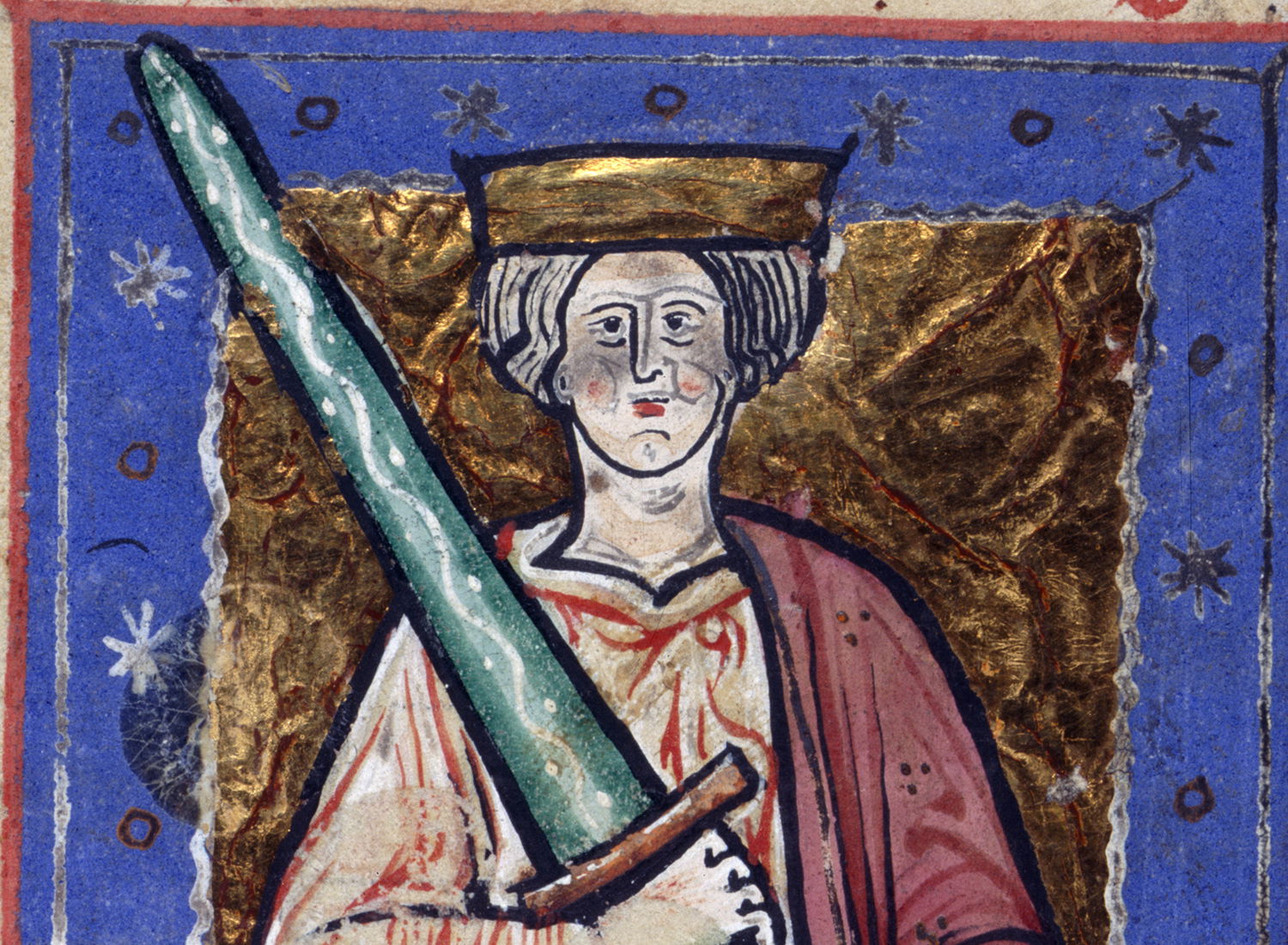
The reign of the Anglo-Saxon king Æthelred the Unready ended badly, paving the way for two and a half decades of Anglo-Danish rule by Cnut and his heirs. The need to explain this apparent failure was felt by contemporary writers. The most detailed account of these years, that of the Anglo-Saxon Chronicle, was written shortly after the events in an attempt to comprehend this disaster.
For the anonymous author, the blame lay above all with Æthelred’s advisers, who failed king and country repeatedly in their hour of need. Following the Norman Conquest, writers read this narrative and were quick to light upon it as evidence of the decadence and moral turpitude of the Anglo-Saxons. According to this perspective, propounded most influentially by William of Malmesbury (d. c.1142), it was Æthelred himself who was to blame for the Danish conquest of 1016 (and, in a sense, for the Norman Conquest 50 years later); it was his incompetence and impiety which brought this on. Such tales grew in the telling and soon it was all but impossible to distinguish the historical Æthelred from the rich foliage of legend that had grown up around him. Modern scholarship has had to work hard to prune this back, restoring Æthelred to something approximating his original dimensions. By focusing on the strictly contemporary evidence, we find a picture of Æthelred that is at once more rounded and more personal, one of a ruler who had his foibles, but nevertheless tried hard, often in the face of near impossible odds.
As with many historical figures, the key to understanding Æthelred lies in his youth. He was the third son of Edgar, who ruled England between 959 and 975. Edgar had enjoyed two other liaisons prior to his marriage to Æthelred’s mother, Ælfthryth, but this latter union amounted to something different. Alone among Edgar’s wives, Ælfthryth is recorded as ‘queen’ (a title which was something of a novelty) and theirs is the only marriage reported in contemporary sources. Ælfthryth herself was clearly a force to be reckoned with and she and Edgar are often mentioned acting together, not least as patrons of the monastic reform movement, which was gaining ground in these years. Her elevated status raised questions regarding the succession. Some saw her as more legitimate than her predecessors because she was Edgar’s only true ‘wife’ and ‘queen’, a legitimacy which in turn rubbed off on her offspring, who might be seen as more worthy of the throne than their elder half-siblings.
The early years
When Edgar died unexpectedly in 975, there was a succession dispute between Edward and Æthelred, his two surviving sons. The former was to prevail, largely on account of his superior age (Edward was between 13 and 16; Æthelred somewhere between six and nine), but two and a half years later he was killed by supporters of his younger half-brother. Although there is no direct evidence to implicate either Æthelred or Ælfthryth in this act – the first was a child and the other’s involvement is only mentioned in post-Conquest sources – it was to cast a shadow over the start of his reign. Indeed, wherever one places the blame, the uncertainty and tensions of these years must have left their mark and it may be that the suspiciousness that was to characterise Æthelred’s adult years has its seeds in these youthful experiences.
Æthelred’s early years on the throne passed remarkably quietly. His mother Ælfthryth; Bishop Æthelwold of Winchester, the leading reformer of previous years; and Ælfhere of Mercia, the kingdom’s senior ealdorman (the equivalent of a continental count or duke, or a later English earl), led a de facto regency in his name. The deaths of the last two in 983 (Ælfhere) and 984 (Æthelwold) brought this to an end. With Æthelwold’s passing, in particular, matters came to a head and over the next nine years Æthelred’s mother disappears entirely from the record. Whether her departure from court was enforced is unknown, but either way the consequences of this sudden change of course are clear: new figures (particularly laymen) rose to favour and were able to use their new-found prominence to take lands and rights from the church. This was a move against the politics of Æthelred’s previous guardians and against the legacy of his father. Of the four churches known to have suffered in these years, three were prominent centres of reform (Glastonbury, Abingdon and the Old Minster at Winchester, the latter two of which had been reformed by Bishop Æthelwold), while the fourth was Rochester, the bishopric of Ælfstan, an associate of Æthelwold and appointee of Edgar. It is clear that the young monarch was striking out on his own, defining himself against what had come before. This trajectory is not uncommon for new regimes, but the sharpness of the break is unusual and requires explanation.
The accession of a child placed unusual strains on the medieval political order, which was accustomed to the rule of an adult. Conflicts were common, as different groups jockeyed for power, seeking to exploit the king’s youth to their own advantage. As the monarch grew older and began taking the reins of power, these rifts often became more acute; it was in the interests of the king’s erstwhile regents to retain as much power and influence as they could for as long as possible, while the monarch was often keen to assert himself at the first opportunity. He tended to find support among the disgruntled elements at court and it was common for shifts of faction to accompany the boy-king’s coming of age, as we can see in the reigns of Henry III (1216-72), England’s next child monarch, and Henry IV of Germany (1056-1106).
If Æthelred hoped that breaking free from his regents’ shackles would lead to success, he was sorely disappointed. Soon after he took control, England was struck by disaster. In 986, the same year in which he is said to have ravaged Rochester, the realm was hit by cattle plague and, two years later, the Vikings arrived in the first of a series of attacks of increasing severity. When a larger Viking force appeared in 991, matters came to a head. This army sacked Ipswich (and perhaps also Folkestone and Sandwich, on the south coast) before meeting the local East Saxon levy, led by Ealdorman Byrhtnoth at Maldon.
The English suffered a decisive defeat and, in response, Æthelred and his counsellors were forced to pay tribute for the first of many times. This struck at the heart of Æthelred’s regime: it was the first major English defeat in living memory and, to make matters worse, Byrhtnoth himself fell in the fray. A poem was composed soon after these events to commemorate the fallen. It reads like an early medieval version of Tennyson’s ‘ The Charge of the Light Brigade’ – an attempt to turn military disaster into an heroic (if ultimately vain) stand. The Vikings themselves remained in the British Isles in the following years, making further incursions. After abortive defensive measures in 992 and 993, Æthelred sued for peace in 994, offering an even larger tribute if the raiders would stop, which, for the time being, they did. A number of them even entered royal employ as mercenaries.

In an era in which religion and politics were closely intertwined, such reverses were bound to cause concern. Edgar and the reformers – above all Bishop Æthelwold – had taught that success in this world was associated with royal and national piety. Æthelred had rejected these teachings and the results were clear for all to see: having sowed the wind (so it must have seemed), he was reaping the whirlwind. The king himself came to this conclusion in the wake of the disastrous Maldon campaign of 991 and in July 993 he issued one of the longest charters of his reign in which he expressed concern about the misfortunes that had struck his nation, associating these with his own recent indiscretions.
This charter is, in a sense, Æthelred’s Magna Carta: a promise to rule better, witnessed by the kingdom’s great and good. Its symbolism is enhanced by the fact that many of those present inscribed their own crosses on the surviving parchment (normally these details would be filled in by the main scribe). The charter’s appearance is commensurate with its political importance: it is one of the grandest documents to survive from the period. What is more, its text alludes to the Regularis concordia, a set of regulations on monastic life issued by King Edgar. Æthelred was thus expressing his renewed support for the politics of his father, mother and sometime regent Æthelwold in the very words in which they had once formulated them.
With this act, the tracks were laid for the politics of subsequent years. The basic principle was that the Vikings were divine punishment, a conviction which was to guide Æthelred’s actions for the rest of his reign. The following years saw the king restore a number of estates to churches despoiled in the 980s; the aim was to regain God’s favour. These were not the only efforts to do so. At Cholsey, then in Berkshire, a monastery was founded in honour of the king’s murdered half-brother, Edward the Martyr, while his veneration was also fostered at Shaftesbury, where his remains were ceremoniously transferred to a more exalted resting place in 1001. A number of other saints were also transferred in these years, including Æthelwold himself; the king and nation were invoking the assistance of the divine at every turn. All efforts were being made to promote the well-being of the church and high-ranking ecclesiastics figure prominently among the witnesses to Æthelred’s charters. The king had clearly learned the lessons of the 980s.

For a time it seemed as if these efforts had borne fruit: between 994 and 997 we hear of no further Scandinavian activity. The raids did resume, however, and from 997 until Æthelred’s death there are few years in which we do not hear of some form of incursion. Æthelred still held that these attacks were the wages of sin; his focus therefore lay in locating and eradicating such iniquity. The Scandinavian mercenaries who had entered royal employ in 994 came under particular scrutiny. Some of them had defected, leading to accusations of conspiracy.
Cockles amongst the wheat
In response, the king ordered that ‘all the Danish men’ within his realm should be executed on the feast day of St Brice, November 13th, 1002. This event, known as the Massacre of St Brice’s Day, was something short of ethnic cleansing in the modern sense: the Danes in question seem to have been recent settlers, probably elements of those mercenary forces which had proven so untrustworthy in previous years. Recent excavations in Oxford and Dorset have uncovered the bodies of a number of men of probable Scandinavian origin who had been violently executed and, though much uncertainty remains, a case can be made for associating them with this event. There was, in any case, more than power politics at stake. A charter issued two years after the event describes how the Danes had settled ‘like cockle amongst the wheat’, an allusion to the Biblical parable (Matthew XIII: 24-30), which likens the kingdom of heaven to the field of a man who has sown wheat, only to discover that his enemies have planted cockles (a weed) amongst them. The Danes are thus cast as enemies of God and man – and Æthelred’s actions as purification. This was, in a sense, a continuation of his earlier efforts to seek divine favour.
In the following years Æthelred intensified his programme of prayer, penitence and purification. The most dramatic event came in 1005-6. Following further Viking activity and a particularly severe famine, the king oversaw a systematic changing of the guard at court: some figures retired peacefully and others were executed or outlawed. This event, dubbed the ‘palace revolution’, has long puzzled historians. The Midlands magnate Eadric Streona (‘the Grasper’) clearly benefited, as he and his associates rose to take the vacant places at court. Nevertheless, the rationale remains something of an enigma. It stands to reason that this was another effort to purify English society. After the king’s own repentance in the 990s and the purge of the Danes in 1002 had failed, he turned on his own advisers, accusing them of undermining his regime, both morally and politically. A document issued at this juncture seems to confirm this. The foundation charter of Eynsham Abbey, produced in 1005, depicts recent Viking attacks as divine punishment and exhorts the English to ‘good works’; it would seem to follow that the king’s own actions constitute just such ‘good work’, intended to win God’s favour. Certainly the growing suspiciousness of Æthelred’s regime is hard to miss.

Like most seismic activity, this sudden shift in the political landscape was followed by a series of aftershocks. When, in 1009, a large fleet assembled at Sandwich to defend England’s shores, infighting soon broke out, led by one of Eadric’s brothers; the seeds of discord had been sown. Even after Swein’s conquest of England in 1013 and Æthelred’s restoration the following year, the effects of these events were still being felt. In 1015 Eadric – now ealdorman of Mercia – orchestrated the execution of the brothers, thegns Morcar and Sigeferth, the leading figures in the region, who were related by marriage to many of those ousted in 1006. This would seem to be the tip of an iceberg of intrigue. The king’s eldest son and presumptive heir, Edmund Ironside, took up the cause of the executed magnates, rebelling against his father, marrying Sigeferth’s widow and setting himself up in the north Midlands. As a consequence, the English were divided when Swein’s son Cnut arrived in late summer, hoping to repeat his father’s conquest of two years before. These divisions continued to dog resistance through the winter of 1015-16 and it was only shortly before his death in late April that Æthelred was finally reconciled with his son, who was himself to die later in the year.
Not ineffectual
What we are witnessing in these years is a regime unravelling under the weight of its own expectations. Logical though it may have been from the standpoint of 993 (or even 1016), the simple equation between the Viking raids and English sinfulness had ultimately undermined the kingdom’s defence. It directed the king’s gaze inwards, encouraging purges and recrimination when solidarity and stability were needed. This is not to say that Æthelred failed to undertake more proactive defensive measures. As we have seen, in 994 he brought a portion of the Viking force into his employ, a move which at least initially proved successful; he did so again in 1012. As a part of the first arrangement, one of the Scandinavian leaders, Olaf, agreed to return to Norway, where he set himself up as king in opposition to the Danish ruler Swein, who also had interests in the region. By dividing his opponents, Æthelred might hope to reduce pressure on his realm. Another part of this strategy was to seek the support of the rulers of Normandy, where the Vikings had sometimes sought safe harbour; a first accord was struck with Richard I in 990 and a more formal alliance followed in 1002 with Æthelred’s marriage to Emma, the sister of the Norman duke Richard II. More importantly, there is considerable evidence of fortification in these years: the ramparts of various centres were reinforced and, in a number of cases, mints were relocated to such sites to afford greater protection. All this is a far cry from inactivity and, while Æthelred himself was rarely at the frontline, he was anything but a ‘do nothing’ king. Indeed, even the payment of tribute, for which he later became so infamous, was only ever a last resort, used when other measures failed.
Still, one cannot escape the impression that such measures took a back seat. In the decrees issued at Enham at Pentecost in 1008, the construction of ships and maintenance of fortifications are ordained, but these injunctions come second to the overarching aim of cleansing English society. Similarly revealing is the response to the arrival of the largest Viking fleet yet in late summer 1009. Æthelred ordered an emergency meeting of his counsellors at Bath, at which they decreed a national programme of prayer and penitence, intended to secure God’s mercy and achieve ‘victory over our enemies and peace’.
These measures were accompanied by the introduction of a short-lived coinage known as the Agnus Dei. These coins bear the image of the Lamb of God (Agnus Dei) in the place normally reserved for the ruler’s own portrait, with a dove, the symbol of peace and the Holy Spirit, on the reverse. This was a visual counterpart to the prayers and masses instituted at this point, a further invocation of divine grace. The core message is hard to miss: Æthelred and his counsellors were looking to divine intervention in their hour of need.
Ultimate downfall
Such religious views were the stuff of which medieval politics were made. Æthelred was not the first ruler to respond to external threats with piety and prayer, nor would he be the last. In his case, however, the situation was exacerbated by the king’s own experiences in the 980s. The fateful coincidence that his years of youthful rebellion corresponded with the renewal of the Viking raids was to cast a long shadow; it led Æthelred and his advisers to endorse a view of these events as divine punishment to a degree otherwise unimaginable. In a sense, it is this that paved the way for the king’s ultimate downfall.
It would be wrong, however, to blame Æthelred alone for this. Contingency played a major part: had the 980s not played out as they did, matters might have been very different. Moreover, the conclusion at which Æthelred arrived in 993 was a perfectly rational one, at least from a medieval standpoint: God’s wrath was clear for all to see. In fact, it is questionable whether his father Edgar, who has gone down as one of the ‘good kings’ of English history, would have reacted any differently. Faced by plague in 962, Edgar’s response had been to issue a set of decrees calling the nation to amend its wayward ways.
In any case, the question of whether or not Æthelred was a ‘good’ or even ‘successful’ king – and, for what it is worth, he was probably neither – is beside the point. The task of the historian is to understand Æthelred, not to judge him. In this respect, his actions were neither as ill-conceived nor as ill-executed as is often supposed, even if they do not conform to what a modern armchair general would counsel. As long as the Vikings were viewed in moral terms, it was with moral weapons that they had to be fought.
Levi Roach is lecturer in medieval history at the University of Exeter and the author of Æthelred the Unready (Yale, 2016).


