
The Battle of Albuera
A major battle in the Peninsular War took place on 16 May 1811.
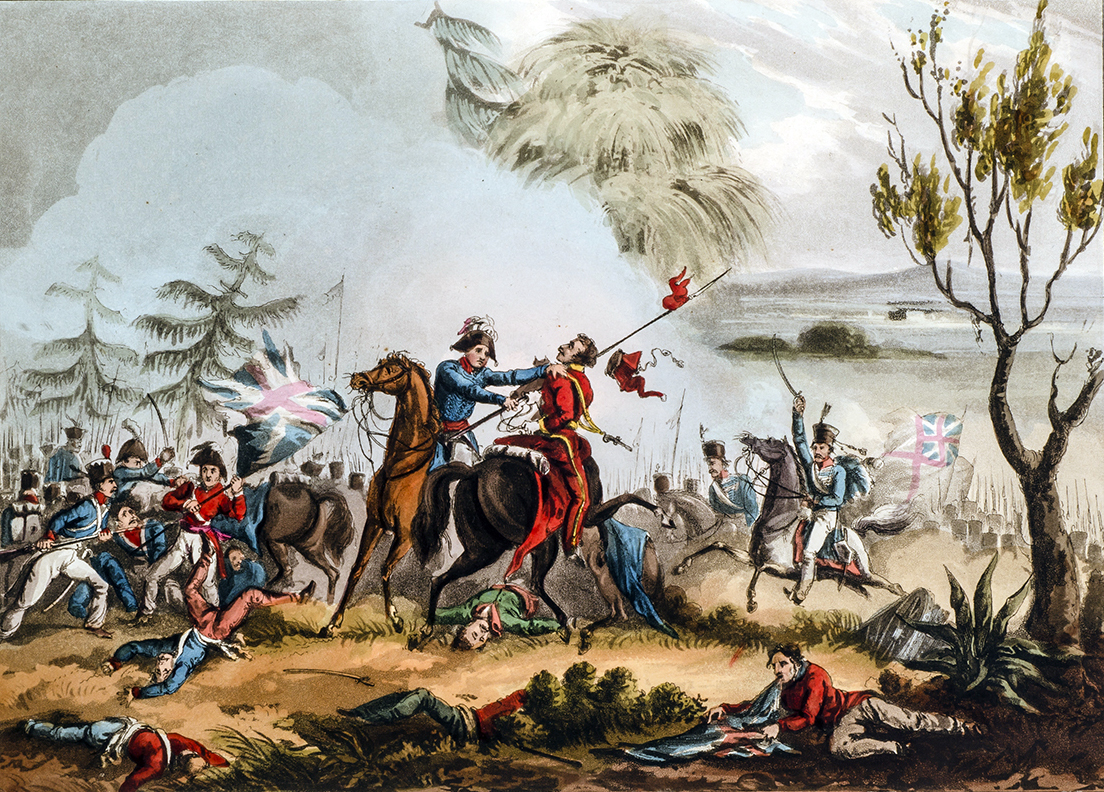
In relation to the numbers involved it was the bloodiest battle of the Peninsular War. The British under Wellington, with their Portuguese and Spanish allies, were defending Lisbon against the French under Marshal Masséna. Meanwhile Wellington had detached a force under Sir William Beresford to besiege the frontier fortress of Badajoz. In May Beresford discovered that a French army under Marshal Soult was moving up from the south with 25,000 men. He raised the siege and moved south-east to the village of Albuera to intercept them.
There was no doubt of Beresford’s personal courage, but as a field commander he was not in the same league as Soult. He had 35,000 men under his command, British, Portuguese and Spanish. Soult attacked the Allied centre, but it was a feint to distract his opponents while he moved men to outflank them on their right. When Beresford realised this, he took British infantry to counter the move, but they were savaged by Soult’s merciless Polish lancers and a hideous stalemate developed as the infantry of the two sides poured fusillades into each other at close range.
Beresford seemed at a loss, but a British staff officer, Colonel Henry Hardinge, rode over to one of the infantry commanders, General Lowry Cole, and urged him to attack, with or without orders. Though subjected to a murderous fire Cole’s men broke the enemy and after a ferocious struggle the French left wing was driven back. Both sides were now exhausted and the fighting dwindled away leaving a battlefield covered with dead and wounded and described at the time as ‘a slaughter house’.
The French lost more than 7,000 men, which compelled Soult to retreat. Allied casualties topped 5,000 and Beresford gave Wellington a gloomy report when the latter arrived three days later. Wellington, wary of public opinion at home, told one of Beresford’s staff: ‘Write me down a victory.’ The French had, after all, been thwarted. To his brother Henry, however, Wellington wrote privately that ‘another such battle would ruin us.’

