

John Cam Hobhouse
Gerald Morgan introduces Byron’s friend and executor; a radical Whig and head of the East India Company during the Afghan troubles of 1835-43.
Gerald Morgan introduces Byron’s friend and executor; a radical Whig and head of the East India Company during the Afghan troubles of 1835-43.
As Consul General for Great Britain in Egypt, Henry Salt established a friendly understanding with the free Albanian Viceroy Mohamed Ali. John Brinton describes how, through their relationship, Salt was able to rescue many treasures of ancient Egyptian art.
James Edward Oglethorpe obtained a charter for the founding of Georgia in 1732. Courtney Dainton describes how the English social reformer spent three terms as chief administrator of the colony and lived long enough to see American independence.
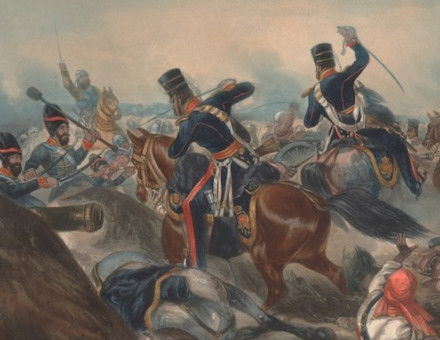
The Sikh Empire was the last strong Indian military power standing against Britain’s East India Company.
Patrick Turnbull writes that the Battle of Dien Bien Phu, which opened on March 3rd, 1954, and continued until early May, marked the end not only of French, but of European hegemony in Asia.
Europe knew little about black Africa, writes Steven R. Smith, until the trading voyages of the late sixteenth century.
Christopher Hibbert describes how the massacre at Cawnpore was one of the events in the Indian Mutiny not expected by benevolent British Commanders.
William Gardener describes how Russia's stealthy advance across Siberia led to close relations with China in the seventeenth and eighteenth centuries.
The term ‘Chimurenga’ has various historical associations. It was originally used to describe the first rising against British rule of the 1890s; the Rhodesian Bush War of the 1970s is known as the Second Chimurenga. J.V. Woolford, writing as the Bush War was ongoing, puts the term in context.
J.M. Brereton introduces Pierre Louis Napolean Cavagnari, a soldier of French-Italian and Irish descent, who played a distinguished part in British relations with Afghanistan, eventually costing him his life.