

Wu Chao: Woman Emperor of China
During the seventh century AD a Celestial Emperor’s concubine herself became Empress; in effect, she ruled China for 50 years.
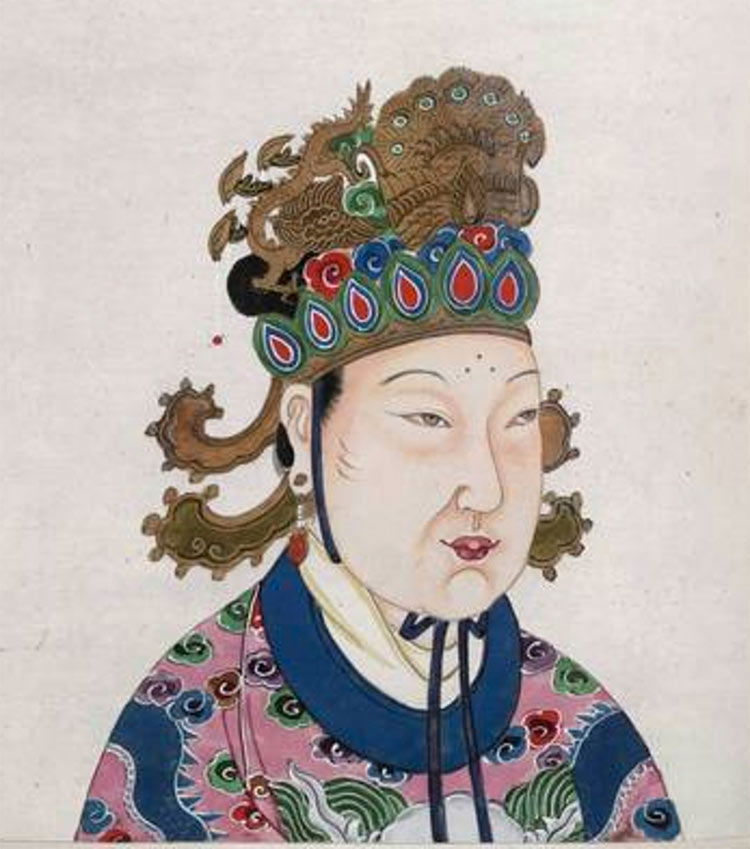
Wu Chao was the only woman to occupy the throne of China with the title and authority of Huang-ti, that is, Emperor, and her reign in the early years of the T’ang Dynasty (618-906) registered outstanding accomplishments. Yet her name is scarcely known in the West.
As woman emperor, Wu Chao is an anomaly in Chinese history: a woman performing the functions of the Son of Heaven, occupying what had always been considered a man’s place, and thus upsetting the Yin-Yang theory of harmonious relationships. Granted that her record includes acts of cruelty and malicious intrigue, not an unusual feature of Chinese imperial politics, the story of her life also shows her to have been an ambitious and intelligent woman whose skill in guiding the government of a great nation, and in wielding power, compares favourably with that of Catherine the Great or Elizabeth I.
Of Wu Chao’s early life little is known other than that she was born in Shansi, a province in central China, in 624. Her father had been given the title of duke for his services in helping to establish the dynasty. At 14, she was chosen to serve in the Emperor’s harem, where she joined some two hundred other concubines. The imperial concubines were ranked by grade; the Empress and four consorts held first grade and had been chosen from aristocratic and wealthy families.
For the lower ranks imperial agents selected from the provinces young, pretty virgins, particularly if they showed promise as dancers and singers. Both the parents and the daughters considered it a great honour to serve the Emperor in this way. Like many another girl, Wu Chao probably left home willingly, looking forward to the excitement that would surround her in the imperial palaces.
Emperor T’ai Tsung, whose imperial household Wu Chao joined, had succeeded his father, founder of the T’ang Dynasty. He was chiefly responsible for unifying the country after centuries of strife. He instituted reforms in the government, and reorganized the administrative system. In this new era of peace, the country opened up to foreign influences which led to innovations in the arts, literature, and religion. Cultivation of more land and the construction of new bridges and roads provided transportation for the produce and goods that supplied the empire. Trade flourished, especially in silk, wool and linen textiles, glass, and skins. Merchants travelled with their commodities on two highways between China and the Near East, where they exchanged goods with middlemen for supplies from as far away as Rome. This renewed prosperity marked the beginning of what came to be known as China’s ‘Golden Age’.
Changan, the capital, was a city of splendour, and for almost all Asians it represented the centre of power and culture. It was a walled city covering an area of about 30 square miles, and nearly two million people resided in it and in its suburbs. It also contained in its northern section two separate imperial walled cities, one where the Emperor, the only adult male, resided together with his Empress, concubines, and children; the other the seat of government where, in the Hall of Audiences, he met his ministers to conduct the affairs of the whole empire. Visitors, entering Changan through wide monumental gates, saw towering spires of pagodas, coloured tile roofs of great halls and palaces, sculptures, pleasure parks, and temples.
The imperial processions proceeding along the boulevard to welcome embassies at the gates were great spectacles. Traders arriving from oasis cities and the Near East, and entertainers and courtesans, particularly from Persia – all with their distinctive facial features and colourful dress – delighted the populace. Subject peoples sent missions bearing tribute, or gifts, to the Emperor. Their magnificent horses drew the admiration of all who saw them, and lions, ostriches, and rare birds aroused curiosity and wonder. The canal and road system made possible the establishment of two enormous markets in Changan, well stocked with merchandise and produce, which attracted merchants from India, Japan, Korea, Persia, Syria, and south-east Asia. In the lively foreign quarter, the Chinese sampled exotic foods, heard strange new languages, and saw ‘outlandish’ costumes and customs. Scholars and missionaries from around China and the Near East were rewarded by the cosmopolitan atmosphere of Changan. Emissaries and merchants from Japan and Korea saw new styles in dress and furnishings, and noticed developments in artistic fields; they carried back to their own countries many of these new fashions and ideas for adoption. Indeed, all of Asia keenly watched the events going on in China.

The Emperor T’ai Tsung, a middle-aged man when his attendants presented the young girl, Wu Chao, to him, was impressed by her beauty and bearing; he immediately named her Concubine of the Fifth Grade, a noteworthy honour. Like the other concubines, she had duties appropriate to her rank, such as supervising maids and eunuchs, and helping to prepare for rites and ceremonies. Her most important duty would be to share, when called upon, the Emperor’s bed. She also received instruction in music, art, and literature. Ambitious and quick to see an opportunity, Wu Chao used her new position to advantage. She soon discovered how to employ her charm and good looks, and before long she became one of the Emperor’s favourites.
In 649 the Emperor T’ai Tsung lay dying; consequently, the heir apparent, Kao Tsung (ne Li Chih), a good-natured young man of weak character, frequently went to the palace to receive instructions from his father. On one of these occasions he met and fell passionately in love with Wu Chao. Court gossip had it that she had intimate relations with him during that time. She must have been fully aware of what was to become of her upon the Emperor’s death: the dynastic law mandated that all concubines must shave their heads and enter a Buddhist convent for the rest of their lives. She could not have failed to see that an alliance with the heir to the throne might be her one means of escaping this fate.
After the Emperor’s death that year Wu Chao joined her sister concubines in the nunnery. A year later Kao Tsung, now Emperor, visited the temple to make sacrifice – burnt offerings – to his father’s spirit. By intent or by accident, he saw Wu Chao again, and the pair discovered that their attraction for one another had not subsided. It so happened that Kao Tsung’s wife, Empress Wang, had no son, but his favourite concubine did have one. Understandable rivalry existed between the two women. The Empress, aware of her husband’s infatuation for Wu Chao, urged him to have her released from the convent as soon as her hair grew back; she thought to use her against Pure Concubine (the favourite), whom she saw as the greatest threat to her position.
So Wu Chao returned to the palace, this time as Concubine of the Second Grade; within a few years, her name became associated with intrigues and scandals. Her promotion and security within the imperial household, she understood, depended upon her having a son, thus giving her an advantage over the Empress who remained without male issue. Two years later Wu Chao gave birth to a son, Li Hung, and the following year to a daughter. On this occasion the Empress Wang visited her; after she left, attendants found the infant smothered to death. There is some disagreement as to what actually happened: the usual account is that Wu killed her child and then proceeded to accuse the Empress of the deed by sorcery. On the other hand, it is possible that the baby’s death was a natural one. The Empress, already in disfavour for not having produced a son, had shown her jealousy of Pure Concubine, and now she saw Wu Chao threatening her position. But it would hardly have helped her situation to kill Kao Tsung’s child, especially a girl baby. Nor does it seem that Wu, already in the desired position of being the mother of a son, would commit such a crime.
It is evident, however, that she saw in the accusation an opportunity to strengthen the Emperor’s growing determination to depose his childless consort. He accepted Wu Chao’s explanation of the baby’s death without question. Later the unfortunate Empress Wang, a haughty, unpopular woman, turned to sorcery in an effort to oust Wu Chao and regain the favour of her husband. When sorcery, a heinous crime, involved the imperial household, the seriousness of the act increased enormously. The Empress and Pure Concubine, now her accomplice, were accused of attempting to poison the Emperor; their imprisonment followed.
Kao Tsung, emboldened by this development, next planned to depose his Empress and raise Wu Chao to the imperial status. To do this, however, he had to gain the approval of the officials in his administration. Many of them agreed to deposition of the childless Empress, but they wanted her supplanted by a woman of higher rank than Wu Chao. Finally, after many weeks of maneuvering and bribery, Wu Chao won their acceptance; the fact that the Emperor preferred her and that she already had a son was important. But more, the officials came to the conclusion that only she would give the ineffectual Kao Tsung the support he obviously needed. In 655, at the age of 31, Wu Chao became Empress, her family having been raised in rank in order to provide her with the proper credentials.
Several months later, when she began to fear that the deposed Empress and Pure Concubine might win their release, Wu Chao had them tortured and murdered. The ex-Empress accepted her fate; but Pure Concubine prayed that in the after life Wu Chao would be a mouse and herself the cat which would eat her. The records do not implicate Kao Tsung in this ugly deed. Wu, believing in reincarnation, ordered all cats removed from the palace. Ghosts began to haunt her at night, and horrible dreams plagued her. Finally, she persuaded the Emperor to move the court a few hundred miles east to Loyang, a city comparable to Changan in size, in physical appointments, and in cultural attainment. It had been the seat of government of previous Emperors, and now became known as the Eastern Capital, Changan the Western.
The administration had to be wherever the Emperor resided, and so frequent moves from one capital to the other took place. But for the most part, Wu Chao lived in Loyang for the next 50 years. As Empress she now took more responsibility in government, becoming familiar with its intricacies. Although she sat on her throne behind a screen, as custom decreed for an Empress, it soon became evident that she exercised undisputed power.
Nevertheless, the Empress looked ahead to the day when Pure Concubine’s son, the heir apparent, would succeed his father. Doubtful about her own security in such a succession, she decided to replace him with her own son, Li Hung. The Crown Prince sensed his uncomfortable position and quickly accepted the governorship offered him in one of the provinces. Thus Li Hung became heir apparent.
To offset criticism that might arise over the change of Empress and heir apparent, the Emperor issued a decree changing the imperial titles to Celestial Emperor and Celestial Empress, thereby surrounding them with a certain aura that made it difficult for adversaries to attack them. At the same time the Emperor ordered measures taken to impress and mollify the ‘common people’. He lowered taxes and set up a system for promotions and rewards. He returned to cultivation land from which farmers had been excluded, in keeping with the firm belief that the earth should be carefully ‘nurtured’. Mourning rites were expanded and revised to include special observances for mothers; previously only fathers had been accorded them.
The following year Wu Chao gave birth to still another son – later to become Emperor Chung Tsung, né Li Hsien. During her pregnancy, a famous Buddhist monk, Hsuan Tsang, stayed at the palace as the guest of the Emperor. The Empress sent him a note asking him to pray for her safe delivery. He later wrote her a letter reporting that he had seen a little pink and red bird fly into the imperial hall and light on her chair -– a good omen. After her son’s birth, Wu Chao honoured the monk with suitable gifts, and informed him that the baby would be called Prince Buddha Light.
She bore two other children later: in 662 the future Emperor Jui Tsung (ne Li Tan) and in 664 a daughter, Princess T’ai P’ing. She gave particular attention to her youngest child and evidently both she and the Emperor found enjoyment in her. When T’ai P’ing reached the age of 14, the Tibetans, in peace negotiations at that time, requested that she be given in marriage as consort for their King. To circumvent this, the Empress built a convent on the palace grounds and enrolled her daughter; thus the throne avoided offending Tibet by declining the honour. The imperial couple could not bear to have this girl go to what the Chinese considered the less civilized Tibetan court; after an interval, T’ai P’ing returned, of course, to the palace of her parents.
The Emperor became ill in 660 with a paralytic malady that seriously affected him for the rest of his life. When Wu Chao questioned the medical treatment he received, some people assumed that she did so not out of personal concern, but because she desired his death. This seems unwarranted, since she sent a Buddhist monk to India to persuade a well-known healer to return with him to Loyang, and to bring medical drugs also. In any event, Kao Tsung became even more dependent on his Empress. She had gained valuable experience by this time and knew how to administer the government. She understood the dependence of the economy on agriculture and on the uninterrupted transportation of its products; she showed her real skill in directing and guiding the court. Experienced officials admired her decisiveness and intelligent grasp of problems.
She, in turn, respected forthright presentations by them, and appreciated a well-argued point. Well informed, she vented her wrath on those who attempted to deceive her. Those who opposed her unreasonably, or by whom she felt threatened, were removed from office, banished to remote areas, or executed. So long as there were no rebellious upheavals to disrupt the supply systems, or famines from natural disaster, the Chinese did not condemn their ruler. Wu Chao had to move cautiously, however, because of her vulnerability. (It is noteworthy that some Chinese historians praise two men of the next reign, Yao Ch’ung and Sung Ching, as ‘model ministers’; these men began their careers and were high officials under Wu Chao, for whom the same historians have few good words.)
In 666 the entire court prepared for the journey to Mt T’ai, the most sacred mountain of China, to make sacrifices (ritual rites). Pilgrimages such as this were undertaken to invoke blessings on a monarch’s reign, and to pray for confirmation and continuation of the authority placed in him. The imperial couple stayed in important monasteries along the way. Indeed, the trip had special significance for the Emperor and his new Empress, and they triumphantly received the envoys from Japan, Korea, and southeast Asia who attended the rites. The time was indeed auspicious – China was at peace and food abundant. To mark the occasion, the Emperor granted promotions, awarded titles, and gave generous gifts to the aged. He and the Empress then visited the major sites as well as the birthplaces of Confucius and Lao Tzu.
There were times when Wu Chao went too far. Such was the case when she allowed a Taoist priest the freedom of the palace. He performed magical rites which some people considered to be sorcery. One of Wu’s enemies immediately informed Kao Tsung. Angered because she had exceeded her authority in a way that exposed him to loss of face, he threatened to depose her. She quickly approached him to deny the charges, accused him of not having confidence in her, and with charm and wiles soon won him over. He knew full well that he could not hold power without her; he relied on her superior intelligence to keep the throne; and moreover, he still enjoyed her beauty and the personal attention she gave him.
In order to enlist the support of the scholar class, Wu Chao became a patron of literature and commissioned a group, called ‘Scholars of the North Gate’, to produce books on a variety of subjects. Textbooks were needed, particularly for those taking the civil service examinations, a route into the bureaucracy; so also were books on procedures for state ceremonies and rituals, on music and poetry, and biographies of men and women. The scholars also prepared state papers, wrote speeches, tutored, became librarians, secretaries and officials.
A number of biographies of this period clearly indicate that appointments to high government posts increased respect for them. Regardless of her motive for enlisting their support, Wu Chao’s patronage raised the intellectual level of the bureaucracy. A picture of the life of that time is to be found in the poetry. Poems were written for almost every occasion; a romance, a birthday, a garden, a beautiful temple, the ritual pomp of an imperial audience, travel to distant places, and military expeditions. From the figurines and paintings found in tombs, it is evident that pleasurable diversions included singing and dancing, polo, football, and other sports. The costumes of the ‘barbarians’ (as foreigners were described) influenced a change in the dress of Chinese women from flowing robes to tight sleeves, low necks, and pleated skirts.
Religious tolerance made room for great diversity. Nestorian Christianity, Manicheism, and Zoroastrianism flourished at this time; Taoism had reached maturity; and Confucian scholars continued to be prominent in the State administration. The Buddhists found particular favour, and their influence began to extend to all levels of society. Although she does not appear to have been a devout woman, Wu Chao encouraged and patronized them. Their music and ceremonies attracted a wide audience, and the architectural design of some of their monasteries achieved a noteworthy excellence. The Buddhist approach to philosophy and art made a profound and lasting impact, especially on Chinese painting and sculpture. Translations of Sanskrit texts under the guidance of such Buddhist scholars as Hsuan-tsang led to the compilation of a Sanskrit-Chinese dictionary by another scholar, I-ching. This led also to the translation of books on medicine, herbs, and sutras, the sacred religious texts. The expanding need for such texts spurred the important new art of printing.
Empress Wu added at least twelve new characters to written Chinese. She changed, for example, the one for her own personal name, Chao. The components of the new character signified that sun and moon were illusory stars, and that she alone was the source of all light. A sutra has recently been discovered in Korea which has been positively identified because of this change of character for her name.
For many years the Chinese had tried by force to place the Koreans under their sovereignty. Literature and the arts were flourishing there and the Chinese considered it a civilized country. But Korea was part of and belonged to China, or so the Chinese reasoned. Emperor T’ai Tsung had struggled for a number of years to conquer it. Finally, the throne decided to make a concentrated effort and in 668 succeeded in achieving victory. Wu Chao could take credit for the victory, for her decision to take action and her planning had made success possible. For this extension of the borders of China, she has received more favourable comment than for almost anything else she accomplished.
A development in the inner palace now demanded the immediate attention of Wu Chao. Her niece had become the mistress of the Emperor. (A concubine had status, a mistress did not.) The girl’s mother had also been his mistress in her younger days, but such relationships never deterred Kao Tsung when he was attracted to a woman. Wu Chao felt threatened by this irregularity and no doubt jealous. She had been faithful to Kao Tsung; had she not been, her enemies at court would have revealed her infidelity. She did not intend to risk being deposed, and the niece was forced to leave the palace. When later the niece became ill during a dinner at her grandmother’s house, Wu Chao was accused of having had her food poisoned.
In 675 Emperor Kao Tsung suffered a second attack of paralysis, which left him incapacitated. He suggested to the court that his wife become Regent, but the court refused to set such a precedent. It looked as though the heir apparent, Li Hung, might soon accede to the throne. He was a bright and personable young man, very popular with the court officials and the people. He differed with his mother on certain issues, but there seems to have been no sharp rift between them. Much has been made of the fact that he died while visiting his parents at the summer palace. No details appear in the records to support a sinister interpretation.
The next in line was a young man who, it is asserted, was the son of Wu Chao’s sister. At the time he was born, Wu Chao had been glad to accept him as her own, thus increasing her advantage as the mother of more than one male child. He was carefree and lacking in leadership qualities, and given to occupying himself with wine, women, and song. Numerous reports came to the throne about his dissolute ways, and the discovery of illegal arms in his palace served as the occasion to demote and exile him to the provinces. The Emperor then appointed Chung Tsung heir apparent.
Kao Tsung died in Loyang at the age of 55 on December 27th, 683. He was buried there rather than in the imperial tomb in Changan, because, some whispered, it would help to avoid recalling the events that had surrounded the deposing of his first wife. In his will the Emperor requested that his successor defer to the Empress in all matters pertaining to military and civil affairs, thus publicly showing his faith in her. Ordinarily as the Empress-Dowager, Wu Chao would have stepped aside, but this statement authorised her continued official activity and presence.
On January 3rd, 684, Chung Tsung ascended the throne. The court did not trust or respect him, and he proved to be quite incapable of ruling. In less than two months Wu Chao, with the court’s approval, deposed him, and exiled him to a palace in one of the provinces. Her son, Jui Tsung, became nominal Emperor, though it was quickly understood by all that the actual imperial power would rest in his mother’s hands. Those forces supporting her obviously felt safer with her in control, and it is likely that her sons also recognized that their own security and comfortable life depended on her. Moreover, it is evident that neither had her ability or the qualities needed to conduct a successful administration. Had the throne been lost to them, all, including the officials supporting them, would have been removed, exiled, or executed, for such were the realities of loss of power. As Empress-Dowager Wu Chao continued to occupy the Emperor’s palace without any protest from her son. The populace accepted these irregularities because of the country’s general well-being and prevailing prosperity.
Spasmodic intrigues to break Wu’s control continued. A rather insignificant uprising of the nobility and their backers attempted to depose her, but the people and the military supported her, which confirmed for Wu her authority and power. She decided it was time for her to take the throne for herself alone. After all, she had made the decisions and had shouldered almost full responsibility for 30 years. Only the title of Huang-ti (Emperor) would give her that full confirmation. It would have been easy for her to exercise power, presumably on behalf of her son. Instead, she chose to have her position officially confirmed, and began to prepare to receive the Mandate of Heaven for herself.
In order to become Emperor it was necessary first to establish her own imperial house. Accordingly, she raised her ancestors to imperial status and erected an ancestral temple for them. She announced that her son, Jui Tsung, had a physical disability that made it difficult for him to fulfill his responsibilities as Emperor. Meanwhile, the less privileged classes had to be won over. She chose talented and able men from their ranks for her official family, men who would be devoted to her in return for the opportunity she gave them. This act changed the face of the bureaucracy, bringing in a whole new group and decreasing the hold of the old aristocratic families that had held power since the beginning of the dynasty, and who awaited any opportunity to oppose her. Fearful of rebellion, however, she introduced an informer system whereby documents were scanned for offensive material, reports of any conspiratorial acts forwarded to her, and even guilt by association could end a career. The purpose was to terrify the bureaucracy into submission.
The first public indication of Wu Chao’s design for gaining the throne occurred at a lavish ceremony held in 689 at the Ming T’ang (Hall of Light), an amazing, imposing structure which she had commissioned. There she sacrificed to Emperors T’ai Tsung and Kao Tsung, and to her own father whose title (Emperor) she had awarded him posthumously. The Buddhist clergy produced a sutra, called Great Cloud Sutra, which glorified her. She received a petition the following year from Emperor Jui Tsung, asking that the name of the dynasty be changed from T’ang to Chou. All members of the court supported him in this, and she personally announced the change from the tower of the Tze T’ien Men.
Jui Tsung abdicated and, on October 16th, 690, Wu Chao was proclaimed Wu Hou Huang-ti, Holy and Divine. The dynastic change of name and her new title symbolised her personal triumph. In the Great Hall of Audiences, no longer behind a screen, but openly on the throne, she held court. Before her appeared envoys and visitors from far and near, officials of the court, and those of her subjects who conducted the business allotted to them.
Now having reached the peak of her ambition, Wu Chao began to devote attention to other than political matters. She became a direct patron of the arts. Architecture had always engaged her lively attention, and now she readily approved plans for new temples and pagodas. A luxurious summer palace was built for her in the beautiful hills outside the city of Loyang. She journeyed to Wu T’ai Shan, a mountain sacred to the Buddhists, where two hundred years later Ennin, a famous Japanese Buddhist monk, reported seeing four iron pagodas that had been erected by her order. Sculptured figures of the Buddha could be seen in every district, as well as a monumental statue erected in Loyang, which history has noted for its artistic merit.
The empress was also a collector: paintings, calligraphy, sculpture, and pottery were to be found in her palaces and in the Hall of Audiences. Her patronage had many other felicitous effects. The modelling of figurines, thousands of which were deposited in tombs according to the rank of the deceased, kept the craftsmen of the day busy; the variety of faces and costumes presents a picture of the changing scene on the streets of Changan and Loyang. Still other artists were absorbed in satisfying the new demand for Buddhist icons and paintings. Stone carvings in many cave shrines - discovered early in this century - are examples of the Chinese artistic ability to work with stone as though it were clay. In 695 an octagonal bronze column, the famous Celestial Axis Monument, was constructed in honour of Empress Wu. A Persian Nestorian Christian, A-lo-han (Abraham), took charge of its execution. Unicorns were carved on its base, bronze dragons surrounded it, and a phoenix in gold leaf, the symbol of the Empress, surmounted it; Wu Chao wrote the inscription for it.
To measure time accurately had been the goal of inventors for a long time. One artisan travelled many miles across the country to ‘present a “Wheel for Reporting the Twelve (Double Hours)” to Empress Wu. When this clock was in exact south position, a door opened and a jack with a horse’s head appeared; the wheel revolved round the four directions (as time passed) without the slightest mistake.’
In her late sixties, Wu Chao accepted a lover, a man named Hsueh Huai-i, who sold cosmetics, then in great demand. To enable him to frequent the palace easily she made him a monk, and then the abbot of a famous Buddhist shrine. He also helped to build the Ming T’ang; for this he received honours and the Empress gave him expensive gifts. In time he became corrupt, arrogantly disregarding Buddhist practices, as well as offending members of the court and imperial household. Angered by some grievance he set fire to the beautiful Ming T’ang and it burned to the ground. Now at last Wu Chao believed the many adverse reports about him that had come to her; by her order he was put to death.
Invasions occurred in 676-78 in Hopei province on the northern border, first by the Khitan and then by the Turkish tribes. Their success in penetrating China was a blow to the imperial prestige. Popular unrest soon developed and the Empress acted quickly. First, she made changes in the military leadership; she removed her nephew, an officer mainly responsible for the inadequate defence, and supplanted him with an able and experienced general. To placate forces ready to use her usurpation as the cause of the deteriorating situation, she recalled Chung Tsung, the first son to be deposed, from exile. She appointed him commander-in-chief of the expeditionary army, whose chief function would be to raise troops for the front. This he successfully carried out; the Turkish tribes withdrew when faced with a formidable and disciplined army. Chung Tsung remained in the capital but without any other duties.
Troubles had been brewing between members of the Wu and Li families. The issue was that of succession. Although Wu Chao owed her family nothing, certain members of it entertained hopes of succeeding her. On the Li side, Kao Tsung’s nephews, supported by the dissatisfied old aristocratic families, reasoned that they were the rightful heirs, now that Wu Chao’s two sons had been deposed. After the usurpation, the Empress had appointed Jui Tsung to be the heir apparent. She obviously considered him more capable than Chung Tsung. She did, not, however, want her Wu relatives to be annihilated in a new reign, and so she called both sides together and made them swear an oath that they would live in peace after she died. The oath was stored in a box and deposited in a Buddhist temple.
Early in the dynasty, medical assistance to the indigent sick had been organized under the auspices of the Buddhists. In fact, the spirit of charity which they introduced was interpreted concretely by princely houses. They founded hospitals and dispensaries, and granted funds for the care of the mentally ill. Wu Chao in 701 created a lay commissariat to administer to the sick through state hospitals. Annexed to monasteries, these havens were supported by the yield of certain monastic lands called ‘fields of compassion’.
During the last years of Wu Chao’s rule, two brothers with the surname Chang became her favourites: eventually they gained influence, notoriety, and power, and finally brought down her reign. Sophisticated young men, they introduced literati to the Empress’s summer palace. There, away from court etiquette, Wu enjoyed the intellectual and social atmosphere surrounding her, and she gave less attention to official matters. But soon the brothers began interfering in politics; the Empress did little to restrain them. It became increasingly impossible for officials to meet her, partly because of the difficult journey to her residence in the hilly country outside the city, and also because the Chang brothers stood guard over her. The aging Empress, often ill, seemed to have lost interest in her administration.
Many officials’ careers were ruined through the influence of these brothers: the powerful minister, Wei Yuan-chang, a man who had been her most respected adviser, suffered from their false accusations, and not until they suggested his execution did the Empress rouse herself to stop them. She seemed oblivious to the hatred and antagonisms they engendered. The son and daughter of Chung Tsung disliked and resented the Changs’ influence over their grandmother. Some records indicate that Wu Chao, when informed by the Changs that her grandchildren were plotting to overthrow her, ordered their suicides. Yet, in recent excavations of the magnificent tomb of this girl, Princess Yung T’ai, it is stated on her coffin that she died in childbirth at the age of nineteen.
Still blind to the role the Changs played, however, the Empress had clearly lost her grip. The court took matters into their own hands, ordered the execution of the Chang brothers and many of their associates, and forced the abdication of Empress Wu. She moved to a sumptuous palace on the fringes of the Imperial City for the remaining months of her life. That she was still held in esteem and respect is evident from the fact that the reinstated Emperor Chung Tsung and his entire court visited her there, as did ministers and other officials. (Chung Tsung was murdered by his wife a few years later, and Jui Tsung again became Emperor.)
This complex and brilliant woman died at the age of 81. Her cruel actions cannot be denied, but it should be remembered that greater attention has always been given to that aspect of her reign probably because she ruled in defiance of established order and belief. What is truly astonishing is the fact that, despite the opposition to her imperial position, Empress Wu ruled a vast empire successfully for 50 years. She reformed and strengthened the government and had the intelligence to grasp the dynamics of imperial rule, and the ability to understand and master much opposition, not always by violence, but by alertness of mind. The people of her time enjoyed amenities of life they had never before known and, due in part to her long reign, women had greater freedom than at any later day. She helped prepare the way for the supreme achievements of T’ang culture, and for the recognition of the Chinese as among the most civilized peoples of the world.
Wu Chao had been the concubine of Emperor T’ai Tsung, the mistress and then the wife of Emperor Kao Tsung. She was the mother of two Emperors, Chung Tsung and Jui Tsung, and the grandmother of Emperor Hsuan Tsung. Above all, as Wu Hou Huang-ti, Emperor of China, she deserves to rank in history with the two outstanding T’ang emperors, T’ai Tsung and Hsuan Tsung.

