

William Harvey and the Circulation of the Blood
Geoffrey Keynes describes how the reception accorded to Harvey’s great book in 1628 proved him to have a creative genius that could leap ahead of his contemporaries.
 If ever a book of outstanding importance to mankind crept quietly into the world, it surely was Harvey’s Exercitatio anatomica de motu cordis et sanguinis in animalibus, published at Frankfort in 1628, when its author was fifty years of age. The exact date of composition cannot be determined, since Harvey had already “for nine years and more” been promulgating his views about the circulation of the blood in his anatomical lectures and demonstrations at the College of Physicians. If, however, the book was finished by 1627, some thought would still be needed before it was put into print. Harvey was never eager to publish his work to the world, but this particular book he knew was soundly argued, complete in itself and of very great importance as a leap forward in man’s knowledge of his own body, that is, in human physiology. He would naturally discuss its publication with his friends, and one of these was Robert Fludd the Rosicrucian.
Fludd had written a number of books, and from 1617 onwards had always given them for publication to Johann Theodore de Bry of Frankfort. When de Bry died in 1626, the business passed to a young Englishman, William Fitzer, who then took over de Bry’s stock and publishing interests. Fitzer was born about the year 1600 at Broadway, five miles from Worcester, the family having been established in the district for a long time. He was educated at the King’s School, Worcester, and in 1616 was apprenticed for seven years to a London bookseller, Thomas Man; he was granted the freedom of the Stationers’ Company in 1624, and soon afterwards moved to Frankfort. In 1625 he married de Bry’s daughter, and so, as a member of the family, naturally succeeded to the publishing business at his father-in-law’s death a year later.
Fludd, by the esoteric nature of his books, had laid himself open to the charge of practising forbidden arts; and a pamphleteer, writing in 1631, said of him that he had “beene written against for a Magician, and 1 suppose this to be one cause why he hath printed his bookes beyond the Seas”. But Fludd had better reasons than this. It seems likely that he advised Harvey also to employ Fitzer, partly, perhaps, because of the larger public to be reached by a book published abroad, but also because Fludd himself had found he could get better terms there than at home. Of his own books he said: “I sent them beyond the seas because our home-born Printers demanded of me five hundred pounds to print the first volume and to find the cuts in copper; but beyond the seas, it was printed at no cost of mine, and that as I could wish. And I had 16 copies sent me over, with 40 pounds in gold as my unexpected gratuity for it.” These arguments would weigh with Harvey; and he decided to send his manuscript to Frankfort for Fitzer to deal with as he thought best. This decision was undoubtedly right if Harvey wished to achieve a wider dissemination of his views than could be expected from publication in London; but in other ways it was unfortunate. If Fitzer received a manuscript draft of the book written by Harvey himself, difficulty must have arisen over deciphering his illegible hand. Distance and the state of war on the Continent would prevent easy communication between author and publisher; and it is clear from the number of misprints in the first edition that Harvey can have seen no proofs. When he did first see the finished book, he must have been appalled at the number of mistakes it contained. Another misfortune was Fitzer’s frugal mind. It would admittedly have been difficult for him to appreciate the importance of this apparently insignificant book, and he therefore economised on the production. He had it printed in a small mean type on paper of such poor quality that in most copies it has turned dark and crumbled. Only fifty-five copies are known to have survived to the present day, scattered through the libraries of the Old and New Worlds. Fortunately Fitzer did have a few copies printed on thick paper of good quality, such as those now in the Hunterian Collection in the University of Glasgow, and at Magdalene College, Cambridge, but of these very few are known.
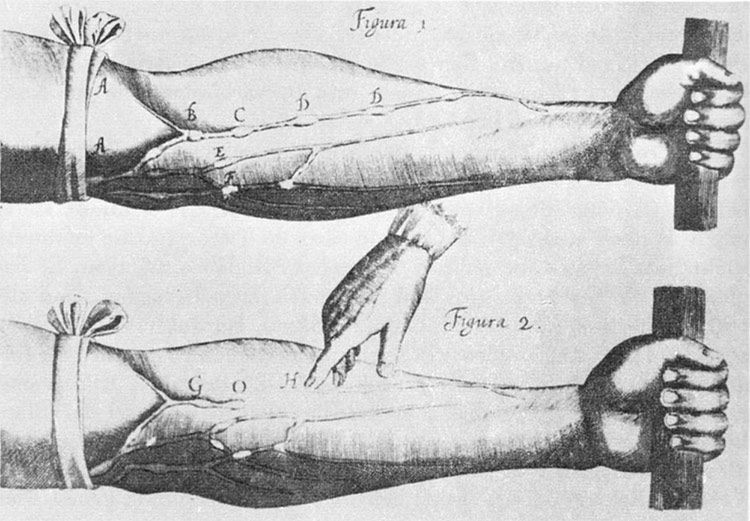
The two engraved plates with which Harvey illustrated his remarks on valves in veins were not original. The tract by Fabricius entitled De venarum ostiolis, published in 1603 and again in 1624, contained the first adequate illustration of the valves. The artist who engraved Harvey’s plates clearly did so with the print from Fabricius before him, and he followed it very closely. A man’s forearm is represented, arranged as for blood-letting. The hand grasps a barber’s pole, and the upper arm is bound with a tourniquet so as to distend the veins below. Harvey did not make any acknowledgement of his debt; but Fabricius’s work was probably so well known to his contemporaries that none was needed.
Harvey’s book, in the mean form Fitzer chose to give it, consists of only thirty-four leaves (sixty-eight pages of type) after the title-page and address to King Charles. Harvey was not so prolix as were many contemporary writers; and his brevity contributed to give his book an unimportant appearance, though Fitzer did try to overcome this by providing a handsome title-page with his large and showy device occupying at least half of it. The publication of the book was announced in the Ostermesskatalog for 1628; and it was issued in the autumn of that year at the price of 6 schilling 2 pfennig.
It is characteristic of Harvey’s aloof modesty that very few copies can be shown to have been given to his friends. He must have presented one, probably in a special binding, to the King; but this has not survived. Another, now at Harvard University, has a note on the title-page that it was given by the author to its first owner, Marco Aurelio Severino, an Italian physician and an almost exact contemporary of Harvey whom he might have met as a student at Padua.
If he gave away any others they have yet to be identified. Harvey himself revealed in his preliminary address to Dr. Argent, President of — the College, and his colleagues that he had “yielded- to the repeated desire of all and the pressing request of some, and in this small book have published it for all to see”.
A study of Harvey’s Prelectiones1leads to the conclusion that, when he first delivered his Lumleian lectures, he was not revealing the whole of what he believed to be true regarding the movements of the blood. It seems possible that up to 1627 or 1628 he was deliberately not revealing the whole of what he knew in order not to incur the odium of serious unorthodoxy. We have Aubrey’s statement, attributed to Harvey himself, that after his book was published “he fell mightily in his Practize and that ’twas believed by the vulgar that he was crackbrained; and all the Physitians were against his Opinion and envyed him”. According to his own statement in the first chapter of De motu cordis, Harvey did in the end propound his views, both in private and publicly in his lectures. Some of his hearers were interested and wanted to know more; others with biased minds and imperfect understanding tried to make a public laughing-stock of him. Yet Aubrey was certainly exaggerating the position; for Harvey wrote in his Dedication to the President and Fellows of the College that “I can name many reliable witnesses of almost all those observations which I use either to assemble the truth or refute errors; you so instanced have seen my dissections and have been wont to be conspicuous in attendance upon, and in full agreement with, my ocular demonstrations of those things, for the reasonable acceptance of which I here again most strongly press”. There is little evidence in the lecture notes that he gave many ocular demonstrations before his public audiences. Perhaps, therefore, these were done in private for the benefit of his particular friends.
The Dedication of De motu cordis also contains Harvey’s profession of faith in philosophic love of truth and wisdom from whomsoever it might come. In addition he deprecated making attacks on the veracity of his predecessors and teachers or provoking his contemporaries. He found it impossible, however, entirely to avoid making these attacks; and more than once he is found naming his old teacher, Fabricius, as the propagator of erroneous doctrines, though there was no acerbity in his words. His Introduction is concerned with stating the manifest errors, or even absurdities, that he sought to overthrow in his book. First, the belief that arteries contain air had to be disproved, this being initially improbable from a consideration of the respiratory habits of cetaceans, and altogether impossible in the foetus. Further, Galen’s experiment by arterial section had shown the arterial system to be filled with blood and nothing else. Active diastole of the arteries was also a wrong notion, Harvey himself having publicly shown “that arteries increase in volume because they fill up like bags or leather bottles, and are not filled up because they increase in volume like bellows.” In this respect Galen was wrong. Another serious error was to regard the blood supply to the lungs as fulfilling “the single, purely private, function” of nourishing them. The structure of the great vessel leading to the lungs showed that it was a true artery; and “Good God! How do the mitral valves hinder the return of air and not of blood?”
Another fundamental error was to suppose that the interventricular septum allowed blood to ooze through it from one ventricle to the other. “But, damme, there are no pores and it is not possible to show such.” All these beliefs appear, Harvey said, “incongruous, or obscure, or impossible” when considered with care; and it would therefore be useful to look with new eyes at the movements of the arteries and heart both in man and in all other animals with hearts, aided by experiments on animals. He instanced Galen’s experiment of incising the trachea of a living dog, filling the lungs forcibly with air by a bellows, and then demonstrating that no trace of air could be found in the heart or great vessels.
In the first short chapter Harvey gave further strong reasons for writing his book and confessed that, at one time, he “all but thought with Fracastoro, that the heart’s movement had been understood by God alone”. He noted that Fabricius had refrained from writing of the heart, though he had dealt with almost every other part of the animal body. Finally he himself wished to show that he had not lived an idle life, and quoted from Terence the words of the old man in the comedy—
No life so perfect ever but that circumstance,
Increase of years, experience, can changes bring;
Your so-thought knowledge be but ignorance; those things
That you believed the finest fail to pass the test.2
The second and third chapters proved by observation and practical arguments that the blood was expelled from the heart during systole, and that it refilled passively during diastole. At the same time, the pulse represented the passive filling of the arteries during the heart’s systole. This he had shown conclusively in his Prelectiones, so that the book said nothing that was new. Valuable evidence was derived from watching the relatively slow movements in cold-blooded animals, and from a patient with a subclavian aneurysm.
In the fourth chapter Harvey turned to the heart’s movements in greater detail, showing that the two auricles are synchronized, as also the two ventricles. Again, dissection of coldblooded animals showed this more clearly in slow motion; and observation of the slowly dying heart of mammals did the same. Even when the ventricle had apparently stopped beating, the auricles continued; and a finger on the ventricles could feel the pulsations. If at the same time the apex of the motionless ventricles was cut off with scissors, blood would spurt out with the auricular contractions. Harvey also showed that the heart muscle could recover from fatigue, when he moistened the dying and motionless heart of a dove with saliva on his finger; the heart would then start beating again, owing, he thought, to the warmth thus applied. Additional evidence of the auricular movements was derived from a human foetus, from the chick embryo, from dissection of snails during hibernation, and from shrimps and insects. This was developed further in chapter v, the movements of auricles and ventricles being seen to be so rapid that the two contractions appear as one. This Harvey compared with the mechanism of a fire-arm, in which the pulling of the trigger, the striking of a spark from the flint, and the ignition of the powder all appear to take place at the same moment. The action of swallowing was also shown to be similar.
The sixth chapter is concerned particularly with the ways by which the blood is conveyed from the vena cava to the arteries, or from the right into the left ventricle. He argued that the majority of animals have no lungs and only one ventricle, and that in these the blood was transmitted by an obvious route from the vein to the artery through the single chamber of the heart. Further, the same state of affairs is present in the foetus of a warm-blooded animal by the communications between the two sides of the heart through the ductus arteriosus (not so named by Harvey) and tins, foramen ovale. The lungs are not being used, so that the heart is virtually a single-chambered organ, though both communications close up and cease to exist after birth. He then touched on the subject of respiration, erroneously supposing cooling of the blood to be one of the functions of the lungs, as he had done in his lectures; but preferred to leave the full development of this to a special treatise, which was never written. He ended by maintaining that ‘in the more perfect and warmer animals, and full-grown ones at that (as in man), the blood definitely permeates from the right ventricle of the heart through the artery-like vein into the lungs, thence through the vein-like artery into the left ventricle of the heart. I maintain, firstly, that this can happen; secondly that it has so happened.’
In the seventh chapter Harvey argued more closely, with supporting passages from Galen, that the blood finds its way from the right ventricle through the parenchyma of the lungs into the pulmonary vein and left ventricle. He could not, in 1628, and never did, see the capillary vessels giving passage to the blood; but he called them pulmonum cæcæ porositates et vasorum eorum oscilla, ‘the invisible porosities of the lungs and the minute cavities of their vessels’. He had seen the capillaries in his imagination; but lack of refined optical apparatus prevented him from demonstrating them. In this chapter he established the existence of the pulmonary circulation, as he had already done in the Prelectiones, referring this time to Columbus as well as to Galen. He added a reference to Caspar Hofmann’s commentary on Galen’s De usu partium, lib. 6, in a footnote.
Although Harvey credited Galen with having provided conclusive evidence for a pulmonary circulation by his description of the valves of the heart and the passage of blood through the lungs, yet nowhere did Galen give a clear, unequivocal statement of it. Harvey was content, however, with his own arguments, using Galen, as far as he went, to support them. He was not, after all, specially concerned to prove the existence of the lesser circulation. His main purpose was to demonstrate a general systemic circulation, of which the pulmonary circuit was only a relatively small part.
The climax of the book was reached in the eighth chapter; and here he expressed forcibly his fear of the consequences if he spoke freely of what he knew. ‘I not only fear that I may suffer from the ill-will of a few, but dread lest all men turn against me.’ This seems to strengthen the suggestion that he had hitherto refrained from saying publicly all that was in his mind. But, he admitted, ‘the die has now been cast, and my hope lies in the love of truth and the clear-sightedness of the trained mind’. Accordingly he had set about trying to discover by experiment how much blood passed from the veins into the arteries. He had been struck by the symmetry and size of the ventricles of the heart and of the great vessels entering and leaving them; and he argued that, if the circulation of the blood was admitted in the pulmonary system, it might equally well circulate in the larger system of the rest of the body. He thought he had as much right to call this movement of the blood ‘circular’ as Aristotle had to say that the air and rain emulate the circular movement of the heavenly bodies:
It may very well happen thus in the body with the movement of the blood. All parts may be nourished, warmed and activated by the hotter, perfect, vaporous, spirituous and, so to speak, nutritious blood. On the other hand, in parts the blood may be cooled, thickened, and be figuratively worn out. From such parts it returns to its starting-point, namely the heart, as if to its source or to the centre of the body’s economy, to be restored to its erstwhile state of perfection. Therein, by the natural, powerful, fiery heat, a sort of store of life, it is reliquified and becomes impregnated with spirits and (if I may so style it) sweetness. From the heart it is redistributed. And all these happenings are dependent upon the pulsatile movement of the heart.
In these words Harvey clinched his argument and committed himself finally to a full statement of the circulation of the blood.
In the Lumleian lecture notes, Dr. Whitteridge has shown that a passage was written later than the body of the work. It was probably now, in 1627, when he had burned his boats by writing De motu cordis, that he added the famous passage for delivery in public:
It is certain from the structure of the heart that the blood is perpetually carried across through the lungs into the aorta as by two clacks of a water bellows to raise water. It is certain from the experiment of the ligature that there is a passage of the blood from the arteries to the veins. And for this reason it is certain that the perpetual movement of the blood in a circle is caused by the heart beat. Why? Is it for the sake of nutrition, or is it rather for the preservation of the blood and of the limbs by means of the infused heat? And the blood by turns heating the limbs and when it is made cold is warmed by the heart.
The book does not use the simile of the water bellows, but the ‘experiment of the ligature’ was fully described, as will presently be seen.
It still remained for Harvey to develop the doctrine in his book by adding arguments which he regarded as irrefutable; and he began his ninth chapter by stating three propositions in confirmation of his main theme. First, that the blood is continuously transmitted by the heart beat from the venous system into the arteries, so that the whole mass of blood passes through in a short time. Second, that the blood is driven in an uninterrupted stream into each limb and every part of the body in far greater volume than is needed merely for their nourishment. Third, that the veins are continuously returning the blood from every part of the body to the region of the heart.
Harvey then, by actual measurement of the capacity of the chambers of the heart, calculated how much blood can be discharged by the heart into the arteries in a given time. He made this calculation for the dog and sheep as well as for man. He added that the whole mass of blood must pass, not only to the members of the body, but also through the pulmonary circulation. A simple mathematical sum could then determine that if an ounce of blood is extruded at each contraction, then 83 lb. 4 oz. had been transferred into the arteries in half an hour. The exact amount would obviously vary according to different circumstances—temperament, age, activity, and so forth. All butchers, Harvey pointed out, would recognize the truth of this, since they habitually drained off the whole blood of an ox in less than a quarter of an hour. Harvey’s measurements were not accurate, but they were adequate for his argument. He ended the chapter by saying that his suppositions allowed him ‘to surmise why no one has yet made a correct statement about the site, mechanism and causation of the anastomosis of the veins and arteries. I am now busy with that research.’ The limitations imposed by the times in which he lived prevented him from solving this final problem; but this did not invalidate the truth of his main proposition.
In the tenth chapter Harvey sought to drive home his argument by further illustrations from the physiology of milk production by a cow or a woman suckling a baby, and by experiments on the slower circulations of blood in fishes and reptiles.
The eleventh to the thirteenth chapters are of particular interest in that they show how Harvey had come to appreciate the true purpose of valves in veins, knowledge which he did not seem to possess when writing his Prelectiones in 1616. He described the effect of a tight ligature on a limb, which abolished the blood flow and the pulse altogether beyond the site of application, and of a medium ligature which compressed the vein, but still allowed blood to traverse the arteries as proved by the presence of a pulse. With the medium ligature the blood could be seen to accumulate in the swollen veins, followed by their emptying towards the heart as soon as the ligature was released. He illustrated this by the simple example of what happened when ‘I once fell from my carriage and struck my forehead on the spot where an arterial branch passes forward from the temples. At once, in the space of about twenty pulsations from receipt of the blow, I developed a swelling the size of an egg without either heat or much pain; because, I presume, of the nearness of the artery, blood was being forced into the bruised part in greater abundance and at greater speed.’ The same thing was seen in the ordinary operation of phlebotomy, where blood flowed more freely from an opening in a vein below the ligature than if it were above. This is followed by an accurate account of the venous valves and their purpose. They were first described by ‘the celebrated Girolamo Fabrizzi d’Aquapen-dente, a most skilful anatomist and venerable old man, or else (as the learned Riolan would have it) Jacques Dubois’; but their discoverer ‘did not understand their real function, and others went no further’. Harvey then explained that ‘the sole purpose for which the valves were created was so that the blood should not move from the large veins into the smaller ones (thus rupturing the latter or making them varicose), or from the centre of the body to its extremities, but rather from those extremities to the centre. Hence the delicate valves readily open to allow the latter movement of the blood, but completely suppress the opposite one.’
Observations follow, which had no place in the Prelectiones, describing Harvey’s dissection of the veins in the limbs and his attempt to pass a probe downwards. The valves invariably provide a complete obstacle, though the probe passed easily in the other direction towards the heart. Now came the celebrated demonstration of the valves in the veins of the forearm, using figures copied from drawings in the book published by Fabricius in 1603. These were the only illustrations in the first edition of De motu cordis, and they were repeated in almost every subsequent edition of the book except, oddly enough, the first English version of 1653.
In the fourteenth chapter Harvey gave a brief restatement, or summary, of his new doctrine, concluding: “I am obliged to conclude that in animals the blood is driven round in a circuit with an unceasing, circular sort of movement, that this is an activity or function of the heart which it carries out by virtue of its pulsation, and that in sum it constitutes the sole reason for that heart’s pulsatile movement.’
There could be little to add to so clear and conclusive a demonstration of the truth of Harvey’s doctrine. Argument from known facts, supported by experiments on living animals, had shown once and for all a fundamental physiological truth which had escaped every previous anatomist. Clear reasoning and perfect scientific method with quantitive measurements had set a pattern initiating advances in the biological sciences and destined to influence all scientific investigation for the rest of time.
But Harvey had not quite finished his book with the irrefutable statement about the circulation of the blood. He found further illustrations of his theme in the effects of cold on the extremities and their recovery of proper warmth and colour if the heart’s activity was unaffected. There were also a number of consequences that seemed to follow, such as the spread of contagion from a poisoned wound or the bite of a mad dog. He further emphasized this point when he told Aubrey, in 1655, ‘that the biteing of a man enraged is poysonous. He instanced one that was bitt in the hand in a quarrell and it swoll up to his shoulder, and killed him in a short time’. Harvey might at this point also have pointed out another practical conclusion which followed, namely the possibility of limiting by means of a ligature the circulation of a poison introduced through the skin, as by a snake bite. Though he did not do so in his book, he must have talked about it; for at a meeting of the Royal Society on 18 July 1678 John Pearson, Bishop of Chester, recalled ‘that Dr Harvey was of opinion that a man might be saved, though shot with a poisoned dart, if a very strong ligature were made above the wound immediately, and the mortified part below the ligature were cut off presently. But it was thought by others, that this means would not be effectual, if at least the poison were so violent as was reported, unless a ligature were made before the person was wounded by the dart.’
Harvey’s inevitable ignorance of the later developments of medical science made these concluding chapters of less value, though he displayed wide knowledge of comparative anatomy. Yet, when he came to think of all the consequences that would flow from the illuminating truth in every part of medicine—physiology, pathology, semeiotics, therapeutics—he foresaw that the rest of his life would not suffice for writing down all that he would like to say about it. He also examined closely the details of the structure of the heart and disclosed many new points in its mechanical efficiency. Richard Lower, who came next to Harvey both in time and merit as a writer on the heart, admitted in his Tractatus de corde, 1669, that Harvey:
in so far as it concerned his magnificent discovery of the circulation, described the structure of the heart and the movement of the blood in a way that left practically nothing to be added or desired by his successors. But, just as in the Ptolemaic hypothesis of the heavens smaller epicycles are allotted to the planets when the enormous revolutions of the worlds have been dealt with, and these epicycles are indispensable for the explanation of observed facts, so in the system of the human body, as also in that of other animals, there are points not mentioned in Harvey’s circulation which need consideration. These points are, I grant you, of minor importance, but they do definitely help in the rational study of a number of symptoms.
On the last page of his book Harvey emphasized again the true nature of the great vessels on the right side of the heart, the artery-like vein being in fact an artery, the pulmonary artery, and the vein-like artery being a vein, the pulmonary vein. In his final sentence he stated his belief that ‘it is very difficult for anyone to explain in any other way than I have done the reason why all these things have been arranged and carried into effect in the maimer that I have described’. Perhaps the German compositor, who no doubt understood the Latin phrases he was printing, thought the claim went too far, for he cynically composed a small ‘printer’s ornament’ below the last line of text in the form (???). Yet Harvey could justifiably write finis below this sober conclusion to his scientific masterpiece. He knew that any attempt to overthrow his arguments would fail.
It has often been asked whether the men of any particular generation take just those steps which the intellectual climate of their time demands. Sir Isaac Newton seemed to do exactly what history required him to do at the appropriate time. On the other hand, the reception accorded to Harvey’s demonstration of the circulation of the blood proved him to have a creative genius which could leap ahead of his contemporaries on a genuinely new and fruitful path. The intellectual level did not compete with that of Newton’s field, but the desire to increase man’s understanding of his own body was a consuming flame in Harvey’s mind.
- Harvey had been appointed Lumleian Lecturer at the Royal College of Physicians in 1615. His lecture notes, or Prelectiones, have been preserved among the Sloane Manuscripts in the British Museum.
- Terence, Adelphi, Act 5, Scene 4.

