

Two Cheers for Versailles
Mark Mazower looks back to the much maligned Versailles Treaty and finds we still live in the continent it created.
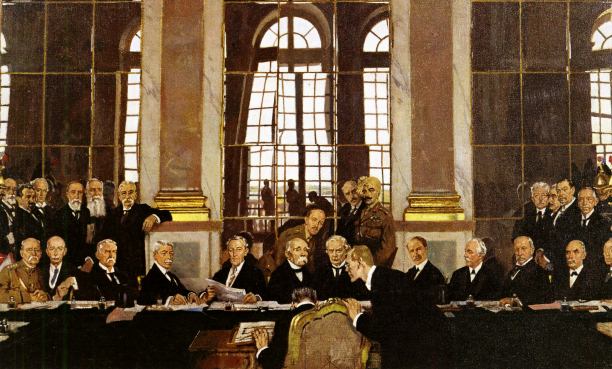 The Versailles Treaty settlement was, from the moment of its birth, unloved as few creations of international diplomacy have been before or since. Hitler and Churchill were united in its condemnation; so were commentators from the American anti-Soviet diplomat and historian George Kennan to the British Marxist E.H. Carr. One is hard put to find a school textbook with anything good to say about the achievements of the Paris peacemakers. Yet curiously we still live in the world they shaped: were the foundations laid more carefully by them than we like to think? The argument that the defects of Versailles led to the outbreak of another world war is commonplace; yet one might as easily argue that its virtues underpinned the peace after 1945.
Some suggest that Versailles was based on principles inconsistently applied. The charge is obviously true. The right of national self-determination was granted at Germany's expense, and the Anschluss with Austria, which Social Democrats in Vienna wanted in 1918, was prevented by the Great Powers and only achieved after the Nazis broke the League of Nations system and marched in twenty years later. But international affairs are not a matter of logic alone, and the principle of consistency must be matched against considerations of power politics or geography. National self-determination could never have been applied across the board; the basic issue is whether a better principle existed for the re-ordering of Europe.
More serious an accusation is that the peace settlement was not so much inconsistent as ineffective: it was based upon an inaccurate appraisal of the European balance of power and deprived of the means of its own defence by American withdrawal and British indifference. At Paris the Great Powers ignored the fact that the almost simultaneous collapse of Germany and Russia had produced an anomalous situation in eastern Europe. The French, who of all the Great Powers felt most immediately threatened, thought the only safeguard of their own security - if the League was not to be equipped with an army of its own - was alliance with grateful clients like the Baltic states, Poland, Czechoslovakia, Romania and Yugoslavia. But it should have been obvious that the newly independent states formed there would be unable alone to ensure stability in the region once these two Great Powers reasserted themselves. The Treaty of Brest Litovsk of early 1918 had shown what intentions the Germans of the Kaiserreich harboured in that area; after 1939, Hitler's New Order pushed the principle of German (and Russian) hegemony one brutal stage further. But this is less an argument against the Versailles settlement itself than against the refusal of the Great Powers who sponsored it to back it up with armed force before 1939.
Thirdly, it is often felt that the whole approach to Germany after the Treaty was flawed. The enemy was humiliated but not crushed, burdened by reparations yet unopposed when it rearmed and marched into the Rhineland. It is true that the contrast is striking with the policies pursued towards Germany after the Second World War when long-term economic assistance was provided and by governments not the markets, and when the Bundeswehr was quickly incorporated within west European defence arrangements. But the economic problem after 1919 was not so much reparations as the shaky structure of international lending and, in particular, the shock of the world depression. The Allies were helped to learn from the mistakes of the inter-war era by the Cold War, which divided Germany, and made Europe's German problem a question of reunification rather than of territorial expansion and revanche in the East.
Finally, there is the accusation common to conservatives and Communists alike that the Versailles peace settlement was overly ideological. For some, it was an extension of nineteenth-century liberal moralising, a combination of British utilitarianism and American idealism - a basically philosophical approach to the world which lacked realism or understanding of the political passions which animated people in Europe.
Alternatively, it was - behind the veil of noble sentiments - an anti-Communist crusade whose liberalism masked a fundamentally reactionary and deeply conservative goal: the containment, if not the crushing, of Bolshevism. Outflanked gradually by other more determined and forceful anti-Communist movements of the right, European liberals lost their enthusiasm for defending the Versailles order and sat back to watch fascism take over the task of saving Europe from red revolution.
One question, however, confronts the critics of Versailles: what were the alternatives? It was not, after all, as if the Powers had willed this new liberal order of independent, democratic nation-states into existence. They had certainly not been fighting the Great War to this end. On the contrary, as late as 1918 most Entente diplomats still favoured the preservation of the old empires in central Europe in the interests of continental stability. Of course, after 1919 the conflicts and tensions produced by the new states of the region made many people nostalgic for what the Austrian writer Stefan Zweig, looking back to the Habsburg era, called 'the world of yesterday'. Fragmentation since the war seemed to have harmed the region both politically and economically, especially once the world depression forced countries into an impoverished self-sufficiency.
Yet it was a rare blend of nostalgia and realpolitik which lay behind much of the antipathy to Versailles. The makers of America's new role in Europe after 1945, for example, who had grown up looking closely at these problems, held Versailles responsible for the instability of inter-war Europe. Adolf Berle, Roosevelt's assistant secretary of state between 1938 and 1944, believed that French generals had been responsible for breaking up the Austro-Hungarian Empire and wanted some kind of reconstitution of that entity to ward off the Russians. Hitler, he advised the president on the eve of Munich, was perhaps 'the only instrument capable of re-establishing a race and economic unit which can survive and leave Europe in balance.'
George Kennan, a younger man but more influential than Berle in defining the Cold War policy of containment, took a very similar view in the late 1930s. In his despatches from Prague he wrote:
It is generally agreed that the breakup of the limited degree of unity which the Habsburg Empire represented was unfortunate for all concerned. Other forces are now at work which are struggling to create a new form of unity... To these forces Czechoslovakia has been tragically slow in adjusting herself... The adjustment - and this is the main thing - has now come.
It did not take long for someone as astute as Kennan to realise that the Nazi New Order was not going to stabilise central Europe in the way the Habsburgs had done. But the reason for this, in his mind, was not the apparently obvious one that Hitler's whole upbringing had turned him into a German nationalist critic of the Austro-Hungarian monarchy. It was, rather, what Kennan conceived as the excessively democratic character of Hitler's Germany and the limited involvement of Germany's aristocracy in the Third Reich. More aristocratic government was Kennan's answer to Europe's problems. It is hard to imagine a more far-fetched or unrealistic approach - the Habsburgs were marginalised between the wars even by Hungary's reactionary regent Admiral Horthy, and the most successful Habsburg aristocrat of that era was the bizarre and premature proponent of European union, Count Coudenhove-Kalergi. Perhaps only an American conservative intellectual like Kennan could have taken the prospect of a Habsburg restoration seriously. European conservatives, closer to the ground, had fewer illusions. 'The Vienna to Versailles period has run its course,' wrote the historian Lewis Namier in February 1940.
Whatever the weaknesses of the system created in 1919, a return to previous forms is impossible. They have been broken, and broken for good. It was not aristocrats that had kept the old empires together but dynastic loyalty, and this had vanished.
If dynasticism no longer offered an alternative principle to the Versailles order, then what of the rival ideologies of right and left? This was where root-and-branch critics of Versailles had to bite the bullet. Most anti-Communists between the wars had no difficulty in swallowing the idea of an authoritarian revision of the Versailles settlement. What made them hesitate was a quite different proposition; the reality of life under the Nazi New Order. The difference between a right tolerable to most conservatives and an extreme and ideological fascism was that, for instance, between King Alexander's royal dictatorship in Yugoslavia, and Ante Pavelic's genocidal Ustase state in Croatia, or between King Carol's Romania and that of the Iron Guard, with its bloody pogroms, in the winter of 1940-41. Above all, the New Order was based on the idea of German racial superiority, and few anti-Communists could stomach this once they saw what it meant in terms of practical politics.
If one agreed with Namier that 'no system can possibly be maintained on the European Continent east of the Rhine which has not the support either of Germany or of Russia,' then the only ideological alternative to Nazism was Communism, or more precisely the extension of Russian rule westwards into Europe. Just as Versailles's critics on the right had seen Germany's move east after 1933 as confirmation of their own prejudices, so critics on the left similarly interpreted the course of events after 1943 as a happy necessity. Historians like E.H. Carr saw this as realism replacing the idealism of Versailles. It was apparently not felt to be realistic to point out that all the historical evidence pointed to the unpopularity of Communism among the majority of the populations who now had to endure it. In only one country in central Europe, Hungary, had a Bolshevik regime held power for any length of time before 1945, and that still brief experience - the Bela Kun regime of 1919 - had only confirmed how unpropitious the soil was for such experiments. Today we are unlikely to see Communism as an attractive alternative to the principles embodied in the Versailles order: yesterday's 'realism' looks riddled with its own form of wishful thinking.
One of the reasons Bela Kun fell from power in 1919 was that he had not understood the strength of Hungarian nationalist feeling. So long as it had appeared to Hungarians that Bolshevik Russia might help them get back their traditional lands, they were prepared to tolerate Kun. But once it appeared that the Allies would not let this happen, Kun lost any popularity he had once enjoyed and he was easily defeated. The power of nationalism was the chief force to emerge from the First World War in Europe, and was the main political factor facing the architects of a new postwar settlement. From our perspective at the century's end, it hardly looks as though fascism and Communism were able to handle European nationalism better than the peacemakers at Versailles. Hitler's New Order proceeded by ignoring all nationalisms except the German, and lost Europe in consequence. Communism believed that eventually nationalist antipathies would vanish, subsumed within an internationalist struggle: but time ran out for the Communists before this happened. If we want to find guidance in the past for how to tackle the problems of nationalism that remain in Europe, we cannot do better than return to the diplomats who gathered in Paris eighty years ago.
In the Bukovina (a former province of the Habsburg empire), Paris seemed very far away in the spring of 1919. But events were occurring there which help us chart the trajectory of antisemitic violence from the unorganised pogroms of the nineteenth century to the more systematic population engineering of the twentieth. A manifesto was posted up in the village of Kamenestie, written in Romanian:
Order to all the Jews in the village.
Those Jews who are still in the village are asked to go to the city or somewhere else. You can leave in good condition [sic] and without fear in ten days. It will be made unbearable for those who stay beyond the limit.
Throughout the little villages of the Bukovina, pogroms were taking place in late 1918. 'Following the example of the neighbouring villages,' runs an account from Petroutz,
The peasants decided to drive the Jews out of this place. On the night of November 17th, they attacked the Jewish families Hermann, Feller and Schubert, broke doors and windows and took away everything they found. A scroll of the Law was torn to pieces by the marauders. After the robbery they burned everything that remained. All three families fled to Suczawa.
The Jews were the chief targets of ethnic violence in the Bukovina, as they were elsewhere in eastern Europe, in Galicia for instance, or in Lithuania. But the war of nationalities could not be reduced to anti-semitism: Poles were fighting with Ukrainians, Germans and Lithuanians. Across much of Europe there fell a double shadow: ethnic as well as class war. Bolshevism was contained by a combination of land reform, reformist social democracy and the military defeat of the Red Army in the Russo-Polish war. But the nationalist enmities and suspicions which exploded into violence as the First World War ended, and which generated casualties on such a scale that some historians have compared them with the violence which erupted under Nazi rule after 1941, these proved harder to tackle.
Ethnic civil war emphasised in the most unmistakable way that the peacemakers in Paris were not sketching their maps on a tabula rasa. On the contrary, they were as much responding to circumstances as shaping them. East European critics of Great Power arrogance often forget today how far the Versailles settlement was brought into being, not by the Powers, but by local nationalist elites and their supporters. New nations were pressing their claims on paper, in the streets and by force of arms, as the war approached an end. Serb, Croat and Slovene delegates issued the Corfu Declaration in July 1917 and declared the new tripartite Yugoslav nation 'a worthy member of the new Community of Nations.'
The Provisional People's Government of the Polish Republic proclaimed 'the authority of Polish democracy' in its November 1918 manifesto. The Czech National Committee seized power in Prague as early as October 28th of the same year in the name of the infant Czechoslovak state. Much of the subsequent fighting from the Baltic to the Balkans was designed to conquer as much territory as possible for the new states, to see off rival claimants and to settle scores with Jews, Germans, Muslims and other hated, despised or feared peoples. Between 1920 and 1923, the Treaty of Sèvres was signed, scrapped and replaced by the Treaty of Lausanne as the struggle between Greece and Turkey shifted first one way then the other, culminating eventually in the forced population exchange of some two million people.
It is to the credit of the Versailles peacemakers that they confronted the problem of ethnic violence head on. They were aware of the chief defect of the Wilsonian principle of national self-determination -- namely that if it was interpreted territorially and not merely as a grant of cultural autonomy, then on its own it ruled out either an equitable or a geographically coherent settlement of the problems of central and eastern Europe. No one, after all, was proposing to give the Kashubians, the Polesians, the Pomaks, or any of the other small ethnic groups of the region a state of their own. They, and several other larger peoples like the Jews, the Ukrainians and the Macedonians, would remain under the rule of others. In other words, the creation -- or better, the recognition - of nation-states at Versailles was accompanied by its inescapable shadow, the problem of minorities.
Fearful in particular that Poland's appetite for territory might destabilise the whole area, the Powers obliged the reluctant Poles to sign a treaty granting the country's very sizeable minority population certain rights. The Polish treaty formed the basis for a series of similar treaties imposed in 1919 and 1920 upon most of the states of central and eastern Europe. The result was that for the first time an international organisation -- the League of Nations -- assumed the right to intervene in a member state's internal affairs on behalf of minority populations.
This right, however, was very limited and scarcely used at all by the League. Most countries feared doing away with the idea that a state was sovereign within its own borders, and even the Great Powers who had sponsored the Minority Rights Treaties trod warily. They had resisted calls to universalise the regime of minority rights on the grounds that 'the League cannot assume to guarantee good government in this matter throughout the world'. By 1929 they were very reluctant to act at all against member states accused of rights violations. British foreign secretary Austen Chamberlain warned that,
We have not reached such a degree of solidarity in international affairs that any of us welcome even the most friendly intervention in what we consider to be our domestic affairs.
This attitude discouraged the most dynamic lobbyists for Europe's minorities, the Germans and the Jews. Until 1933, they worked together in the European Congress of Nationalities to try to give the Minorities Treaties teeth. Thereafter their paths diverged. But Hitler's rise to power can be seen in the context of the failure of the League to protect Europe's minorities. Where the League's rather timid use of international law had failed, the Nazis used force; their 'solution' involved forced population transfer, resettlement and ultimately genocide. And after 1944 many of these instruments were turned on the Germans themselves as they were driven out of Poland and the former Habsburg lands.
Yet we should not write off the peacemakers of Versailles too quickly. Despite the horrors of the 1940s, which virtually eliminated both the Jews and the Germans from much of eastern Europe, many minorities remained across the region. However, instead of building on the League's tentative efforts to construct an international regime of minority rights, the architects of the post-war order enshrined in the United Nations deliberately retreated from the problem and tried to dress up its reluctance to deal with it with meaningless persiflage about 'human rights'. As a result, when issues of minority rights came to the fore after the collapse of Communism in eastern Europe in the decade after 1989, most obviously in the context of the disintegration of Yugoslavia, the international community possessed no coherent strategy for tackling the problem.
The consequences have been all too visible in Bosnia and Kosovo. The United Nations was less equipped to tackle the fundamental problem of minority rights than its predecessor, the League, had been. It delivered food and tried to keep the peace without a clear doctrine of what kind of peace it should keep. The contrast between the self-confident and articulate liberal universalism of the 1920s and the post-modern evasions of the 1990s was all too conspicuous. In Kosovo, too, the contrast with the Versailles generation does not flatter our own times. NATO intervention in Kosovo could, as articulated somewhat optimistically by Tony Blair, be interpreted as marking a new doctrine of foreign affairs, according to which state sovereignty may be overridden to prevent massive violations of minority rights. Yet, NATO's attacks on the Serbs, in the absence of any UN mandate, do not indicate any great confidence in international law and institutions. The United States, which has been leading the charge, is, after all, opposed to the creation of an International Criminal Court. If inter-war Europe suffered because international guarantees were never acted upon, we may suffer in the 1990s through military action taken without any reference to international law at all, the late twentieth-century equivalent of gunboat diplomacy handled by a post-Holocaust generation of politicians.
The very least, then, that we can say for Versailles is that it recognised and articulated the major problems for European stability at that time. What was more, there was no palatable alternative to the nation-state then, or since. Where the peace was found wanting between the wars was in the will to uphold it. Today NATO is turning itself into the kind of force which the peacemakers of 1919 lacked. But do its political masters have a clear grasp of what kind of Europe they wish to defend? They could do worse than cast their eyes back to the work of their predecessors eighty years ago.
For Further Reading:
I.Claude, National Minorities : An International Problem (Harvard, 1955), James Headlam-Morley, A Memoir of the Paris Peace Conference, 1919 (London, 1972), J.Harper, American Visions of Europe (Cambridge, 1996), C. Fink , 'Defender of Minorities': Germany in the League of Nations 1926-1933 (Central European History, 5:4, 1972), R.Brubaker, Nationalism Reframed : Nationhood and the National Question in the New Europe (Cambridge, 1996), E.Kulischer, Europe on the Move: War and Population Changes, 1917-1947 (New York, 1948).
- Mark Mazower is a Visiting Professor of History at Princeton University. He is the author of Dark Continent: Europe's Twentieth Century (1998).

