

Topolski's Brush with the United Nations
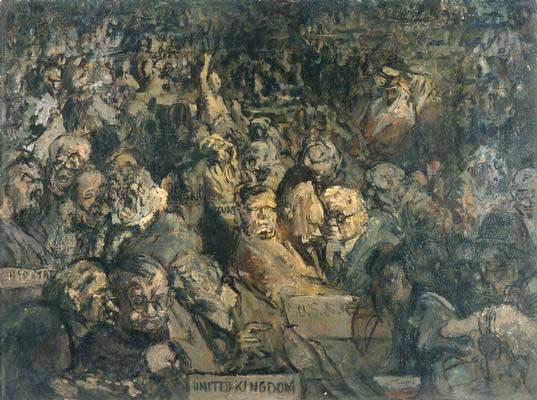
Gallery owner John Martin appeals to readers to help identify figures in a significant work ‘The Opening Session of the United Nations’ by the twentieth-century artist Feliks Topolski.
 Feliks Topolski (1907-89) has a unique place in twentieth-century art. He was driven by a need to record the significant events of the moment and through a combination of charm, contacts and force of character somehow managed to make himself and his sketchpad witness to a succession of events that would make the most long-toothed foreign correspondent green with envy.
While most British war artists recorded the home front, the Polish-born Topolski made his way to Archangel with the first Arctic Convoy in November 1941. He sketched on the Russian front, crossed into China from Burma, drew the brothels of Calcutta, the ‘behind-the-lines levity’ of Cairo and was present for the liberation of Rome, entered Germany with the Allied troops, visited Belsen and attended the Nuremberg trials.
There had been no artist like Topolski before him, though his work is now largely forgotten. His sketches from the front, reproduced in newspapers and magazines, were enormously popular and, arguably, had more relevance at the time than the images left by Nash, Piper and Sutherland. In the late 1940s, he was invited to India by Pandit Nehru and witnessed the last days of the Raj, then went on to Burma and experienced the wars of liberation in Malaya and lndo-China.
The fact that Topolski’s arrival coincided with the emergence of the frontline photo-journalist makes his achievement all the more extraordinary. His work was never going to compete with the photographers from Magnum, and even his monumental ‘Memoir of the Century’ (a 600-ft long mural done in 1948 that covered three railway arches near Hungerford Bridge in London, incorporating many events Topolski had himself witnessed) will remain neglected by art historians. Yet his importance is sure to resurface at some point.
Like Picasso, to whom he was close, Topolski believed art could tackle important issues of the day and the artist’s ability to express human emotion would eventually triumph over the camera.
It is not recorded how Topolski came to be present at the opening session of the United Nations. He had a wide circle of friends including diplomats and politicians and if he wanted to paint something he deemed important, he would usually manage to get a front row seat. I found this painting in an auction ten years ago and was struck by the energy with which it was painted. The conspiratorial groups huddled together were in the tradition of a courtroom drama by Daumier, or a coffee-house plot by Rowlandson. For a twentieth-century artist, it was too fascinating not to buy and I was immediately rewarded by finding a letter Topolski had lodged at the Witt Library describing it. In spite of its apparent spontaneity he continued to work on this painting for many years, altering the composition and the portraits.
Unfortunately the letter has since vanished, and with it the list of participants. The painting will be on show throughout August and the first part of September at my gallery. There is a magnum of champagne* to the reader who can convincingly name the greatest number of people.
* Note -- if it was claimed at all, the champagne has probably long been imbibed as this article was published in 2004.

